The top offshore safety courses in 2026
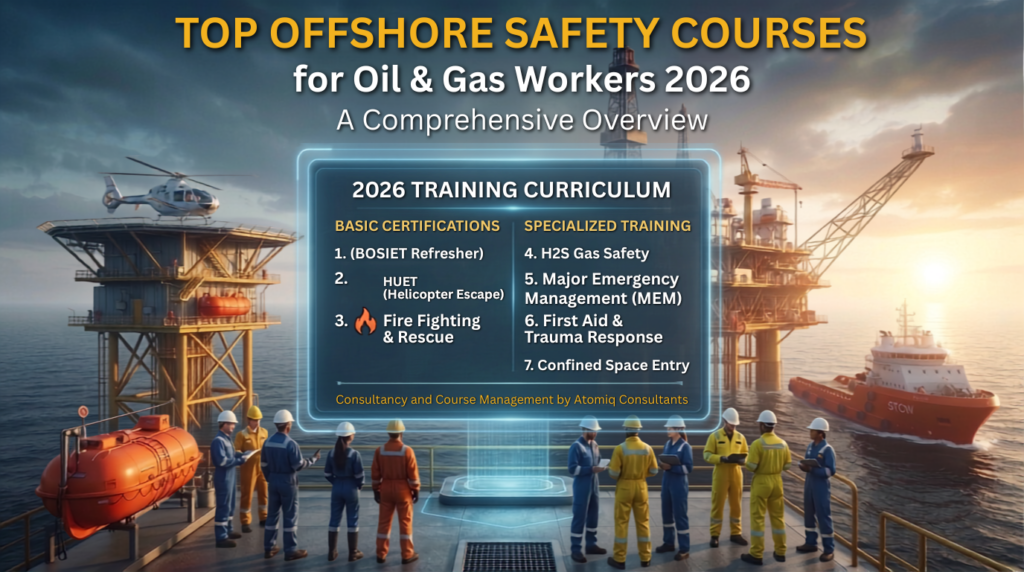
1. BOSIET (Basic Offshore Safety Induction and Emergency Training)
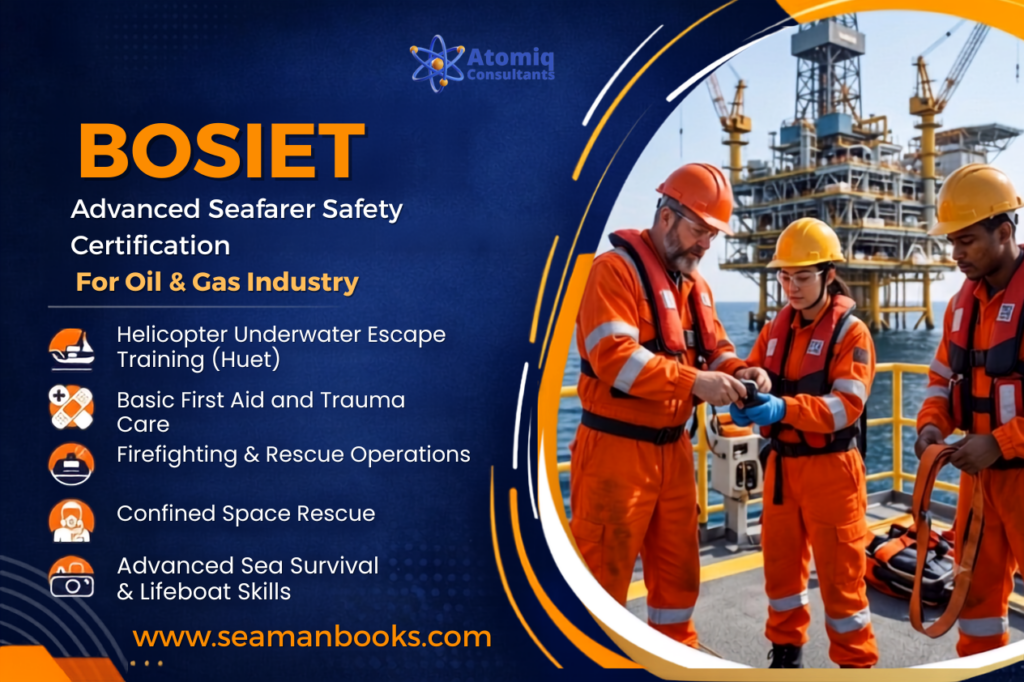
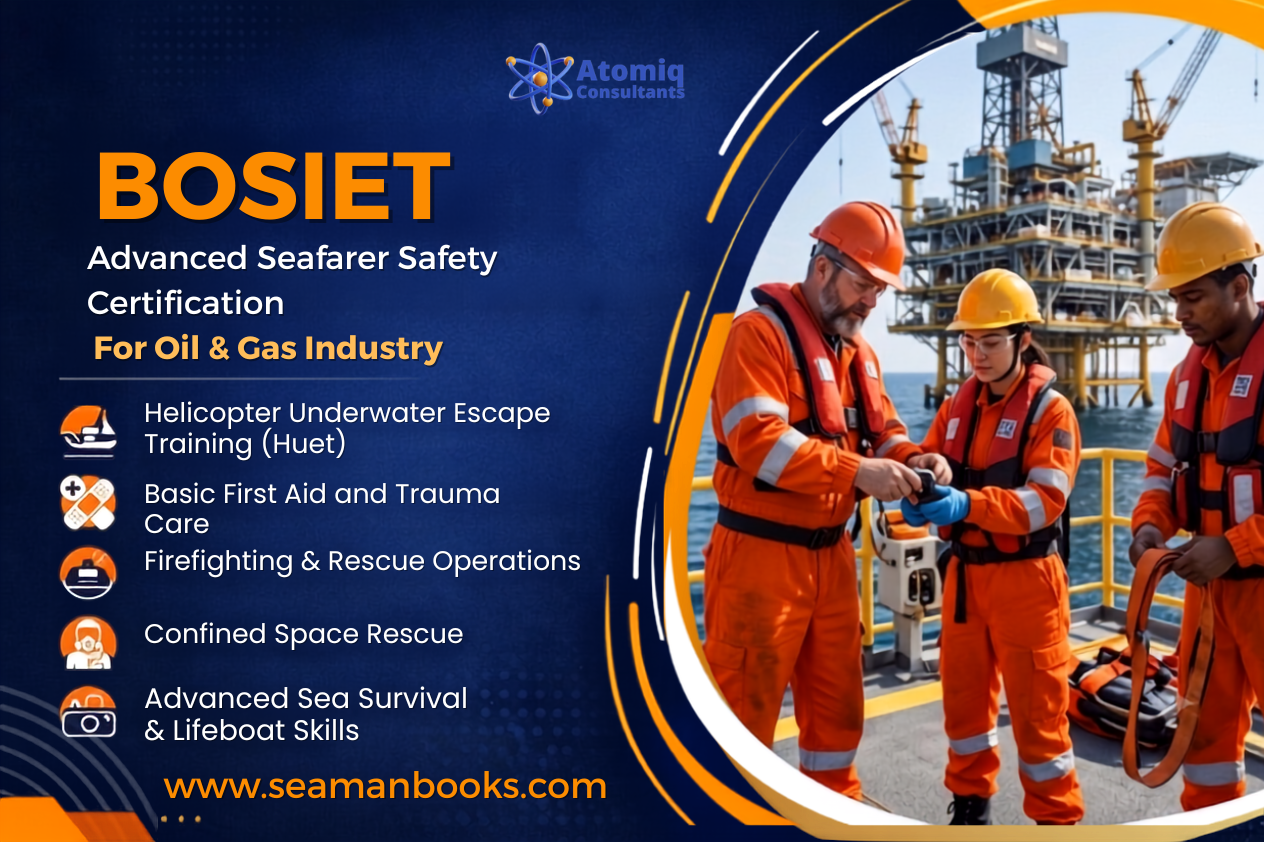
BOSIET is the entry ticket to the offshore oil and gas industry and the single most requested certificate for new starters. Set to the OPITO standard, it typically runs over three days and bundles four core elements: safety induction, helicopter safety and escape, sea survival and first aid, and firefighting and self-rescue. Modern BOSIET includes CA-EBS (Compressed Air Emergency Breathing System) training, which replaced older rebreather systems and is now the industry norm for helicopter transfers.
A BOSIET certificate is generally valid for four years. It is the right starting point if you have never worked offshore in oil and gas.
2. HUET (Helicopter Underwater Escape Training)
Because most offshore workers reach the installation by helicopter, HUET focuses specifically on escaping a helicopter that has ditched and capsized in water. Trainees practice brace positions, underwater escape from a submerged simulator, and use of emergency breathing systems.
HUET is built into BOSIET, but it is also offered as a standalone or on-demand course for workers who only need the helicopter component — for example, those refreshing a single element or attending a site with its own requirements. When people compare BOSIET vs HUET training, the simplest way to think about it: BOSIET is the full induction package and HUET is one module within it. For a detailed comparison, see our guide on BOSIET vs HUET: which offshore safety course do you need in 2026.
3. FOET (Further Offshore Emergency Training)
FOET is the refresher for workers who already hold a valid BOSIET and need to renew before it expires. It condenses the emergency response, helicopter escape, and sea survival elements into a single day. If your BOSIET is approaching its four-year expiry and you’re staying in oil and gas, FOET — not a repeat BOSIET — is what you book.
4. T-BOSIET (Tropical BOSIET)
T-BOSIET is the warm-water version of BOSIET, designed for workers in tropical and sub-tropical regions such as the Arabian Gulf, West Africa, and Southeast Asia. The survival and escape elements are adapted for warm-water conditions. If you’re mobilizing to the GCC or offshore India, confirm with your employer whether the tropical certificate is accepted in place of the cold-water standard.
5. H2S Awareness Training
Hydrogen sulphide (H2S) is a toxic gas encountered on many oil and gas sites. H2S awareness training teaches workers to recognize the hazard, use detection equipment, wear breathing apparatus, and follow emergency response procedures. It’s a one-day course and is frequently a mandatory add-on for onshore and offshore oil and gas roles in the Middle East.
6. Sea Survival and Advanced Fire Fighting (STCW)
Seafarers and marine crew on offshore support vessels are usually required to hold STCW certificates issued to International Maritime Organization standards. Personal Survival Techniques (sea survival) and Advanced Fire Fighting are the two most relevant to offshore work, covering life-saving appliances, abandon-ship procedures, and the command of firefighting operations on board. These complement — rather than replace — OPITO installation training.
7. GWO Basic Safety Training (offshore wind)
If your future is in offshore wind rather than oil and gas, the Global Wind Organization (GWO) Basic Safety Training is the equivalent of BOSIET. It comprises five modules — First Aid, Manual Handling, Fire Awareness, Working at Heights, and Sea Survival — and is typically valid for two years. As offshore wind expands across Europe and Asia, GWO certification is increasingly the entry standard for renewable-energy technicians.
8. MIST (Minimum Industry Safety Training)
MIST is an OPITO safety-awareness programmed covering the offshore risk environment, working practices, and individual responsibility for safety. Some UK and international operators require it alongside BOSIET before mobilization, so check your specific contract.

Offshore safety courses compared at a glance
Course | Best for | Standard | Typical duration | Typical validity |
BOSIET | New oil & gas offshore workers | OPITO | ~3 days | 4 years |
FOET | Renewing an existing BOSIET | OPITO | ~1 day | 4 years |
HUET | Helicopter escape (standalone/on-demand) | OPITO | ~1 day | Aligns with BOSIET/FOET |
T-BOSIET | Workers in tropical/warm-water regions | OPITO | ~3 days | 4 years |
H2S Awareness | Roles with hydrogen sulphide exposure | Industry/OPITO | ~1 day | Employer-dependent |
Sea Survival / Adv. Fire Fighting | Marine crew on offshore vessels | STCW (IMO) | 1–4 days | 5 years |
GWO Basic Safety Training | Offshore wind technicians | GWO | ~5 days | 2 years |
MIST | Offshore safety awareness (UK/intl) | OPITO | ~1 day | 4 years |
Durations and validity are typical industry values and can vary by training provider and region — confirm the exact requirement for your role before booking.
What do offshore safety courses cost?
Course fees vary widely by country, provider, and whether you’re taking a full course or a refresher — a one-day H2S awareness sits at the lower end, while a full BOSIET or GWO Basic Safety Training package is a larger investment because of the pool, helicopter simulator, and instructor time involved. Rather than quote a figure that may be out of date for your region, we provide a current, itemised price when you request a quote for your specific course and location.
How to enrol in offshore safety courses with Seaman Books
Seaman Books, part of Atomiq Group, is a Dubai-based maritime consultancy that helps seafarers and offshore professionals get certified and documented for work across the UAE, the wider GCC, India, and beyond. We partner with accredited training providers so every certificate you earn is recognised by offshore employers and flag-state administrations.
Enrolling takes three steps:
- Tell us your target role and region so we can confirm exactly which courses your employer requires.
- Choose your schedule from flexible dates and locations that fit around your rotation.
- Complete your training and receive your recognised certification, with support all the way from selection to documentation.
Ready to get offshore-ready for 2026? Enrol in an offshore safety course or contact our team Atomiq Consultants for tailored advice. If you also need your seafarer documentation in order, explore our STCW certifications support.
Frequently asked questions
Which offshore safety course should I take first in 2026?
For oil and gas, start with BOSIET — it’s the standard entry certificate most operators require. For offshore wind, start with GWO Basic Safety Training. If you already hold a BOSIET that’s about to expire, book FOET instead of repeating the full course.
What is the difference between BOSIET and HUET?
BOSIET is the complete offshore safety induction covering survival, firefighting, first aid, and helicopter escape. HUET is the helicopter underwater escape module — it is included inside BOSIET but can also be taken on its own when only the helicopter element is needed.
How long is a BOSIET certificate valid?
A BOSIET certificate is typically valid for four years. To renew, you take the one-day FOET refresher rather than the full BOSIET again.
Are offshore safety certifications recognised internationally?
Yes. Certificates set to OPITO (oil and gas), GWO (offshore wind), and STCW (marine) standards are recognised by employers worldwide, so you generally don’t need to re-certify when moving between employers or regions — provided the certificate is still in date.
Do I need a different course for the Gulf or tropical waters?
Often, yes. Warm-water regions such as the GCC frequently use T-BOSIET, the tropical version of BOSIET. Confirm with your employer which variant they accept before booking.
Which offshore courses do oil and gas workers in the UAE and India need?
Most offshore roles in the region require a combination of BOSIET (or T-BOSIET), sea survival, firefighting, and H2S awareness. The exact set depends on your employer and installation — our team can confirm the precise requirement for your job.
The bottom line
The best offshore safety certification courses for oil and gas workers in 2026 aren’t about collecting the most certificates — they’re about matching accredited training (OPITO, GWO, or STCW) to your sector, region, and experience level. For most new oil and gas workers that means BOSIET first, refreshed with FOET; for offshore wind it means GWO Basic Safety Training; and warm-water regions may call for T-BOSIET. Get the combination right and you’ll clear mobilisation without delay.
Not sure which courses your next contract requires? Enrol or get tailored advice from Seaman Books and start 2026 fully offshore-ready.