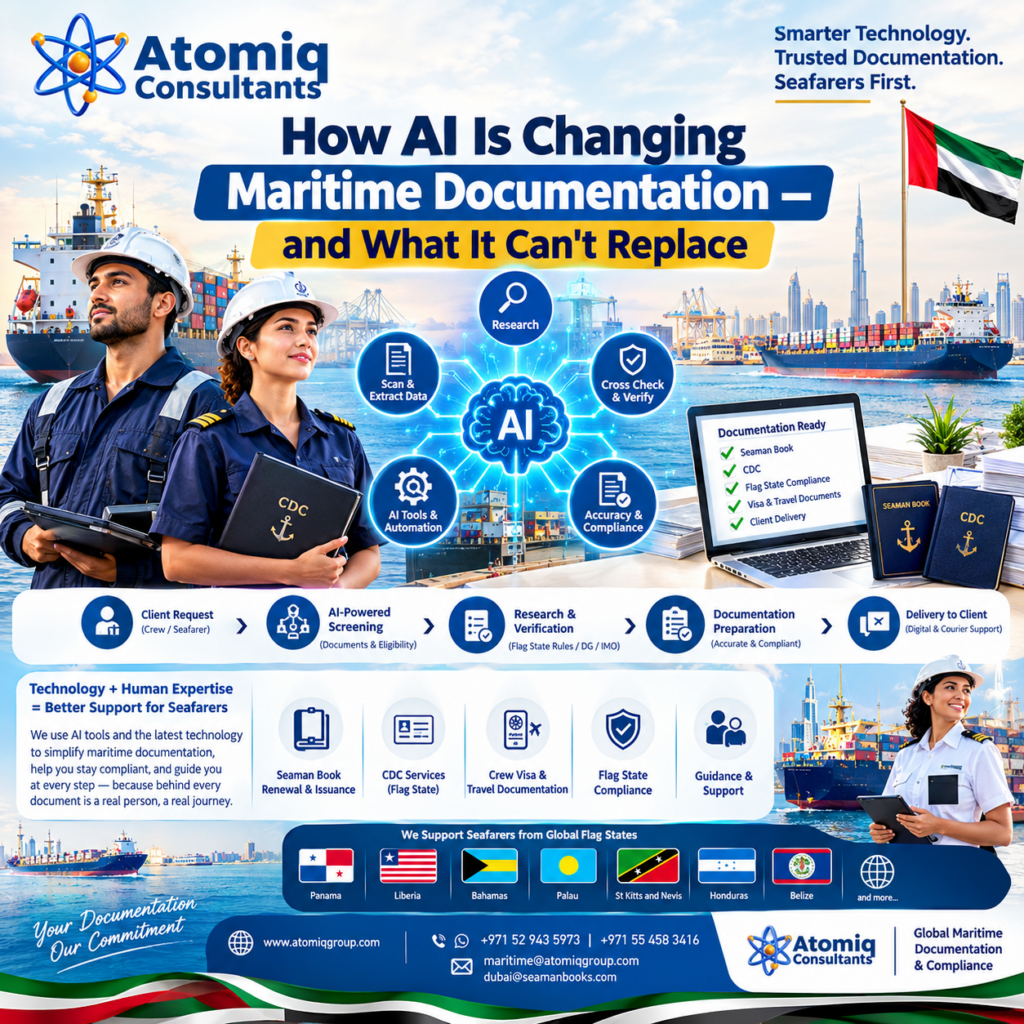
How AI Is Changing Maritime Documentation — and What It Can’t Replace

Services

 
Posted on Google Google
Andy Fitriansyah profile picture
Andy Fitriansyah
Google star 1Google star 2Google star 3Google star 4Google star 5Trustindex verifies that the original source of the review is Google.
Trust agency and fast respon
Posted on Google Google
Zameel Kapat profile picture
Zameel Kapat
Google star 1Google star 2Google star 3Google star 4Google star 5Trustindex verifies that the original source of the review is Google.
Quality and Quick service
Posted on Google Google
Dody Pambudhi profile picture
Dody Pambudhi
Google star 1Google star 2Google star 3Google star 4Google star 5Trustindex verifies that the original source of the review is Google.
Fast and trusted. Very recommended 👍
Posted on Google Google
ahmed abouzid profile picture
ahmed abouzid
Google star 1Google star 2Google star 3Google star 4Google star 5Trustindex verifies that the original source of the review is Google.
Helpful and professionals Thanks Atomiq Consultant
Posted on Google Google
Leo Worrall profile picture
Leo Worrall
Google star 1Google star 2Google star 3Google star 4Google star 5Trustindex verifies that the original source of the review is Google.
Very fast application process and good service. Palau seaman’s book was dispatched to me by courier within 48 hours of payment. Would definitely recommend
Posted on Google Google
Olga Poltavtseva profile picture
Olga Poltavtseva
Google star 1Google star 2Google star 3Google star 4Google star 5Trustindex verifies that the original source of the review is Google.
Thanks Gyanvi, thanks Karunesh you made our day. We were very happy to receive such a quick response and excellent communication from the team. They work efficiently and fast, and the delivery service was also excellent! We received the seaman’s book for our sailor without any issues. Highly recommended! Thank you again, and have a great day!
Posted on Google Google
Wael Farouk profile picture
Wael Farouk
Google star 1Google star 2Google star 3Google star 4Google star 5Trustindex verifies that the original source of the review is Google.
It was a wonderful , fast and easy experience, thank you for your efforts and support
Verified by Trustindex
Trustindex verified badge is the Universal Symbol of Trust. Only the greatest companies can get the verified badge who has a review score above 4.5, based on customer reviews over the past 12 months. Read more
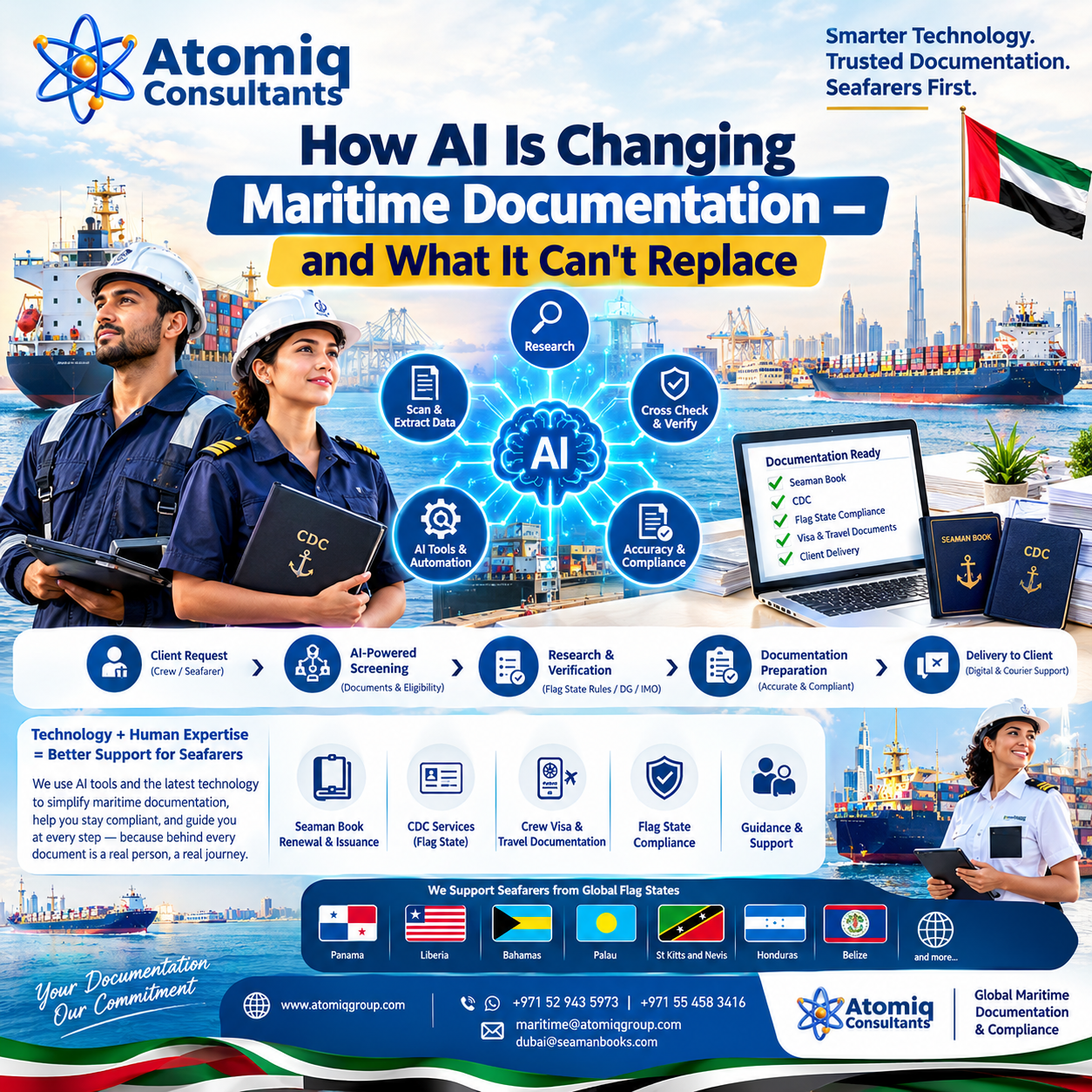
AI in Maritime Documentation How AI Is Changing Maritime Documentation — and What It Can't Replace

AI in maritime documentation is used for three jobs: reading data off seafarer documents automatically, cross-checking that data for mismatches, and screening certificates for signs of forgery. It does not issue documents. A seaman book, CDC, SIRB or certificate of competency is still issued only by a flag-state administration, and many are still required as a physical book.

Most of what gets called “AI” in maritime paperwork is really two different things: digitisation (moving a document or a lookup online) and automation that learns from examples (reading, matching, flagging). The difference matters, because it decides what a seafarer can actually rely on. A scanned certificate is not a verified certificate. A certificate that a machine has checked is still only valid because an administration issued it.

This guide separates what has genuinely changed from what has not, answers the question most seafarers ask first — why is this industry still on paper? — and shows how to check a document yourself.

What AI actually does in maritime documentation today

TaskWhat the technology doesIs it really AI?What still needs a person or an administration
Reading documentsExtracts name, date of birth, certificate number and expiry from a passport, CoC or medical scan (optical character recognition plus trained models)Yes — the modern versions are machine-learning basedSomeone must confirm the extracted data against the original
Cross-checking a fileCompares the same field across documents — a surname spelled one way on the passport and another on the STCW certificatePartly — much of it is simple rulesThe applicant must correct the source document; no software can
Forgery screeningFlags altered images, inconsistent fonts or layouts that don’t match a known templateYesFinal proof is the issuing administration’s record, not the screening result
Online verificationLets an employer or inspector look up a certificate number on the administration’s systemNo — this is a database lookup, not AIThe administration owns and maintains the record
Expiry trackingAlerts before a medical, STCW refresher or seaman book lapsesUsually no — date arithmeticThe seafarer still has to renew in time

The honest reading of this table: the parts of maritime documentation that have changed most are checking and finding. The part that has not changed at all is issuing.

Where AI is used beyond documents — voyage planning, engine monitoring, port logistics, the wider field often sold as “AI maritime services” — it has no bearing on whether a seafarer’s papers are valid.

Digital is not the same as AI — the IMO distinction

The rules that govern maritime documents talk about electronic certificates, not artificial intelligence. IMO issued guidelines for the use of electronic certificates, which allow a flag administration to issue ship certificates in electronic form provided they carry a unique tracking number and can be verified online through a secure, administration-controlled source.

AI-assisted maritime document verification can support the checking of electronic certificates against issuer-provided verification systems, unique tracking numbers and certificate data, in accordance with applicable IMO electronic-certificate guidance. Final acceptance and verification remain with the issuing Administration/authorized authority.

Separately, IMO made electronic exchange of ship-clearance data through a maritime single window mandatory for ports from 1 January 2024. That rule covers ships arriving and departing — crew lists and cargo declarations — not the seafarer’s own seaman book or CoC.

FAL Convention amendments adopted by FAL 46 (Resolution FAL.14(46)), entered into force on 1 January 2024. 

For seafarer certificates, the relevant hook is older. STCW requires each administration to keep a register of the certificates it issues and to answer authenticity enquiries from other administrations and employers. 

STCW Regulation I/2, paragraphs 14–16, requires Parties to maintain registers of seafarer certificates and endorsements and to make certificate-status information available for verification of authenticity and validity; the information required under paragraph 15 must be available electronically in English.

That obligation is what makes online verification possible. It does not require any administration to stop issuing paper.


Why is the maritime industry still paper-based?

Because every document is only as valid as the administration behind it, and each administration moves at its own pace. Five reasons, in order of weight:

  1. Legal recognition is per flag. A seafarer working a Panama-flagged vessel needs Panama’s document; a Liberia-flagged vessel needs Liberia’s. There is no single global register, so there is no single switch to “go digital”. Each administration decides for itself.
  2. Inspections happen on board, not online. Port state control officers and employers check documents on the ship, in the port, sometimes with poor connectivity. A physical book that can be inspected in seconds still works where a portal cannot.
  3. Fraud made administrations cautious. Forged certificates are a long-standing problem in this industry — IMO maintains a dedicated module for reporting fraudulent certificates. Administrations are slow to accept any format they cannot verify end-to-end.
  4. The chain is fragmented. One seafarer’s file touches a flag administration, a training centre, a medical examiner, a manning agency and an employer. Unless all of them accept the digital version, the paper one is still needed somewhere in the chain.
  5. Identity documents have their own rules. The ILO’s revised seafarers’ identity document convention introduced a biometric document, but adoption has been limited, so most seafarers still travel and sign on with passports and paper books. 

ILO NORMLEX — Convention No. 185 (Seafarers’ Identity Documents Convention (Revised), 2003), as amended; current ratification status and official NORMLEX record.

The result is a hybrid. Many administrations now verify online and issue interim certificates quickly, while the 5-year book itself is still printed and couriered. Panama is a clear example: through Seaman Books, the Processing Certificate is issued in 3 to 5 business days and is valid for 90 days, while the printed 5-year book takes up to 25 to 30 days (within 10 days on urgent processing), counted from a complete, verified file.

Where AI helps seafarers — and where it creates new risk

Where it helps. Most rejected applications fail on something small and fixable: a name that doesn’t match across documents, an expired medical, a photo that doesn’t meet the specification. Automated cross-checking catches those before a file is filed, which is where the time saving actually comes from. See the pre-submission checklist used to avoid CDC rejection.

Where it creates risk. The same tools that make forgeries easier to detect also make convincing forgeries and convincing fake agency websites cheaper to produce. A professional-looking PDF, a QR code or a polished website proves nothing on its own. The only proof that a seaman book or CoC is real is a match on the issuing administration’s own record. See how to spot fake maritime document services and the risks of a fake or invalid CDC.

AI based Maritime Documentation services for Seafarers

How to verify a maritime document yourself

  1. Identify the issuing administration from the document itself — not from the agency that helped you.
  2. Find that administration’s official verification service from its own website, reached by search or from the IMO member-state list — never from a link in an email or on an agency page.
  3. Enter the certificate or book number and check that the name, date of birth, rank and expiry match exactly.
  4. Treat a QR code with caution unless it resolves to the administration’s own domain.
  5. If the lookup fails, stop. Ask the administration directly before you sail on the document.

Crewing managers checking documents at volume: verifying crew documents online — a guide for GCC crewing managers.

What doesn’t change — who issues, who checks, who is accountable

RoleWhoCan AI replace it?
Issuing the seaman book, CDC, SIRB or CoCThe flag-state administrationNo
Keeping the official recordThe flag-state administrationNo
Delivering STCW and offshore trainingAn approved training centreNo
Preparing, checking and filing the applicationThe seafarer, or a documentation partner such as Seaman BooksIt can assist; a person remains accountable for what is filed
Inspecting documents on boardPort state control, the employerIt can assist the lookup; the inspector decides

How Seaman Books fits in

Seaman Books is a Dubai-based documentation consultancy. We prepare and verify seafarer files and coordinate with IMO- and ILO-ratified flag-state administrations — Panama, Palau, Liberia, Bahamas, Belize, Honduras, and St. Kitts & Nevis. We do not issue documents; the administration does.

Every application starts with a free eligibility check. Fees are quoted upfront after the check, with no hidden charges. If you are in the UAE or the wider GCC, you can also visit our office in Business Bay, Dubai.

 WhatsApp: +971 55 458 3416 for Details Information

Start here: free seaman book eligibility check · all services for seafarers
Frequently asked questions

Can AI issue a seaman book or CDC?

No. A seaman book, CDC or SIRB can only be issued by the flag-state administration whose flag the vessel flies. Software can read, cross-check and screen application documents, and some administrations use online systems to process them, but the legal document and the official record always come from the administration itself.

Is a digital seaman book valid?

It depends on the administration. Some flags issue interim or electronic certificates that are valid for a set period and verifiable online, while the full book is still printed. Check the issuing administration’s rules and confirm your document on its official verification service before relying on it at sign-on or in port.

Why is the maritime industry still paper-based?

Because each flag administration controls its own documents and moves at its own pace, inspections happen on board where connectivity is unreliable, and a long history of certificate fraud makes administrations cautious about any format they cannot verify end-to-end. Most now combine online verification with a printed book.

Can AI detect fake seafarer certificates?

It can flag warning signs — altered images, inconsistent fonts, layouts that don’t match a known template — but it cannot prove a certificate is genuine. The only reliable test is a matching record on the issuing administration’s own verification system, checked through a link you found yourself rather than one supplied to you.

Will AI replace maritime documentation agents?

It is replacing some of the manual checking. It does not replace the accountability for what gets filed, the knowledge of which flag accepts which documents, or the relationship with administrations. A good documentation partner should use better tools to reduce rejections — and still be able to show you how to verify the result yourself.

Written By

Picture of Dipak Paudel

Dipak Paudel

Dipak is an experienced maritime documentation and content professional with experience since 2021, specializing in seaman books, crew documentation, maritime compliance, and visa-related documentation solutions through SeamanBooks.com and Atomiq Consulting.

Contact Form

Recent Post