10 topmost hidden benefits of a seaman book
Seaman’s Book Benefits: What a CDC Actually Does for Your Career
A seaman’s book — also called a Continuous Discharge Certificate (CDC), seafarer’s discharge book or service book — is the document that records your identity as a seafarer and the sea time you have actually served. Its real value is evidentiary: it proves where you sailed, in what rank, and for how long, which is what employers and maritime administrations check when you apply for a job or a higher certificate. It does not provide insurance, medical cover, travel discounts, visa-free entry or guaranteed employment, whatever you have read elsewhere.
What a seaman’s book is, in one paragraph
It is a small booklet issued by a maritime administration — either your own country’s, or a foreign flag state such as Panama, Palau or Liberia — that carries your photograph and personal details and then accumulates, voyage by voyage, a signed record of your service.
What it is called and what it legally does both change depending on who issued it. That is the part most articles skip, and it is the part that matters when a crewing agent asks for “your book” and you are not sure which document they mean.
The UK is the clearest illustration. The Maritime and Coastguard Agency describes a seaman’s discharge book as “a full record of a seaman’s career experience and certification” — a service record, in other words. The travel function sits in a separate document, the British Seaman’s Card, which GOV.UK describes as “an internationally accepted document which lets British seamen land at foreign ports without needing a visa.” Two documents, two jobs. Systems that combine those functions into one booklet exist; systems that split them exist too. Never assume yours does both.
Sources: GOV.UK — Get a seaman’s discharge book or British seaman’s card
The 10 real benefits, and the limit on each
Read this table as a pair. The left column is what seafarers are promised; the right column is what actually holds up when someone checks.
| # | What it gives you | Where it stops |
|---|---|---|
| 1 | A recognised record of your status as a seafarer, with photograph and document number | Whether it is legally an identity document depends on the issuing country. Several systems, including the UK’s, keep identity and service in separate documents |
| 2 | A signed, chronological record of sea service — vessel, rank, join and discharge dates | It records service; it does not certify competence. That is a CoC or CoP |
| 3 | A document crewing agents and owners expect to see before you join | It is one item on a list that also includes STCW certificates, a medical, a passport and usually a visa |
| 4 | A career history that travels with you between employers and flags | Only if the entries are complete and correctly signed. An unsigned page is not evidence |
| 5 | Evidence of qualifying sea service for your next certificate | The amount and type of service that counts is set by the administration issuing that certificate, not by the book |
| 6 | One place to keep a service history that would otherwise be scattered across contracts | Keep the contracts anyway. If the book is lost, they are your reconstruction |
| 7 | Documentation accepted internationally for employment on foreign-flag vessels | Acceptance for employment is not permission to enter a country. Those are different authorities |
| 8 | A document routinely presented during sign-on, sign-off and crew-change procedures | It does not create a right of entry, priority clearance or e-gate access. Port and immigration authorities decide that |
| 9 | Preserved evidence of experience as you move toward senior rank | Evidence of experience, not entitlement to promotion |
| 10 | A documented foundation for a long career, alongside STCW training and certification | On its own it guarantees nothing. It is the record, not the qualification |
The four benefits that actually decide outcomes
Six of the ten above are variations on “you have a tidy record.” These four are the ones that change what happens to your application.
It is the evidence behind your sea service claim
When you tell an employer you have eighteen months as AB on bulk carriers, the book is what turns that sentence into a verifiable fact. Depending on the issuing authority, entries typically cover vessel name, rank or capacity, dates of joining and discharge, and the period of service, signed by the master on sign-off.
India's Directorate General of Shipping states that the master of the vessel signs the CDC each time a seafarer signs off, certifying the experience gained on board.
This is also why a gap in your book is worse than a gap in your CV. A CV gap invites a question; an unsigned or missing entry invites a rejection.
It carries the sea time your next certificate requires
Certificates of Competency are not granted on training alone. Administrations set a qualifying sea-service requirement, and they ask for evidence of it.
The Australian Maritime Safety Authority (AMSA) requires qualifying sea service for applicable STCW certificate applications and requires applicants to provide evidence meeting its requirements.
The practical consequence is unglamorous and worth repeating to every cadet: a book with sloppy entries costs you the certificate, not just the paperwork. Check every entry before you leave the vessel, while the master is still reachable.
It is what a crewing agent asks for first
Not because it outranks your STCW certificates, but because it is the fastest way to see whether you are who you say you are and whether you have sailed. A complete book shortens the conversation. An expired or damaged one stops it.
It is portable across flags and employers
Your book follows you; your employment contracts do not. Over a career spanning six companies and four flags, the book is the only continuous document you hold. Treat it accordingly — it is the single document worth photographing page by page and storing somewhere you can reach from a ship.
What a seaman’s book does not get you
This section exists because the claims below are published widely, including in places that look authoritative, and seafarers make decisions on them.
| Claimed “benefit” | Reality |
|---|---|
| Free or subsidised medical treatment | Medical cover comes from your employer, your contract, your P&I club or a national scheme — not from the book |
| Health or accident insurance | Same. The book is not an insurance policy and no flag state attaches one to it |
| Airline, hotel or car-hire discounts | Commercial decisions by those companies. Where seafarer fares exist, they are set by the carrier and usually need a ticket booked through a crew travel agent |
| Military or retail discounts | Unrelated to maritime documentation entirely |
| Visa-free travel | Visa policy belongs to the destination country. Some systems (the UK’s British Seaman’s Card, for example) do carry a landing function — but that is a separate document, and it is not universal |
| Automatic e-gate access or priority immigration | Border authorities decide this. No document issued to a seafarer overrides that |
| Guaranteed employment | It is a requirement, not an offer |
| Automatic promotion or higher pay | Rank follows certification and experience, assessed by employers |
| Job security | No document provides this |
If a service or an article offers you these as reasons to obtain a seaman’s book, treat everything else it tells you with the same suspicion. In this industry, the pitch that oversells the perks is usually the one underselling the requirements.
Seaman’s book, passport, and seafarer identity document: three different things
New seafarers ask whether the book replaces the passport. It does not.
| Document | What it establishes | Who issues it | Does it replace the others? |
|---|---|---|---|
| Passport | Your nationality and identity for international travel | Your government | No |
| Seaman’s book / CDC | Your status as a seafarer and your record of sea service | A maritime administration — your own or a foreign flag state | No |
| Seafarer identity document (SID) | Identity for seafarers under international arrangements, where the issuing state participates | Your government, where it participates | No |
| Document | Governing framework | Relationship to passport |
|---|---|---|
| Seafarers’ Identity Document (SID) | ILO Convention No. 185 (Seafarers’ Identity Documents Convention (Revised), 2003) | A standalone identity document, not a passport. |
You will usually travel to join a vessel carrying the passport and the book, plus a visa where one is required. Budget for all three.
Which book do you actually need?
This is the question behind most “benefits” searches, and it has a short answer: the one your employer and your intended flag accept.
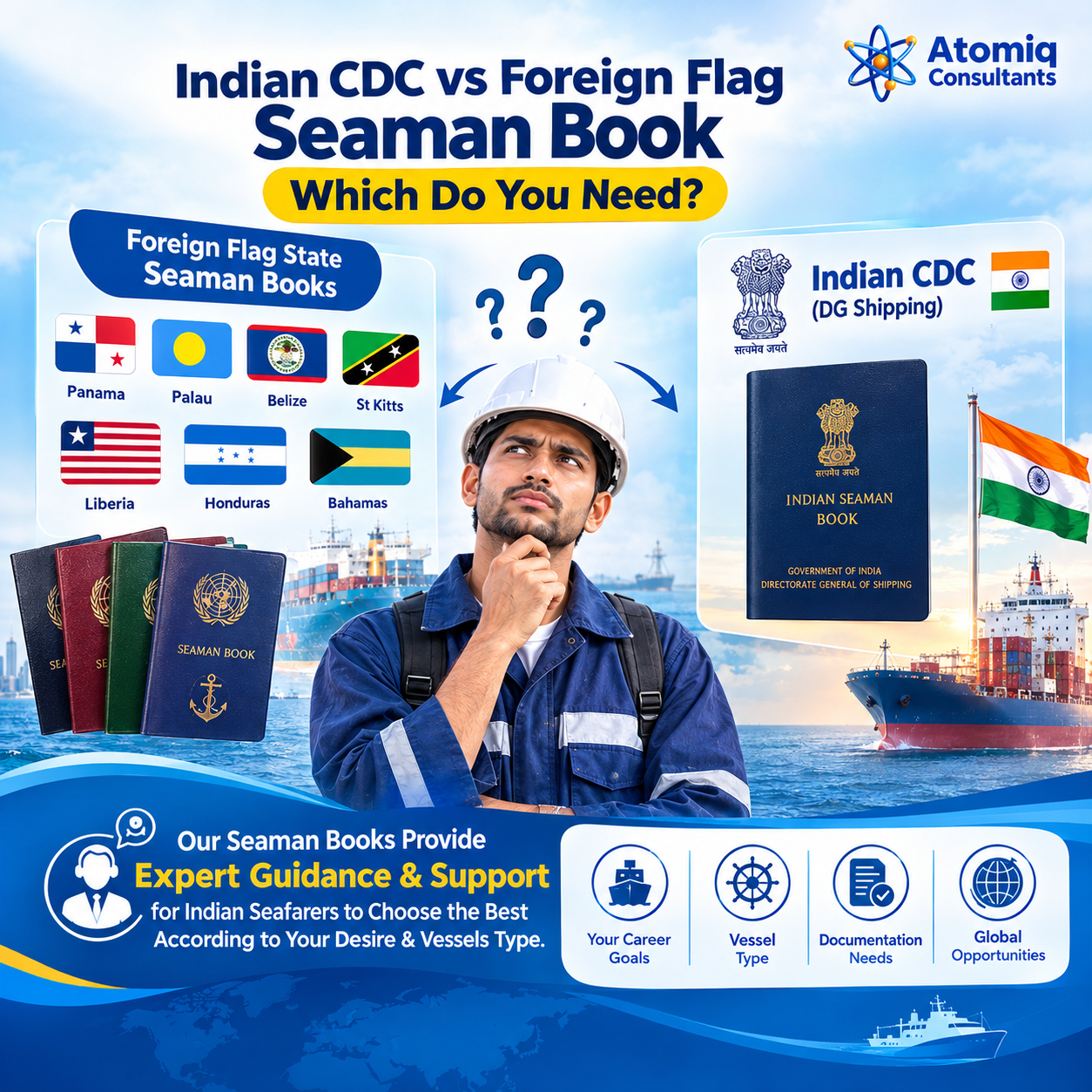
If you are sailing on a Panama-flagged vessel, a Panamanian seaman’s book is the document the operator expects. Seafarers who cannot obtain a national book, or who need one faster than a national system delivers, commonly apply through a foreign flag-state administration — Panama, Palau, Liberia, the Bahamas, Belize, Honduras or St Kitts & Nevis among them.
Before you apply anywhere, settle six things:
- Which book or CDC your intended employer accepts
- Whether you meet that administration’s eligibility requirements
- Which STCW certificates the position requires
- Whether an approved medical examination is needed, and which form
- Which identity and supporting documents the application takes
- Whether the vessel or flag imposes anything additional
Getting item 1 wrong is the expensive mistake. Everything after it is recoverable.
Not sure which flag your situation calls for? Run the free eligibility check — it takes a few minutes and tells you what you qualify for before you pay anything. Or send your rank, nationality and intended vessel type to WhatsApp +971 55 458 3416 and we will tell you which route applies.
Last reviewed 16 September 2026 by Seaman Books, a maritime documentation consultancy in Business Bay, Dubai, part of Atomiq Management Consultancies EST. (ISO 9001:2015, operating since 2011). We prepare and file seafarer documentation with flag-state administrations. We are not a flag state and we do not issue documents.
You’re well aware of the benefits of seaman book that come with your seafarer book, but did you know there are many more benefits than those most commonly known?
It’s easy to take some things for granted, especially when it comes to your job, so it’s good to keep a steady mind about what you have and what you don’t.
Whether you are exploring the benefits of being a seaman for the first time or looking to make the most of your existing CDC, these advantages go well beyond what most seafarers realize — and understanding the basic seaman book requirements is the first step to unlocking all of them of
Conclusion
These are 10 unexpected benefits to having a seaman book.
We are just found out that a mariner can buy travel insurance without prior medical examination (that’s huge!). Also, you don’t have to pay for life and medical insurance through your employer anymore.
And if you think that is great, there are more benefits! Take a look below to see what else there is to learn about these books.
Before you apply
A seaman’s book is worth having for one reason: it is the evidence behind everything you will claim about your career at sea. It is not a loyalty card and it is not an insurance policy, and the sooner you stop looking for perks in it the sooner you can get the document set right.
If you want the requirements for your situation checked before you spend anything, send your rank, nationality and intended vessel type to WhatsApp +971 55 458 3416, or use the free eligibility check.
These blogs will help you better understand how useful they really are. Happy reading!
Frequently Asked Questions regarding benefits of seaman book
What are the top hidden benefits of holding a Seaman Book (CDC) in 2026?
Beyond travel eligibility, CDCs unlock priority port clearance, global hotel and airline discounts, and specialized maritime insurance plans—valuable for active and aspiring seafarers.
Can I use my Seaman’s Book for discounts on global travel and accommodation?
Yes. Leading airlines and hotels offer discounted rates for CDC holders. Always ask for “seafarer” rates when booking.
Does a seaman book offer any career or salary advantages?
Absolutely—employers use CDC sea service entries as proof for promotions and higher pay brackets.
How can my CDC help in emergency or fast-track immigration situations
Port and immigration officers prioritize CDC holders for quick inspection and expedited processing, reducing delays at borders.
Are there financial or insurance perks linked to CDCs for mariners?
Many employers and agents offer group health, accident, or travel insurance plans exclusively for CDC holders. Ask your ship manager for options.
What are the main benefits of being a seaman?
The main benefits of being a seaman include globally recognized employment credentials through your CDC, access to maritime-specific medical and accident insurance, tax advantages in many flag states, career flexibility across vessel types and countries, and port-entry privileges that speed up immigration at major ports worldwide. These benefits apply to both entry-level and experienced seafarers holding a valid seaman book.
Do seaman benefits apply only to experienced seafarers or first-timers too?
Most seaman benefits—including discounted travel, port-entry privileges, and employer-provided insurance — begin from the moment your first CDC is issued, even if you have no prior sea service recorded in it. The more sea-service entries your book accumulates, the more career and salary benefits you unlock, as employers use those entries to assess rank eligibility and pay grade.
Atomiq Group is a trusted global maritime consultancy dedicated to simplifying the documentation process for seafarers and offshore workers worldwide. Backed by over a decade of industry expertise, the ISO 9001:2015-certified firm provides seamless, end-to-end support for acquiring and renewing essential Seaman Books (CDC/SIRB) and STCW certifications across major IMO- and ILO-ratified flags—including Panama, Palau, Liberia, Belize, and the Bahamas. By efficiently managing regulatory coordination and ensuring strict international compliance, Atomiq Group minimizes administrative delays, helping maritime professionals advance their careers and join their vessels faster and with complete confidence.