Deck Department Ranks Explained (Master to Deck Cadet, 2026)
The deck department of a merchant ship runs from Master down to trainee rating, but it contains only three officer certificate levels under STCW Chapter II: Officer in Charge of a Navigational Watch (Regulation II/1), Chief Mate (Regulation II/2) and Master (Regulation II/2). Third Officer and Second Officer are company titles held on the same OICNW certificate. Ratings are certificated separately — Rating Forming Part of a Navigational Watch (Regulation II/4, minimum age 16) and Able Seafarer Deck (Regulation II/5, minimum age 18, normally 18 months of deck service). Every step up the ladder is gated by a certificate and a stated period of sea service, not by years served.
Who is in the deck department
The deck department is responsible for navigating the ship, working the cargo, and maintaining the hull, decks and deck machinery. It is one of the ship’s two or three operating departments, alongside the engine department and, on passenger and cruise tonnage, the catering or hotel department.
Under the STCW Convention, deck personnel divide into two certificated tiers:
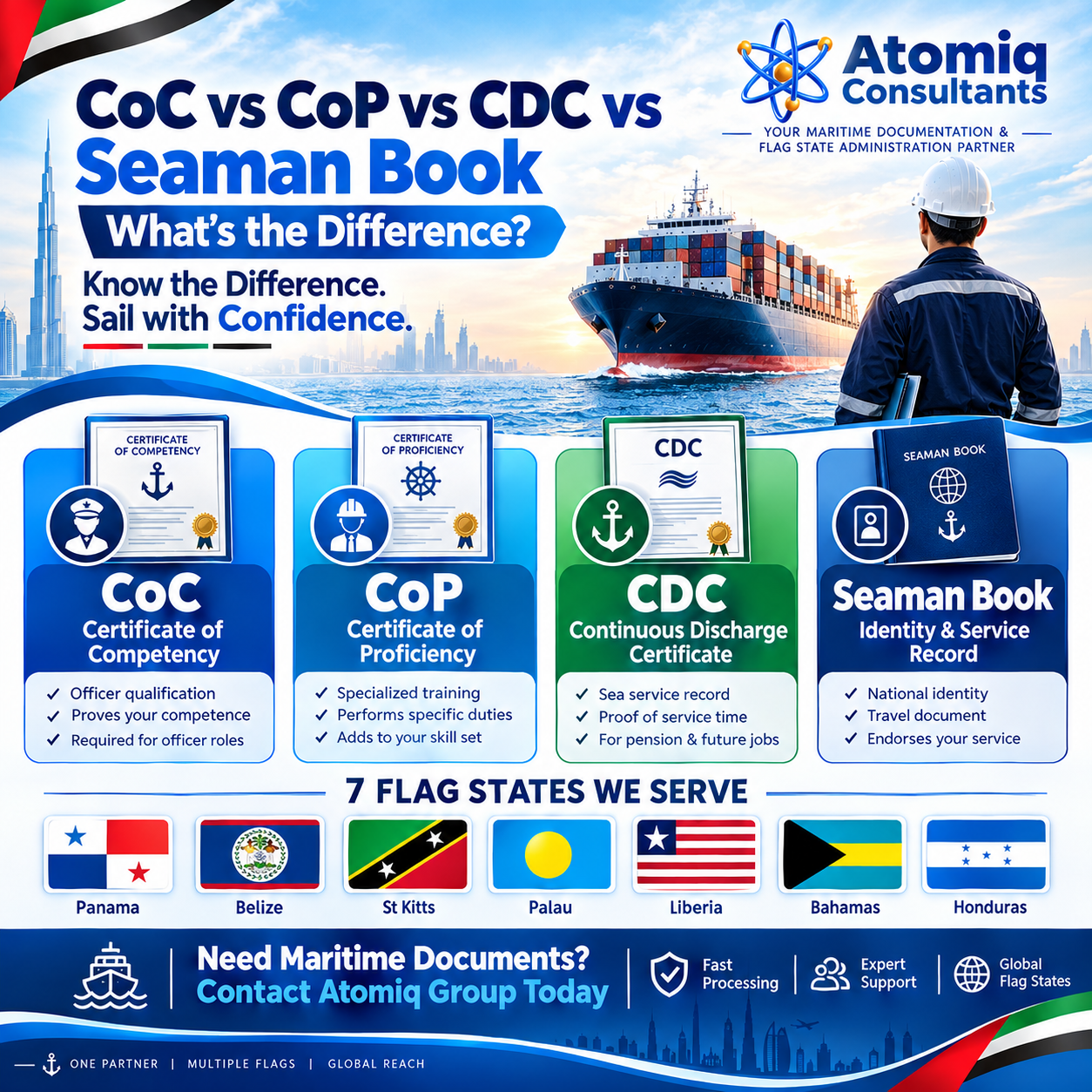
- Officers, who hold a Certificate of Competency and stand a navigational watch or manage the department.
- Ratings, who hold a Certificate of Proficiency and support the watch and the deck work.
The titles used on board are set by the shipowner. The certificates are set by the flag state, under a Convention that applies to almost every merchant ship trading internationally. Understanding which is which is the difference between knowing what you are called and knowing what you are permitted to do.
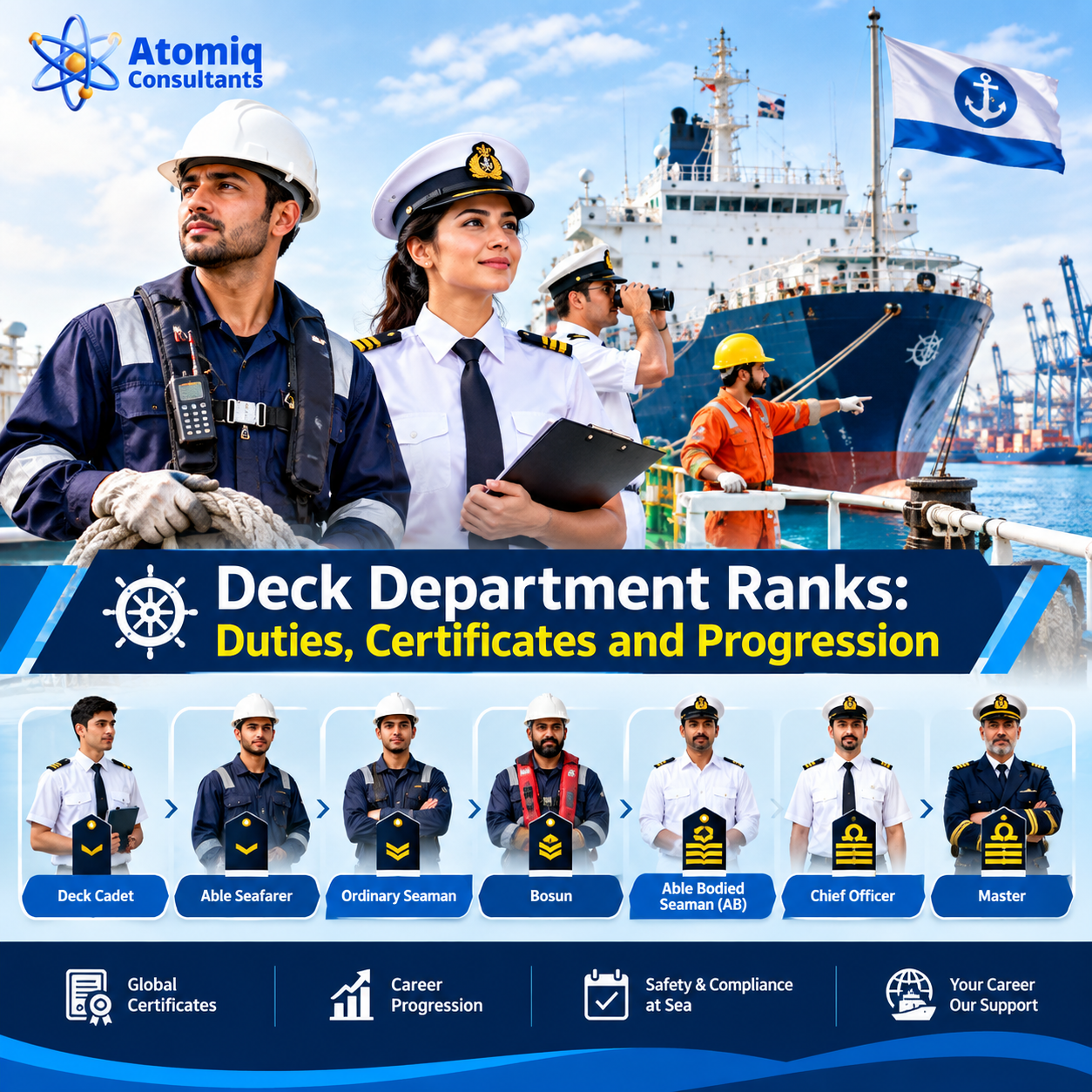
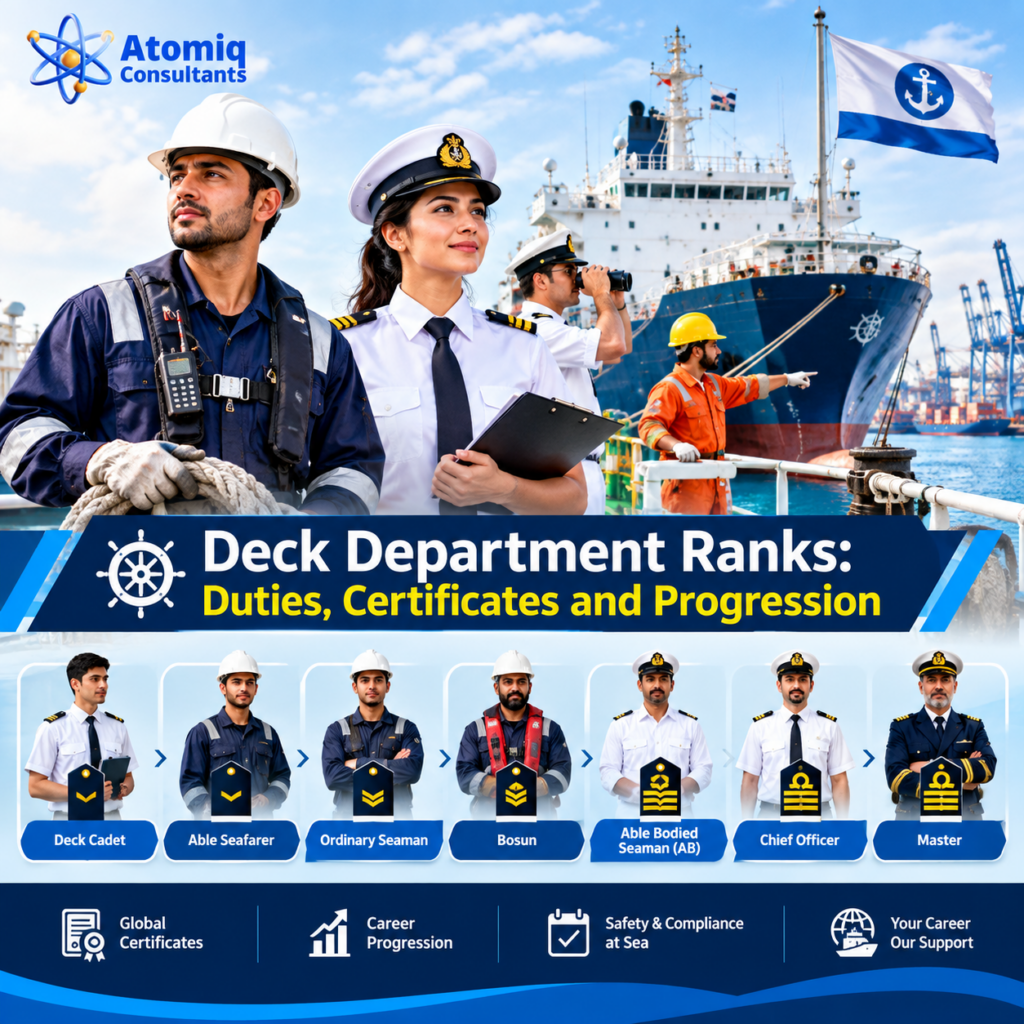
Deck department ranks in order
| Rank | Tier | STCW certificate required |
|---|---|---|
| Master | Officer — management level | Master, Regulation II/2 |
| Chief Officer (Chief Mate) | Officer — management level | Chief Mate, Regulation II/2 |
| Second Officer | Officer — operational level | OICNW, Regulation II/1 |
| Third Officer | Officer — operational level | OICNW, Regulation II/1 |
| Deck Cadet | Trainee officer | Basic training (VI/1) and an approved training record book |
| Bosun (Boatswain) | Senior rating | Normally an Able Seafarer Deck |
| Able Seafarer Deck (AB) | Rating | Able Seafarer Deck, Regulation II/5 |
| Ordinary Seaman (OS) | Rating | RFPNW, Regulation II/4 |
| Deck Boy / trainee rating | Entry | Basic training (VI/1) |
The Panama Maritime Authority’s own certification list follows exactly this structure: Officer in Charge of a Navigational Watch under II/1, Chief Mate and Master under II/2, and ratings covering Ordinary Seaman, Able Seaman under II/4 and II/5, Bosun and Deck Cadet. Source: Panama Ship Registry — seafarer certification.
Deck officer ranks: three certificates, four titles
This is the part most rank guides get wrong.
Officer in Charge of a Navigational Watch (Regulation II/1) is the entry-level officer certificate for ships of 500 gross tonnage or more. A newly certificated officer joins as Third Officer and is normally promoted to Second Officer on the same certificate. No new certificate of competency is required to make that step. What changes is the watch, the secondary duties and the pay.
Chief Mate (Regulation II/2) is the next certificate. It requires 12 months of service as an Officer in Charge of a Navigational Watch, as codified by the US Coast Guard at 46 CFR §11.307.
Master (Regulation II/2) requires 36 months as an Officer in Charge of a Navigational Watch — or 24 months, if at least 12 of them were served as Chief Mate (46 CFR §11.305). Both the Chief Mate and Master certificates are issued separately for ships of 3,000 GT and above and for ships between 500 and 3,000 GT.
On the figures above. The month values are the United States’ codification of STCW Chapter II. They mirror the Convention, which is why they are quoted here with the regulation cited alongside. Your own flag state or certifying administration may impose additional requirements — an approved training course, a written and oral examination, a specified period in a particular ship type. Always check the requirement published by the administration issuing your certificate.
Ships under 500 GT on near-coastal voyages are certificated separately under Regulation II/3, with its own service requirements.
What each deck officer does
The duties below are customary shipboard practice. The statutory element is the STCW function each rank is certificated to perform — navigation, cargo handling and stowage, and controlling the operation of the ship and care for persons on board, at operational level for OICNW and management level for Chief Mate and Master.
Master. Holds command and overall responsibility for the ship, crew, cargo and compliance. Represents the owner in dealings with port state control, charterers, agents and authorities. Does not normally stand a navigational watch. Final authority on safety and security decisions, which under the ISM and ISPS Codes cannot be overridden commercially.
Chief Officer. Second in command and head of the deck department. Responsible for cargo planning, stowage and stability, deck maintenance, and the deck crew’s work programme. Normally stands the 04–08 and 16–20 watch. Takes command if the Master is incapacitated.
Second Officer. Usually the navigation officer: passage planning, chart and publication corrections, ECDIS management, and the bridge navigational equipment. Normally stands the 12–16 and 00–04 watch. Frequently also the medical officer on ships without a dedicated one.
Third Officer. Usually responsible for life-saving appliances and fire-fighting equipment — inspection, servicing records and drills. Normally stands the 08–12 and 20–00 watch. The first officer rank a newly certificated OOW holds.
Deck Cadet. An officer under training, sailing against an approved training record book that documents the competences required for a first certificate of competency. A cadet stands watches under supervision and does not hold a certificate of competency.
Deck ratings: who they are and what certificates they hold
Ordinary Seaman (OS) is the entry rating. The STCW certificate is Rating Forming Part of a Navigational Watch, Regulation II/4. The minimum age is 16, and the service requirement is six months of seagoing service that includes watchkeeping training and experience under supervision — or approved training plus at least two months of seagoing service (46 CFR Part 12). An OS keeps lookout, steers, handles lines and does general deck work.
Able Seafarer Deck (AB) is the certificated deck rating, Regulation II/5. The minimum age is 18. The applicant must already qualify as a Rating Forming Part of a Navigational Watch and then complete 18 months of deck department service — or 12 months plus approved training (same source). Proficiency in survival craft and rescue boats is also required. An AB steers, stands lookout, works cargo gear, mooring and anchoring stations, and carries out deck maintenance without supervision.
Bosun (Boatswain) is the senior rating and the Chief Officer’s foreman: allocating the deck crew’s daily work, running maintenance jobs, and taking charge forward or aft during mooring. There is no separate STCW certificate for Bosun — it is a shipboard appointment normally held by an experienced Able Seafarer Deck.
Deck Boy / trainee rating covers a first-time entrant with basic safety training (Regulation VI/1) who is building the service needed for a Rating Forming Part of a Navigational Watch certificate.
How long the progression takes
Read down this column and the shape of a deck career is visible. The service requirements are cumulative minimums, not typical timelines — a berth has to be available at each step.
| Step | Minimum service required | What gates it |
|---|---|---|
| Entry → Ordinary Seaman (RFPNW) | 6 months with watchkeeping training, or approved training plus 2 months | Age 16, basic training |
| Ordinary Seaman → Able Seafarer Deck | 18 months deck service, or 12 months plus approved training | Age 18, RFPNW held first |
| Rating → Officer (OICNW) | 36 months deck seagoing service, or 12 months in an approved training programme | The approved cadetship route is three times faster |
| OICNW → Chief Mate | 12 months as OICNW | Certificate of competency examination |
| Chief Mate → Master | 36 months as OICNW, or 24 months including 12 as Chief Mate | Certificate of competency examination |

The single most consequential decision on that table is the third row. A cadetship compresses 36 months of qualifying service into 12. That is why the approved training route matters far more than most entrants realise, and why the training record book a cadet sails with is a career document, not paperwork.
Pay tracks the same structure. The two largest increases on the published wage scale sit exactly where a new certificate is required — see seafarer salary by rank for the figures and the source.
What you need to carry, at every rank
A certificate proves competence. It does not by itself get you onto a crew list. Every deck rank, from Deck Boy to Master, sails with the same four-part document set:
| Document | What it does | Who issues it |
|---|---|---|
| Seafarer’s identity and record book (CDC / SIRB / seaman book) | Records identity and sea service | A flag-state administration |
| STCW certificates | Record competence for the rank and ship type | A flag-state administration, on approved training |
| Certificate of competency (officers) | Authorises service at a given rank and tonnage | The administration that examined you |
| Medical fitness certificate | Confirms fitness for the trade | An approved medical practitioner |
The step most officers discover late. A certificate of competency issued by one country does not automatically authorize service on another country’s flag. To serve as an officer on a Panama, Liberia, Bahamas or Palau ship, a national certificate has to be recognized by that administration through a Regulation I/10 endorsement of recognition. Panama issues exactly this for masters and chief engineers, alongside its own certificates of competency. Source: Panama Ship Registry.
This is the point at which a promotion stalls: the rank is earned, the examination is passed, and the endorsement for the flag the ship actually sails under has not been applied for.
Deck department and engine department
The deck department navigates the ship and works the cargo. The engine department runs and maintains the propulsion, power generation and machinery systems, under a parallel certificate structure in STCW Chapter III. The two ladders are separate: sea service in one does not count toward a certificate in the other, and the crossing point — Electro-Technical Officer aside — is essentially a fresh start.
Where Seaman Books fits
Seaman Books is the maritime documentation arm of Atomiq Management Consultancies EST. — ISO 9001:2015 certified, operating from #903 Regal Tower, Business Bay, Dubai since 2011.
We prepare, verify and coordinate seafarer documentation with IMO/ILO-ratified flag-state administrations including Panama, Palau, Liberia, Bahamas, Belize, Honduras and St Kitts & Nevis, and we arrange STCW certification and offshore training with accredited centers.
Whatever rank you hold or are working toward, the documentation has to match it. We are a documentation support and processing partner. We are not a flag-state authority, we do not issue documents or certificates of competency ourselves, and we cannot guarantee a government outcome.
Not sure which documents your rank requires? Run the free eligibility check — tell us your rank, your flag and your joining date — or message the Business Bay team on WhatsApp at +971 55 458 3416. Office hours 09:30–18:00 GST.