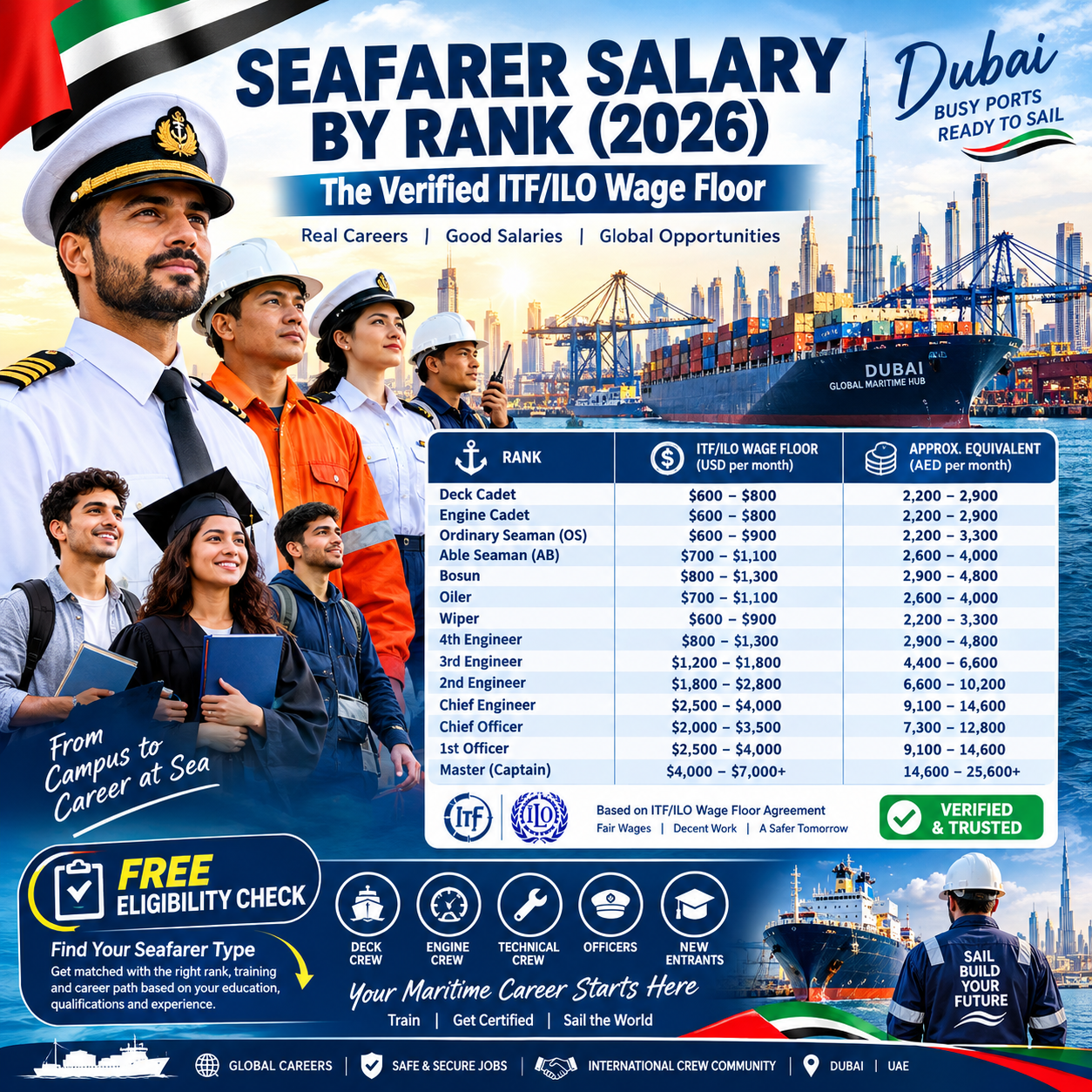
Seafarer Salary by Rank (2026): The Verified ITF/ILO Wage Floor
The ILO minimum monthly basic wage for an Able Seafarer is US$690 (AED 2,534) from 1 January 2026, rising to US$704 in 2027 and US$715 in 2028. Extrapolated across ranks on the ITF’s published scale, basic pay runs from US$513 a month for an Ordinary Seaman to US$2,325 for a Master — or US$902 to US$4,083 once 104 hours of monthly overtime and leave pay are included. These are floor figures set by the ILO Joint Maritime Commission under MLC 2006 Guideline B2.2.4, not market wages. Actual contract wages on ITF-covered ships sit above them, and those scales are not published publicly.
Why most seafarer salary tables are worthless
Search for seafarer salaries and you will find a dozen confident tables. Almost none of them cite a source.
That matters more in this industry than in most. Wages at sea are not set by a labour market you can survey — they are set by whichever collective agreement, if any, covers the ship. A Master on an ITF-covered tanker, a Master on a non-covered coastal vessel and a Master on a national-flag ship in a domestic trade are three different wage propositions. A single averaged figure describes none of them.
So this page does something narrower and more useful. It publishes the one rank-by-rank wage scale that a named authority publishes openly, links the source document, and is explicit about what the scale does and does not cover.
Seafarer salary by rank, 2026
Figures from the ITF ILO Minimum Wage Scale (Annex 1 to ITF E-Circular 204/S/SS/2025), effective 1 January 2026. AED converted at the fixed UAE peg of AED 3.6725 to the US dollar. Here is details Seafarer Salary by Rank
Rank | Basic pay/month | Total incl. 104h overtime | ||
USD | AED | USD | AED | |
Master | 2,325 | 8,539 | 4,083 | 14,995 |
Chief Engineer | 2,113 | 7,760 | 3,711 | 13,629 |
Chief Officer | 1,501 | 5,512 | 2,636 | 9,681 |
First Engineer | 1,501 | 5,512 | 2,636 | 9,681 |
Second Officer | 1,202 | 4,414 | 2,111 | 7,753 |
Second Engineer | 1,202 | 4,414 | 2,111 | 7,753 |
Electrical Engineer / ETO | 1,202 | 4,414 | 2,111 | 7,753 |
Chief Steward / Chief Cook | 1,202 | 4,414 | 2,111 | 7,753 |
Third Officer | 1,159 | 4,256 | 2,035 | 7,474 |
Third Engineer | 1,159 | 4,256 | 2,035 | 7,474 |
Bosun | 771 | 2,831 | 1,354 | 4,973 |
Pumpman (tankers only) | 771 | 2,831 | 1,354 | 4,973 |
Able Seafarer (AB) | 690 | 2,534 | 1,212 | 4,451 |
Engine Room Rating | 690 | 2,534 | 1,212 | 4,451 |
Steward | 588 | 2,159 | 1,033 | 3,794 |
Ordinary Seaman (OS) | 513 | 1,884 | 902 | 3,313 |
Junior Engine Room Rating | 513 | 1,884 | 902 | 3,313 |
Source: ITF ILO Minimum Wage Scale 2026–2028 (PDF)
How to read this table
Four things determine whether these numbers apply to you. We state them because most salary pages do not.
- Only the AB figure is the ILO’s. The rest are ITF extrapolation. The ILO sets one number — the minimum monthly basic wage for an Able Seafarer. The ITF projects that single figure across every other rank using the differentials in its own Standard Agreement. The scale says so on its face: “ITF interpretation of the ILO recommended minimum wage for an AB — extrapolated on basis of ITF Standard Agreement differentials.” The AB row carries the authority of an ILO resolution. Every other row carries the authority of an ITF calculation from it.
- These are floors, not salaries. The ILO resolution states that the figure “in no way prejudices collective bargaining or the adoption of higher levels in other international wage-setting mechanisms.” Real contract wages under the ITF Uniform TCC and IBF agreements are materially higher. Those scales are distributed to affiliated unions, signatory owners and ITF inspectors — they are not published openly, and we will not reproduce figures we cannot source. If you need your actual contract scale, your union or an ITF inspector holds it.
- Basic pay is not take-home. The “total” column assumes 104 hours of monthly overtime and includes leave pay accrued at 2.5 days per month. The ITF calculates overtime at 1.25 times the basic hourly rate on a 48-hour working week, against an MLC maximum of 72 hours. Work fewer overtime hours and you earn less than the total column.
- Flag and agreement decide everything. A ship with no ITF agreement has no obligation to this scale beyond whatever its flag state’s own law requires. Which is why the flag on the stern is a wage question, not just a paperwork one.
What the 2026 increase actually was
The ILO Subcommittee on Wages of Seafarers met in Geneva on 14–15 April 2025 and agreed a three-year schedule:
Effective | AB minimum basic wage |
1 January 2026 | US$690 |
1 January 2027 | US$704 |
1 January 2028 | US$715 |
The figure in force immediately before this schedule was US$673, set from 1 January 2025 under the previous resolution (US$658 in 2023, US$666 in 2024). The 2026 step is therefore a US$17 increase, about 2.5%.
The Subcommittee is scheduled to reconvene in the first half of 2028 to set the figure applying from 1 January 2029, and biennially after that. Source: ILO resolution, April 2025.
The rank ladder, and what each step is worth
Read down the basic pay column and the structure of a deck or engine career is visible in the gaps.
Ordinary Seaman to Able Seafarer is a 34% step — US$513 to US$690. It is also the step most new entrants underestimate, because it is gated on sea time and certification rather than on time served.
AB to Bosun adds 12%. Bosun to Third Officer adds 50%, and it is the largest single jump on the ladder, because it is the crossing from rating to officer. It requires a Certificate of Competency, not just experience.
Third Officer to Second Officer adds 4%. Second Officer to Chief Officer adds 25%. Chief Officer to Master adds 55%.
The engine side mirrors it: Junior ERR to ERR is 34%, ERR to Third Engineer 50%, Third to Second 4%, Second to First 25%, First to Chief Engineer 41%.
The pattern is consistent and worth naming: pay steps track certification thresholds, not years at sea. The two biggest jumps on each side of the ship sit exactly where a new Certificate of Competency is required.
What this scale does not tell you
Being straight about the gaps is the point of the page.
- It is not a market rate. Officers on IBF-covered ships in the Gulf, on LNG tonnage or in offshore support earn well above these figures. We do not publish those numbers because no public source states them.
- It excludes everything that is not wages. Repatriation, victualling, insurance, employer pension contributions and travel are governed separately under MLC 2006 and do not appear here.
- It says nothing about contract length or rotation. A four-month rotation and a nine-month contract at the same monthly rate are very different jobs.
- It is not country-specific. There is no Philippines rate or India rate on this scale. National minimum wage law may apply on top for seafarers on their own country’s flag.
- Cruise, yacht and offshore sit outside it. Those sectors have their own wage structures, often with a tips or day-rate component the ITF scale does not model.
Your documentation is what gets you onto the ships that pay this
A wage scale only applies to a seafarer a shipowner can legally sign on.
Access to ITF-covered and IBF-covered tonnage runs through documentation: a valid seafarer’s identity and record book (CDC or SIRB) issued by a recognised flag state, current STCW certification, and a medical fit for the trade. A seafarer whose seaman book has lapsed, whose flag state is not recognised by the owner, or whose STCW refreshers have expired is not negotiating a rank — they are off the crew list.
That is the connection between this table and what we do. Seaman Books, the maritime documentation arm of Atomiq Management Consultancies EST. — ISO 9001:2015 certified, operating from Business Bay, Dubai since 2011 — prepares and coordinates seafarer documentation with IMO/ILO-ratified flag-state administrations including Panama, Palau, Liberia, Bahamas, Belize, Honduras and St Kitts & Nevis, and arranges STCW certification and BOSIET and HUET offshore training with accredited centres.
We are a documentation support and processing partner. We are not a flag-state authority, we do not issue documents ourselves, and we cannot guarantee a government outcome.
Not sure which flag state fits your situation? Run the free eligibility check, or message us on WhatsApp at +971 55 458 3416. Office hours 09:30–18:00 GST.

Frequently asked questions Seafarer Salary by Rank
What is the minimum wage for a seafarer in 2026?
The ILO minimum monthly basic wage for an Able Seafarer is US$690 from 1 January 2026, set by the ILO Joint Maritime Commission under MLC 2006 Guideline B2.2.4. It rises to US$704 in 2027 and US$715 in 2028. Other ranks are extrapolated from this figure on the ITF’s published scale.
How much does a ship captain earn per month?
On the ITF ILO Minimum Wage Scale, a Master’s basic pay is US$2,325 per month for 2026, or US$4,083 including leave pay and 104 hours of overtime. This is a floor figure, not a market rate — Masters on IBF-covered and specialist tonnage earn substantially more, and those scales are not published publicly.
What is the difference between basic pay and total monthly wage?
Basic pay covers contracted hours, normally a 48-hour week. The total adds leave pay, accrued at 2.5 days per month under MLC Regulation A2.4, and overtime, calculated by the ITF at 1.25 times the basic hourly rate for up to 104 hours a month. Work less overtime and your total falls accordingly.
Do these salaries apply to every ship?
No. They apply where an ITF agreement is in place. A ship with no ITF or IBF agreement is bound only by its flag state’s law and its own contracts. This is one reason the flag a vessel sails under directly affects what its crew are paid.
Why do other websites show much higher seafarer salaries?
Most published seafarer salary tables are crewing-agency estimates or survey figures with no cited source. Actual contract scales under the ITF Uniform TCC and IBF agreements are higher than the ILO minimum but are distributed only to affiliated unions, signatory shipowners and ITF inspectors. We publish the scale we can source and link.
Does rank or certification determine pay?
Certification. The largest steps on the scale — Bosun to Third Officer at 50%, and Engine Room Rating to Third Engineer at 50% — sit exactly where a Certificate of Competency is required. Sea time qualifies you to sit for the certificate; the certificate moves the wage.