Singapore Seaman Book: Eligibility, Cost and Alternatives
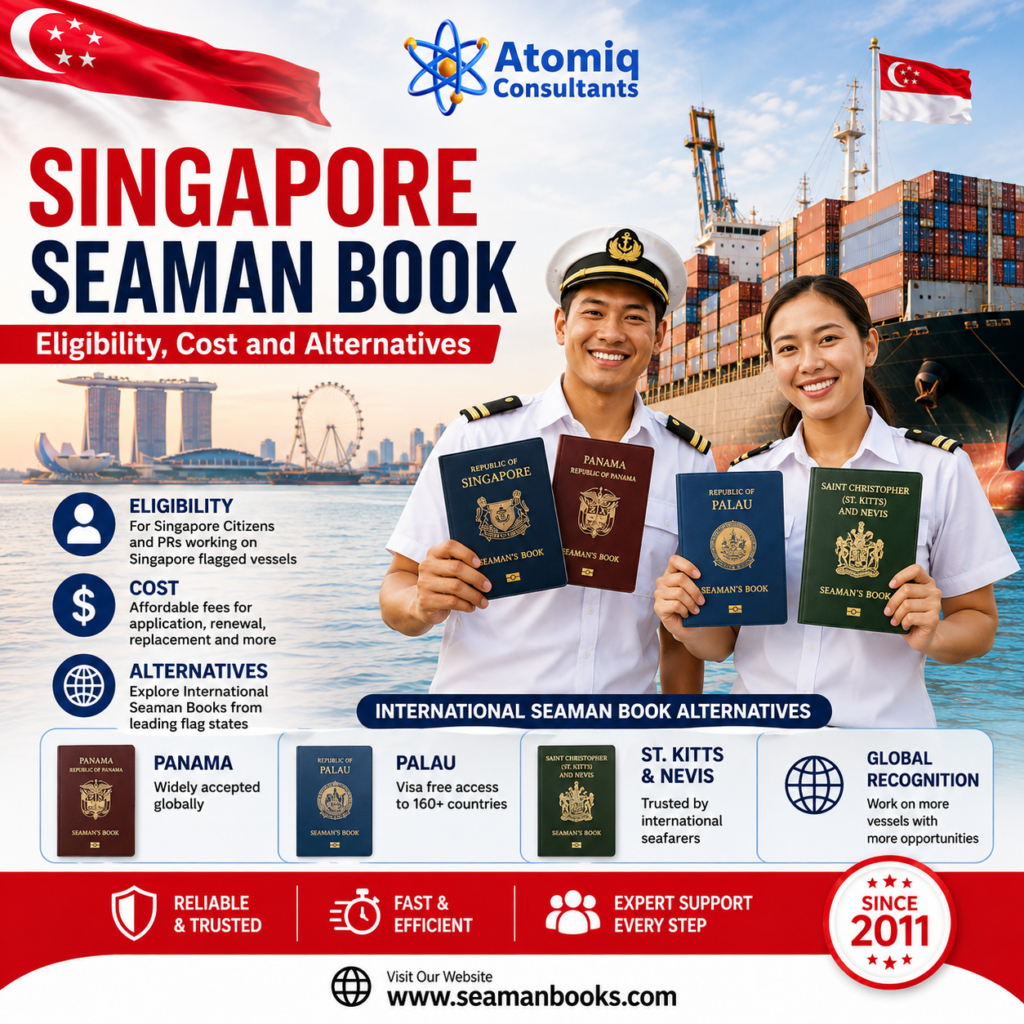
If you are based in Singapore and searching for a seaman book, one rule decides everything else: Singapore’s Seaman Discharge Book is issued only to Singapore citizens and permanent residents. The Maritime and Port Authority of Singapore (MPA) charges S$18 for it and takes applications through FormSG with Singpass — which is why a foreign national crewing out of Singapore cannot apply, no matter how many years of sea time they have logged locally.
That leaves most seafarers in this market needing a different document. This guide covers what a seaman book legally is, who qualifies for the Singapore one, which international alternatives are genuinely usable, and how the answer shifts depending on whether you are sailing out of India, the UAE, Europe or the United States.
What a seaman book actually is
A seaman book — also called a Continuous Discharge Certificate (CDC), Seafarer’s Identification and Record Book (SIRB), or Seaman’s Discharge Book — is an official record issued by a maritime administration that logs a seafarer’s sea service: ship name, flag, rank, and dates on and off. It proves sea time for licence progression. It is not a visa, a passport, or a certificate of competency.
The requirement traces back to the Maritime Labour Convention, 2006 (MLC, 2006), Standard A2.1, which entitles every seafarer to a document containing a record of their employment on board and requires that the document say nothing about the quality of their work or their wages. That is the seaman book’s whole job: neutral, verifiable proof that you sailed.
Four documents get confused constantly. They are not interchangeable:
|
Document |
What it proves |
Issued by |
|
Seaman book / CDC / SIRB |
Sea service history and identity as a seafarer |
A maritime administration (flag or national) |
|
Seafarer’s Identity Document (SID) |
Identity for shore leave and transit under ILO conventions |
Your national administration |
|
Certificate of Competency (CoC) |
Your rank and what you are licensed to do |
A maritime administration, after examination |
|
STCW certificates / CoP |
Completion of specific safety and proficiency training |
Approved training providers, endorsed by an administration |
A recruiter asking for “your book” wants the first one. A port state asking for ID at the gangway may want the second. Sending the wrong one costs you days.
Who can get a Singapore seaman book — and who cannot
MPA’s Seaman Discharge Book is open to Singapore citizens and permanent residents only. The application runs through FormSG using Singpass, and the fee is S$18, paid by internet banking before collection. MPA states the purpose plainly: to “log the seaman’s sea time to pursue professional qualifications in their career.”
Two consequences matter if you are deciding what to buy:
First, there is no foreigner route. Employment on a Singapore-flagged ship, a Singapore employment pass, or a Singapore-based manning agent does not create eligibility. Citizenship or PR status is the gate.
Second, even holders shouldn’t treat it as ID. MPA explicitly notes the book is “not intended to be the primary document for purposes of personal identification and border control clearance.” Your passport does that work.
On the competency side, Singapore does deal with foreign nationals: MPA recognises Certificates of Competency from 69 countries, and Singapore-issued CoCs are recognised by 62 maritime administrations, with applications handled through digitalPORT@SG. So a foreign officer can be endorsed to serve on a Singapore-flagged ship while remaining ineligible for the Singapore seaman book. Recognition of your licence and issuance of your discharge book are two different systems — conflating them is the single most common mistake we see.
Your alternatives when the Singapore book is closed to you
1. Your own national administration’s CDC
Usually the cheapest option, and the one to check first. Most major seafarer-supplying countries issue a discharge book to their nationals — India through the Directorate General of Shipping, the Philippines through MARINA, and so on. If yours is current and your employer accepts it, you may need nothing else.
Best for: seafarers whose home administration issues promptly. Watch out for: renewal backlogs, mandatory in-person appearance at home, and books that run out of pages mid-contract.
2. A Panama seaman book
Panama is the most-used route for Singapore-based foreign nationals, and the specifications are why:
- No nationality restrictions — seafarers from any country can apply.
- Five-year validity, typically.
- A Temporary Certificate in as little as 24 hours, with the full printed book delivered in 3–7 working days.
- Documents required: application form, valid passport copy, recent photograph, medical fitness certificate, and STCW course certificates including Basic Safety Training and Security Awareness Training (STSDSD).
Panama’s own registry confirms it issues seaman’s books and CoCs to nationals and non-nationals through fourteen SEGUMAR offices worldwide, and prices non-nationals higher — a Master or Chief Engineer CoC runs US$275 for non-nationals versus US$25 for nationals. Budget the foreigner rate, not the headline one. Full requirements are on our Panama seaman book page.
3. A Palau seaman book
Palau is the speed option. Flag state documentation can be processed same-day, which matters when a join date is already fixed. Requirements are broadly comparable to Panama’s: original application form, valid national passport copy, six passport-sized color photographs, medical fitness certificate, and STCW certificates for personal survival techniques, fire prevention and basic firefighting, elementary first aid, and personal safety and social responsibility. See the Palau seaman book page for the current document checklist.
4. Liberia and the other open registries
Liberia issues Seafarer Identification and Record Books alongside Special Qualification Certificates and officer certificates. Note the sequencing: the registry requires a Liberian seafarer book before you are eligible for its other documentation, so the book is step one, not an afterthought — details on our Liberia seaman book page. Bahamas, Belize, St Kitts & Nevis and Honduras are the other routes worth pricing, and the right one is usually decided by the flag of your next ship rather than by preference.
5. An endorsement instead of a new book
If your license is the blocker rather than your book, you may not need a second discharge book at all — you need your existing CoC endorsed by the flag you are joining. Buying a book when an endorsement was the actual requirement is one of the more common wasted purchases in this market. Ask before you apply.
One thing that is not an option: employer-issued “service records” or letters of sea service. Those are not discharge books, are not issued by a maritime administration, and an examiner can refuse them. Sea time you cannot evidence in an accepted format is sea time you may have to sail again.
Comparison at a glance
|
Option |
Issuing authority |
Who is eligible |
Validity |
Speed |
Best fit |
|
Singapore Seaman Discharge Book |
MPA Singapore |
Singapore citizens and PRs only |
Not published by MPA — confirm at application |
Not published |
Citizens and PRs logging sea time for licence progression |
|
Home-country CDC |
Your national administration |
Nationals of that country |
Varies by administration |
Varies |
Seafarers with a responsive home administration |
|
Panama seaman book |
Panama Maritime Authority (SEGUMAR) |
Any nationality |
Typically 5 years |
Temporary Certificate in ~3 to 5 business days; book in 25 to 30 days |
Most Singapore-based foreign nationals |
|
Palau seaman book |
Palau International Ship Registry |
Any nationality |
Confirm at application |
Same-day flag state documentation |
Tight join dates |
|
Liberia SIRB |
Liberian Registry (LISCR) |
Applied for via the registry; prerequisite for other Liberian documents |
Confirm with the registry |
Confirm with the registry |
Seafarers needing a full Liberian documentation package |
Cells marked “confirm” are deliberately not filled with estimates. Fee schedules and validity terms change; verify against the issuing authority on the day you apply.
Where you sail changes what you need
The document that gets you aboard is not always the document that gets you ashore. Four regions come up constantly.
India
Indian nationals are served by their own administration: the Directorate General of Shipping handles examination and certification of Merchant Navy officers and the regulation of seafarer employment, and an INDoS registration number is the standard identifier behind Indian seafarer records. If you hold a current Indian CDC, start there — a flag-state book is a supplement, not a replacement. Where Indian seafarers based in Singapore typically need a Panama or Palau book is when the vessel’s flag requires its own discharge record, or when a renewal appointment at home would cost them the contract. Confirm current eligibility and renewal rules directly with DG Shipping before you plan around them.
UAE
Crewing out of Dubai, Sharjah and Abu Dhabi is overwhelmingly expatriate, and offshore support work in the Gulf moves fast. In practice the document that clears the gangway is a flag-state book matched to the vessel, held alongside the seafarer’s national CDC where one exists. If your work is offshore rather than deep-sea, the certificate stack matters as much as the book — check the vessel’s requirements before you buy either.
Europe
There is no single “European seaman book.” Each EU and EEA administration issues its own discharge document to its own nationals, and recognition of a foreign CoC is handled state by state. For a non-EU seafarer, the practical question is rarely the book — it is whether shore leave in the Schengen area needs a visa in advance. Sort that with the ship’s agent before the port call, not at the gate.
USA
The United States runs a different system. The Coast Guard issues the Merchant Mariner Credential rather than a discharge book, and records service on its own Certificate of Discharge form (CG-718A). US-flag crewing is citizenship-weighted, so a US credential is not a realistic alternative for a foreign national based in Singapore. If your route involves joining or leaving a ship in a US port, the binding constraint is the crew visa, not the book. Our seaman book for USA seafarers page covers where a flag-state book still fits that picture.
How to choose: five questions in order
- What flag is your next ship? This narrows the list faster than anything else. Flag first, then document.
- Do you already hold a valid national CDC? If yes, ask your manning agent whether it is accepted before you buy anything.
- Is the blocker your book or your licence? A missing endorsement and a missing discharge book are different problems with different price tags.
- What is your join date? Palau’s same-day processing and Panama’s 24-hour Temporary Certificate exist for exactly this reason.
- When does it expire, and can you renew from Singapore? A five-year book you must renew in person overseas is a future problem you are buying today — see seaman book renewal.
Red flags when buying a seaman book
The Singapore market attracts intermediaries, and some of them sell paper that will not survive scrutiny at a gangway.
- The issuing authority is vague. A real book names a maritime administration you can look up. “International Maritime Bureau of…” is not a flag state.
- No sea service, medical or STCW certificates are asked for. Legitimate applications require evidence. An offer needing only payment and a photo is selling a souvenir.
- A job is bundled in. Document issuance and job placement are separate functions. Combining them is a recruitment-scam signature.
- You cannot verify it after issuance. If the administration cannot confirm your book number, your employer’s vetting team will treat it as invalid.
- Payment is cash-only or to a personal account. Registries and their authorised agents invoice.
What a seaman book will not do
- It is not a visa. You still need the correct visa or transit permission for the country you fly into or out of.
- It is not a passport substitute. MPA says so directly about its own book.
- It is not a competency certificate. Your CoC and STCW certificates are separate and separately examined.
- It does not guarantee employment. It makes you employable within a documentation framework. That is all.
FAQ
Can a foreigner get a Singapore seaman book?
No. MPA issues the Seaman Discharge Book to Singapore citizens and permanent residents only. Working on a Singapore-flagged ship or holding a Singapore work pass does not create eligibility. Foreign nationals based in Singapore use their home administration’s CDC or a flag-state book instead.
How much does a Singapore seaman book cost?
S$18, paid via internet banking before collection, with applications submitted through FormSG using Singpass. That fee covers the book itself. Training, medical certificates and any certificate-of-competency costs you incur alongside it are separate and considerably larger.
How long does a Panama seaman book take?
A Temporary Certificate can be issued in 3 to 5 business days, and the full printed book is usually delivered within 25 to 30 days. Panama books are typically valid for five years and carry no nationality restrictions, which is why they suit most Singapore-based foreign crew.
Is a Panama or Palau seaman book valid for work in Singapore?
It is valid for service on that flag’s vessels, subject to the registry’s terms — not as a Singapore document. Singapore does not convert a foreign discharge book into a Singapore one. Confirm acceptance with your manning agent and the flag you are joining before applying.
Do I still need a seaman book if I hold STCW certificates?
Yes, in most cases. STCW certificates prove training; a seaman book records sea service. Licence progression is assessed on documented sea time, so training certificates alone will not carry you to the next rank without an accepted discharge record.
How long is a seaman book valid?
It depends on the issuer — Panama books are typically five years. A book can also become unusable when its pages fill, so plan renewal around both the expiry date and the space remaining, not the expiry date alone.
Can I hold more than one seaman book?
Seafarers commonly hold a national CDC plus a flag-state book. Keep entries consistent across both, because vetting teams compare them. Contradictory sea-service records do more damage to a job application than a missing second book ever would.
Where this leaves you
If you are a Singapore citizen or PR, the path is short: apply to MPA, pay S$18, and keep your passport for identity purposes. If you are one of the many foreign nationals crewing out of Singapore, the Singapore book is closed to you, and the real decision is between your home administration’s CDC and a flag-state book chosen around the flag of your next ship — Panama for the standard five-year route, Palau when the join date is tight.
Get the flag confirmed first, then match the document to it. Our seaman book service for Singapore seafarers maps your nationality, rank and next vessel’s flag to the documents you actually need — and rules out the ones you don’t. Talk to us with your join date and we will tell you which route makes it.
