You applied for a job as a waiter, a cabin steward, a bartender, a photographer or a stage performer. Then the recruiter asked for your seaman book and your STCW certificates, and the offer suddenly looked a lot more complicated than a hospitality contract.
It isn’t complicated — but it is non-negotiable. Every crew member on a cruise ship, whatever their job title, is legally a seafarer. That means the same document set applies to a Michelin-trained chef and to a second officer. This guide explains exactly what a seaman book means for cruise staff in 2026, which flag state to choose, what STCW training cruise ships require that cargo ships do not, and the order to do things in so you are not the reason your join date slips.
Do cruise ship staff need a seaman book?
Yes. Cruise ship staff need a seaman book — also called a CDC (Continuous Discharge Certificate) or SIRB (Seafarer’s Identity and Record Book) — regardless of department. Because cruise ships are registered under a foreign flag, everyone signed onto the crew list is classed as a seafarer under international maritime law, including hotel, galley, retail, spa and entertainment personnel.
That single fact is where most first-time cruise applicants get caught out. Your contract may be with a hospitality brand. Your legal status onboard is not.
Your job title doesn’t decide this. The flag state does.
A cruise ship is a piece of registered territory. Most of the world’s major cruise vessels fly the flag of the Bahamas, Panama, Bermuda, Malta, the Netherlands or Italy — not the country where the cruise line has its headquarters or where you were hired.
Whichever flag the ship flies, that country’s maritime administration sets the crew documentation rules, and the ship must satisfy them at every port state inspection. Three consequences follow for cruise staff:
- Nationality doesn’t exempt you. A US, UK, Indian, Filipino or Indonesian passport does not replace a seafarer document. You still need a book the flag state and the manning agency will accept.
- You don’t need sea experience to hold a book. Entry-level cruise staff routinely receive a first seaman book with zero recorded sea service. It starts empty and fills up contract by contract.
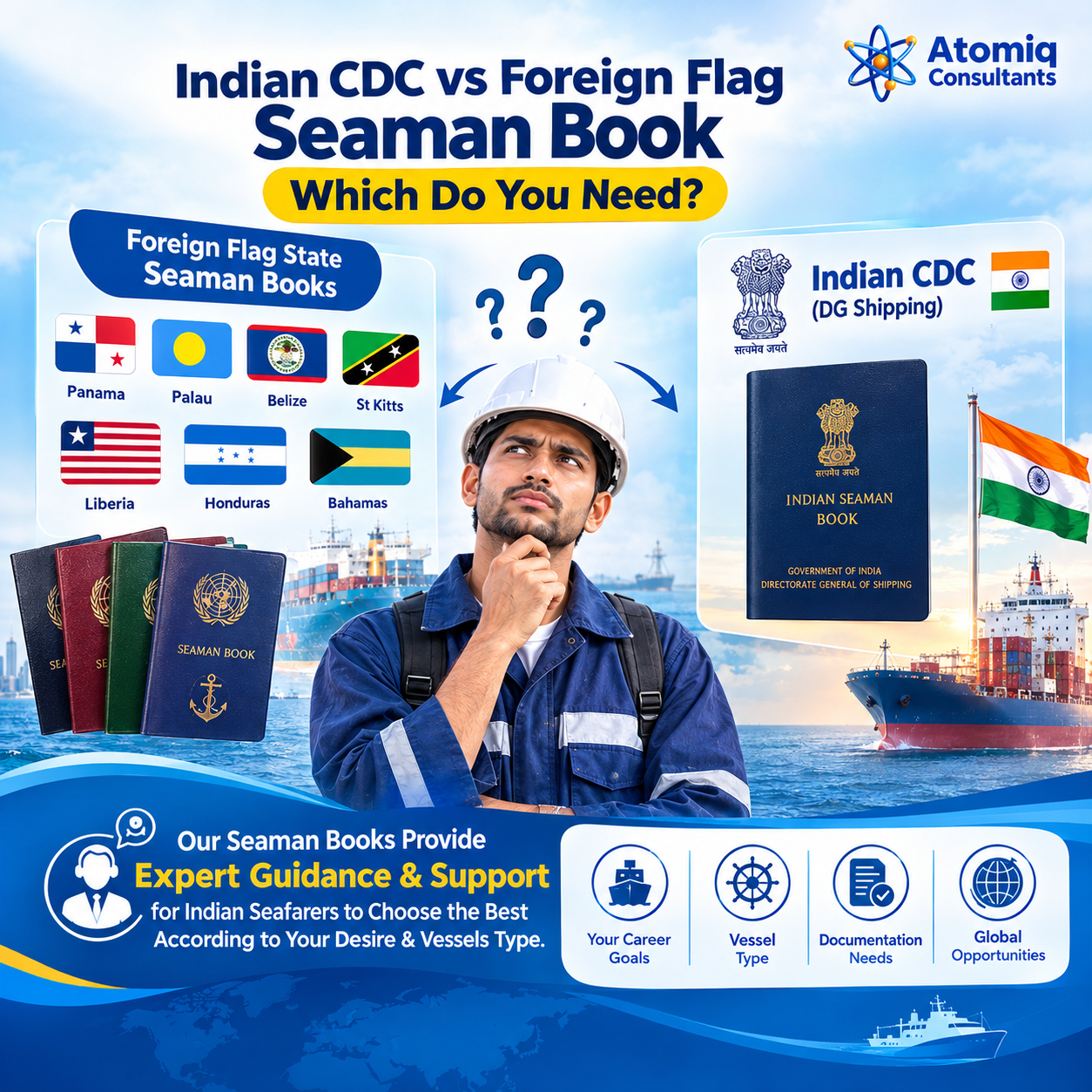
- You can hold a flag state book without living in that country. Open registries such as Panama, Palau, Belize, St. Kitts & Nevis, Honduras, the Bahamas and Liberia issue to seafarers of any nationality through authorized agents.
For the full background on what the document is and who issues it, read our pillar guide: What is a seaman book and why every seafarer needs one.
The four documents every cruise crew member needs
Manning agents for the major lines work from a standard checklist. Miss one item and your file sits unprocessed.
1. Seaman book (CDC / SIRB)
Your record of identity and sea service. Every contract you complete is endorsed in it — sign-on date, sign-off date, vessel, rank. Over a career it becomes the evidence you use to prove sea time for promotion, and the document port authorities check at shore leave.
Seafarer identity documents sit under the ILO’s Convention No. 108 (1958) and its modern replacement Convention No. 185 (2003), which introduced a biometric standard. Not every flag state has ratified C185, which is one reason acceptance varies by registry — and one reason your choice of flag matters.
2. STCW basic safety training
Mandatory before you set foot on a cruise ship. The core package sits under STCW Code Table A-VI/1 and covers four elements:
Module | STCW reference | What it covers |
Personal Survival Techniques | A-VI/1-1 | Abandon ship, liferaft entry, survival in water |
Fire Prevention & Fire Fighting | A-VI/1-2 | Extinguisher use, breathing apparatus, fire parties |
Elementary First Aid | A-VI/1-3 | Casualty handling, CPR, shock, burns |
Personal Safety & Social Responsibility | A-VI/1-4 | Shipboard emergency procedures, working practices, living onboard |
Most operators also require Security Awareness (STCW Regulation VI/6) under the ISPS Code before you join.
The 2010 Manila amendments, in force since 1 January 2012, added a refresher requirement every five years for survival and firefighting competences. Plan for it: an expired refresher blocks a contract just as effectively as no certificate at all. Our STCW certification guide covers the full module list and course formats.
3. Seafarer medical certificate
Issued by an approved maritime doctor to the standard in STCW Regulation I/9, and reinforced by the Maritime Labor Convention, 2006. As a general rule the certificate runs to a maximum of two years (one year for seafarers under 18), with color vision assessed on a longer cycle.
Cruise-specific point: hotel and galley departments are usually food handlers, so many lines add a food-handler medical screening on top of the standard seafarer examination. Ask your agency which panel they use before you book, so you don’t pay twice.
4. Visas — and the C-1/D in particular
If your itinerary touches a US port, you will need a US C-1/D crewmember visa. It is the single most common cause of a delayed cruise join date, because appointment availability — not processing — is the bottleneck. Start it the day you have a conditional offer.
Depending on the itinerary and your nationality, you may also need a Schengen crew visa, a UK transit visa, or a Caribbean-region entry permit. Your manning agency confirms which apply to the specific ship.
STCW for cruise ships isn’t the same as STCW for cargo ships
This is the part general guides skip, and it matters more than anything else on this page.
Because a cruise ship carries thousands of passengers who are not trained in emergency procedures, STCW Regulation V/2 adds passenger-ship-specific training on top of basic safety training. Depending on your role, that includes:
- Crowd management training — directing hundreds of passengers to muster stations under pressure
- Safety training for personnel providing direct service to passengers in passenger spaces — the requirement that catches waiters, bar staff, retail and spa teams
- Crisis management and human behavior training — how people actually react in an emergency, and how to work with that rather than against it
- Passenger safety, cargo safety and hull integrity training — for personnel with assigned muster-list responsibilities
In practice, most cruise lines deliver V/2 training themselves during onboarding or at their own training academy, because it has to reflect that specific vessel’s muster arrangements. You are not usually expected to arrive holding it.
What you are expected to arrive holding is the A-VI/1 basic package, your seaman book and your medical. Knowing the difference stops you from paying an outside training center for a course your employer would have given you free.
Quick rule: Basic safety training is your responsibility before you join. Passenger-ship training under V/2 is usually the cruise line’s responsibility after you join. Confirm with your manning agent in writing.
Which flag state seaman book is best for cruise staff?
There is no single right answer — there is a right answer for your nationality, budget and join date. Here is how the main open registries compare for cruise applicants.
Flag state | Why cruise staff choose it | Watch out for |
Panama | The world’s largest ship registry and the most widely recognised open-registry book. The safest default if you don’t yet know which ship you’ll join. | Most in demand, so agent quality varies widely. |
Bahamas | A major cruise flag in its own right — a natural fit if your target ship is Bahamas-registered. | Requirements can be stricter than smaller registries. |
Palau | Straightforward process, popular with first-time and entry-level crew. | Narrower acceptance than Panama at some operators. |
Belize | Cost-effective route into a first book with no sea service. | Verify operator acceptance before you commit. |
St. Kitts & Nevis | Practical alternative when other registries are backlogged. | Smaller registry footprint. |
Honduras | Budget option for entry-level applicants. | Acceptance varies most of the group — check first. |
Liberia | Large, well-established registry with strong international standing. | Documentation requirements are more demanding. |
Two rules cut through the comparison:
- If you already have a conditional offer, ask the manning agent which flags they accept and get the answer in writing. Their list beats any general ranking, including this one.
- If you’re applying speculatively, choose the widest-accepted book you can afford. A cheaper book that a recruiter rejects costs you the contract, not just the fee.
Full side-by-side detail: Flag state seaman book comparison — cost, time and acceptance.
The order to do things in
Getting the sequence right is worth more than getting any single step right.
- Apply for your seaman book first. It has the longest lead time and no prerequisites. You do not need a job offer or sea service to start — see how to get a CDC without sailing experience.
- Book STCW basic safety training in parallel. Courses run on fixed calendars and fill up. Don’t wait for the book to arrive.
- Take your seafarer medical. Do it after you’ve committed, not before — the clock on a two-year certificate starts the day it’s issued.
- Start the visa the moment you have a conditional offer. Especially the C-1/D.
- Send the complete file to your agency in one submission. Partial files go to the bottom of the queue.

Why cruise applications get rejected
The rejections we see most often are administrative, not disqualifying — which means they are preventable.
- Name mismatch. Your passport says one thing, your certificate says another. Every document must match your passport exactly, including middle names and spelling.
- Passport validity too short. Most operators want at least six months’ validity beyond the contract end date, and many want blank visa pages.
- Photo specification failures. Wrong background, wrong dimensions, glasses or headwear that obscure features.
- Expired STCW refresher. The certificate exists, but the five-year refresher lapsed.
- A book from an unrecognised issuer. The most expensive mistake. If a “registry” cannot be verified against the flag state administration, it is not a seaman book — see how to spot fake maritime document services.
What it costs and how long it takes
Costs depend on the flag state, and any provider quoting one universal price for every registry is quoting badly. As a general guide, Seamanbooks.com publishes government fees in the range of USD 100–300 depending on registry, with agent service fees quoted separately.
On timing: digital certificates are typically issued within 24–48 hours, while physical books generally take 10–30 working days depending on the flag state. Build the longer figure into your planning, then treat anything faster as a bonus.
Add STCW basic safety training (typically a five-day residential course, priced by the training centre) and your seafarer medical, and you have the full cost picture.
Frequently asked questions
Do I need a seaman book if I work in a cruise ship restaurant?
Yes. Restaurant, bar, galley and retail personnel are all signed onto the crew list and are classed as seafarers under international maritime law. The seaman book requirement applies to every department onboard, not only to deck and engine.
Can I get a seaman book before I have a cruise job offer?
Yes, and you generally should. A seaman book has no sea-service prerequisite, so you can apply as soon as you decide to pursue a cruise career. Arriving at an interview with the document already in hand puts you ahead of applicants who still have to obtain one.
How long is a seaman book valid?
Validity depends on the issuing flag state, with most registries issuing for a fixed multi-year term and renewal available before expiry. Check the expiry date printed in your book and start renewal early — an expired book prevents you from signing on to a new contract.
Does STCW training expire?
Survival and firefighting competences require refresher training every five years under the STCW Manila amendments, in force since 2012. Other modules follow their own cycles. Cruise operators check refresher dates before every contract, so keep them current.
Is a superyacht seaman book different from a cruise ship one?
The document is the same — a flag state seaman book — but yacht crew often face different flag preferences and additional role-specific certification. superyacht crew documentation guide, D14]
Getting started
Being classed as a seafarer isn’t an obstacle to a cruise career. It’s what makes the career portable — the same book, the same STCW certificates and the same medical work across every operator and every flag in the world.
The one thing you control is timing. Cruise contracts are offered on short notice, and the applicant with a complete file joins the ship. Start your seaman book now, and be ready when the offer comes.
Seamanbooks.com, managed by Atomiq Group, processes flag state seaman books for Panama, Palau, Bahamas, Belize, St. Kitts & Nevis, Honduras and Liberia, and coordinates STCW certification for crew of every nationality.