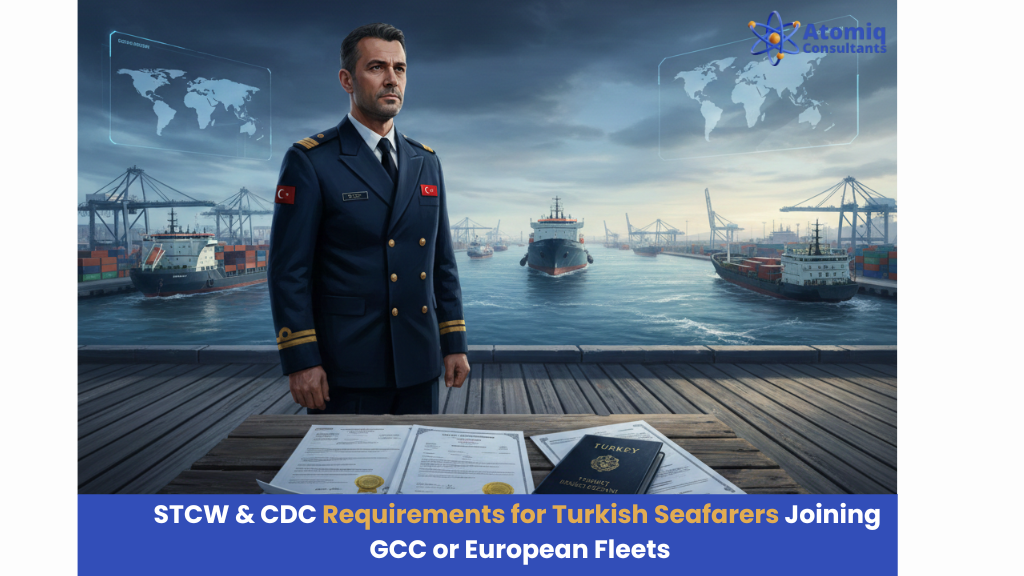
Turkish seafarers who want to work on GCC or European fleets must align their CDC, STCW, and supporting documents with both Turkish maritime rules and foreign-flag/port requirements. This blog content positions Atomiq Group as the bridge between Turkish mariners and compliant international employment.
1. Understanding CDC & STCW for Turkish Seafarers
In Turkey, the national seaman book/CDC is issued under the Ministry of Transport and Infrastructure through local port authorities, and it records identity, rank, and every sea-service period. To receive or renew it, seafarers must hold a valid passport, complete mandatory STCW basic training, and meet national medical fitness standards. For work on foreign-flag ships, Turkish STCW certificates can be recognized under bilateral protocols, giving access to fleets from dozens of flag states that have agreements with Turkey.
2. Working on GCC & European Fleets
GCC operators and European shipowners require that CDC, STCW, and medical documents be fully compliant with IMO and flag-state rules, not just local port expectations. Turkish seafarers may join ships flying flags like Panama, Liberia, or EU registers, where the flag administration verifies STCW authenticity and recognition before endorsing or accepting the certificates. Atomiq Group focuses on matching each seafarer’s profile with a suitable flag strategy so documents are accepted smoothly in Gulf ports, EU ports, and major offshore hubs.
3. Core Documents Turkish Seafarers Usually Need
When joining a GCC or European fleet, Turkish seafarers are typically expected to have:
- Valid Turkish passport and national ID.
- Turkish CDC/seaman book with updated sea-service entries, or proof that a CDC application is in process.
- STCW basic safety courses and any role-specific endorsements (tankers, DP, security, etc.).
- Flag-compliant medical fitness certificate (often following ILO/MLC or specific flag guidelines).
- Contracts, experience letters, and sea-service testimonials that support rank and watchkeeping duties.
Atomiq Group helps seafarers organize and cross-check these documents against specific fleet or flag requirements before any deployment.
4. How Atomiq Group Supports Turkish Seafarers
Atomiq Group’s seafarer documentation team works with Turkish and regional clients to:
- Explain which Turkish CDC and STCW combinations are acceptable to particular GCC and European flags, based on existing recognition protocols.
- Arrange or advise on fast-track international seaman books and flag endorsements (e.g., Panama or other open registries) where appropriate for the employer or vessel.
- Pre-screen files to reduce flag queries, certificate rejections, or onboarding delays at shipyards, terminals, and offshore bases.
This end-to-end guidance means Turkish seafarers can focus on contracts and career planning instead of navigating complex paperwork alone.
5. Joining Ship Abroad: Practical Checklist
For Turkish seafarers flying from Istanbul, Izmir, or other hubs to join a ship abroad, a clear document checklist is critical. Atomiq Group advises carrying:
- Original passport, CDC, and STCW certificates, plus spare copies.
- Original medical certificate, employment contract, and joining instructions.
- Flag endorsements or international seaman book (if required by the company), plus any visa or entry permit issued by the destination state.
The team can review scanned copies before travel, flag missing items, and coordinate with crewing or flag administrations to minimize last-minute issues at immigration or port-state checks.
6. When You Might Need an Additional International Seaman Book
Some Turkish seafarers choose to hold both their Turkish CDC and an international seaman book from an IMO-recognized open registry to increase flexibility. This can be useful for mixed careers that include offshore projects, yacht work, or frequent contract changes with different shipmanagers operating under multiple flags. Atomiq Group evaluates whether this added document will genuinely help for a seafarer’s target GCC or European employers before proceeding, so investments are aligned with real job opportunities.
7. Key Benefits of Using Atomiq Group
For Turkish seafarers, the main advantages include
- Clear explanation of how the Turkish CDC and STCW are viewed by foreign flags and port authorities.
- Reduced risk of rejection due to incomplete files, expired courses, or non-aligned medicals.
- A single point of contact for CDC support, STCW guidance, and international seaman book or flag endorsements connected to real vacancies in GCC or European fleets.
Frequently Asked Questions
- Can Turkish seafarers work on foreign-flag ships with a Turkish CDC?
Yes. Turkish seafarers can serve on foreign-flag vessels as long as their CDC, STCW certificates, and medicals are valid and recognized by the flag administration under existing protocols or endorsement rules. In practice, many flags will endorse Turkish STCW certificates so they can legally accept Turkish crew on GCC and European routes. - Do Turkish STCW certificates need a separate endorsement for GCC or EU flags?
Often, yes. When you join a foreign-flag vessel, the flag state may issue an endorsement confirming that your Turkish STCW certificate is recognized for service on that registry. Atomiq Group helps identify which endorsements are required for specific GCC or European flags and supports the documentation process. - Is a Turkish CDC enough to join GCC offshore or tanker fleets?
A Turkish CDC is a key identity and service record, but most GCC operators also require valid STCW courses, a compliant medical certificate, and, in some cases, a flag-state endorsement or international seaman book. Atomiq Group reviews employer requirements and advises if an additional flag document is needed for your target vessel or project. - What happens if my CDC or STCW has expired before a GCC or European contract?
Sailing or attempting to join with expired CDC or STCW can lead to contract cancellation, port-state issues, or insurance problems. Atomiq Group assists Turkish seafarers in planning renewals or replacement routes so documents are updated before travel or crew change. - Can I keep my Turkish CDC and also get an international seaman book?
Yes. Many Turkish seafarers keep their national CDC and add an international seaman book from an IMO-recognized open registry to increase job flexibility. Atomiq Group evaluates whether this dual setup will actually help with your GCC or European employers before starting any additional application.
