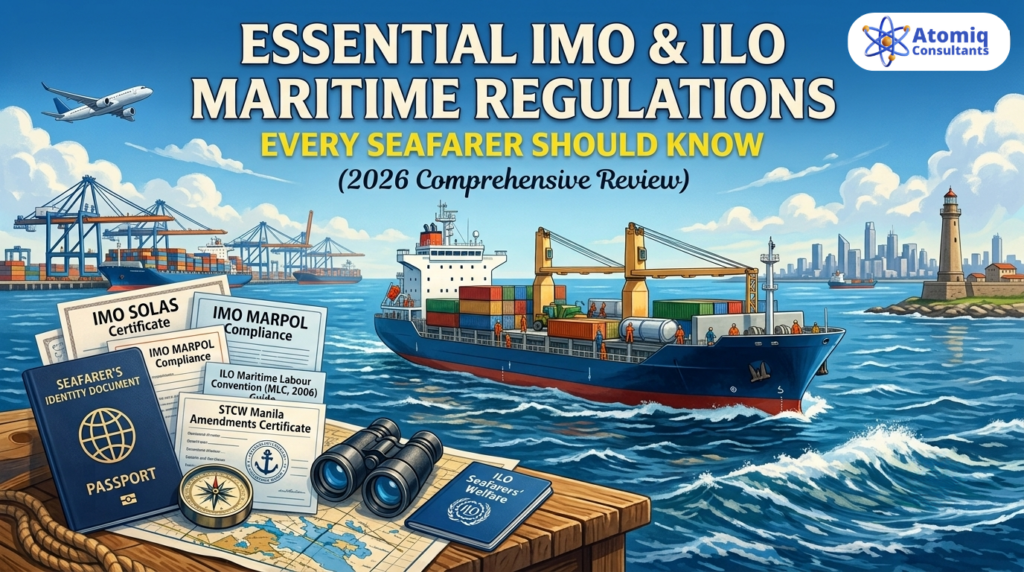
IMO and ILO Maritime Regulations All Seafarer Should Know

IMO and ILO Maritime Regulations All Seafarer Should Know

IMO and ILO maritime regulations seafarer rights form the two legal pillars that govern every merchant vessel at sea. The IMO sets safety and pollution standards, while the ILO protects seafarer working conditions. Together they define how every crew member trains, works, and lives on board.

Whether you sail under a Panama, Bahamas, or Palau flag, or you are hired through crewing hubs in Dubai, Mumbai, Doha, Manama, Dammam, or Europe, these frameworks decide your certification, contract, and safety. Here is a clear, human breakdown of the IMO ILO regulations for seafarers explained without the legal jargon.

What is Inside IMO and ILO maritime regulations

What Is the IMO and Why It Matters to Seafarers

The International Maritime Organization (IMO) is the United Nations agency, with 176 member states, responsible for the safety, security, and environmental performance of international shipping. It creates the conventions that flag states like Panama, Liberia, and the Marshall Islands enforce on board.

For a working seafarer, the IMO is not abstract policy. It is the reason your fire drills, lifeboat musters, and oil-record books exist. Three IMO conventions shape daily shipboard life more than any other, and knowing them is essential for any certified crew member.

SOLAS – Safety of Life at Sea

SOLAS is the most important safety treaty in maritime history, first adopted in 1914 after the Titanic disaster and updated continuously since. It sets minimum standards for construction, life-saving appliances, fire protection, and navigation equipment on every commercial ship.

Under SOLAS, your vessel must carry certified lifeboats, EPIRBs, and SOLAS-approved firefighting gear. Seafarers must know muster stations, abandon-ship procedures, and how to operate life-saving equipment during real emergencies, not just inspections.

MARPOL – Marine Pollution Prevention

MARPOL is the IMO convention that prevents pollution of the sea by oil, chemicals, sewage, garbage, and air emissions from ships. Its six annexes govern everything from oily-water separators to sulphur limits in fuel.

Every seafarer contributes to MARPOL compliance by maintaining accurate Oil Record Books, garbage management plans, and following the 2020 global 0.50% sulphur cap. Violations lead to heavy fines and detention in Port State Control ports across the EU, the Gulf, and Asia.

STCW – Training and Certification

The STCW Convention sets the international standards of training, certification, and watchkeeping that every seafarer must meet to work legally at sea. It is the reason your certificates are recognised in the UAE, India, Qatar, Saudi Arabia, and across Europe.

No seafarer can join a SOLAS vessel without valid STCW basic safety training and rank-specific competency certificates. To understand your required courses and revalidation timelines, review our full guide to STCW certifications.
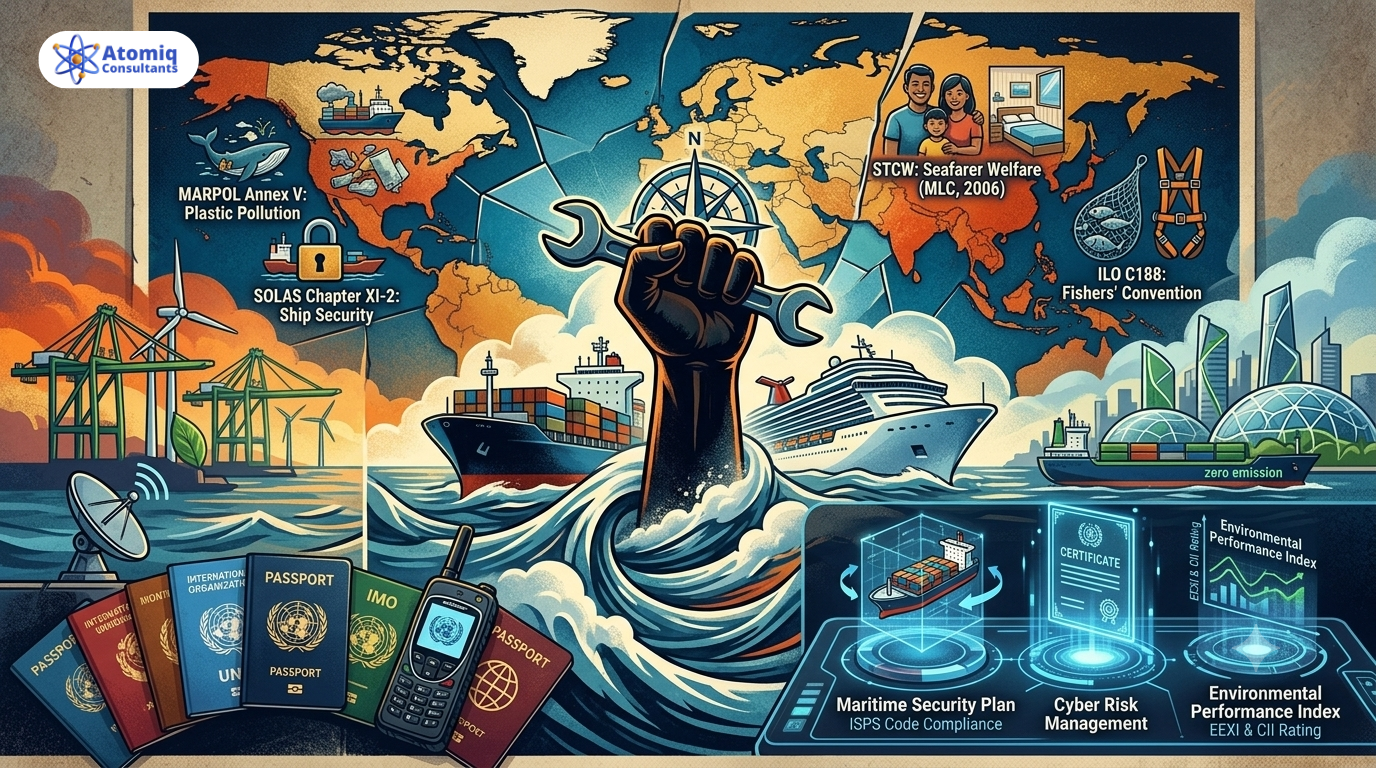
IMO and ILO Maritime Regulations 2026 Every Seafarer Should Know

What Is the ILO and How It Protects Seafarer Rights

The International Labour Organization (ILO) is the UN agency that sets global labour standards, and its Maritime Labour Convention (MLC 2006) is known as the “seafarers’ bill of rights.” It guarantees fair treatment, wages, and living conditions for over 1.5 million seafarers worldwide.

While the IMO protects the ship, the ILO protects the person. ILO seafarer rights are enforced through the MLC and inspected during Port State Control, giving crew clear, legally binding protections at sea and in port.

Core Protections Under MLC 2006

MLC 2006 guarantees written employment agreements, minimum rest hours, regular wage payment, medical care, decent accommodation, and repatriation rights for every seafarer. It applies to ships of 500 GT or more on international voyages.

Practical protections include a maximum of 14 hours of work in any 24-hour period, a valid Seafarer Employment Agreement (SEA), and a Maritime Labour Certificate on board. If you are abandoned or unpaid, MLC financial-security rules require insurers to cover your repatriation and outstanding wages.

Why These Regulations Matter for Your Career

Understanding IMO and ILO regulations directly increases your employability and safety across every major hiring market. Compliant, well-documented seafarers are prioritised by shipowners and manning agencies in the Gulf, India, Europe, and open-registry flag states.

Keeping your STCW certificates, seaman’s book, and MLC documentation current ensures you clear Port State Control, avoid contract disputes, and qualify for higher-paying international contracts.

Why Crewing Managers Across the Gulf Choose Atomiq Group for IMO-Compliant Documentation


Frequently Asked Questions

What is the difference between IMO and ILO regulations?
The IMO regulates ship safety, security, and pollution prevention, while the ILO regulates seafarer labour rights, wages, and living conditions. Both apply simultaneously on international vessels.

Which IMO conventions must every seafarer know? Every seafarer should know SOLAS for safety, MARPOL for pollution prevention, and STCW for training and certification, as these three govern daily shipboard operations.

Is MLC 2006 mandatory for all ships?
MLC 2006 is mandatory for most commercial ships of 500 GT or more on international voyages, and it is enforced through Port State Control inspections worldwide.

Dipak Paudel

Dipak Paudel — Maritime Documentation & Digital Content Expert Dipak Paudel is an Author, Digital Content Writer, and Maritime Documentation Expert specializing in Crew Documentation, Continuous Discharge Certificates (CDC), Flag State Administration, maritime services, and client service operations. Since 2021, he has been creating and managing professional maritime content and supporting information-driven services for seafarers, ship-management professionals, maritime businesses, and international clients. His areas of expertise include CDC and crew documentation, seafarer documentation requirements, flag-state procedures, maritime administration, vessel and crew compliance processes, maritime service information, and client support. Dipak combines practical knowledge of maritime documentation with digital content expertise to make complex maritime procedures easier to understand. His work focuses on producing accurate, useful, accessible, and search-friendly maritime information for audiences navigating documentation, compliance, and administrative requirements. Areas of Expertise Maritime documentation and administration Crew documentation and seafarer records Continuous Discharge Certificate (CDC) information Flag State Administration and procedures Seafarer documentation requirements Maritime compliance and administrative processes Maritime services and client support Digital content writing and editing SEO content strategy Answer Engine Optimization (AEO) Geographic/Generative Engine Optimization (GEO) Maritime industry research and information publishing Client service and communication Professional Focus Since 2021, Dipak Paudel has focused on bridging the gap between maritime services and accessible digital information. His content is designed to help seafarers, maritime professionals, shipowners, ship managers, recruitment agencies, and other industry stakeholders better understand documentation and administrative processes. His writing approach emphasizes clarity, practical explanations, structured information, and user-focused answers. Where maritime requirements vary by country, flag administration, or authority, his content aims to clearly identify the relevant jurisdiction and documentation context. Maritime Documentation Expertise Dipak's specialist content covers topics related to crew documentation, CDC requirements, seafarer certificates, flag-state administration, maritime applications, documentation procedures, and related maritime services. He writes explanatory content addressing questions such as: What is a Continuous Discharge Certificate (CDC)? What documents are required for seafarers? How does the CDC application process work? What are common crew-documentation requirements? How do flag-state requirements affect seafarers and vessels? What maritime documents need to be maintained or renewed? How can seafarers understand maritime administrative procedures? What should clients know before using a maritime documentation service? Geographic and International Focus Dipak's maritime content is intended for an international audience, with particular relevance to seafarers and maritime clients dealing with documentation and administration across different jurisdictions. His work can address country- and region-specific maritime requirements, including South Asia, the Middle East, Europe, the United Kingdom, and other major maritime jurisdictions, while recognizing that official requirements can differ between flag states, maritime authorities, and regulatory bodies. For jurisdiction-specific information, readers should always verify current requirements with the relevant maritime authority, flag administration, embassy, port authority, or other official source. Who Can Benefit From His Content? Dipak's content is particularly useful for: Seafarers and crew members Merchant navy professionals Shipowners and ship managers Crewing and recruitment agencies Maritime documentation service providers Vessel operators Maritime consultants International maritime clients Individuals researching CDC and crew-documentation requirements Author's Editorial Approach Dipak believes maritime information should be clear, practical, and easy to understand. His articles are structured around real user questions and common documentation challenges, helping readers quickly identify relevant procedures, documents, terminology, and next steps. His digital publishing approach incorporates SEO, AEO, and GEO principles, including question-based content, concise answers, structured headings, relevant maritime terminology, geographic context, and information designed to be discoverable through traditional search engines and modern AI-powered search systems. Author Profile Name: Dipak Paudel Profession: Author & Digital Content Writer Specialization: Maritime Documentation, Crew Documentation, CDC, Flag State Administration & Maritime Services Additional Expertise: Client Service, SEO Content, AEO & GEO Content Strategy Experience: Since 2021 Industry: Maritime / Shipping / Seafarer Services Audience: Seafarers, maritime professionals, ship-management organizations, maritime businesses, and international clients

Leave a Reply