BOSIET vs HUET course both are gold-standard OPITO-approved offshore safety courses, they serve entirely different career paths. BOSIET/HUET are governed by OPITO (Offshore Petroleum Industry Training Organisation) and are universally mandated for energy sector installations. Traditional maritime crew and ship-board deckhands fall under STCW (Standards of Training, Certification, and Watchkeeping) governed by the IMO (International Maritime Organization).
BOSIET is a full 3-day offshore safety induction that includes HUET; HUET is a standalone 1-day helicopter escape module. New offshore seamen need BOSIET for first-time deployment, while HUET alone suits crew who transfer by helicopter but already hold base safety credentials.
If you’re comparing the two before applying for offshore jobs, this guide breaks down the difference between BOSIET and HUET offshore certification — scope, cost, validity, and which one recruiters actually ask for.
What Is BOSIET?
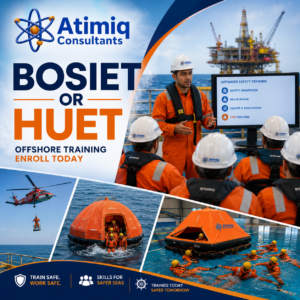
BOSIET (Basic Offshore Safety Induction and Emergency Training) is the OPITO-approved entry certificate required before any first offshore deployment on oil, gas, or energy installations. It runs 3 days and covers four modules: safety induction, sea survival and first aid, firefighting and self-rescue, and HUET with Emergency Breathing System (EBS) training.
Key facts:
- Standard: OPITO code 5700 (with EBS) / 5750 (tropical, no EBS)
- Duration: 3 days (approx. 22–24 training hours)
- Validity: 4 years — renewed via FOET (Further Offshore Emergency Training), a 1-day refresher
- Typical cost: USD 700–1,400 depending on country and training center
- Recognized in: UK North Sea, Norway (with escape-chute add-on), Middle East, Asia-Pacific, West Africa
What Is HUET?
HUET (Helicopter Underwater Escape Training) is a 1-day standalone course teaching controlled escape from a submerged, capsized helicopter simulator. It exists because roughly 60–80% of offshore crew transfers happen by helicopter, and ditching survival depends almost entirely on trained escape response.
Key facts:
- Standard: OPITO 5095 or company/national equivalents (e.g., THUET for tropical regions)
- Duration: 1 day (6–8 hours), typically 4+ simulator submersions including inverted escape
- Validity: Commonly 4 years (some operators require 2-year refreshers)
- Typical cost: USD 250–500
- Who needs it standalone: Merchant seamen, wind-farm technicians, medics, caterers, and inspectors who fly offshore but whose employer doesn’t mandate full BOSIET
BOSIET vs HUET: Side-by-Side Comparison
|
Factor |
BOSIET |
HUET |
|
Scope |
Full offshore safety induction (4 modules) |
Helicopter escape only |
|
Includes the other? |
✅ Includes HUET |
❌ Does not include BOSIET |
|
Duration |
3 days |
1 day |
|
Validity |
4 years (renew via FOET) |
4 years (operator-dependent) |
|
Cost range |
$700–1,400 |
$250–500 |
|
Best for |
First-time rig/platform crew |
Helicopter-transferred support crew |
|
Governing body |
OPITO |
OPITO / national bodies |
Which Course Do You Need for Offshore Seaman Jobs BOSIET vs HUET?

Choose BOSIET if you’re entering the offshore oil and gas industry for the first time — it’s the minimum hiring requirement for rigs, platforms, FPSOs, and drillships worldwide. Choose standalone HUET only when a specific employer or offshore wind project requires helicopter-escape competency without the full induction.
Quick decision guide:
- Drilling rigs, platforms, FPSOs: BOSIET (mandatory)
- Offshore wind farms: Often GWO Basic Safety Training + HUET
- Vessel crew flying to offshore assets occasionally: HUET (check charterer requirements)
- North Sea (UK/Norway): BOSIET with EBS/CA-EBS; Norway requires an escape-chute module
- Gulf of Mexico: T-BOSIET or T-HUET (tropical variants, no cold-water EBS)
Important: you cannot substitute HUET for BOSIET. Recruiters filtering CVs for offshore seaman roles search for “BOSIET” as a keyword — holding only HUET will exclude you from most oil and gas vacancies. Alongside these, most offshore seaman positions also require a valid OGUK/OEUK medical certificate and, for vessel-based roles, STCW basic safety training.
Ready to get certified? Browse accredited offshore seaman courses including BOSIET, HUET, FOET, and STCW packages with global training-center options.
Looking for OPITO-approved offshore training courses near you? Atomiq Group delivers globally recognized safety, survival, and technical certifications required for careers in the offshore oil and gas, maritime, and renewable energy sectors. Our comprehensive training portfolio includes BOSIET, HUET, and FOET certifications, alongside specialized technical training designed to meet rigorous STCW and international maritime standards. Whether you are mobilizing to a drillship, a floating production unit, or an offshore wind farm in UAE, Saudi Arabia, Europe, USA, India, Panama, Qatar, Australia Atomiq Group Seaman books provides the practical, hands-on survival skills necessary to secure your safety clearance and clear compliance checkpoints worldwide.
FAQ: BOSIET vs HUET Offshore Certification
Is HUET included in BOSIET?
Yes. HUET is one of the four mandatory modules inside the BOSIET syllabus. If you complete BOSIET, you do not need a separate HUET certificate — your BOSIET card covers helicopter escape competency for its full 4-year validity.
How long is BOSIET valid, and how do I renew it?
BOSIET is valid for 4 years and is renewed with the 1-day FOET refresher course. If your certificate expires before renewal, most training centers require you to retake the full 3-day BOSIET rather than the refresher.
Can I do BOSIET if I can’t swim?
Yes — swimming ability is not an OPITO entry requirement, though basic water confidence is strongly recommended. All pool exercises are conducted in lifejackets with instructors and divers present. You will, however, need a valid offshore medical (OGUK/OEUK) before enrolling.
Which is better for offshore wind jobs: BOSIET or GWO?
Offshore wind employers typically require GWO Basic Safety Training, adding HUET only if crew transfer is by helicopter. BOSIET remains the oil and gas standard; GWO + HUET is the wind-sector equivalent pathway.
How much does BOSIET cost compared to HUET?
BOSIET costs roughly $700–1,400 while standalone HUET costs $250–500, varying by country. Since BOSIET already includes HUET, first-time offshore workers get better value taking BOSIET directly rather than stacking both.