An OGUK medical certificate — now correctly called the OEUK offshore medical — is a fitness-to-work assessment carried out by a doctor on the Offshore Energies UK register before you go offshore. It is typically valid for up to two years, shorter for older workers and for managed conditions, and it is the standard used across the UK Continental Shelf. It is a health assessment, not a training certificate.
At a glance
|
What it is |
A medical fitness assessment against the OEUK Medical Guidelines |
|
Who sets the standard |
Offshore Energies UK (OEUK), formerly Oil & Gas UK |
|
Current edition |
OEUK Medical Guidelines Issue 8.2, August 2026 |
|
Who can issue it |
Only a doctor on the OEUK register — UK or overseas |
|
Typical validity |
Up to two years; shorter for older workers, managed conditions, or weight near the limit |
|
Where it is required |
The UK Continental Shelf as standard; elsewhere, where the operator specifies it |
|
What it is not |
Not BOSIET, not HUET, not STCW, not a seaman book, not a visa medical |
|
Change coming |
A 124 kg clothed weight limit becomes mandatory on 1 November 2026 |
Why there are two names for the same certificate
Oil & Gas UK, the trade association that owned the offshore medical standard, renamed itself Offshore Energies UK to reflect a membership that now spans wind and hydrogen as well as oil and gas. The medical standard travelled with the name.
In practice both names are still in circulation and both are correct in context. A certificate issued before the rename says OGUK. A certificate issued today says OEUK. Employers, agents and training centres use the two interchangeably, and search engines still see far more people looking for “OGUK medical” than “OEUK medical”.
If an operator asks you for an “OGUK medical” and your certificate says OEUK, you are holding the right document. The reverse is also true: a valid OGUK certificate issued before the rename does not stop being valid because the association changed its name. What matters is the issuing doctor’s registration and the expiry date, not the letterhead.
What the OEUK offshore medical actually assesses
The governing document is the OEUK Medical Guidelines, Issue 8.2, published August 2026. OEUK describes it as the official medical fitness framework for working offshore in the UK energy sector, and as the definitive standard for assessing medical fitness to work offshore across the UK continental shelf.
The guidelines cover medical examination requirements, fitness criteria, named medical conditions, employment-group considerations such as normally unmanned installations, and — the part most people miss — fitness-to-train assessments for offshore survival training. That last clause is why the medical has to come before your BOSIET or HUET booking rather than after it.
The underlying question the examiner is answering is narrower than a general health check. It is this: if this person is injured or falls ill 150 kilometres offshore, on an installation where evacuation takes hours and the nearest hospital is a helicopter flight away, can they be kept safe, and can they take part in an emergency evacuation without becoming a casualty themselves? OEUK requires its registered examiners to work to a risk-based approach rather than a pass/fail checklist, which is why two people with the same condition can receive different outcomes.
What the examination typically includes
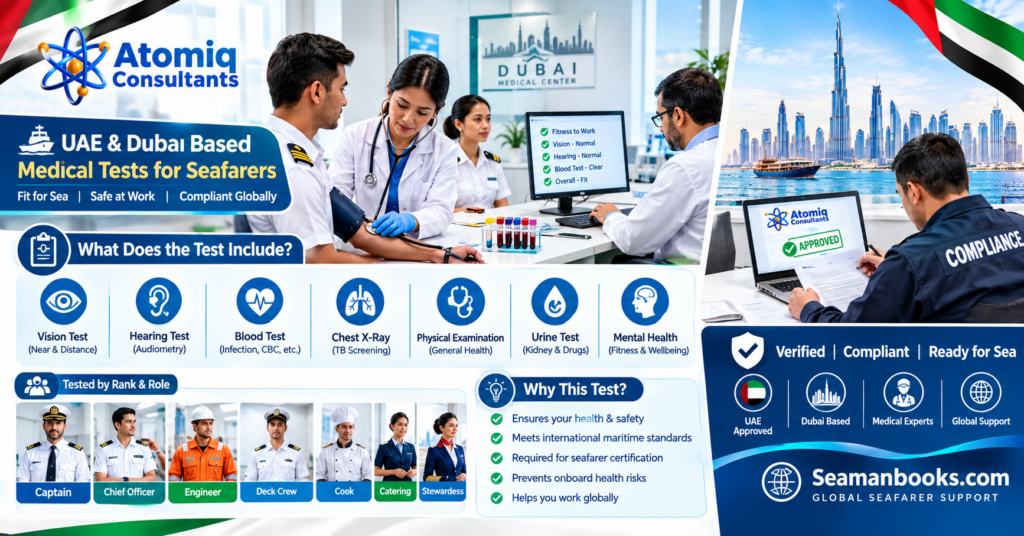
OEUK publishes the standard itself as a paid guideline, so the station-by-station content is not available to quote from a public source. What the UAE clinics on the OEUK overseas register publish for their own OGUK/OEUK appointments consistently includes:
- audiometry (hearing)
- urinalysis
- vision testing
- height and weight
- blood pressure and general physical examination
Treat that as an indication of what to expect, not as the standard.
If you do not meet the guidelines
The examiner is expected to explain the OEUK guidelines to you and the specific reason you do not meet them. If you believe your assessment was not handled in line with the guidelines, OEUK publishes a route: contact the OEUK Medical Adviser first, and if that does not resolve it, a further review may be implemented in which three other medical examiners review the documentation.
That route belongs to OEUK. No agent, employer or consultancy can overturn a medical outcome, and anyone who tells you otherwise is selling something that does not exist.
The 124 kg rule, and why it matters before 1 November 2026
This is the single most consequential change to the offshore medical in years, and most seafarers in the Gulf have not heard about it.
OEUK’s safe weight limit policy sets the clothed weight limit for offshore workers at 124 kg, including a 0.7 kg margin. “Clothed weight” means your weight dressed in the industry travel clothing for the relevant season, with shoes, measured at the heliport. The policy applies to all offshore installations operating under accepted Safety Cases as defined in the Offshore Installations (Offshore Safety Directive) (Safety Case etc.) Regulations 2015.
The rollout is phased:
|
Phase |
Dates |
What happens |
|
Awareness |
From 1 November 2025 |
Policy published; industry communication |
|
Transition |
To 31 October 2026 |
OEUK medical examiners issue reduced-duration certificates for individuals near or above 124 kg |
|
Mandatory |
From 1 November 2026 |
No certificate is issued to anyone exceeding 124 kg |
Two practical consequences, stated as of 15 September 2026:
- If you are near the limit and your medical is due, the certificate you are issued right now may be shorter than two years. That is the transition phase working as designed, not an error, and it will move your next renewal date forward.
- After 1 November 2026 there is no certificate at the other side of the limit. Not a shorter one, not a conditional one. That changes the medical from a formality into the item on your document list with the longest lead time, because weight is the only entry on it that cannot be fixed in a week.
If you are planning offshore work in the UK sector in 2027, this is the thing to deal with first.
Who needs one
|
Situation |
Do you need an OEUK offshore medical? |
|
Working on an installation on the UK Continental Shelf |
Yes. This is the standard the sector runs on. |
|
Booking BOSIET, HUET or FOET at an approved centre |
Usually yes — fitness to train is part of what the OEUK guidelines assess, and centres set entry conditions accordingly. Confirm which medical your centre accepts before you book. |
|
Working offshore in the UAE, Saudi Arabia, Qatar or Oman |
Depends on the operator. GCC operators typically require an operator-specified medical, frequently OEUK-equivalent, plus a separate country medical for the work visa. Get the requirement in writing before you pay for anything. |
|
Working on a merchant vessel under a foreign flag |
No. That is a flag-state seafarer medical — ENG1 or the flag’s equivalent — not an offshore medical. Different standard, different examiner, different certificate. |
|
Working in the US Gulf of Mexico |
No. US operators run operator and BSEE-driven medicals, usually paired with fitness-for-duty and substance screening. |
The distinction in rows four and five is where most of the money gets wasted. A seafarer medical and an offshore medical are not interchangeable, and neither one substitutes for the other. If you hold an ENG1 and the operator asked for OEUK, you do not hold what they asked for.
Where to get one in the UAE and the wider Gulf
OEUK maintains two registers of examining doctors: a UK register and an overseas register. The overseas register is searchable by country and city, and it lists doctors in more than ninety locations — including the United Arab Emirates, the Kingdom of Saudi Arabia, Qatar, Kuwait, Bahrain and the Sultanate of Oman, as well as India, the Philippines and Malaysia.
This matters for anyone crewing out of Dubai: you do not need to fly to Aberdeen for an OEUK medical. What you do need is a doctor who is actually on the register, at the location printed on your certificate.
To be on the OEUK register, a doctor is expected to have knowledge of the offshore or a similar remote working environment, knowledge of occupational medicine, access to appropriate examination facilities, and to have completed a one-day training programme in offshore medical assessment.
How to check that a certificate is genuine
This is worth knowing whether you are a seafarer holding a certificate or a crewing manager accepting one. OEUK publishes the procedure, and it is two steps:
- Check that the doctor is on the OEUK list.
- Check that the doctor is on the list at the clinic, facility, location or provider given on the certificate.
If the register does not confirm both, OEUK directs you to contact them, as they can confirm whether a doctor has moved, retired or left the list since the certificate was issued. OEUK is explicit on the point: no other verification check should be regarded as authoritative.
A certificate from a doctor who is not on the register is not a cheaper version of the same document. It is not the document. In a category where document fraud is common enough to have its own vocabulary, the two-step check takes a minute and is worth doing on every certificate that crosses your desk.
Where the medical sits in the order of getting certified
The medical is not the biggest item on an offshore worker’s document list, but it is the one that gates the others, and the sequence catches people out:
- Offshore medical first. It is comparatively inexpensive, and it is the only item on the list that can fail you outright. Book a survival course before the medical and you risk paying for a seat you cannot take.
- Survival training next — BOSIET, FOET or HUET at an approved centre, with the variant matched to the scope you are being hired into.
- STCW certification where the role sits on the marine side — see STCW certifications.
- Flag-state documentation — a seaman book / CDC where the vessel or installation is registered under a flag that requires one.
- Country documents — visa, work permit, and the country medical that goes with them. These are separate from the offshore medical and are not a substitute for it.
The full picture, layer by layer, is in our offshore oil and gas certifications guide. If you are already working in the Gulf, the three documents every offshore worker in the GCC must carry covers the paperwork side of the same sequence.
Frequently asked questions
What is an OGUK certificate and what is it used for?
It is a certificate confirming you have been assessed as medically fit to work offshore, issued by a doctor on the Offshore Energies UK register. Operators on the UK Continental Shelf use it as a condition of going offshore, and approved training centres use it to confirm you are fit to take survival training.
What is the full form of OGUK?
Oil & Gas UK — the former name of the trade association that owns the offshore medical standard. It is now Offshore Energies UK (OEUK), and the certificate is correctly called the OEUK offshore medical. Both names refer to the same assessment.
How long is an OGUK / OEUK medical certificate valid?
Typically up to two years. It can be shorter for older workers, for workers with managed medical conditions, and — during the current transition phase — for anyone near or above the 124 kg clothed weight limit. Your certificate states its own expiry date; that date is the one that counts.
What medical do I need to work offshore?
It depends on the sector and the operator. UK Continental Shelf work runs on the OEUK medical. Merchant shipping runs on a flag-state seafarer medical such as ENG1. GCC offshore work usually runs on an operator-specified medical, frequently OEUK-equivalent, plus a country medical for the visa. Ask the operator for the requirement in writing before you book anything.
Can I get an OGUK medical in Dubai?
Yes. OEUK maintains an overseas register of examining doctors searchable by country and city, and the United Arab Emirates is one of the listed locations, along with Saudi Arabia, Qatar, Kuwait, Bahrain and Oman. Check the doctor against the register before the appointment, not after.
Is an OGUK medical the same as an ENG1?
No. The ENG1 is a seafarer medical for merchant shipping under the UK flag; the OEUK medical is an offshore worker medical for the UK Continental Shelf. Different standards and different examiner registers. Holding one does not satisfy a request for the other.
Do I need an offshore medical before BOSIET or HUET?
Usually yes. Fitness to train for offshore survival training is within the scope of the OEUK Medical Guidelines, and approved centres set their entry conditions accordingly. Confirm with the centre which medical it accepts before you pay for a seat.
What happens if I fail the offshore medical?
The examiner is expected to explain the OEUK guidelines and the specific reason you do not meet them. If you believe the assessment was not handled in line with the guidelines, you can contact the OEUK Medical Adviser, and a further review by three other medical examiners may follow. No employer, agent or consultancy can change a medical outcome.
Does Seaman Books carry out offshore medicals?
No. We are a maritime documentation consultancy. The medical is carried out by a doctor on the OEUK register — use OEUK’s own register to find one. What we handle is everything the medical sits alongside: flag-state seaman books and CDCs, STCW certification, and enrolment for BOSIET, HUET and FOET at approved centres.
We coordinate medical appointments with a registered UAE clinic, so the clinic-specific examination process, appointment requirements, and applicable medical documentation should be confirmed directly with the clinic before presenting this information as current or authoritative.
Next step
If the medical is on your list because a contract is coming, it is rarely the only item on that list. Send us your rank, the flag or operator you are joining, and the expiry dates on your existing certificates, and we will tell you what else needs doing and in what order — before you spend anything.
WhatsApp: +971 55 458 3416 · dubai@seamanbooks.com · #903 Regal Tower, Business Bay, Dubai