Before you can sign on to any commercial vessel, you need a seaman’s book — and knowing the seaman book requirements for new applicants is the first real step in your maritime career. A seaman’s book (also called a Seafarer’s Identification and Record Book, SIRB, or Continuous Discharge Certificate, CDC) is the official document that proves you are a registered seafarer and records every voyage you complete. This quick guide covers what the document is, the Seaman book requirements you’ll need to prepare, and how to apply.
What Is a Seaman’s Book?
A seaman’s book is an official government-issued record book that identifies you as a seafarer and logs your sea service — the vessels you join, your rank, and the dates of each voyage. Shipping companies, manning agencies, and immigration officers use it to verify your employment history at sea. It works alongside your passport; it does not replace it.
Each maritime country issues its own version through its maritime administration — for example, the SIRB from MARINA in the Philippines, the CDC from the Directorate General of Shipping in India, and the Discharge Book from the MCA in the UK.
Seaman Book Requirements for New Applicants
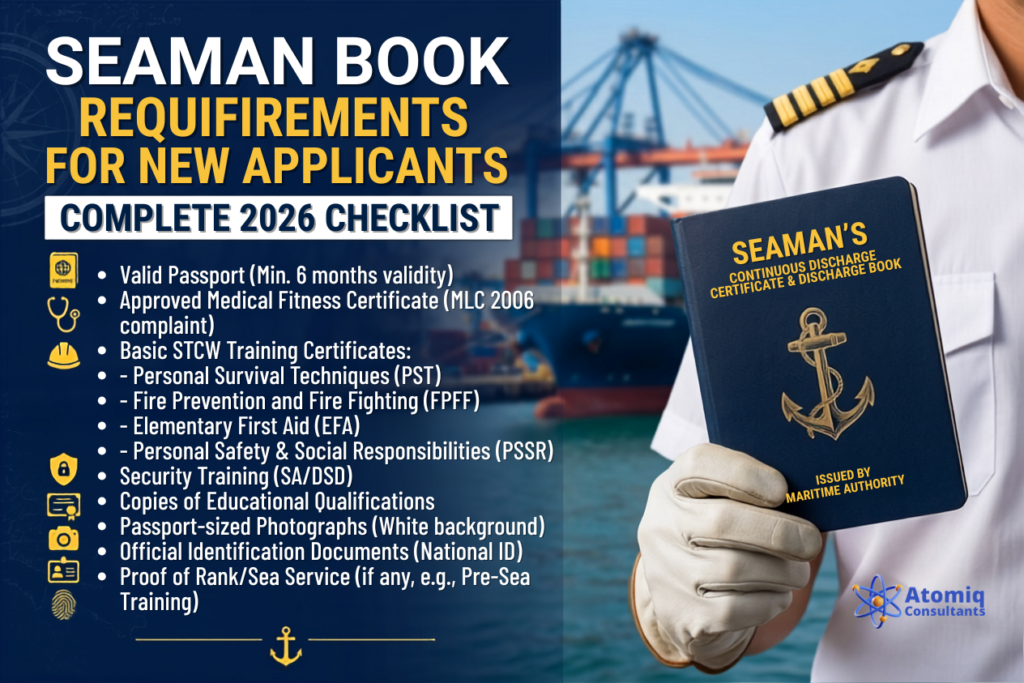
Seaman book requirements vary by country, but first-time applicants are typically asked for the following:
- Completed application form — usually filed online through your maritime authority’s portal (e.g., MARINA’s MISMO system in the Philippines).
- Valid passport — most authorities require at least 6–12 months’ remaining validity. (check your issuing authority’s exact rule)
- Proof of citizenship / birth certificate — to confirm eligibility with your national registry.
- Seafarer’s medical certificate — a medical fitness exam from an accredited maritime clinic, covering eyesight, hearing, and general fitness, as required under the STCW Convention and the Maritime Labour Convention (MLC, 2006).
- Basic Training (BT) certificate — most administrations require completion of STCW Basic Training (personal survival, fire fighting, first aid, personal safety) before or shortly after issuance.
- Passport-size photos — white background, specifications set by each authority.
- Application fee — varies by country; in the Philippines, related seafarer documents cost only a few hundred pesos to issue.
Some authorities also ask for proof of enrollment in a maritime course, a certificate of employment from a shipping or manning agency, or an NBI/police clearance. Always confirm the current checklist on your maritime administration’s official website before booking an appointment.
What training do I need before applying for a seaman’s book?
The training requirement for a first seaman’s book is STCW basic training — four courses under Regulation VI/1 of the STCW Convention: Personal Survival Techniques, Fire Prevention and Fire Fighting, Elementary First Aid, and Personal Safety and Social Responsibilities (Code Tables A-VI/1-1 to A-VI/1-4). Most approved centres run all four as a single five-to-seven-day intake. Certificates are typically issued one to two weeks after the course.
Most flag administrations want the training evidence as part of the seaman-book application rather than after it. Booking the training first is usually what stops you filing the paperwork twice.
| Course | STCW Code table | Typical duration | Practical assessment |
|---|---|---|---|
| Personal Survival Techniques (PST) | A-VI/1-1 | 1 – 1.5 days | Yes — water entry, liferaft |
| Fire Prevention and Fire Fighting (FPFF) | A-VI/1-2 | 1.5 – 2 days | Yes — live fire |
| Elementary First Aid (EFA) | A-VI/1-3 | 1 day | Yes |
| Personal Safety and Social Responsibilities (PSSR) | A-VI/1-4 | 1 day | No |
| Security Awareness — added by most centres | A-VI/6-1 | 0.5 day | No |
You will see basic training described as both four courses and five. Four is the regulation: MCA MSN 1865 (M) Amendment 1 §3.1 lists exactly four elements under Chapter VI Regulation VI/1, in this table order. Five is the package most centres sell, because Security Awareness — mandatory for most seafarers, but under Regulation VI/6, Table A-VI/6-1 — is bundled into the same week.
One course changed on 1 January 2026. PSSR was revised by IMO Resolution MSC.560(108), and any basic safety training taken after that date should include the updated syllabus — which now covers contributing to the prevention of, and response to, violence and harassment on board, including sexual harassment, bullying and sexual assault. Certificates of Proficiency issued under Regulation VI/1 before 1 January 2026 stay valid until the expiry date printed on them (St. Kitts & Nevis International Ship Registry, Maritime Circular MC 150 26, 11 February 2026). If a centre is still describing the old PSSR syllabus, ask when its course was last approved.
Three things worth knowing before you book.
- The practical elements are assessed in person, not online. Competence under Regulation VI/1 is evidenced by demonstration against the criteria in the Code tables — survival techniques mean entering the water and boarding a liferaft; fire fighting means a live fire. Approved online delivery is, in the MCA’s words, “only normally available for theory-based courses that have no practical requirements” (MSN 1865, Annex B). So treat an offer of a complete basic safety certificate with no attendance at all as a document that will not survive an inspection — and check the centre’s approval covers the specific course and the delivery method before paying.
- The four basic certificates do not all expire. Within basic training, only PST and FPFF require documented evidence of updating every five years; EFA, PSSR and Security Awareness carry no such requirement (MSN 1865 §4.4). Outside basic training the same five-year rule also catches Survival Craft and Rescue Boats, Fast Rescue Boats and Advanced Fire Fighting — so if you hold any of those, check them too. Updating is not always a full retake; routes vary by flag. Detail is in STCW renewal.
- Do all four at one centre, in one block. Split across centres or months, you get certificates with mismatched issue dates — which complicates every renewal you will do afterwards.
Training must be delivered by a centre holding approval from a flag administration for that specific course. Before paying anyone, ask which administration approved them and for the approval reference. The four courses and the five-year rule come from the Convention and apply everywhere; the administrative detail around them — who issues the Certificate of Proficiency, which equivalents are accepted, whether onboard experience counts toward updating — is set by your flag, and Panama, Palau, Liberia, Bahamas, Belize, Honduras and St. Kitts & Nevis each publish their own terms. Seaman Books is a documentation consultancy in Business Bay, Dubai — we do not deliver training and we do not issue certificates. We identify an approved centre with an intake that fits your join date, confirm its fee before you commit, and file the seaman book around it: how to enrol in STCW basic training.
We Can Check your eligibility fill-up form below our expert will guide you
How to Apply Seaman Book: All Seaman Book Requirements Steps
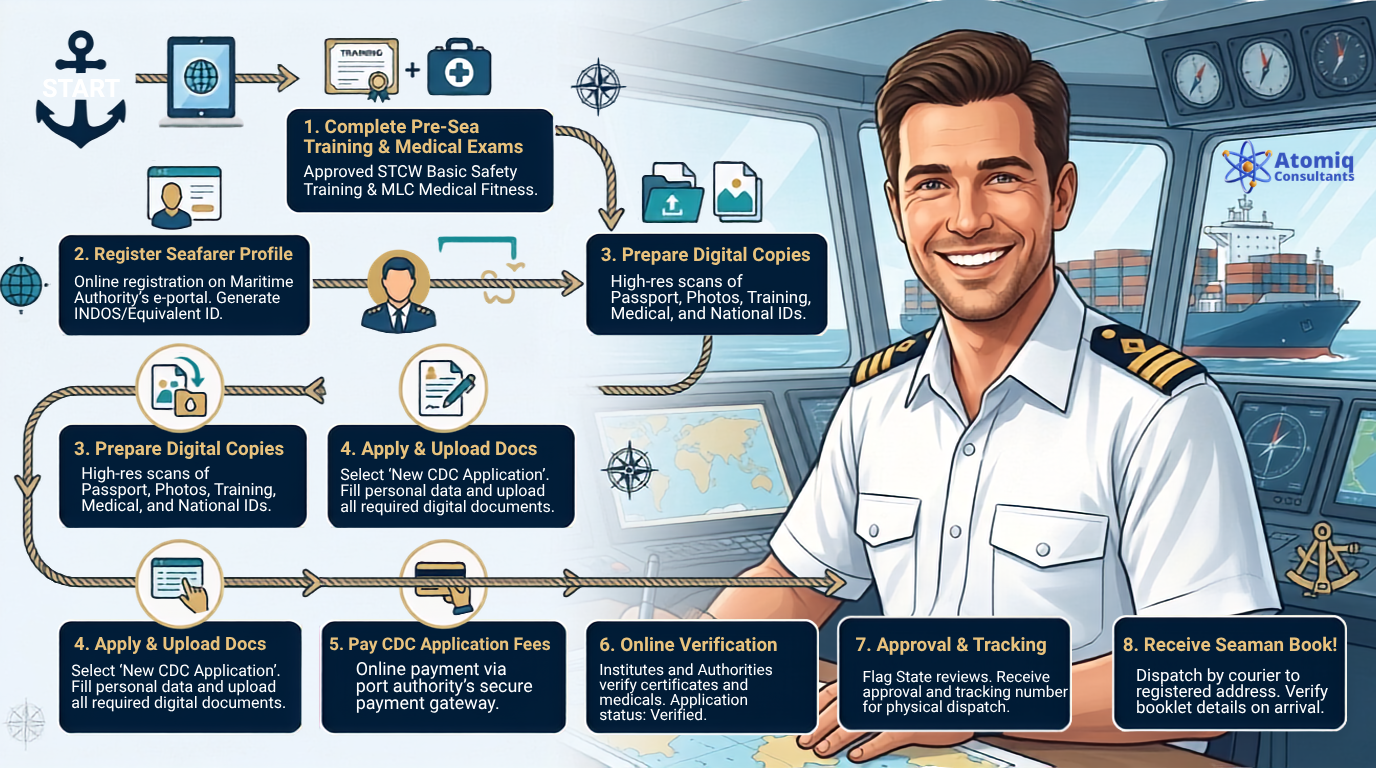
- Complete your medical and Basic Training first. These have their own schedules and are prerequisites almost everywhere.
- Register online with your maritime authority. Create an account, upload scanned documents, and wait for online evaluation.
- Pay the fee and book an appointment. Bring your original documents for final verification.
- Attend biometrics capture and claim your seaman’s book. Processing ranges from same-day release to a few weeks depending on the country.
How Long Is a Seaman’s Book Valid?
Validity varies by issuing country — commonly 5 to 10 years. The Philippine SIRB, for instance, is valid for 10 years, while the related Seafarer’s Identity Document (SID) is valid for 5 years. Renewal is simpler than a new application, but you must keep the book updated: every sign-on and sign-off should be recorded and stamped by the ship’s master.
what’s the easiest way to apply for a seaman’s book and what documents do I need?
A Seaman’s Book—officially known as a Continuous Discharge Certificate (CDC) or Seafarer’s Identification and Record Book (SIRB)—is an official maritime passport issued by national or flag-state maritime authorities. It verifies your identity as a certified seafarer and logs your official sea service time across voyages.
The fastest path to applying involves completing your mandatory STCW Basic Safety Training (BST) and maritime medical fitness check first, followed by an online submission through your regional maritime authority’s portal.
Required Documents Checklist
Before submitting an application, you must assemble the following standard documents. Requirements remain largely uniform under the STCW Convention and ILO Maritime Labour Convention (MLC 2006):
| Document Category | Required File / Item | Purpose / Verification |
| Proof of Identity | Valid Passport (minimum 6–12 months validity) | Establishes citizenship and legal identity. |
| Safety Training | STCW Basic Safety Training (BST) Certificate | Proves completion of mandatory safety, fire, survival, & first aid modules. |
| Medical Fitness | Maritime Medical Fitness Certificate | Issued by an officially accredited/approved maritime doctor. |
| Identity Proof | National ID or Birth Certificate | Verification of legal age (16-18+ depending on jurisdiction). |
| Background Check | Police / Government Clearance (e.g., NBI / PCC) | Proves clean criminal record for international port access. |
| Photos & Signature | Passport-style photos (white background) + digital signature | Used for biometric identity recording in the booklet. |
| Proof of Employment | Employment Contract, Manning Agency letter, or Cadet enrollment | Proves intent to serve on commercial vessels. |
Frequently Asked Questions
Can I get a seaman’s book without experience?
Yes. A seaman’s book is the entry document for a sea career — new applicants only need to meet the documentary, medical, and basic training requirements. Sea service is recorded in the book after you start working, not before.
Is a seaman’s book the same as a passport?
No. Your passport proves nationality; the seaman’s book proves your status and service record as a seafarer. You’ll typically need both to join a vessel abroad, though some port states grant seafarers special transit privileges.
How much does a seaman’s book cost?
Fees are set by each maritime administration and are generally modest Start from$20.
What training is required for a seaman’s book?
STCW basic training — four courses under Regulation VI/1: Personal Survival Techniques, Fire Prevention and Fire Fighting, Elementary First Aid, and Personal Safety and Social Responsibilities. Most administrations require evidence of all four as part of a first application.
How many days of training do I need for a seaman’s book?
Five to seven days when the four basic courses run as one continuous block, plus roughly one to two weeks for the approved centre to issue the certificates. Individual modules run one to two days each.
Start Your Maritime Career the Right Way
Getting your seaman’s book is easier when your medical, Basic Training, and documents are handled in the right order. Our maritime training center offers STCW Basic Training and application guidance for new seafarers — enroll today or contact our team to get document-ready for your first voyage.