Seaman Book Egypt: How Egyptian Seafarers Apply in 2026
If you are an Egyptian seafarer trying to get a seaman book in Egypt, you are really choosing between two different documents — and most applicants only find that out after they have already lost a month. One route is the national book issued through Egypt’s own maritime administration. The other is a flag-state Certificate of Discharge (CDC) issued by an open registry such as Panama, Palau or Liberia, which many foreign-flag employers ask for by name.
This guide sets out both routes as they stand in 2026: what each document is, who each one suits, the documents you need, realistic timelines, and the mistakes that send Egyptian applications back to the start.
What a Seaman Book Is — and What Egypt Issues
A seaman book in Egypt is the official record of a seafarer’s identity and sea service. Egyptian seafarers can hold the national book issued by Egypt’s maritime administration, or a flag-state CDC issued by an open registry such as Panama or Palau, which is accepted on foreign-flag vessels worldwide. Both record rank, vessel and sea time.
The two are not interchangeable in the way most crewing adverts imply. If you are new to the document itself, start with what a seaman book is and why every seafarer needs one — this guide assumes you already know the basics and are choosing a route.
Three documents get confused constantly:
- Seaman book / CDC (Certificate of Discharge) — your service record. Signed on and off by the master, it is the evidence of sea time that promotions and certificate renewals are built on.
- Seafarer’s Identity Document (SID) — a shore-leave and transit identity document under ILO Convention C185 . It is not a service record and it does not replace a CDC.
- STCW certificates — competency and safety training under the STCW Convention. Your seaman book proves where you sailed; STCW proves what you are qualified to do.
Verification note for the editor: Egypt’s ratification status for ILO C185 and for the Maritime Labor Convention, 2006 must be confirmed against ILO NORMLEX before this page goes live.
The Two Routes Open to Egyptian Seafarers in 2026
|
Egyptian national seaman book |
Flag-state CDC (Panama, Palau, Bahamas, Liberia, Belize, St Kitts & Nevis, Honduras) |
|
|
Issued by |
Egypt’s maritime administration, via the Maritime Transport Sector. |
The vessel’s flag registry, through an authorised processing agent |
|
Who can apply |
Egyptian nationals meeting national eligibility rules |
Any nationality, including Egyptian nationals |
|
Where you must be |
In Egypt, in person. |
Anywhere. Applications are processed remotely on documents |
|
Typical processing |
2 days to 2 weeks | |
|
Validity |
Valid for 5 years from the date of issue |
5 years across all seven registries we process |
|
Best for |
Egyptian-flag vessels, national service, government-linked employment |
Foreign-flag merchant ships, offshore, cruise and superyacht work |
Processing and validity figures for flag states are our own published service data, current for 2026 — see the full flag-state cost, time and acceptance comparison for the flag-by-flag breakdown.
The practical point: if your next contract is on a foreign-flag vessel, the flag state — not your passport — usually decides which book the employer will accept. That is why the flag-state route exists, and it is the same route UK seafarers use when their national process is slow or does not fit the vessel.
Which Route Fits Your Situation
Choose the Egyptian national book if you are joining an Egyptian-flag vessel, working for a state-linked operator, or your employer has named the national document in writing.
Choose a flag-state CDC if any of these describe you:
- You already have a job offer on a Panama-, Palau- or Liberia-flagged ship and the crewing manager has asked for a matching CDC.
- You are a cadet or first-time seafarer who needs a valid book before a joining date that is weeks away, not months.
- You are working offshore in the GCC and cannot take leave to travel back to Egypt to file in person.
- You are cruise or superyacht crew, where open-registry books are the norm rather than the exception.
- Your Egyptian book has expired while you are outside Egypt.
If you are in the last group, read the renewal path first — the rules differ from a first application.

Documents Required for Egyptian Seafarers
For a flag-state CDC application processed from Egypt or the Gulf, the standard document set is:
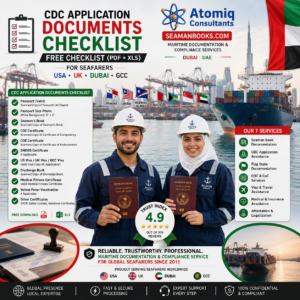
- Passport — clear color scan of the bio-data page, valid for at least six months beyond the application date.
- Passport-size photograph — white background, taken within the last six months, meeting the registry’s biometric spec.
- Completed application form — signed, with rank and department stated exactly as they appear on your certificates.
- Medical fitness certificate — issued by an approved maritime doctor and still in date.
- STCW basic safety training certificates — as a minimum, personal survival, fire prevention, elementary first aid and personal safety.
- Proof of sea service or a job offer — a previous discharge book, sea service testimonial, or a letter of employment for first-time applicants.
- Certificate of Competency (CoC) — for officers and ratings holding one.
A full breakdown, including the format traps that cause rejections, is in our CDC application documents checklist.
Egypt-specific note: requirements for the national Egyptian book — including national ID, military service status documentation, and any accredited-academy training certificate.
Cost and Timeline: What to Expect
Flag-state CDC processing times, as published for our 2026 service:
|
Flag state |
Standard processing |
Express |
Validity |
|
Palau |
1–2 working days |
Often same-day |
5 years |
|
Belize |
1 working day |
Provisional in days |
5 years |
|
St Kitts & Nevis |
1 working day |
24 hours |
5 years |
|
Bahamas |
1–2 working days |
24 hours |
5 years |
|
Liberia |
2 working days |
24 hours |
5 years |
|
Honduras |
2 working days |
24 hours |
5 years |
|
Panama |
25 to 30 days |
3 to 5 business days |
5 years |
Source: Atomiq Group service data, 2026. Processing time is counted from the point a complete, correct document set is received — not from first enquiry.
Costs vary by flag, by rank and by whether you need express handling, so we quote per application rather than publishing a single number that would be wrong for most seafarers. Two costs applicants routinely forget to budget for: the medical fitness examination, which you pay locally, and renewal in five years, which is cheaper to plan for than to fix in a hurry. The flag-state comparison explains what actually drives the price difference between registries.
Why Egyptian Applications Get Rejected
The rejections we see are almost never about eligibility. They are about paperwork:
- Passport under six months’ validity — the single most common cause. Renew the passport first, then apply.
- Name mismatch across documents. Arabic-to-English transliteration varies between your passport, your STCW certificates and your medical. The passport spelling governs; everything else should match it.
- Photograph fails the biometric spec — shadow on the background, glasses, or a crop that cuts the crown of the head.
- Expired STCW certificates submitted with an otherwise complete file, which stops the whole application rather than just that item.
- Rank stated aspirational rather than as evidenced by sea service and certificates.
- Paying an unverified “agent” who cannot show which registry they are authorized by. A book that is not traceable in the flag state’s own records is worthless — and dangerous to sail on.
For Egyptian Seafarers Working in the GCC
A large share of Egyptian seafarers are already in the Gulf when their documentation comes due, and the rule that surprises people is this: the Gulf state you are working in is usually not the state that issues or renews your book. Issuance follows your nationality or the vessel’s flag, not the port you happen to be standing in.
That means a UAE, Saudi or Qatar residency does not on its own give you a route to a book — but it also means you do not need to fly home. Flag-state applications are processed on documents, so an Egyptian seafarer in Dubai, Doha or Dammam can be issued a valid CDC without leaving the job. Our guide to seaman book renewal in the GCC sets out the three renewal routes and the timelines for each.
One timing rule worth writing down: start the renewal when you have six months of validity left, not six weeks.
How Atomiq Group Helps Egyptian Seafarers
We are a maritime documentation service, not a government body — we do not issue seaman books, and no legitimate service does. What we do is process your application through the authorized channels of the flag registries we work with, so it is filed correctly the first time.
For Egyptian seafarers that means:
- Document screening before submission — we check the passport validity, transliteration consistency, photo spec and STCW dates that cause most rejections.
- No embassy or overseas travel — applications are handled remotely from Egypt or from your posting in the Gulf.
- Flag guidance based on your actual contract — if your employer has named a flag, we process that one; if not, we tell you which registries that employer type usually accepts.
- Renewal reminders before your five-year expiry, not after.
→ Apply Now — send your documents and we will confirm the flag, timeline and cost for your rank before you pay anything.
Frequently Asked Questions
Can Egyptian seafarers get a seaman book without travelling to Alexandria or Port Said?
Yes — for a flag-state CDC. Registries such as Panama, Palau and Liberia process applications on submitted documents, so no in-person attendance is required. The Egyptian national book has its own attendance rules, which should be confirmed with the maritime administration directly.
Is a flag-state seaman book legal for Egyptian nationals?
Yes. Open registries issue discharge books to seafarers of any nationality serving on their flagged vessels, and holding one does not affect your Egyptian citizenship or any national document you already hold. The book must be issued through the registry’s authorized channels to be valid and verifiable.
How long does a seaman book take for an Egyptian applicant in 2026?
Flag-state CDCs are typically issued in one to five working days once a complete document set is received, with 24–72 hour express options on most registries. Delays are almost always caused by incomplete files rather than registry processing. National-route timelines must be confirmed with the Egyptian authority.
Which flag state is best for an Egyptian seafarer?
There is no single best flag — it depends on your contract. If your employer has named a flag, match it. If not, Palau and Belize are the fastest to issue, while Panama carries the widest employer recognition as the world’s largest registry. Compare acceptance before choosing on speed alone.
Do I still need STCW certificates if I have a seaman book?
Yes. They serve different purposes. The seaman book records your identity and sea service; STCW certificates prove your competency and safety training. Crewing managers check both, and an application submitted with expired STCW certificates will normally be held rather than partially approved.
What happens if my Egyptian seaman book expires while I am abroad?
You have three practical options: renew the national book through an Egyptian mission, renew the flag-state book through the registry’s channels, or apply for a new flag-state CDC if your next vessel is foreign-flagged. The last is usually fastest. Do not sail on an expired book.
Before You Apply
For most Egyptian seafarers in 2026 the decision comes down to one question: what flag is your next ship? If it is Egyptian, use the national route. If it is Panamanian, Palauan, Liberian or any other open registry — which covers the large majority of foreign-flag merchant, offshore and cruise work — a matching flag-state CDC is faster, can be processed without travel, and is what the crewing manager will actually ask to see.
Get your passport validity and STCW dates checked first. Then send the file once, correctly.
Published 2026. This guide describes documentation routes and processing timelines and is not legal advice. Flag-state requirements can change; confirm current requirements before applying.