Seaman Book by Country: What You Need to Know
The process and the best flag to choose differ depending on where you are based. Here is a plain-language breakdown for the most common regions.
🇦🇪 UAE — Dubai and Abu Dhabi
If you are living and working in the UAE, the most popular choices are the Panama, Bahamas, Belize, and Palau flag CDCs — all processable through licensed consultancies in Dubai without needing to travel. The UAE issues its own Seaman’s Record Book too, but international flag CDCs give you far better global job access. Typical processing: 7–15 working days.
🇸🇦 Saudi Arabia
Workers targeting offshore oil and gas contracts in the Arabian Gulf — especially those working with ARAMCO contractors or Saudi-based vessel operators — most commonly need a Bahamas or Panama CDC. These are the flags most requested by offshore employers in the Kingdom. You will also need STCW Basic Safety Training completed before applying.
🇶🇦 Qatar
Qatar is home to one of the world’s largest LNG operations, and maritime activity at the Port of Ras Laffan is constant. Seafarers joining LNG carriers, supply vessels, or offshore support ships in Qatari waters need a valid CDC — most commonly Bahamas or Panama flagged — as a mandatory requirement for crew changes.
🇵🇦 Panama
Panama runs the world’s biggest ship registry — more vessels fly the Panamanian flag than any other country. A Panama CDC is one of the most universally accepted maritime documents on the planet. One helpful note: Panama does not issue a traditional SIRB booklet like most other flags. Instead, it issues a ratings certificate alongside the CDC. The digital version (called a “blue chit”) is typically approved within 24 hours of a complete application. The physical book arrives in 15–30 working days.
🇮🇳 India
India manages its own seafarer certification through the Directorate General of Shipping (DGS). Indian seafarers receive a CDC and a biometric Seafarer Identity Document (SID), both linked to their personal INDoS number (Indian National Database of Seafarers). However, many Indian seafarers also apply for a foreign CDC — Panama, Liberia, or Bahamas — because it gives them access to international shipping contracts that often pay significantly better than domestic roles.
🇧🇸 Bahamas
The Bahamas Maritime Authority (BMA) has built a strong reputation specifically in offshore and Gulf region employment. If you are targeting oil and gas vessels, FPSOs, or offshore support work in the GCC — UAE, Saudi Arabia, Qatar, Kuwait — a Bahamas Seaman Book is often the preferred and sometimes the specifically requested flag by employers.
Documents You Need to Apply for a Seaman Book
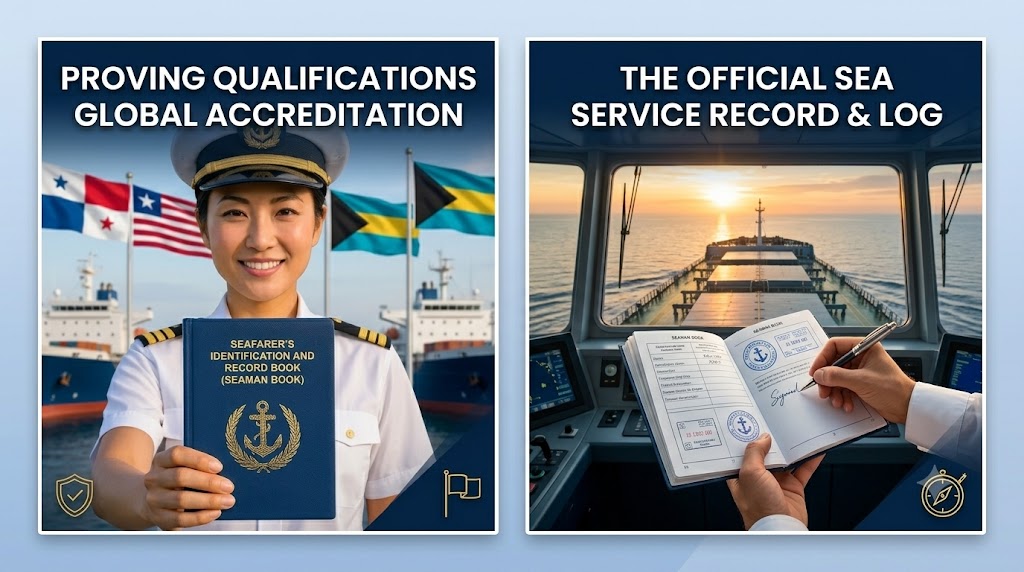
The good news is that the core document list is similar across all flag states. Here is what you will typically need:
Document
| What to Know | |
| Valid Passport | Must have at least 6 months validity. Both original and color scans are required. |
| Passport-Size Photographs | Recent photos against a plain background. |
| Medical Fitness Certificate | Must be issued by a flag-state approved doctor confirming you are fit for sea duty. |
| STCW Basic Safety Training Certificates | All five modules: Personal Survival Techniques, Fire Prevention, Elementary First Aid, Personal Safety, and Security Awareness. |
| Completed Application Form | Specific to the flag state you are applying under. |
| Previous CDC (if you have one) | Needed for renewals or if you want endorsements transferred. |
| Employment Letter or Sea Service Record | Required for officer-rank or experience-based applications. |
If you have all of these ready, the application process is faster than most people expect — especially if you work through a licensed and experienced maritime documentation consultancy.
How to Get Your Seaman Book: Step by Step
Here is the process broken down into plain, simple steps for seafarers applying from the UAE, GCC region, or India:
Step 1 — Pick your flag state. Based on the type of work you are targeting (offshore Gulf, international shipping, cruise, etc.), choose the flag that best matches your employment goals. Panama and Bahamas are the most popular starting points for most seafarers.
Step 2 — Complete STCW Basic Safety Training. If you have not done it already, enroll in and complete all five basic safety modules at an approved maritime training institute.
Step 3 — Gather your documents. Prepare your passport, medical certificate, STCW certificates, and photographs. Make sure everything is current and within validity.
Step 4 — Submit through an authorized agent. A licensed maritime consultancy will verify your documents, prepare the application correctly, and submit directly to the flag authority — eliminating common errors that cause delays.
Step 5 — Receive your certificate. A temporary digital certificate is typically issued within 24–48 hours for most flags once documents are verified. Your physical Seaman Book arrives within 10–30 working days depending on the flag state and courier.
Frequently Asked Questions
Can I get a seaman book with no sailing experience at all?
Yes — and this surprises many first-timers. Flags like Panama and the Bahamas will issue a CDC to first-time applicants with zero sea time, as long as you have completed STCW Basic Safety Training and hold a valid medical certificate. You do not need to have sailed a single day to get your first Seaman Book.
How long is a seaman book valid?
Most international CDCs (Panama, Bahamas, Belize, etc.) are valid for five years. If you hold an Indian CDC issued by DGS, the validity extends to ten years.
Can I hold more than one seaman book at the same time?
Absolutely. It is very common and completely legal. Many experienced seafarers hold both an Indian CDC and a Panama or Liberian CDC simultaneously. Having multiple CDCs simply widens the range of vessels and contracts you can join.
What is the difference between a seaman book and a seafarer ID book?
They are the same document, just different names. “Seaman Book” and “CDC” are the everyday terms used in the maritime industry. “Seafarer ID Book” and “SIRB” are the formal ILO terms. You will hear all four used interchangeably — they all mean the same thing.
How much does a seaman book cost?
Costs vary by flag state and whether you apply directly or through an agent. For most popular flags — Panama, Bahamas, Belize — government fees typically range from USD 100–300. Agent service fees are separate and vary. Always use a licensed, verified consultancy to avoid fraudulent services.
Your Maritime Career Starts With This One Document
The sea offers remarkable career opportunities — competitive pay, international travel, professional growth, and work on some of the most impressive vessels ever built. But none of that is accessible until you hold a valid Seaman Book in your hand.
Whether you are just starting out, switching careers, or looking to expand your flag options to access better-paying international contracts, getting your seaman book right — correct flag, correct documents, correct process — is the foundation of everything that follows.
If you are ready to apply or simply want to know which flag is the right fit for your situation, our team processes genuine, internationally recognized Seaman Books for seafarers across the UAE, Saudi Arabia, Qatar, India, and beyond — with some flags approved in as little as 24 hours.
Apply today and take the first step toward your global maritime career with Seamanbooks.com Managed by Atomiq Group.