Seaman Book Scams Explained: Verify Any Agency Before You Pay
Seaman book scams follow a simple pattern: someone takes your money for a document they were never able to issue. A fake maritime document service can look completely professional — a working website, a WhatsApp number that answers within minutes, a sample book photographed on a desk — and still leave you holding a worthless piece of card six weeks later, or nothing at all.
The damage is not only financial. A seafarer who turns up at a crewing office with an unregistered book fails the check, loses the contract, and in many jurisdictions faces criminal exposure for presenting a fraudulent document. Recovering from that is far harder than avoiding it.
This guide is about the scam itself: who runs it, how the pitch is built, the nine signals that expose it, and the exact checks that separate a real documentation service from a fake one. If you want the other half of the picture — what actually happens to your career if a bad document slips through — read our companion piece on the risks of a fake or invalid CDC.
What is a seaman book scams?
A seaman book scams is a fraud in which an unauthorised operator takes payment for a seafarer’s record or identity document — a seaman book or CDC — and delivers a counterfeit, an unregistered book, or nothing at all. Because only a flag state administration can issue a genuine seaman book, any document that does not appear in that administration’s own database has no value.
That last sentence is the whole test. Everything below is a way of applying it before you pay rather than after.
Why seafarers are targeted
Three things make this document unusually attractive to fraudsters.
The process is genuinely unfamiliar. Most first-time applicants have never dealt with a foreign maritime administration. They do not know what a normal timeline looks like, which office handles what, or what a legitimate agent’s role actually is — so they cannot tell an unusual promise from a standard one. Our guide to who issues a seaman book exists largely to close that gap.
The applicant is often abroad and in a hurry. A joining date is fixed, the vessel will not wait, and the seafarer is in a third country without local language or local contacts. Urgency suppresses verification. Scammers know this and build their pitch around your deadline.
The payment is plausible. Real documentation work has real costs — administration fees, medicals, translations, courier. A fraudulent invoice for a few hundred dollars does not look absurd, which is exactly why it works.
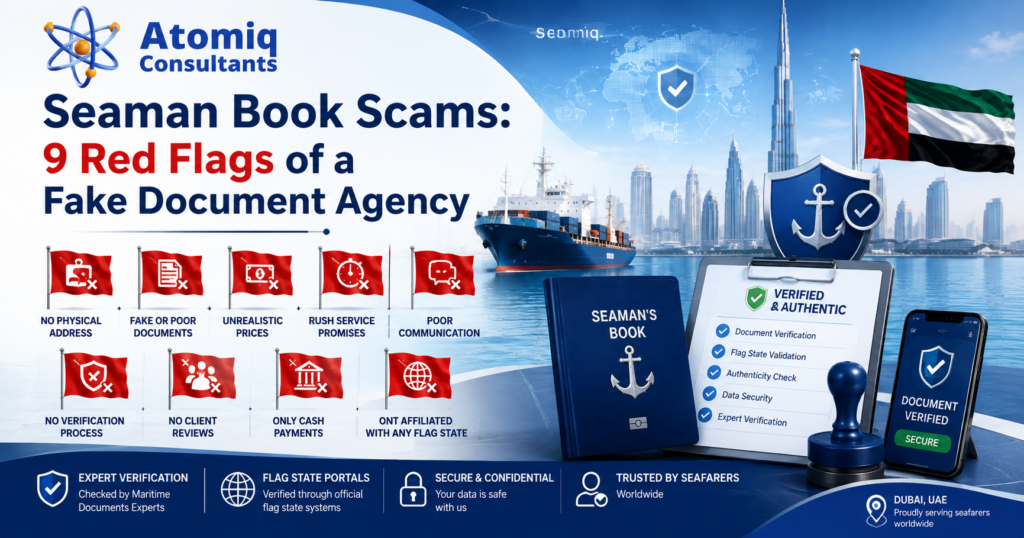
9 red flags of a fake maritime document service
Any single item below is reason to pause. Two or more together, and you should walk away.
- They claim to issue the book themselves. No consultancy, agency, or training centre issues a seaman book. Only a flag state maritime administration does. A service coordinates and submits your application; it does not create the document. A provider blurring that line is either careless about the most basic fact in its own field, or lying deliberately.
- They will not name the flag state and the processing office. A legitimate provider tells you which administration your file goes to and which office handles it, because you will need that information to verify the result. Vagueness here — “we have our channels”, “our contact inside” — is the single most diagnostic red flag in the list.
- Payment goes to a personal account, cash, or crypto. Real service companies invoice from a registered entity to a company bank account. A personal name on the transfer details, an untraceable wallet address, or a cash-only meeting removes every route you would otherwise have to a refund or a complaint.
- A job is bundled with the document. “Seaman book plus guaranteed placement on a Gulf vessel.” Legitimate documentation and legitimate recruitment are separate services, and charging a seafarer a fee to obtain employment is prohibited under the Maritime Labour Convention, 2006 — recruitment and placement services may not pass recruitment costs to the seafarer [needs source: link ILO MLC 2006 consolidated text, Standard A1.4]. An operator that ignores that rule is not a compliance partner.
- They offer to add sea service you have not done. This is worth stating precisely, because a related and legitimate question gets confused with it. Applying for an entry-level book with no sea time is normal — that is how careers start, and we cover it in getting a CDC without sailing experience. What is fraud is an operator offering to write in voyages, backdate discharge entries, or supply sea service letters for ships you never sailed on. That is document forgery, and the person holding the book carries the consequence.
- The timeline beats the administration’s own. Flag states have published or observable processing times. An offer of “seaman book in 24 hours” is not efficiency; it is a signal the document is not going through the administration at all. Compare any promise against realistic ranges in our breakdown of how long a seaman book takes by flag state.
- There is no verifiable company behind the website. No registered trade licence number, no physical address you can find on a map, no landline, no named people. Contact exists only through WhatsApp and a free email address. A domain registered six weeks ago with stock photography and no corporate footprint is a disposable storefront.
- The pressure is artificial. A discount that expires today, a “last slot this month”, a warning that fees rise tomorrow. Genuine administrative processes do not run flash sales. Urgency is manufactured to stop you from spending an afternoon checking.
- They will not explain how you verify the finished book. Ask directly: which official portal will show this document, and what will I enter? A real provider answers with a URL. A fraudulent one deflects — the document will never appear in any database, so the question has no safe answer.
The four Seaman book scams formats you will actually encounter
|
Format |
The pitch |
What actually happens |
|
The counterfeit |
“Full book, fast, no complications.” |
You receive a physically convincing book with no corresponding record at the administration. It fails the first employer check. |
|
The ghost application |
“Your file is submitted, we’re waiting on the administration.” |
Nothing was ever filed. Payment is taken, updates continue for weeks, then contact stops. |
|
The clone |
Uses the name, logo, or near-identical domain of an established provider. |
You believe you are dealing with a known company. Payment goes to the impostor and the real company has no record of you. |
|
The bundled job scam |
Document plus a guaranteed contract, for one combined fee. |
The document is fake or never arrives, the vessel does not exist, and the fee itself breaches the MLC prohibition on charging seafarers for placement. |
The clone deserves particular care. Always reach a provider through a domain you typed yourself or found through the flag administration, never through a link forwarded in a group chat.
How to verify a maritime document service in six steps
- Establish the flag state first. Before discussing price, get a straight answer on which administration will issue the book and why that flag suits your route and rank. If the provider cannot explain the choice, they are not advising you.
- Check the administration’s own published lists. Several registries publish approved providers and practitioners directly. The Bahamas Maritime Authority, for example, maintains a public list of BMA service providers, and Liberia publishes approved medical practitioners and training courses through LISCR. Where a list exists, use it — it is the most authoritative check available to you.
- Verify the company, not the website. Ask for the trade license or registration number and the registered legal name, then confirm them against the relevant commercial registry. A provider operating from the UAE, for instance, should be able to give you a license number you can check independently.
- Get the scope in writing. A legitimate engagement letter distinguishes what the provider does — preparing, submitting, and tracking your application, coordinating medicals and translations — from what only the administration does. Vague deliverables are where disputes and disappearances live.
- Pay a company, with an invoice. Company name, license number, itemized fees, and a company bank account. If the only payment route offered is personal or irreversible, that is your answer.
- Confirm the verification path before you pay. Get the portal URL in advance and check the finished document yourself the day it arrives. This step alone defeats every format in the table above.
Official verification channels
Fake maritime documents circulate widely enough that most administrations now publish a way to check one. These are the flag state and national channels a genuine document must stand up to — bookmark the one relevant to your book.
|
Authority |
What it verifies |
Official channel |
|
Panama Maritime Authority (AMP) |
Seafarer certificates and documents |
|
|
Liberia (LISCR) |
Seafarer certificates |
|
|
Bahamas Maritime Authority |
Certificates |
|
|
MARINA (Philippines) |
SID and Seafarer’s Record Book |
|
|
MARINA (Philippines) |
STCW certificates |
stcw.marina.gov.ph |
|
DG Shipping (India) |
CDC |
dgshipping.gov.in — CDC Checker |
For a walkthrough of what to enter in each portal and how to read the result, see how to verify a seaman book online. Crewing managers checking documents in volume should use our guide to verifying crew documents online.
If a search returns nothing, do not accept “the system is not updated yet” as an explanation from the person who sold you the document. Contact the administration directly.
What a legitimate service can and cannot do
Honesty about this boundary is itself a trust signal, so here it is plainly.
|
A legitimate documentation service can |
It cannot |
|
Advise which flag state fits your rank, route, and nationality |
Issue, print, or “produce” a seaman book |
|
Prepare and check your file against the administration’s requirements |
Change eligibility rules or skip requirements |
|
Submit the application and track it to issue |
Guarantee approval — the administration decides |
|
Coordinate medicals, translations, attestations, and courier |
Add, backdate, or invent sea service |
|
Tell you exactly where and how to verify the result |
Guarantee you a job in exchange for a fee |
Any provider promising something in the right-hand column is describing a crime, not a service. That distinction is the one we apply to our own work across all flag state seaman books we handle, and it is the standard we would encourage you to hold any provider to — including us. Our approach is set out in reliable maritime documentation for seafarers.
If you have already paid a scammer
Act quickly; the first 48 hours matter most.
- Stop any further payment and cancel standing instructions or recurring transfers.
- Preserve everything — chat logs, invoices, transfer receipts, the website as it appeared, phone numbers, and account names. Screenshot before profiles are deleted.
- Contact your bank or payment provider immediately to ask about recall or chargeback. Card and bank transfers sometimes have short recovery windows; crypto generally does not.
- Report it to the flag state administration whose name was used. Registries want to know when their name is being used fraudulently.
- File a police or cybercrime report where you are, and where the operator claims to be based. A report number is what banks and authorities ask for.
- Tell your union or an ITF inspector. The ITF Seafarers network maintains inspector and union directories and can flag an operator to other seafarers.
- Do not present the document. Whatever you paid, using an unverifiable book turns a financial loss into a career-ending one.
Frequently asked questions
Can an agency issue a seaman book?
No. Only a flag state maritime administration can issue a seaman book or CDC. Agencies, consultancies, and training centres act as facilitators — they prepare, submit, and track applications. Any provider claiming to issue the document itself is misrepresenting how the process works.
How do I know if my seaman book is real?
Check it in the issuing administration’s own verification portal using the document number and your details. If the record does not appear and the administration cannot confirm it when contacted directly, the book is not valid. Fake maritime documents are often physically convincing; only the database record settles it.
Is it legal to use a third-party service for a seaman book?
Yes. Using a consultancy to prepare and submit your application is legitimate, and common for seafarers applying to a foreign flag from abroad. What is illegal is buying a document that bypasses the administration, or paying anyone to falsify sea service or eligibility.
Should I pay a fee to get a seafarer job?
No. Under the Maritime Labor Convention, 2006, recruitment and placement costs may not be charged to the seafarer [source: ILO MLC 2006, Standard A1.4]. Limited statutory costs such as your medical certificate, national seafarer’s book, and passport are your own. A placement fee is a red flag.
What is the biggest red flag in a seaman book scam?
An operator who will not tell you which official portal will show your finished document. Every other warning sign is circumstantial; this one is decisive, because a genuine document is always verifiable and a fraudulent one never is.
The short version
Seaman book scams do not survive one question: where will I verify this? Ask it before money moves, get a URL rather than a reassurance, and check the result yourself the day the book arrives. Confirm the flag state, confirm the company behind the website, pay an invoiced entity, and treat any bundled job guarantee as disqualifying.
If you are starting an application and want to know what a properly documented process looks like — which flag suits you, what the administration requires, and how you will verify the outcome — see our seaman book requirements for new applicants, or contact our team with the flag state and rank you are targeting.
Editorial note: verification URLs in this article were checked against the issuing authorities’ own websites in August 2026. Portals change — if a link fails, go to the administration’s homepage rather than a third-party mirror.