HUET Renewal Requirements: Validity, the Refresher Route and the 90-Day Window
An OPITO Helicopter Underwater Escape Training (HUET) with CA-EBS certificate — standard 5295 — is valid for four years and runs 7 hours 10 minutes. Renewing it is not the same as renewing BOSIET: OPITO’s Further Offshore Emergency Training (FOET) entry requirements list only BOSIET, T-BOSIET, FOET and T-FOET certificates, so FOET does not revalidate a standalone HUET. There is no published OPITO grace period after expiry, and if your current certificate expires within 90 days of your course date, the new one is dated from the old expiry date rather than from the day you train.
Renewing now? Send your certificate reference and expiry date on WhatsApp +971 55 458 3416 and we will confirm seat availability and the centre’s fee before you commit anything. Renewing your seaman book in the same period? Start with seaman book renewal — that file is prepared separately and the eligibility check is free.
HUET renewal at a glance
|
Item |
What OPITO states |
Source |
|
Standard |
HUET with CA-EBS, product code 5295 |
OPITO 5295 |
|
Duration |
7 hours 10 minutes guided learning |
OPITO 5295 |
|
Validity |
4 years |
OPITO 5295 |
|
Renewed by FOET? |
No. FOET (5850) is open only to holders of a “valid (in-date)” BOSIET, BOSIET (with EBS), TBOSIET, FOET or TFOET certificate |
OPITO 5850 |
|
Published grace period |
None |
OPITO 5295, 5850, 5750, 5501, 5614 |
|
Back-dating rule |
If the previous certificate expires within 90 days before enrolment, the new certificate is dated from the old expiry date — “unless stated otherwise by the Duty Holder or Asset Owner or Operator” |
OPITO 5295 |
|
Who issues it |
The OPITO-approved centre, not Seaman Books |
— |
|
Verification |
Surname + certificate reference at OPITO’s certificate validation page |
OPITO |
How long is a HUET certificate valid?
Four years. OPITO standard 5295 states it plainly — “Validity: 4 years” — and the same four-year validity applies to BOSIET with CA-EBS (5750), FOET with CA-EBS (5850), Tropical BOSIET (5501) and Tropical FOET (5614).
Two qualifications matter more than the number itself.
Your duty holder can be stricter than OPITO. OPITO sets the standard; the operator, asset owner or duty holder sets what it will accept on its installation, and OPITO’s own standards defer to them in writing. Norway is the clearest published example: Offshore Norge’s Recommended guidelines for safety and emergency response training (Guideline 002, Rev. 24) runs a separate GSK regime in which “Certified maritime personnel must also have taken the Huet at a course provider approved by Offshore Norge” and “The Huet must be repeated at five-year intervals.” That document does not mention OPITO, BOSIET, FOET or CA-EBS anywhere. A Norwegian-sector requirement is not satisfied by reading OPITO’s page, and the reverse is equally true.
Four years from the certificate date, not from the course date. Where the back-dating rule below applies, those are different days.
The standard validity period is not universally the same across regimes; some duty holders or regulators may impose requirements shorter than the standard validity period.
Does FOET renew a HUET certificate?
No — and this is where most renewal enquiries start from the wrong assumption.
FOET is the refresher for the BOSIET family. OPITO’s FOET with CA-EBS standard states that it “is open to persons who have a valid (in-date) OPITO-approved BOSIET (with CA-EBS), BOSIET (with EBS), TBOSIET, FOET (with CA-EBS), FOET (with EBS) or TFOET certificate.” HUET does not appear in that list. Tropical FOET (5614) carries the same list, also without HUET.
So the assumption splits two ways, and which one applies to you depends on which certificate you actually hold:
- You hold BOSIET (or T-BOSIET), which contained the HUET module. Your renewal is FOET, or T-FOET for the tropical route — and OPITO’s T-BOSIET standard puts the outer limit in writing: “The maximum interval between the successful completion of T-BOSIET training and subsequent completion of T-FOET training is 4 years.” Your helicopter escape competence is refreshed inside that course.
- You hold a standalone HUET (5295). FOET is not open to you on the strength of it. OPITO publishes no HUET refresher standard and no progression route from HUET on the 5295 page. In practice that leaves sitting the 7-hour-10-minute HUET course again.
Standalone HUET is the less common case. It is the one that goes wrong, because a worker who books FOET on a HUET certificate can be turned away at the centre door on the entry requirement.
When to book: the 90-day window, and why booking early costs you
OPITO’s back-dating rule is the most commercially useful sentence in the standard, and almost nobody reads it:
“If the expiry date on the learners previous certificate is within 90 days prior of the course enrolment date then the date of the new certificate should correspond with the expiry date of the existing/previous certificate unless stated otherwise by the Duty Holder or Asset Owner or Operator.”
Read it in the direction that affects your pocket. Inside the last 90 days, you lose nothing — the new four years are stacked on top of your existing expiry date, so the remaining weeks are not forfeited. Book five months early and the new certificate is dated from the day you train, and those five months are gone. The same course, the same fee, several weeks of validity thrown away.
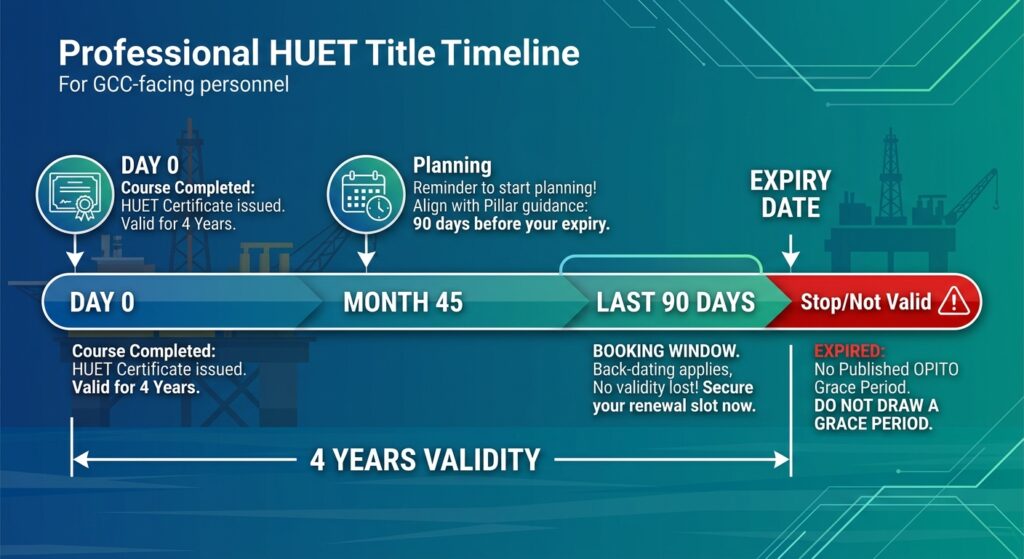
Note the two windows are different documents and must not be conflated. Our own seaman book renewal guidance is to start three to six months before expiry, because a flag-state file involves an administration, a courier and a queue. OPITO’s 90 days is about how a training certificate is dated. Neither figure overrides the other.
Is there a grace period if my HUET has already expired?
Not one that OPITO publishes. Across the 5295, 5750, 5850, 5501 and 5614 standards and OPITO’s learner and centre sections, there is no grace period, no late-renewal allowance and no expired-certificate provision. The back-dating rule is the opposite of a grace period: it preserves continuity for people who renew before expiry.
What expiry actually costs you:
- Your mobilisation stops. A duty holder that requires in-date offshore safety training will not accept an expired certificate, and crew-change windows do not wait.
- If you hold BOSIET, you lose FOET eligibility. FOET is open only to “valid (in-date)” certificate holders. Let BOSIET lapse and the short refresher is off the table — you are back to the full BOSIET (20 hours 40 minutes for the CA-EBS route, 19 hours for T-BOSIET), at full price.
- You lose the back-dating benefit. Renewing after expiry means the new certificate is dated from the course, with a documented gap in your record that a vetting check will show.
An expired standalone HUET has no equivalent short route to lose — the course is the same 7 hours 10 minutes either way. The cost of lapsing is the lost rotation, not a longer course.
What you need before you book a HUET renewal
|
Requirement |
Detail |
|
Valid offshore medical |
Fitness to train is an entry condition on the HUET standard. Your operator or the centre will state which medical it accepts — UK OEUK, ENG1, or a local GCC equivalent. Medical requirement: Check the individual UAE OPITO centre before booking. The accepted offshore medical certificate is centre-specific; this page does not currently publish a verified UAE-wide acceptance list. |
|
Previous certificate |
Reference number and expiry date. Both are needed to establish whether the 90-day back-dating rule applies to you. |
|
Photo ID matching your documents |
Name spelling must match your seaman book, passport and certificate. A mismatch is a rejection risk across every document in your file. |
|
The right variant |
CA-EBS, EBS or Tropical. Booking the wrong one is a full re-sit at full price. Confirm the variant against the scope you are being hired into, not against the last course you took. |
|
Shoulder-breadth measurement |
Shoulder-breadth measurement: OPITO identifies this as a requirement for offshore helicopter travel in certain regions, including the UK, where applicable. It is not listed as a general entry requirement for OPITO 5295. Check your employer/operator and destination requirements before travel.HUET renewal cost, and who sets it |
Course fees are set by each approved centre, not by OPITO — that is stated on our own BOSIET and HUET enrolment page, and it is why no honest page publishes a single global price. HUET is a shorter, one-day OPITO course, while BOSIET is a broader initial offshore-safety programme. Course fees are set by individual approved centres and vary by location, course variant and inclusions, so we do not publish a generic price comparison. If your HUET certificate is approaching expiry, renewing through the applicable HUET pathway may avoid having to complete a broader initial BOSIET programme—but always confirm the certification route required by your employer or operator.
Seaman Books charges for coordination, not for training. We confirm the centre’s fee with you in writing before anything is booked.
How a HUET renewal works with us
- Send your certificate reference and expiry date. That alone tells us whether you are inside the 90-day window and whether you need HUET, FOET or T-FOET.
- We confirm which course your scope actually requires. Some workers arrive certain they need a full BOSIET when a FOET would do, and a few arrive booked onto a FOET they are not eligible for.
- We identify an OPITO-approved centre with a seat, and confirm dates and the centre’s fee before you pay anything.
- You attend. The centre delivers the training and issues the OPITO certificate directly to you.
- We keep the reference on file against your next four-year cycle, and flag your other expiries — seaman book, STCW, medical — while we are in the file.
Dates & fee: Send your preferred training window and we’ll come back with the available course dates and applicable centre fee.
Seaman Books is a documentation and enrolment consultancy. We are not an OPITO-approved training centre, we do not deliver or assess HUET, and we do not issue OPITO certificates.
Frequently asked questions
How long is a HUET certificate valid?
Four years. OPITO’s HUET with CA-EBS standard (5295) states “Validity: 4 years”, the same interval as BOSIET, FOET and both tropical variants. Your duty holder can require a shorter cycle — Offshore Norge’s guideline, for example, sets a five-year HUET repetition for certified maritime personnel under its own GSK regime.
Does FOET renew my HUET?
No. OPITO’s FOET entry requirements list only in-date BOSIET, BOSIET (with EBS), TBOSIET, FOET and TFOET certificates. A standalone HUET is not an entry qualification for FOET. If your HUET came bundled inside a BOSIET, then FOET refreshes that BOSIET — including its helicopter escape element.
Is there a grace period after my HUET expires?
OPITO publishes none. There is no late-renewal allowance in the HUET, BOSIET, FOET or tropical standards. The only expiry-related rule is back-dating, which applies to certificates renewed within 90 days before expiry, not after it.
How early should I book my HUET renewal?
Inside the last 90 days before expiry. Within that window OPITO’s rule dates your new certificate from the old expiry, so no validity is lost. Book earlier and the new four years start from the course date, forfeiting whatever time was left.
Can I renew my HUET in Dubai?
Yes — HUET with CA-EBS is delivered at OPITO-approved centres in the UAE, and we handle enrolment from our Business Bay office. Send your expiry date and the scope you are joining, and we confirm the centre, the dates and the fee before you commit.
How do I prove my HUET is valid?
Your certificate carries a reference number that can be checked on OPITO’s certificate validation page using your surname and that reference. OPITO’s TRAIN-R app also gives learners access to their own training records.
The short version
A HUET with CA-EBS certificate (OPITO 5295, 7 hours 10 minutes) lasts four years. FOET will not renew it unless your HUET came inside a BOSIET. There is no published grace period, and the cheapest month to renew is inside the last 90 days before expiry, when OPITO’s back-dating rule protects the validity you have left.
Send your certificate reference and expiry date on WhatsApp +971 55 458 3416 or through the form on this page, and we will come back with the centre, the dates and the fee. If your seaman book or CDC expires in the same window, seaman book renewal is prepared as a separate file — the eligibility check is free and fees are quoted upfront.
Seaman Books is the maritime documentation brand of Atomiq Management Consultancies EST., #903 Regal Tower, Business Bay, Dubai. We prepare and coordinate seafarer documentation and arrange training with accredited centres. We are not a flag-state authority, an OPITO-approved centre or a training provider of record. OPITO figures cited from OPITO’s published training and assessment standards, retrieved 14 September 2026.