Where the BMA is based
The head office is in Nassau, but the Authority deliberately keeps staff in the world’s shipping centres so operators and crewing managers can reach a real person in their own time zone.
Office | Location | Contact |
Head office | Shirlaw House, 226 Shirley Street, Nassau, The Bahamas | +1 242 356 5772 · info@bahamasmaritime.com |
London | 120 Old Broad Street, EC2N 1AR, United Kingdom | +44 20 7562 1300 · londonoffice@bahamasmaritime.com |
Piraeus | 10 Antoniou Ampatielou Str., 185 36 Piraeus, Greece | +30 210 429 3802 · piraeusoffice@bahamasmaritime.com |
Hong Kong | Suite 813-14, Ocean Centre, 5 Canton Road, Tsimshatsui, Kowloon | +852 2522 0095 · hongkongoffice@bahamasmaritime.com |
New York | Bahamas House, 231 East 46th Street, New York 10017, USA | +1 212 829 0221 · newyorkoffice@bahamasmaritime.com |
Tokyo | YP Toranomon 3F, 2-35-2 Nishi-shinbashi, Minato-ku, Tokyo 105-0003 | +81 3 6402 5274 · tokyooffice@bahamasmaritime.com |
Seoul (regional agent) | Ben Line Agencies | +82 2 2135 1113 · benline@bahamasmaritime.com |
For seafarer certification specifically, the Seafarers & Manning Department is reached on +44 20 7562 1300 or seafarers@bahamasmaritime.com.
Which Documents Does the BMA Issue to Seafarers?
This is the part that matters most if you are crew rather than an owner. The BMA issues several distinct documents, and they are routinely confused with one another.
Document | What it is | Who it is for | Governing notice |
Certificate of Recognition (flag state endorsement) | Bahamas recognition of a CoC issued by another country, making it valid on Bahamas-flagged ships | Non-Bahamian officers | MN017 |
Certificate of Competency (CoC) | A Bahamas-issued officer licence, earned by written and oral assessment | Bahamian candidates | MN014 |
Endorsements of Certificates of Proficiency | Flag recognition of GMDSS, tanker, passenger ship and similar STCW Chapter VI/V certificates | All officers and ratings needing them | MN016, MN021, MN022 |
Seafarer Identification and Record Book (SIRB / seaman book) | Identity and sea-service record document accepted for MLC 2006 purposes | Any seafarer serving on Bahamas tonnage | Bulletin 107 |
Notice of Eligibility (NOE) | Confirmation that a candidate may sit BMA assessments | Bahamian CoC candidates | — |
Minimum Safe Manning Document | Ship-level document fixing required crew numbers and ranks | Issued to the ship, not the seafarer | — |
Offshore certification | Credentials for offshore-sector personnel | Offshore crew | MN015 |
Ship Security Officer CoP | SSO proficiency certification under the ISPS Code | Designated security personnel | Bulletin 118 |
The BMA’s own Marine Notices and Bulletins are the authoritative reference for each of these. If a crewing agent tells you something that contradicts MN017, the Marine Notice wins.
Who Needs the Bahamas Maritime Authority?
Not everyone reading this needs anything from the BMA. Here is the honest breakdown.
✅ You need a BMA endorsement if…
You are a non-Bahamian officer joining a Bahamas-flagged ship. This is the headline rule: all Certificates of Competency held by non-Bahamian officers must be recognised (endorsed) by The Bahamas before they are valid on board. Your Indian, Filipino, Ukrainian or British CoC does not become a Bahamas CoC — it stays what it is, and the BMA issues a separate Certificate of Recognition alongside it.
You hold GMDSS or tanker certificates of proficiency and are joining Bahamas tonnage. These also require flag state endorsement.
Your ship’s Minimum Safe Manning Document lists your rank. If the MSMD says the vessel must carry a certificated Second Engineer, that person’s certificate needs to be flag-recognised.
✅ You need a BMA-issued seaman book if…
Your employer or manning agent requires a Bahamas SIRB. The Bahamas seaman book is widely used by cruise operators and offshore contractors as a workable identity and sea-service document, particularly for crew whose own country’s CDC is slow to obtain or poorly accepted. It is valid for five years.
✅ You need a full Bahamas CoC if…
You are a Bahamian national training as a deck or engineer officer. The BMA runs its own examinations for Bahamian candidates — written and oral assessments, held twice a year in June and November, following a signed Notice of Eligibility.
❌ You probably do not need the BMA if…
- You sail exclusively on ships flagged elsewhere (Panama, Liberia, Malta, Marshall Islands, your own national flag). Each flag has its own administration and its own endorsement.
- You are a rating whose ship and role do not require certificated proficiency — though check your MSMD before assuming this.
- You are still at cadet stage and have not yet been assigned to a Bahamas-flagged vessel. Endorsements are tied to a real employment need, not obtained speculatively.
How BMA Recognition Works: STCW Regulation I/10 in Plain English
Here is the mechanism behind the endorsement, because understanding it removes most of the anxiety around the process.
Under the STCW Convention (adopted 7 July 1978, in force since 28 April 1984), a flag state may recognize a certificate issued by another Party — but only where the two administrations have an arrangement in place under Regulation I/10. In practice this means the BMA has satisfied itself that the issuing country’s training, examination and certification system meets STCW standards.
Three consequences follow:
- The issuing state must have an STCW I/10 arrangement with The Bahamas. The BMA holds arrangements with most established maritime nations, but not with every state on earth. If your CoC comes from a country outside that list, it cannot be endorsed.
- For STCW Chapter VI certificates of proficiency, the issuing state must appear on the IMO “White List” — the list of Parties confirmed by the IMO Maritime Safety Committee as giving full and complete effect to STCW, published as MSC.1/Circ.1163 and updated periodically.
- The endorsement is a separate document with its own expiry. It does not extend your underlying CoC. When the CoC is revalidated, the endorsement must follow.
Applying: it goes through the company, not the individual
An important practical point that catches seafarers out. Endorsement applications are submitted electronically through BORIS, and BORIS access sits with the shipowner, manager or manning agent — not with the individual seafarer. If you are a non-Bahamian officer, your route to a Bahamas endorsement runs through your employer or a licensed crewing agency. Bahamian nationals may submit paper applications directly to the Nassau office.
The same holds for the Bahamas seaman book: the BMA accepts SIRB applications from companies actively engaged in employing, recruiting or selecting personnel for Bahamian ships, which is why individual walk-up applications are refused.
The Bahamas Seaman Book at a Glance
Because the SIRB is the document most seafarers actually deal with, here are the current parameters in one place:
Item | Detail |
Issuing authority | Bahamas Maritime Authority |
Validity | 10 years |
Standard processing | 2-5 working days from receipt of application |
Fast-track processing | 2 business days (surcharge applies) |
Physical SIRB fee | US$60 |
Digital SIRB fee | US$50 |
Both formats | US$90 |
Fast-track surcharge | US$300 |
Core documents | Passport copy, valid seafarer medical certificate, signed application form, passport-size color photo, signature scan (digital version) |
Submission route | Company/agent via BORIS |
Full document checklist and current fees: Bahamas seaman book — application, documents and fees.
How Does the Bahamas Compare as a Flag?
Registry reputation is not a vanity metric — it determines how often your ship is detained, how smoothly you clear port, and how readily other employers accept your sea time.
On the Paris MoU flag performance lists published in 2025, covering inspections from 2023 to 2025, the Bahamas sits at number 15 on the White List, with 1,604 inspections, 40 detentions and an excess factor of −1.26. The White List is the top performance band; grey and black listed flags attract heavier inspection targeting. Sitting mid-White-List places the Bahamas ahead of several far larger registries and comfortably inside the tier that port state control treats as low-risk.
The Bahamas is also strongly associated with the cruise and passenger sector, and with LNG and offshore tonnage — which is why cruise crew and offshore workers encounter the BMA far more often than, say, tramp bulker crews do.
For a side-by-side against the other major open registries, see our top 10 flag states for seafarers comparison, or the individual guides to Panama, Palau, Belize and Liberia.
Three Misconceptions Worth Clearing Up
“A Bahamas endorsement replaces my national CoC.” It does not. The endorsement recognizes your existing certificate for service on Bahamas ships. Let the underlying CoC lapse and the endorsement is worthless.
“I can apply for a Bahamas seaman book myself online.” You cannot. The BMA accepts applications from employing or recruiting companies through BORIS. Any website offering direct individual issuance without a company behind it should be treated with suspicion — see our guide on spotting fake maritime document services.
“The Bahamas is a ‘flag of convenience’, so the paperwork is loose.” The Bahamas is an open registry, but its Paris MoU White List position and its published refusal to accept substandard tonnage put it in a different category from the weakest open registries. Documentation requirements are real and enforced.
Frequently Asked Questions
What is the Bahamas Maritime Authority?
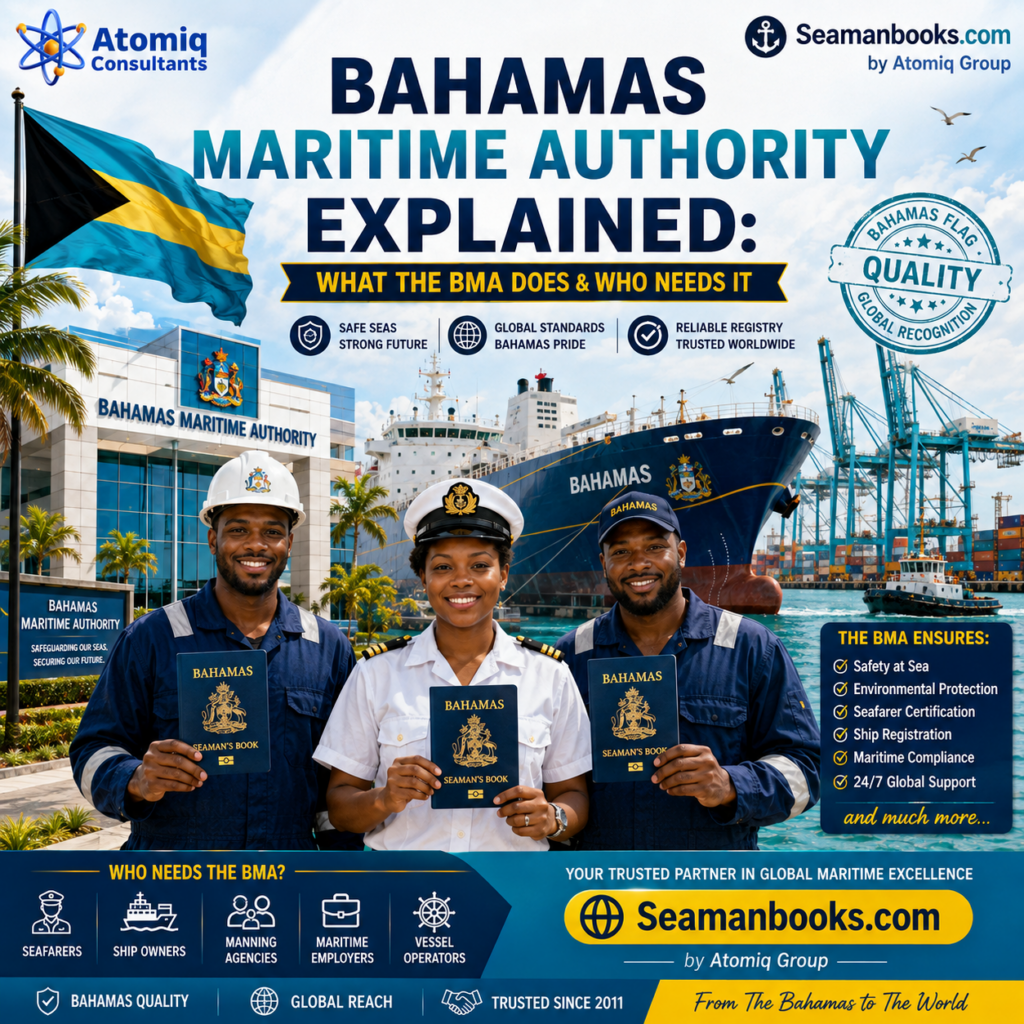
The Bahamas Maritime Authority (BMA) is the flag-state administration of The Bahamas, established in July 1995. It registers ships under the Bahamas flag, enforces international safety and labor conventions on those ships, investigates marine casualties, and issues seafarer certificates, endorsements and record books.
Is the Bahamas Maritime Authority a government body?
Yes. The BMA is the official maritime administration of the Commonwealth of The Bahamas and represents the country at the International Maritime Organization and before bodies such as the European Commission and the US Coast Guard. It is not a private registry operator.
Do I need a Bahamas endorsement for my Certificate of Competency?
You do if you are a non-Bahamian officer serving on a Bahamas-flagged ship. All CoCs held by non-Bahamian officers must be recognized by The Bahamas through a Certificate of Recognition. Your national certificate alone is not sufficient on board.
Can I apply to the Bahamas Maritime Authority directly as a seafarer?
Generally no. Endorsement and seaman book applications are submitted through BORIS by the employing or recruiting company. Bahamian nationals may submit paper applications for Bahamas Certificates of Competency directly to the BMA’s Nassau office.
How long is a Bahamas seaman book valid?
A Bahamas Seafarer Identification and Record Book is valid for five years. Standard processing is 15 working days from receipt of a complete application, with a fast-track option processed in two business days for an additional fee.
Which countries’ certificates does the Bahamas recognize?
The BMA recognizes Certificates of Competency from states holding an STCW Regulation I/10 arrangement with The Bahamas, which covers most established maritime nations. For STCW Chapter VI certificates of proficiency, the issuing state must appear on the IMO White List.
Where are the Bahamas Maritime Authority’s offices?
The head office is in Nassau, with further offices in London, Piraeus, Hong Kong, New York and Tokyo, plus a regional agent in Seoul. Seafarer certification enquiries are handled by the Seafarers & Manning Department on seafarers@bahamasmaritime.com.
Is the Bahamas flag well regarded? Yes. On the Paris MoU performance lists published in 2025, covering 2023–2025 inspection data, the Bahamas ranks 15th on the White List — the top performance band — with 1,604 inspections and 40 detentions recorded across the period.
The Bottom Line
The Bahamas Maritime Authority is the rule-setter for every ship flying the Bahamas flag and every seafarer working on one. If you are a non-Bahamian officer, your relationship with it is simple and specific: your CoC needs a Bahamas Certificate of Recognition, your GMDSS and tanker certificates need endorsing, and the application has to come through your company’s BORIS access rather than from you personally. If you are joining a cruise line or an offshore contractor, expect to meet the BMA sooner rather than later.
Everything else — which flag suits your career, how the Bahamas stacks up against Panama or Liberia, what a seaman book actually is — sits one level up from here. Start with our foundational guide, what is a seaman book and why every seafarer needs one, or go straight to the practical route with our Bahamas seaman book service.