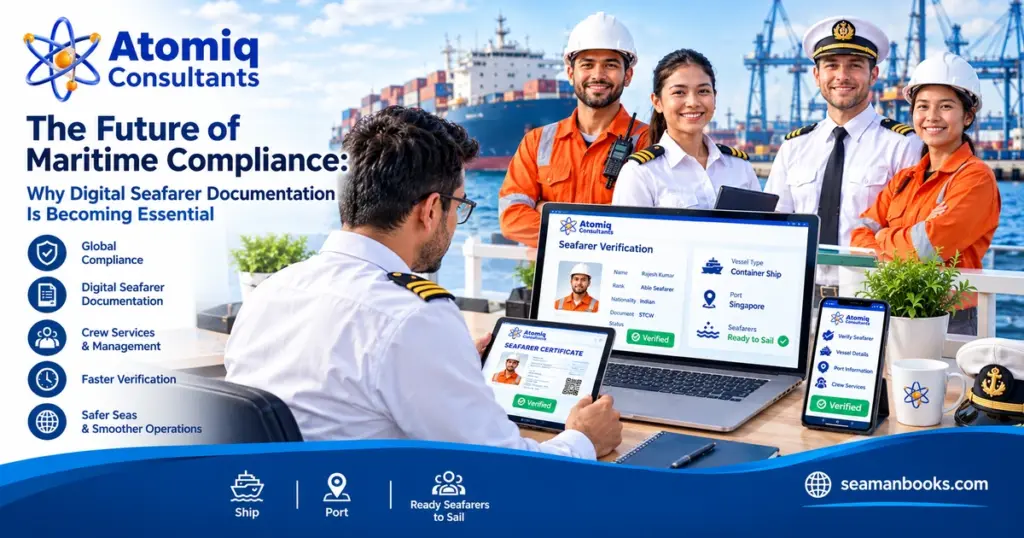
 Digital seafarer documentation means certificates, seaman books and identity documents that are issued, stored or verified electronically instead of only on paper. It is becoming essential because IMO has accepted electronic certificates since 2016, the FAL Convention has required electronic exchange of port data, including crew lists, since 1 January 2024, and employers and port state control increasingly check documents online before a seafarer signs on. Paper books are still valid where the flag state issues them; the change is that a document now has to be verifiable, not only presentable.
1. The IMO’s Guidelines for the Use of Electronic Certificates are set out in FAL.5/Circ.39/Rev.2, dated 20 April 2016.
2. Since 1 January 2024, Maritime Single Windows have been mandatory under the amendments to the FAL Convention adopted by the IMO Facilitation Committee at its 46th session (FAL 46) in May 2022, through resolution FAL.14(46).
Both statements are supported by official IMO documentation.
Why digital seafarers documentation is becoming essential
1. Electronic certificates are formally accepted
IMO’s guidelines on electronic certificates allow administrations to issue certificates in electronic form, provided they carry the features the guidelines list. Once an issuing administration does this, port states are expected to accept them the same way they accept paper. This is the foundation everything else rests on.
2. Port data now moves electronically
Since the Maritime Single Window became mandatory, ports must accept the FAL forms electronically — and the crew list is one of them. A crew list built from documents that cannot be checked quickly slows clearance.
3. Administrations must be able to confirm certificates
STCW Regulation I/2 requires each Party to keep a register of the certificates and endorsements it issues and to answer verification requests from other Parties and from companies. Online registers are the fastest way to meet that duty, which is why most flag states have moved to them.
4. Fraud has made “show me the paper” insufficient
Certificate fraud is a recurring item at IMO, and a well-made fake book looks identical to a real one. A record held by the issuing administration does not. See our guide to the risks of a fake or invalid CDC.
5. Crew changes are decided on short notice
A crewing manager approving a joiner for tomorrow’s crew change cannot wait for a courier. Online verification turns a multi-day check into minutes, which is why employers increasingly ask for documents that can be verified before travel is booked.
What makes an electronic certificate valid
A PDF of a scanned book is a copy, not an electronic certificate. Under IMO’s guidelines, an electronic certificate should:
- contain the same information as the paper version;
- carry a unique tracking number;
- be protected against unauthorised editing;
- be printable and viewable as a human-readable document;
- be verifiable through a secure, 24-hour online service run or authorised by the issuing administration.
The practical test for any seafarer: can someone who has never met you confirm this document on the issuing administration’s own system? If yes, it is doing what digital documentation is for.
What digital does not change
- The flag state still issues the document. No agency, app or platform issues a seaman book, CoC or endorsement. Seaman Books does not either; we prepare and coordinate the application.
- Paper remains valid where the flag state issues paper. Digital adds a verification route; it does not cancel books already in your hand.
- Requirements do not get lighter. Sea service, training, medical fitness and identity checks still apply. Digital processing changes the speed of handling, not the eligibility rules. See seaman book requirements for new applicants .
- A digital document can still be invalid. Expired, unendorsed or issued on false information is invalid in any format.
The new risk: fake verification portals
As checking moves online, fraud moves to the checking step. The pattern is a look-alike verification page, sent by the person selling the document, that “confirms” a book the administration never issued.
Two rules prevent it:
- Reach the verification page from the administration’s official website, never from a link someone sends you.
- Check that the details shown match your passport exactly — name order, date of birth, nationality.
Our step-by-step guides: how to verify a seaman book online and how to spot a fake maritime document service.
What seafarers should do now
- Keep a clean, dated scan of every document, plus the original.
- For each document, know its verification route and test it once yourself.
- Make sure every document shows your name exactly as in your passport.
- Track expiry dates for the CDC, CoC, medical and STCW refreshers in one place.
- Before paying anyone for a document, confirm which administration will issue it and how you will verify it afterwards.
What crewing managers should do now
For manning agencies and ship managers, digital documentation shifts the burden from collecting copies to proving checks were done:
- Verify each joiner’s CDC and CoC against the issuing administration before sign-on, not at the gangway.
- Keep a dated record of each verification for audit and port state control.
- Track expiries across the whole crew list, not per seafarer.
Tools: How to verify crew documents online — a guide for GCC crewing managers, the free crew certification tracking matrix , and crew documentation services for business.
What to watch next
Only developments with a named process behind them:
- STCW comprehensive review at IMO, whose scope includes how certificates are issued and verified.
- Uptake of ILO C185 biometric SIDs as more states ratify.
- More flag administrations offering online verification for seafarer documents, not only ship certificates.
Anything beyond these — single global seafarer wallets, blockchain registries — is a proposal, not a requirement. Plan around what administrations actually issue.
How Seaman Books fits
Seaman Books is a Dubai-based documentation consultancy, operating since 2011. We prepare and check seafarer applications and coordinate them with the flag-state administrations of Panama, Liberia, Bahamas, Belize, Palau, Honduras and St Kitts & Nevis, so the document you receive is one you and your employer can verify. Fees are quoted upfront after a free eligibility check, with no hidden charges.
Get a free eligibility check→ WhatsApp +971 55 458 3416 →
Frequently asked questions
Are digital seafarer certificates legally accepted?
Yes, where the issuing flag state issues them in electronic form and they meet IMO’s guidelines for electronic certificates. Port states are expected to accept a compliant electronic certificate as they would paper. Acceptance depends on the issuing administration, not on the format chosen by the seafarer or an agent.
Is a scanned copy of my CDC a digital certificate?
No. A scan is a copy of a paper document. An electronic certificate is issued electronically by the administration, has a unique tracking number and can be verified on the administration’s own secure online service. Employers may accept scans for screening, but the original or a verifiable record is what counts.
Do I still need my physical seaman book?
If your flag state issued a physical book, keep it and carry it. Digital verification adds a way to confirm it; it does not replace a document the administration issued on paper. Check the issuing administration’s current rules for your flag before travelling.
Can an agency issue a digital seaman book?
No. Only the flag-state or national administration issues a seaman book, in any format. An agency such as Seaman Books prepares and submits the application and coordinates with the administration. Treat any provider claiming to issue the document itself as a warning sign.
How do I verify a digital seafarer document?
Go to the issuing administration’s official website, open its verification service from there, and enter the document number. Confirm every detail matches your passport. Never rely on a verification link sent by the seller of the document.
What is maritime digitalization in compliance terms?
In compliance terms, maritime digitalization means regulators, ports and employers exchanging and checking ship and crew data electronically: electronic certificates, the Maritime Single Window for port clearance, and online certificate registers. For seafarers, it means documents must be verifiable online.