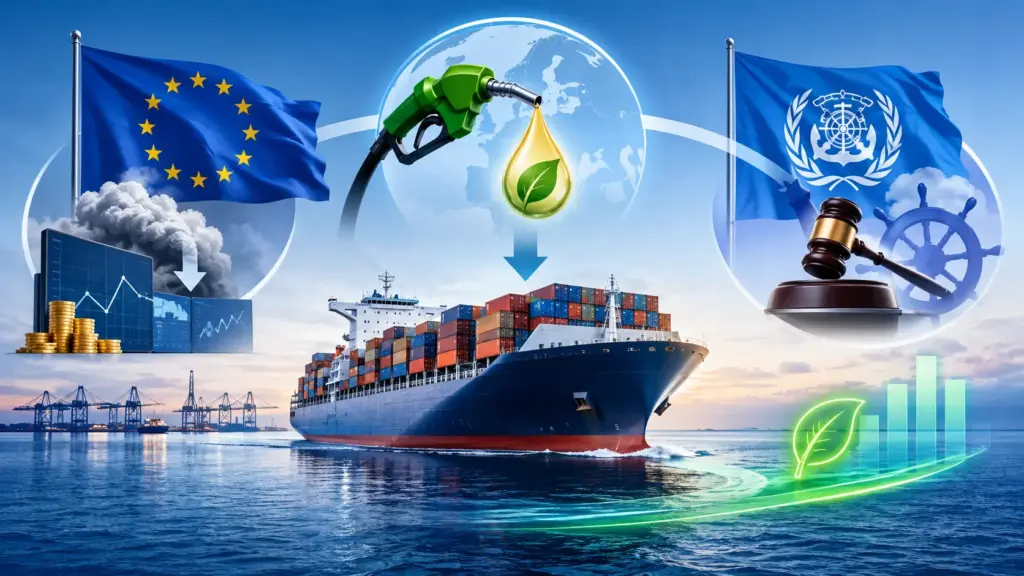
There is no single global maritime carbon tax on shipping. Since 1 January 2024, ships of 5,000 gross tonnage and above that call at EU and EEA ports must buy EU Emissions Trading System allowances for their CO2 emissions, and since 1 January 2025 FuelEU Maritime has penalised fuel that misses an EU greenhouse-gas intensity limit. (A, if adopted) The IMO’s Net-Zero Framework, adopted in 2026 adds the first global price on ship emissions from. (B, if not adopted) A global IMO price, the Net-Zero Framework, was approved in draft in April 2025 but has not yet been adopted.
The cost falls on the shipping company, not on the seafarer. What changes for crew is the work: more emissions data to record, tighter speed and fuel discipline, and new fuels that need new certificates.
The three regimes at a glance
Is there a maritime carbon tax on shipping?
Not in the strict sense. No government levies a per-tonne tax on ship emissions the way some countries tax fuel. What exists is a set of carbon pricing rules. The EU makes ships buy allowances in a capped market. FuelEU fines ships whose fuel is too carbon-intensive. The IMO framework, as drafted, would make ships that exceed a global fuel-intensity line buy remedial units, and would pay ships that run on zero or near-zero fuels. People call all three a “carbon tax” because the effect is the same: burning fossil fuel now costs money beyond the fuel itself.
How the EU ETS works for ships
The EU extended its Emissions Trading System to maritime transport from 1 January 2024. Each year a shipping company monitors the CO2 its ships emit within scope, has the figure verified, and surrenders one allowance for each tonne.
The obligation was phased in:
| Emissions year | Share that must be covered by allowances | Surrender deadline |
|---|---|---|
| 2024 | 40% | 30 September 2025 |
| 2025 | 70% | 30 September 2026 |
| 2026 onward | 100% | 30 September of the following year |
Editorial note: Do not describe 30 September as the emissions-reporting deadline. It is the allowance-surrender deadline. The verified emissions report has a separate reporting timetable.Methane and nitrous oxide come into scope from 2026, which matters for LNG-fuelled ships because methane slip now carries a cost. Offshore ships of 5,000 GT and above are due to be included from 2027. Smaller general cargo and offshore ships (400–5,000 GT) report emissions under EU MRV from 2025 but are not yet in the trading system.
Offshore ship inclusion: Under Directive (EU) 2023/959, offshore ships of 5,000 gross tonnage (GT) and above are included in the EU MRV system from 1 January 2025 and in the EU Emissions Trading System (EU ETS) from 1 January 2027. Offshore ships between 400 and 5,000 GT are subject to MRV reporting from 2025, while their potential inclusion in the EU ETS is subject to the Commission’s review under Article 3gg(5).
In practice, most charter parties now pass the allowance cost to the charterer, usually through an ETS clause such as BIMCO’s.
BIMCO contractual mechanism: BIMCO published the ETS – Emission Trading Scheme Allowances Clause for Time Charter Parties 2022 (ETSA Clause) to allocate responsibility for monitoring emissions and providing, transferring and surrendering emission allowances between shipowners and time charterers. The clause generally places the cost of allowances on the party responsible for supplying and paying for the vessel’s fuel, subject to the parties’ contractual agreement.
How FuelEU Maritime works
FuelEU Maritime sets a cap on the greenhouse-gas intensity of the energy a ship uses, measured well-to-wake against a 2020 baseline of 91.16 gCO2e per megajoule. The cap tightens every five years:
| From | Required reduction vs 2020 baseline |
|---|---|
| 2025 | 2% |
| 2030 | 6% |
| 2035 | 14.5% |
| 2040 | 31% |
| 2045 | 62% |
| 2050 | 80% |
A ship that misses the limit pays a penalty of €2,400 per tonne of VLSFO-equivalent energy it fell short by. Ships can bank surplus, borrow against next year or pool compliance across a fleet. From 2030, container and passenger ships must also use shore power at berth in major EU ports.
Onshore Power Supply (OPS): Under Article 6 of Regulation (EU) 2023/1805, containerships and passenger ships above 5,000 GT must use OPS or eligible zero-emission technology at covered EU ports from 1 January 2030, extending to other EU ports where OPS is available from 1 January 2035. Member States may extend the requirement earlier. Exemptions apply.
What the IMO is doing
The IMO’s 2023 Strategy on Reduction of GHG Emissions from Ships commits the industry to net-zero emissions “by or around, i.e. close to, 2050”. Its checkpoints, against 2008, are a cut in total annual GHG of at least 20%, striving for 30%, by 2030, and at least 70%, striving for 80%, by 2040. It also targets zero or near-zero fuels making up at least 5%, striving for 10%, of the energy shipping uses by 2030.
Two IMO rules already in force shape day-to-day operations. Since 1 January 2023, ships of 5,000 GT and above have had an Energy Efficiency Existing Ship Index (EEXI), a one-off design measure, and an annual Carbon Intensity Indicator (CII) rating from A to E. A ship rated D for three consecutive years, or E in a single year, must file a corrective action plan.
The Net-Zero Framework is the step that would put a global price on emissions. As approved in draft at MEPC 83 in April 2025, it sets an annual limit on the GHG intensity of a ship’s fuel, with two tiers. Ships above the line buy remedial units; ships using zero or near-zero fuels earn rewards from an IMO Net-Zero Fund.
Who actually pays?
The legal obligation sits with the shipping company. Under the EU ETS that is the ISM Document of Compliance holder unless another entity has formally taken it on. Commercially, the cost moves down the chain: to charterers through charter clauses, then to cargo owners through freight rates and surcharges. Seafarers do not pay any of these charges, and none of them is deducted from wages.
What carbon pricing means for seafarers
This is where the regulation reaches the wheelhouse and the engine room.
More data, recorded more carefully. Fuel consumption, bunker delivery notes, distance run and hours at berth now feed verified emissions reports with money attached. Errors in the engine log or the noon report become a compliance cost for the company, so expect closer checks.
Speed and fuel discipline. CII ratings and allowance costs both reward slower steaming, voyage optimisation and less time idling. That can mean longer passages and tighter fuel-management routines on board.
New fuels need new competence. LNG, methanol and, later, ammonia and hydrogen bring new hazards. Ships running on low-flashpoint fuels fall under the IGF Code, and crew on them need STCW Regulation V/3 basic or advanced IGF training, endorsed by the flag. The IMO has also approved interim guidelines on training for seafarers on ships using alternative fuels.
The training gap is large. A study for the Maritime Just Transition Task Force estimated that up to 800,000 seafarers may need additional training by the mid-2030s if shipping moves to zero-carbon fuels.
Seafarer training: A 2022 DNV study for the Maritime Just Transition Task Force estimates that 450,000 seafarers will require additional training by 2030 and 800,000 by the mid-2030s under the Zero Carbon by 2050 scenario, reflecting the anticipated uptake of alternative marine fuels.
Officers and ratings who already hold gas or IGF certificates will be in demand first. If you are working towards LNG-fuelled or gas-carrier work, our guide to LNG and gas carrier certification explains the difference between IGC and IGF training and how a flag endorses each one.
Where Seaman Books fits
Seaman Books is a documentation consultancy, not an emissions-compliance provider: we do not verify emissions, trade allowances or advise on charter clauses. We prepare and coordinate the seafarer side: flag-state seaman books, endorsements of your STCW certificates by Panama, Liberia, Palau and other administrations, and STCW training arranged through Atomiq College or an approved partner centre in the UAE.
Not sure which documents you need for your next contract? Run the free eligibility check or message us on WhatsApp +971 55 458 3416.