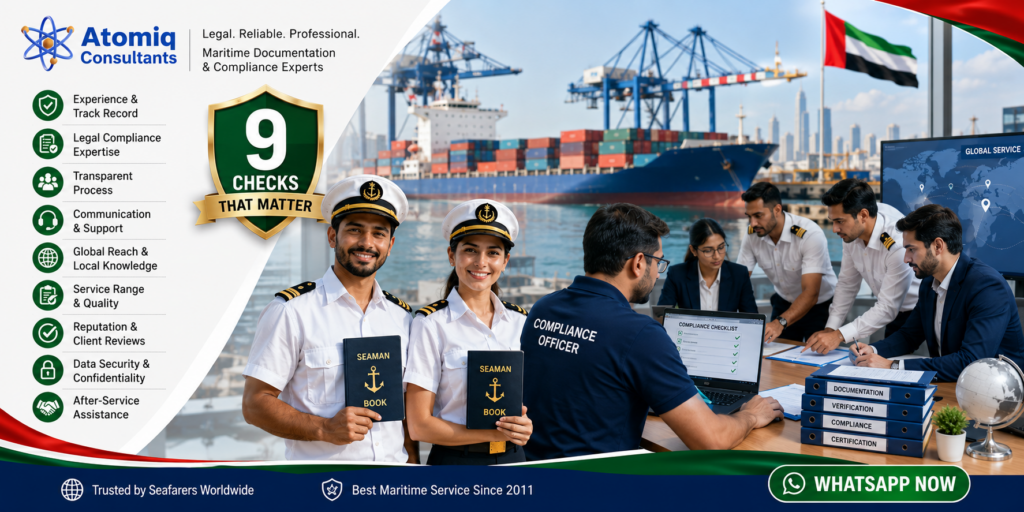
Nine checks before you choose a maritime document consultancy
- A named authority and a visible accountability chain. Ask which administration, registry or class body ultimately issues what you are buying, and how the provider files into it. A real firm answers with a name and a route — Panama Maritime Authority, the Liberian registry, the Bahamas Maritime Authority. “We handle everything” and “our partner takes care of it” are not answers. If this check fails, nothing below it matters.
- A verifiable legal entity and a physical office. Trade licence number, registered address, named people you can reach twice. A Dubai-registered consultancy can produce a license number on request; a WhatsApp number and a logo is not a company.
- A documented quality system you can check. ISO 9001:2015 is the common signal — but ask for the certificate number and the certification body, then verify it. An uncheckable claim is marketing, not a control.
- Scope that matches your next problem, not just today’s. If STCW refreshers and offshore courses land in six months, splitting documentation and training across two vendors doubles your coordination work. Check the provider’s full service range against what you will need next.
- A verification path for the finished document. A good provider volunteers how you will confirm the document is genuine — the registry portal, the certificate reference, the lookup steps. If verification is treated as an insult, that is your answer. Our walkthrough on how to verify a seaman book online lists the official channels, and the scams guide covers what evasion here usually means.
- Turnaround in writing, with a pre-submission check. The number matters less than what sits behind it. Ask whether files are compliance-checked before submission or after rejection. Realistic timelines vary by registry — the flag-state comparison on cost, time and acceptance has the specifics. A blanket “24 hours, any flag, guaranteed” is a sales number, not an operational one.
- Transparent pricing into a company account. An itemized quote separating government fees from service fees, paid to a corporate bank account. Personal accounts, crypto and cash-only pricing are not payment preferences; they are audit avoidance.
- Clear handling of documents and data. You are sending passports, photographs and sea service records. Ask who holds originals, how scans are stored, how long they are retained and how they are destroyed. Any provider handling EU or UK seafarers should answer in data-protection terms without stalling.
- One named owner and an escalation route. The most common failure in this industry is not fraud — it is drift. Files sit because nobody owns them. Ask who your contact is, who covers their leave, and what happens on day ten of a five-day promise.
How to shortlist the best maritime service providers for your operation
Rankings and “top 10” lists are a starting point, not a shortlist. Five steps turn one into the other.
- Write the deliverable, not the service. “Six ratings deployable to a Panama-flagged vessel by 14 October” is a brief. “Crew documentation support” is a shopping category, and you will get quotes you cannot compare.
- Pick the category first. Match the deliverable to one of the five above. This eliminates most of any published list in a single pass.
- Verify authority before comparing price. Run check 1 on every candidate. Price comparisons between a firm that files with the registry and one that cannot are meaningless.
- Test with one file before you commit a fleet. Send a single real application and watch the process — what they ask for at intake, whether they flag problems early, how they communicate on day three. One file tells you more than any proposal.
- Buy the process, not the promise. Choose the provider whose answers were specific, not the one whose numbers were best. Specificity survives contact with a registry queue; optimism does not.
Extra checks when you’re buying for a fleet
Volume changes the failure modes. A process that holds for one application quietly collapses at forty.
- Intake quality control. Errors must be caught at intake, not at registry rejection. One bad photograph found late can cost a joining date.
- Genuine multi-flag competence. Multiple flags means multiple rulebooks. Confirm they file with each flag you use rather than sub-contracting the unfamiliar ones.
- Scheduling from sign-on dates backwards. The deliverable is a crew member who can board. Ask them to work back from your rotation, not forward from their queue.
- Commercial hygiene. Purchase orders, consolidated invoicing, a named account manager, agreed reporting on file status. Our page on bulk crew documentation for crewing managers sets out what a managed pipeline looks like.
- Auditable record retention. When a port state inspector asks, you need the certificate, the issuing reference and the date — retrievable in minutes.
Compliance ground rules a good provider raises unprompted
- Only flag states and their authorized bodies issue. Seafarer certification sits with the flag-state administration under the IMO’s STCW Convention, as amended in Manila in 2010. Consultancies prepare and file.
- Seafarers should not be charged recruitment fees. Under the Maritime Labour Convention, 2006, recruitment and placement services must not charge seafarers for finding them work. A “document plus guaranteed job” bundle priced to the seafarer is a compliance problem, not a package.
- Identity documents are a state function. ILO Convention No. 185 places seafarers’ identity document issuance with the state of nationality or permanent residence, under defined security standards. No agency substitutes for that.
- Sea service is recorded, not created. Any offer to backdate or manufacture service entries ends the conversation and puts every genuine document you hold at risk.
Run a 20-minute vetting call
Six questions, in this order. Listen for the shape of the answer, not its confidence.
- Which authority issues this, and how do you file into it? → A name and a route.
- Trade license number and registered address? → Given without friction.
- What could cause this to be rejected, and what do you check before submitting? → A specific list. Vagueness means no pre-submission check exists.
- How will I verify it once issued? → A portal or reference, offered willingly.
- Split the price into government fees and your fee, and name the payment account. → Itemized, corporate account.
- If it misses the promised date, who do I call and what happens? → A name and a process.
Two evasions in six is enough. You are not being difficult; you are doing what any procurement function would do, on paperwork that gatekeeps someone’s career.
Where Seamanbooks.com fits
Seaman Books, operated by Atomiq Group Consultants from Regal Tower in Business Bay, Dubai, sits in the fourth category above — documentation and crew compliance. It has processed seafarer documentation since 2011 as an ISO 9001:2015-certified documentation support agency, filing with flag-state administrations across Panama, Palau, the Bahamas, Belize, St. Kitts & Nevis, Liberia and Honduras, alongside STCW certification and offshore training coordination.
Run the nine checks on us. Then run them on everyone else you are considering — that comparison is the entire point of this guide. If you would rather start from a live case than a checklist, tell us the flag, the rank and the joining date, and we will tell you what is realistic.
Frequently asked questions
What is a maritime consultant?
A maritime consultant advises shipowners, operators and seafarers on regulatory, technical and documentation requirements. Depending on specialism, that spans flag-state compliance, seafarer certification, marine surveying, accident investigation or crew management. Consultants prepare and advise; issuing authority stays with flag states and class societies.
What are maritime services?
Maritime services are the commercial and technical services supporting ships and seafarers: ship management, class and statutory certification, marine consultancy and surveying, seafarer documentation and training, crew management, and port services such as agency and chandlery. Each is delivered by a different type of provider.
Which maritime company is best?
There is no single best — it depends on which of the five provider categories your deliverable falls into. A top-ranked ship manager cannot issue a seafarer document, and a documentation consultancy cannot run your vessel. Define the deliverable, pick the category, then compare within it.
What is the difference between a maritime consultancy and a ship management company?
A ship management company operates vessels on the owner’s behalf under an ISM system, taking on technical and crewing responsibility. A maritime consultancy advises and processes on specific requirements — documentation, certification, compliance — without assuming operational control of the vessel.
How do I check that a maritime service provider is legitimate?
Ask which authority issues what you are buying and how they file into it, request the trade license number and registered address, confirm how you will verify the finished document through an official channel, and require an itemized quote paid to a company bank account.
Do maritime consultancies issue seaman books or certificates?
No. Seaman books, CDCs and statutory certificates are issued by flag-state maritime administrations or bodies they authorize. A consultancy prepares the application, checks it for compliance and files it. Any provider claiming to issue directly is misrepresenting how the system works.
Choose on process, not on promises
Every provider in this market sounds competent on a landing page. The difference shows in whether they can name the authority, show you the verification path, and tell you who owns your file at 5pm on a Thursday. That is a twenty-minute conversation, and it is cheaper than a rejected application and a missed contract.