Which consulate, and from which country
Two rules decide where you apply.
1. Which Member State. Apply to the consulate of the country you are going to, which for a sign-on is normally the country where the ship is. If your stay covers several countries, apply to the one where you spend longest. If the stays are equal, apply to the country you enter first (EC, Applying for a Schengen visa). For transit through several Member States, the competent one is where you “intend to cross to start the transit” (Art. 5(2)(b)).
2. Which country you apply from. You apply at that Member State’s consulate (or visa centre) covering the place where you legally reside (Art. 6(1)). A consulate may also accept an application from someone legally present but not resident, if they can justify applying there (Art. 6(2)).
For crew based in the UAE and the GCC, this is the practical point. If you hold a UAE residence visa, you normally apply in the UAE, not in your home country, even when your passport is Indian, Filipino, Nepali or Pakistani. If you are only visiting the UAE, expect to justify applying there, or to be sent home to apply.
Example: a Nepali AB resident in Dubai joins a tanker in Rotterdam, flying via Frankfurt. The stay is in the Netherlands, so the competent Member State is the Netherlands. The application goes to the Dutch consulate or its visa centre covering the UAE.
When to apply: the nine-month rule for crew
This is the provision most seafarers do not know about. The Visa Code lets crew apply earlier than anyone else:
| Applicant | Earliest you can apply | Latest, as a rule |
|---|---|---|
| Ordinary traveller | 6 months before the trip | 15 calendar days before |
| Seafarer in the performance of duties | 9 months before the trip | 15 calendar days before |
Source: Visa Code Art. 9(1). The same article lets a consulate accept a later application in justified cases of urgency, but the consulate decides, and it is not something to plan around.
Processing time: the consulate decides within 15 calendar days of an admissible application. In individual cases it can extend that to 45 days (Art. 23). Appointment waiting time comes on top of that, and in peak season it is often the longer delay.

Planning rule: count back from the sign-on date. Allow the appointment wait for your consulate, plus 45 days, plus courier time. If the contract is offered closer than that, tell your manning agent at once rather than booking flights.
Schengen visa documents for seafarers: the checklist
The first block is what every consulate asks for. The second is what a crew application is judged on.
| Document | Required or likely | Why it matters |
|---|---|---|
| Completed Schengen application form | Required | The application |
| Passport | Required | Note: The three-month period is calculated from the intended departure date, not the date of arrival or visa application. In justified emergency cases, the validity requirement may be waived. |
| Photograph to the consulate’s specification | Required | Identity |
| Visa fee | Required | EUR 90 (see above) |
| Travel medical insurance, or evidence your employer covers you | Required, but see note | Art. 15(6) lets the consulate treat the requirement as met for “particular professional groups, such as seafarers” already covered through their work. Bring the P&I or employer cover letter. The consulate decides |
| Letter from the shipowner, manager or manning agent naming the vessel, port, join date and your rank, with an undertaking for your costs and repatriation | Likely, and decisive | It shows the purpose of the trip and the return the consulate has to be satisfied of |
| Employment contract or offer | Likely | Purpose |
| Seaman’s book (CDC / SIRB), valid, with your name exactly as in the passport | Likely | Shows you are a working seafarer. An expired or mismatched book weakens the application |
| STCW certificates and flag-state endorsements for the rank you are joining as | Likely | Supports the rank in the letter |
| Flight itinerary that matches the join date | Likely | Consistency |
| Proof of legal residence (e.g. UAE residence visa) if applying outside your home country | Required under Art. 6 | Establishes the consulate’s competence |
What sinks crew applications most often is a mismatch, not a missing document. The name, rank or join date differs between the passport, the seaman’s book, the agent’s letter and the ticket. Each document can be valid on its own and the file still fails as a whole. Our crew document audit checklist covers exactly this check.
The seafarer visa at the border: Article 36, and why it is a last resort
The Visa Code has a provision that exists only for crew:
“A seafarer who is required to be in possession of a visa when crossing the external borders of the Member States may be issued with a visa for the purpose of transit at the border where … he is crossing the border in question in order to embark on, re-embark on or disembark from a ship on which he will work or has worked as a seafarer.” Visa Code, Art. 36(1)
It is not an alternative to applying in advance. It depends on the general border-visa conditions in Article 35(1), which apply only “in exceptional cases”:
- you meet the normal entry conditions;
- you could not apply in advance and can show unforeseeable, imperative reasons, for example a crew change ordered at short notice after illness on board;
- your return or onward travel is assessed as certain, which in practice is what the agent’s letter of guarantee is for.
A border visa allows a stay of 15 days at most (Art. 35(3)). Your shipping agent, not you, arranges this with the border authority before you fly. Never board a flight expecting to get a visa on arrival. If the conditions are not met, you are refused entry and the airline flies you back.
Validity, multiple entries and the 90/180 rule
- A type C visa allows up to 90 days in any 180-day period, across all Schengen countries combined.
- A consulate may issue a multiple-entry visa with longer validity (one, two, then five years) to applicants with a record of using previous visas lawfully (Art. 24(2)). For crew who sign on and off in European ports every contract, a clean visa history pays off.
- The visa lets you join the ship. It does not cover a stay ashore beyond what it states. Shore leave in port during a contract is a separate matter for the port State.
Your seaman’s book is not a Schengen visa
A seaman’s book is issued by a flag-state administration and records your identity and sea service. A Schengen visa is granted by a Member State. Neither one replaces the other. The consulate uses your book to confirm that the reason for your trip is real. That is why an expired CDC, or a book in a name spelled differently from your passport, causes trouble well before anyone looks at your flight.
What Seaman Books does, and what it does not do
Seaman Books does not issue Schengen visas, does not book consulate appointments, and cannot influence a consular decision. Only the competent Member State decides.
What we do is make sure the seafarer file behind your application holds together before it reaches the consulate:
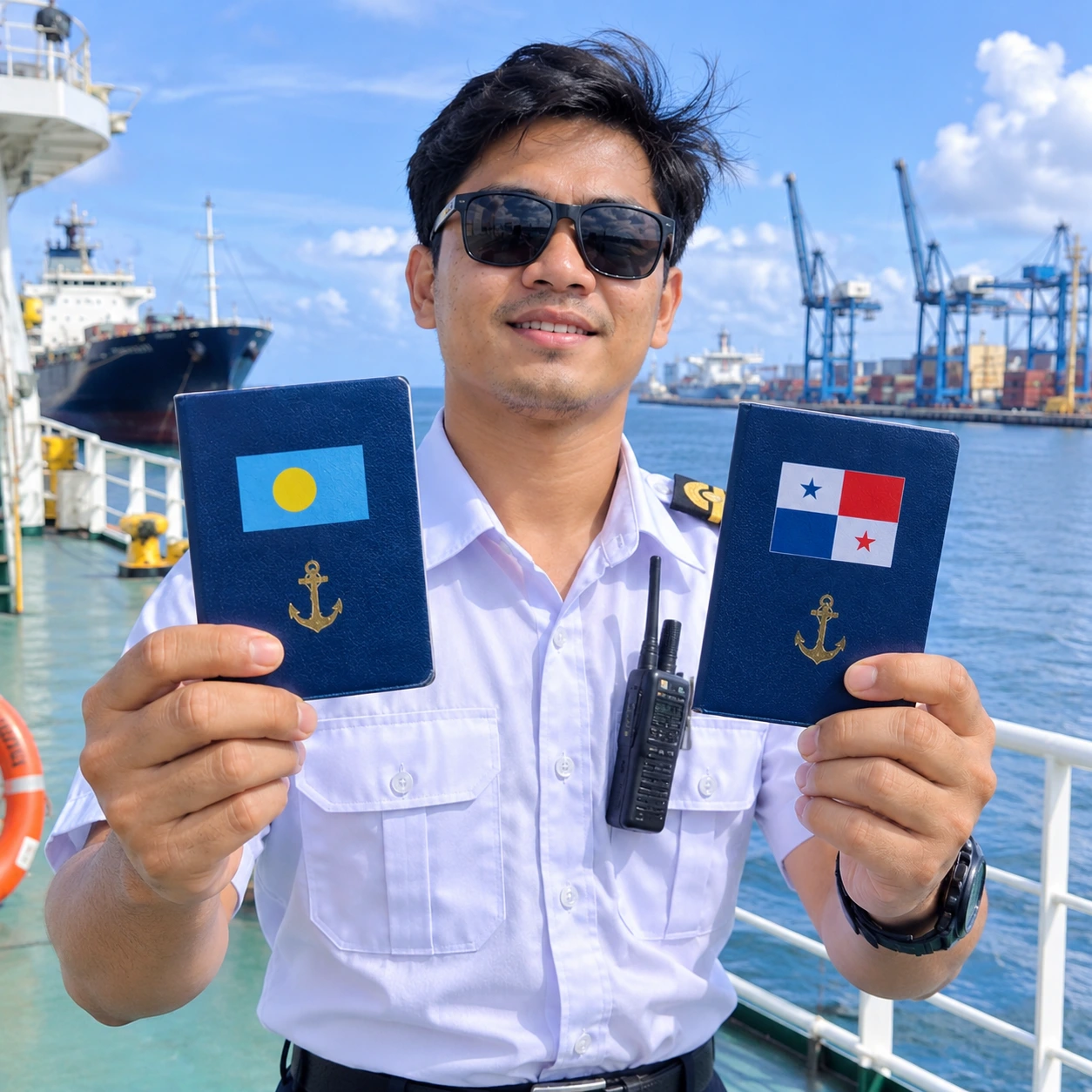
- Flag-state seaman’s book (Panama, Liberia, Bahamas, Belize, Palau, Honduras, St. Kitts & Nevis), filed and checked so your rank and name match your joining letter. See seaman book requirements.
- Liberia SIRB as an authorised LISCR filing agent. See Liberia seaman book.
- STCW certificates and refreshers through Atomiq College, the Group’s training institute, in Kathmandu or at an approved partner centre in the UAE. See STCW certifications.
- For manning agents mobilising crew to European ports: a document audit across the crew list before visa appointments are booked. See crew documentation for business.
Know your file is ready before you apply
One goal. Different needs. Personalised solutions.
Every seafarer’s file is different: nationality, residence, rank, flag and the documents already held. That is why our service fees vary with what your file actually needs.
- Eligibility and file assessment. We review your passport, seaman’s book, certificates and joining letter against what a Schengen consulate will look at.
- Itemised quotation. Once we know what is needed, you get an itemised quote of the costs and service fees involved.
- Individual WhatsApp guidance. A member of our team guides you personally through each step, the charges and what comes next.
- Full transparency. All service fees are quoted before you proceed. We make no vague price promises and add no unexpected charges.
Country-based pricing | Itemised quotation | Personal WhatsApp guidance
Joining a ship in Europe? Get your documents checked first. Message the documentation team on WhatsApp at +971 55 458 3416, or visit us at #903 Regal Tower, Business Bay, Dubai (Mon–Sat, 9:30am–6:00pm ).
Frequently asked questions
Do seafarers need a Schengen visa?
Yes, if their passport is on the EU visa-required list. Being crew does not exempt you. Joining or leaving a ship in a Schengen port normally needs a type C short-stay visa from the country where the vessel is. Visa-exempt nationals do not need one, but will need ETIAS once it starts.
How much is a Schengen visa for seafarers?
EUR 90 for adults, the same as any other applicant. There is no separate crew rate. Where the consulate uses a visa centre, a service fee of up to half the visa fee may be added. Fees are paid to the consulate or its visa centre, never to a documentation agent.
How early can a seafarer apply for a Schengen visa?
Up to nine months before the trip, compared with six months for ordinary travellers. Article 9(1) of the EU Visa Code gives this longer window to seafarers travelling in the performance of their duties. The latest, as a rule, is 15 calendar days before you travel.
How long does a Schengen visa take for crew?
The consulate decides within 15 calendar days of an admissible application, extendable to 45 days in individual cases. Add the wait for an appointment, which is often the longer delay. Plan back from your sign-on date and do not book flights before the visa is in your passport.
Can a seafarer get a Schengen visa at the border?
Only in exceptional cases. Article 36 lets a border authority issue a transit visa to a seafarer embarking on or leaving a ship, but only if they could not apply in advance and their return is assessed as certain. It is limited to 15 days and is arranged by the shipping agent before travel.
Which country’s consulate do I apply to?
The country where your ship is, which is your main destination. If you transit through several Member States, it is the one where your transit starts. You apply from the country where you legally reside, so a seafarer with UAE residence normally applies in the UAE.
Do seafarers need travel insurance for a Schengen visa?
Usually yes, but Article 15(6) of the Visa Code lets a consulate treat the requirement as met for professional groups such as seafarers who are already covered through their employer. Bring your employer or P&I cover letter. The consulate decides whether it is enough.
Does a seaman’s book replace a Schengen visa?
No. A seaman’s book is issued by a flag-state administration and records identity and sea service. A Schengen visa is granted by a Member State. The consulate uses your book to confirm you are a working seafarer, so an expired or mismatched book weakens the application.