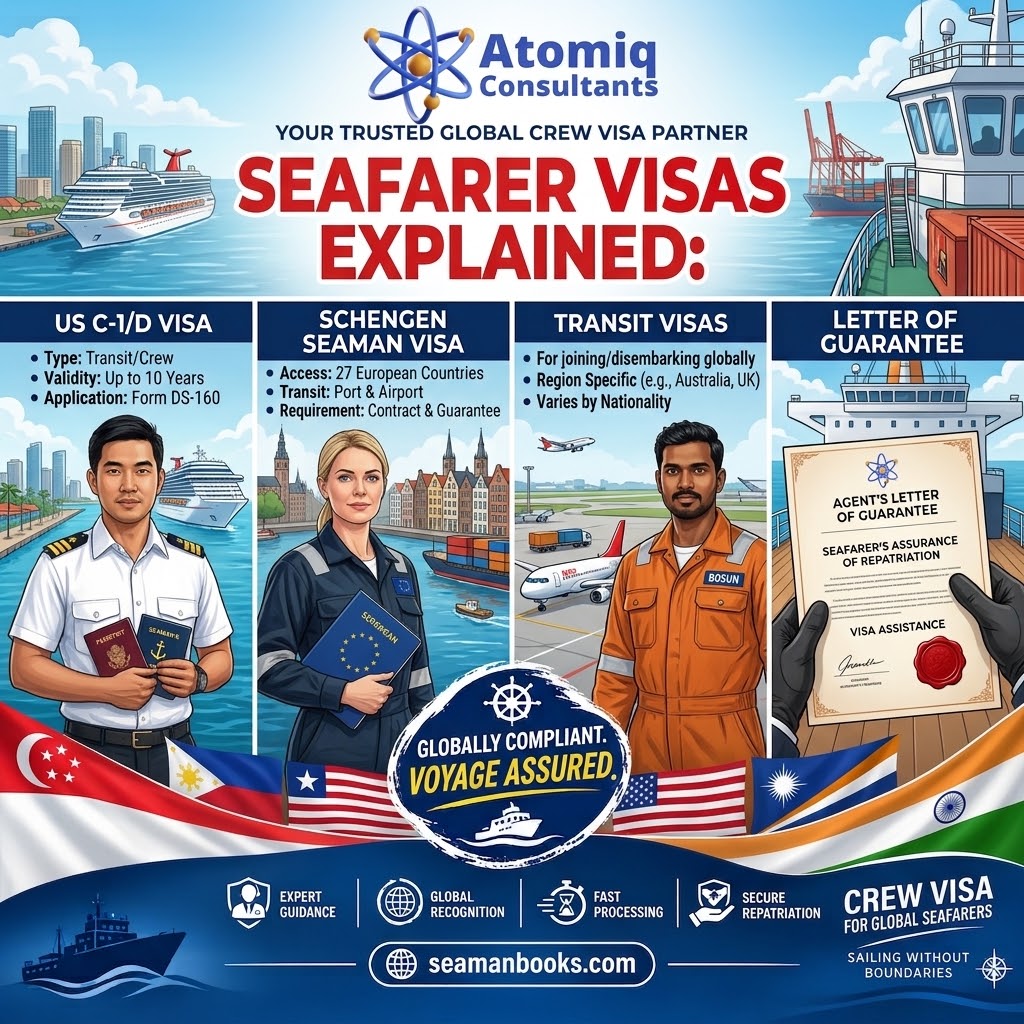
A “seafarer visa” is not one document. Joining a ship normally means one of three: the US C-1/D crewmember visa, which combines transit (C-1) and crew (D) and carries a US$185 application fee; a Schengen visa, including the transit visa a seafarer may be issued at the border itself under Article 36 of the EU Visa Code; or a national transit visa such as the UK’s, alongside a £20 UK Electronic Travel Authorisation if you pass through border control. A letter of guarantee from the shipping company or its agent is the document that ties them together — it names the vessel, the join port, and who carries the cost of getting you home. None of them replaces your seaman’s book. Every one of them is assessed against it.
Which visa you need depends on three things, not on your rank
Crew visas are decided by the route, not the job. Three questions settle almost every case:
- Where does the vessel trade? A US port means the C-1/D. A European port usually means Schengen. Nothing else follows automatically.
- How do you get to the ship? Flying to join a vessel is transit, and transit is often its own visa — separate from the one that lets you work on board.
- What passport do you hold? Visa requirements, validity and the number of entries are set per nationality, not per seafarer.
The third one is the trap. Two ABs on the same contract, joining the same ship on the same day, can face different requirements and different visa validity purely because of the passports they hold. Never plan a join date on a colleague’s experience.
| You are | Route | What you are likely to need |
|---|---|---|
| Joining a vessel calling at a US port | Fly to the US, board there | US C-1/D (transit + crew, issued as one where reciprocity allows) |
| Joining a vessel in a Schengen port | Fly into the Schengen area | Schengen type C visa, or a seafarer transit visa issued at the border under Article 36 |
| Changing flights in the UK, airside only | Never pass UK border control | Direct Airside Transit visa if your nationality requires one |
| Passing through UK border control to join a ship | Leave the UK within 48 hours | Visitor in Transit visa, or an ETA where that applies |
| Signing on or off in a GCC port | Fly into the UAE, Saudi Arabia, Oman, Qatar“GCC crew entry is arranged port-by-port through the vessel’s local shipping agent and the rules are not published in one consolidated place.” |
Legal review: This table is provided for general informational and routing purposes only and does not constitute legal advice. Requirements may vary by jurisdiction and individual circumstances. Please have the applicable requirements reviewed by qualified legal counsel before relying on them for a specific matter.
The US C-1/D crewmember visa
The D visa is for people working on board — the US State Department names “captain, engineer, or deckhand on a sea vessel” among the examples. The C-1 is the transit visa you need to travel to the US in order to reach and board that vessel. Because almost every joining seafarer needs both, they are usually issued together:
“If you apply for the transit (C-1) visa at the same time as your crewmember (D) visa, you may be issued a combination C-1/D visa” — where your country’s reciprocity schedule permits it. — US Department of State, Crewmember Visa
What the application involves
| Step | Detail |
|---|---|
| 1 | Complete Form DS-160 online |
| 2 | Pay the application fee — US$185 for non-petition-based nonimmigrant visas, the category C-1/D sits in (State Department fee schedule) |
| 3 | Schedule an interview at a US Embassy or Consulate |
| 4 | Attend the interview with your documents |
Documents the State Department lists: a passport valid at least six months beyond your intended stay; the DS-160 confirmation page; the fee receipt; the photo uploaded with the DS-160; and evidence of your employment or transit purpose if requested.
Two facts worth knowing before you plan a join date.
You do not have to be employed to apply: “You may apply for a crewmember visa without being employed at the time of your visa application.” That matters — a C-1/D already in your passport when the offer lands is the difference between joining on time and losing the contract.
And the visa does not let you stay. A crewmember on a D visa who is not engaged in lightering must depart the United States on a vessel within 29 days; lightering crew (D-3) have 180 days.
[VERIFY: The standard U.S. nonimmigrant visa application fee is currently US$185 for B visitor visas. Any additional visa issuance (“reciprocity”) fee, along with the permitted number of entries and visa validity period, is specified by country/area of authority and visa classification in the U.S. Department of State’s current Visa Reciprocity Schedule. Check the current country-specific schedule before publication. Do not publish a validity figure (such as 5 years, 10 years, or single-entry) or an additional issuance fee for any nationality without confirming it against the current State Department schedule.]
What actually delays a C-1/D is not processing. It is the interview appointment. Wait times are published per post by the State Department and in some markets run to months. Start the day you have a conditional offer, not the day you have a join date.
H2: Schengen — and the transit visa a seafarer can be issued at the border
Non-EU nationals need a visa for the Schengen area for stays of up to 90 days, counted on a rolling basis: “When someone enters a country in the Schengen area, the 180-day period starts. They can enter Schengen area countries as many times as they want, but only stay for a total of 90 days, every 180 days” (European Commission, visa policy).
The ordinary route is a short-stay type C visa applied for at the consulate of the main destination country, before travel. Apply that way whenever the join date allows it.
The provision most seafarers have never heard of sits in Article 36 of the EU Visa Code and exists for exactly the case where it did not:
“A seafarer who is required to be in possession of a visa when crossing the external borders of the Member States may be issued with a visa for the purpose of transit at the border where: (a) he fulfils the conditions set out in Article 35(1); and (b) he is crossing the border in question in order to embark on, re-embark on or disembark from a ship on which he will work or has worked as a seafarer.” — Regulation (EC) No 810/2009 (Visa Code), Article 36, consolidated text of 2 February 2020
The Article 35(1) conditions it refers back to are strict, and worth reading in full because they are the reason most border applications fail:
“In exceptional cases, visas may be issued at border crossing points if the following conditions are satisfied: (a) the applicant fulfils the conditions laid down in Article 5(1)(a), (c), (d) and (e) of the Schengen Borders Code; (b) the applicant has not been in a position to apply for a visa in advance and submits, if required, supporting documents substantiating unforeseeable and imperative reasons for entry; and (c) the applicant’s return to his country of origin or residence or transit through States other than Member States fully implementing the Schengen acquis is assessed as certain.”
Three things follow, and they are the whole point of the provision:
- It is exceptional, not an alternative. “Has not been in a position to apply in advance” means a crew change that moved, not a crew change you did not plan for.
- A visa issued at the border is short — the Visa Code limits it to a maximum of 15 days.
- “Return assessed as certain” is what your paperwork has to prove. This is where the letter of guarantee does its work.

The UK — three different documents, and crew are not exempt from working it out
The UK splits transit into two visas depending on one question: do you cross the border?
| Situation | Document | Source |
|---|---|---|
| Changing flights, never passing UK border control | Direct Airside Transit visa — “Apply for a Direct Airside Transit visa if you’ll be changing flights in the UK and will not be going through UK border control” | gov.uk, transit visa |
| Passing through UK border control, leaving within 48 hours | Visitor in Transit visa — “if you’ll be going through UK border control but leaving the UK within 48 hours” | as above |
| Staying more than 48 hours, or transiting frequently over six months | Standard Visitor visa | as above |
| Passing through border control and eligible for it | ETA — “You need an ETA if you’re passing through border control at a UK airport before continuing your onward journey.” £20, valid for travel “for up to 6 months” | gov.uk, ETA guidance |
Stated plainly, because the honest answer is more useful than a confident one: the gov.uk transit visa page sets out no special provision for seafarers or for people joining a ship. Crew are routed through the same visitor and transit framework as everyone else.
[Note: UK Immigration Rules and current Home Office guidance contain specific provisions for seafarers and crew. In particular, current UK carrier guidance states that a visa-national seafarer travelling on duty, including in transit through the UK, may not need a visa where they hold a valid qualifying seafarer’s book issued in accordance with the applicable ILO requirements. Before publication, check the seafarer’s nationality, the issuing country and ILO status of the seaman’s book, the purpose and route of travel, and the current Home Office transit guidance to determine whether the exemption applies. Do not state that all seafarers require a DATV or Visitor in Transit visa without accounting for these crew provisions. Current published fees should also be checked against the Home Office fee table before publication.]
The letter of guarantee — the document that does the convincing
Every crew visa decision turns on the same underlying question: is this person genuinely joining a ship, and will they leave when they are supposed to? The Schengen provision says so outright — the applicant’s return must be “assessed as certain”. A letter of guarantee is how a shipping company or its appointed agent answers that in writing.
A letter of guarantee is issued by the shipowner, manager, manning agent or the vessel’s local port agent — never by the seafarer, and never by a documentation consultancy. It is the counterparty’s undertaking, which is exactly where its value comes from.
What a usable letter states:
- The seafarer’s full name, passport number and rank, matching the passport and the seaman’s book character for character
- The vessel name, IMO number and flag
- The port and expected date of joining or leaving
- The purpose — sign-on, sign-off or repatriation
- An explicit undertaking that the company accepts responsibility for the seafarer’s costs, including repatriation
- The issuing company’s letterhead, a named signatory with a position, and contact details a consular officer can actually call
The single most common failure is not a missing letter. It is a name mismatch. A passport reading one way, a seaman’s book reading another, and a letter of guarantee typed from a crew list that used a third spelling is enough to end an application. Check all three against each other before anything is submitted — it costs ten minutes and it is the cheapest rejection you will ever avoid.
H2: Your seaman’s book is not a visa — and the difference matters
A seafarer’s identity document or seaman’s book records identity and sea service. It is issued by a flag-state administration, and it is the document almost every crew visa application is assessed against: the consular officer uses it to confirm you are a working seafarer rather than someone with a job offer.
What it does not do is admit you to a country. Immigration status comes from a visa or an entry permit, granted by the state you are entering. A valid CDC and an invalid visa is a refused boarding.
There are international instruments that make shore leave and transit easier for holders of a recognised seafarer identity document, and MLC 2006 gives seafarers a right to shore leave.
[VERIFIED: ILO Convention No. 185 (Seafarers’ Identity Documents Convention (Revised), 2003, as amended) contains specific provisions in Article 6 concerning facilitation of shore leave and the transit and transfer of seafarers. The current ILO/NORMLEX record shows 40 ratifications. The IMO FAL Convention also contains facilitation standards relevant to crew and shore leave. Before publication, cite the current applicable FAL Standard/Recommended Practice from the latest IMO text. Do not state that a seafarer automatically requires or does not require a visa for shore leave solely because C185 or FAL applies; determine the position under the port State’s current immigration law and whether the relevant Convention is in force for that State.]
Our page on seafarer rights under MLC 2006 covers the repatriation and shore-leave entitlements behind this.
H2: What actually delays a crew visa
From the published rules rather than from anecdote, four things do the damage:
| Cause | Why it bites | What to do |
|---|---|---|
| Interview appointment availability | The C-1/D bottleneck is the calendar, not the adjudication | Apply on the conditional offer, not the join date. You may apply without being employed |
| Passport validity | The US requires validity at least six months beyond the intended stay | Renew at 12 months remaining, not at 6 |
| Document mismatch | Passport, seaman’s book and letter of guarantee spelling the same name three ways | Reconcile all three before submitting anything |
| An expired underlying document | An expired CDC, a lapsed STCW certificate or an out-of-date medical undermines the “genuine seafarer” case the visa rests on | Check expiry dates before the visa, not after |
The fourth is the one within your control and the one most often left too late. An expired seaman’s book takes longer to put right than a visa appointment.
H2: What Seaman Books does, and what it does not do
Stated plainly, because in this category the boundary is the trust signal.
We do not issue visas, and nobody can guarantee one. Visas are granted by the immigration authority of the destination state. Any agency promising you a C-1/D or a Schengen visa is promising something it cannot deliver.
What we do is prepare and verify the documentation those applications are assessed against, and coordinate it with the IMO- and ILO-ratified flag-state administrations that issue it:
- Flag-state seaman book / CDC — new application, renewal, transfer and replacement across Panama, Palau, Liberia, Bahamas, Belize, Honduras and St. Kitts & Nevis. See the service
- STCW and offshore training — arranged with accredited centres
- Offshore medical — the OGUK/OEUK certificate most offshore contracts depend on
- For employers and manning agents — crew mobilisation support, including visas, tickets and joining logistics, as part of crew documentation for business
Joining a ship and not sure which document is the weak link? Message the documentation team on WhatsApp at +971 55 458 3416, or visit the office at #903 Regal Tower, Business Bay, Dubai.
Frequently asked questions
Do seafarers need a visa?
Usually, yes — but which one depends on the route and your nationality, not your rank. Joining a vessel calling at a US port normally means a C-1/D. A Schengen port normally means a type C visa. A seaman’s book records identity and sea service; it does not grant entry to a country.
What is a C-1/D visa?
It is the combined US visa for crew: C-1 covers transit to reach your vessel, D covers working on board. The State Department issues them together where your country’s reciprocity schedule permits. The application fee is US$185 and the process runs through Form DS-160 and a consular interview.
Can I apply for a C-1/D before I have a job?
Yes. The State Department states you may apply for a crewmember visa without being employed at the time of application. Because interview availability is the real bottleneck, applying as soon as you have a conditional offer is usually the difference between joining on time and losing the contract.
How long can I stay in the US on a D visa?
A crewmember not engaged in lightering must depart the United States on a vessel within 29 days. Lightering crew on a D-3 visa have 180 days. The visa is for joining and working on a vessel, not for staying ashore.
Can a seafarer get a Schengen visa at the border?
In exceptional cases, yes. Article 36 of the EU Visa Code allows a transit visa to be issued at the border to a seafarer crossing in order to embark on, re-embark on or disembark from a ship. The conditions are strict — you must not have been in a position to apply in advance, and your return must be assessed as certain — and a visa issued at the border is limited to 15 days.
What is a letter of guarantee for a seafarer?
It is a written undertaking from the shipping company or its agent confirming that you are joining or leaving a named vessel and that the company accepts responsibility for your costs, including repatriation. It is what answers the question every crew visa decision turns on: will this person leave when they are supposed to?
Do I need a UK visa to change flights on the way to my ship?
It depends on whether you cross the border. Airside only, without passing border control, means a Direct Airside Transit visa if your nationality requires one. Passing through border control and leaving within 48 hours means a Visitor in Transit visa. An ETA, at £20 and valid for travel for up to six months, applies where you pass through border control and are eligible for it.
Does a seaman’s book replace a visa?
No. A seaman’s book is issued by a flag-state administration and records identity and sea service. A visa is granted by the country you are entering. Consular officers use the seaman’s book to confirm you are a working seafarer — which is why an expired one weakens a visa application well before anyone checks your ticket.