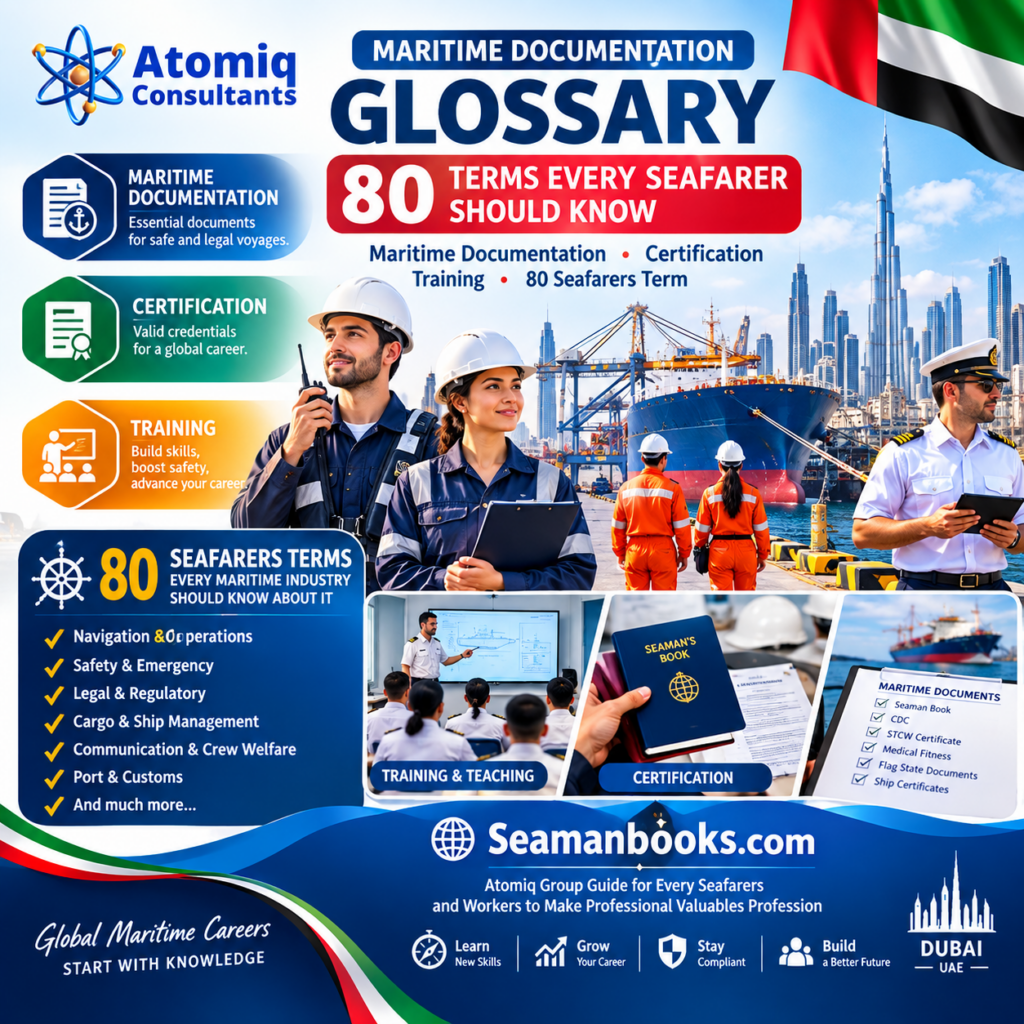
Maritime documentation glossary is the set of documents & term a seafarer needs to work on a ship: a seaman’s book issued by the ship’s flag state (also called a CDC or SIRB), STCW certificates of competency and proficiency, a flag-state endorsement when the certificate was issued by another country, and a medical certificate valid for up to two years. This glossary defines 80 of the terms seafarers meet most often, in eight groups, and links each one to its full guide.
Jump to: Seafarer identity and record documents · Certificates, endorsements and validity · STCW and offshore training · Medical and health certificates · Ranks, careers and sea service · Applications and documentation process · Conventions, codes and regulations · Authorities and organisations
Seafarer identity and record documents
Seaman’s book
A record and identity book issued by a flag-state maritime administration. It holds the seafarer’s personal details and photograph, and each ship served on is entered with rank and sign-on and sign-off dates. It proves seafarer status and sea service. It is not a passport, and it is not a licence to serve in a rank. The full seaman’s book guide →
CDC (Continuous Discharge Certificate)
The name India’s Directorate General of Shipping and several other administrations use for the seaman’s book. The name comes from the continuous record of discharges: the sign-off entries made each time a seafarer leaves a ship. In recruitment, “CDC” is often used loosely for any seaman’s book, whichever flag issued it. What a CDC is, in full →
SIRB (Seafarer Identification and Record Book)
The name the Liberian Registry and the Philippines’ Maritime Industry Authority (MARINA) use for their seaman’s books. The function is the same: identity plus a record of sea service. A Philippine SIRB and a Liberian SIRB are different documents, issued by different administrations. The Liberia seaman’s book →
Discharge book
An older and still widely used name for the seaman’s book, taken from the discharge entry made when a seafarer signs off. “Discharge book” and “seaman’s discharge book” refer to the same class of document as the CDC and the SIRB. Seaman’s book guide →
Libreta de Embarque
The Spanish name of the Panamanian seaman’s book, issued by the Autoridad Marítima de Panamá (Panama Maritime Authority) through its Gente de Mar (seafarers) directorate. English-language pages usually call it the Panama seaman’s book or Panama CDC. The Panama seaman’s book →
SID (Seafarers’ Identity Document)
A standardised seafarer identity document defined by ILO Convention No. 185 (2003), which revised Convention No. 108 (1958). It is issued by the seafarer’s country of nationality, not by the flag state, and is meant to ease shore leave and transit. Many countries do not issue one. Seafarer visas and transit →
SEA (Seafarer Employment Agreement)
The employment contract required by MLC 2006 (Regulation 2.1). It must be signed by the seafarer and by the shipowner or the shipowner’s representative, and the seafarer keeps a signed original. It sets out wages, hours, leave, repatriation and termination terms. Your rights under MLC 2006 →
Sea service testimonial
A signed statement from the master or the company confirming the ships served on, the rank, the dates and the duties. Administrations use it alongside seaman’s book entries to count qualifying sea service for a first certificate of competency or an upgrade. The required format varies by administration. How sea service leads to a CoC →
Crew list
The document naming everyone on board with rank, nationality and identity-document numbers, presented to port, customs and immigration authorities on arrival and departure. The numbers on it must match each seafarer’s seaman’s book and passport exactly. Crew documentation for companies →
Certificates, endorsements and validity
CoC (Certificate of Competency)
The licence to serve in a rank, such as Officer in Charge of a Navigational Watch, Chief Mate or Second Engineer Officer. An administration issues it after assessing qualifying sea service, approved training and an examination. It has to be earned; it cannot be bought or obtained through an agency. CoC vs CoP vs CDC →
CoP (Certificate of Proficiency)
A certificate attesting one specific competence rather than a rank, for example proficiency in survival craft, advanced fire fighting or tanker cargo operations. Depending on the country, it is issued by the administration or by an approved training institute. CoC vs CoP vs CDC →
Flag-state endorsement
A document from the administration of the ship’s flag that recognises a CoC issued by another country, so the holder can serve in that capacity on ships under the new flag. STCW Regulation I/10 requires it. Panama calls it a Refrendo; the Bahamas issues a Certificate of Recognition. How flag-state endorsement works →
Capacity and limitations
The capacity is the rank or function a CoC or endorsement allows, such as Master or Chief Engineer Officer. Limitations restrict it, for example by gross tonnage, propulsion power, near-coastal voyages or ship type. Serving outside a stated limitation counts as serving without a valid certificate. What your CoC covers →
Revalidation
The renewal of a CoC, and of certain CoPs, at intervals of no more than five years under STCW Regulation I/11. It is usually shown through recent qualifying sea service or by completing an approved course or assessment. STCW renewal →
GMDSS certificate
The radio operator certificate under STCW Chapter IV for the Global Maritime Distress and Safety System. The General Operator’s Certificate (GOC) is the standard one for deck officers on ships trading beyond coastal waters; the Restricted Operator’s Certificate (ROC) covers sea area A1 only. Deck department ranks →
Tanker certificates
Certificates of proficiency required for cargo duties on tankers: STCW Regulation V/1-1 for oil and chemical tankers and V/1-2 for liquefied gas tankers, each at basic and advanced level. Advanced certificates need tanker sea service as well as a course. LNG and gas carrier certification →
TRB (Training Record Book)
The book in which a cadet’s onboard training tasks are signed off by the ship’s officers during approved seagoing service. A completed TRB is part of the evidence for a first CoC at operational level. Deck ranks and the cadet route →

STCW and offshore training
BST (Basic Safety Training)
The entry-level STCW safety training every seafarer needs before taking on shipboard duties, under Regulation VI/1. It has four elements: Personal Survival Techniques, Fire Prevention and Fire Fighting, Elementary First Aid, and Personal Safety and Social Responsibilities. STCW certifications →
PST (Personal Survival Techniques)
The BST element covering abandoning ship, survival in the water, lifejackets, immersion suits and liferafts. The competence standard is STCW Code Table A-VI/1-1. It needs refresher training at least every five years. STCW certifications →
FPFF (Fire Prevention and Fire Fighting)
The BST element covering fire chemistry, prevention, portable and fixed extinguishing equipment, breathing apparatus and fire drills. The competence standard is STCW Code Table A-VI/1-2. It needs refresher training at least every five years. STCW certifications →
EFA (Elementary First Aid)
The BST element covering immediate action in a medical emergency on board: assessing a casualty, resuscitation, bleeding control and treating shock. The competence standard is STCW Code Table A-VI/1-3. Unlike PST and FPFF, it has no STCW refresher requirement. STCW certifications →
PSSR (Personal Safety and Social Responsibilities)
The BST element covering safe working practices, emergency procedures, pollution prevention, shipboard communication and working relationships, and fatigue. The competence standard is STCW Code Table A-VI/1-4. It has no STCW refresher requirement. STCW certifications →
Refresher training
Updating training required by STCW at least every five years for PST and FPFF, and for the Survival Craft and Rescue Boats and Advanced Fire Fighting certificates. It keeps the certificate valid for service; letting it lapse means repeating the course before the next sign-on. STCW renewal →
PSCRB (Proficiency in Survival Craft and Rescue Boats)
STCW Regulation VI/2 training for seafarers assigned to launch or take charge of lifeboats, liferafts or rescue boats other than fast rescue boats. It is a prerequisite for most officer CoCs and follows a five-year refresher cycle. Basic vs advanced STCW training →
AFF (Advanced Fire Fighting)
STCW Regulation VI/3 training in controlling fire-fighting operations on board, required for seafarers designated to lead fire teams and for officer CoCs. It builds on FPFF and follows a five-year refresher cycle. Basic vs advanced STCW training →
Medical First Aid and Medical Care
STCW Regulation VI/4 training. Medical First Aid is for the crew member designated to give first aid on board; Medical Care is for the person in charge of medical care, typically the master or a deck officer. Both go well beyond Elementary First Aid. Basic vs advanced STCW training →
Security training (SAT, DSD, SSO)
STCW Regulations VI/5 and VI/6. Every seafarer needs security awareness training; crew with designated security duties need the next level; the Ship Security Officer needs the SSO certificate. These requirements follow from the ISPS Code. The ISPS Code explained →
BOSIET
Basic Offshore Safety Induction and Emergency Training: an OPITO standard for people travelling by helicopter to offshore oil and gas installations. It covers helicopter underwater escape, sea survival, firefighting, first aid and emergency breathing systems. It is an industry certificate, not an STCW certificate. BOSIET vs HUET →
FOET (Further Offshore Emergency Training)
The OPITO refresher course that keeps a BOSIET current. BOSIET and FOET certificates are valid for four years, and completing FOET before expiry maintains the certification without repeating the full BOSIET. HUET and FOET renewal →
HUET (Helicopter Underwater Escape Training)
Practical training in escaping from a submerged, inverted helicopter cabin, done in a pool simulator. It is part of BOSIET and FOET, and is also run as a standalone module where a client or region requires it. HUET renewal requirements →
OPITO
The oil and gas industry’s skills and standards body. It publishes training standards such as BOSIET and FOET and approves the centres that deliver them. Only an OPITO-approved centre can issue an OPITO certificate, and certificates can be checked in OPITO’s central register. Offshore courses →
GWO (Global Wind Organisation)
An organisation founded by wind turbine manufacturers and owners that sets Basic Safety Training standards for the wind industry, onshore and offshore. GWO Basic Safety Training is separate from STCW Basic Safety Training, and neither substitutes for the other. Offshore courses →
Medical and health certificates
Seafarer medical certificate
The certificate of medical fitness required by STCW Regulation I/9 and MLC 2006 Regulation 1.2, issued by a recognised medical practitioner. It is valid for no more than two years, or one year for seafarers under 18. Flags publish lists of the doctors whose certificates they accept. The seafarer medical fitness test →
PEME (Pre-Employment Medical Examination)
A medical examination ordered by the employer or manning agency before a contract, often with tests beyond the statutory standard. A PEME may or may not also produce the statutory medical certificate, so check which document you have been given. The seafarer medical fitness test →
ENG1
The seafarer medical certificate issued by doctors approved by the UK Maritime and Coastguard Agency. It meets the STCW and MLC standard, and many other flags accept it. ENG1 Medical Test →
OEUK (formerly OGUK) offshore medical
The offshore medical standard of Offshore Energies UK, required for work on UK Continental Shelf installations and widely requested elsewhere. It is an industry medical, separate from the seafarer medical certificate, and valid for up to two years. The OGUK / OEUK offshore medical →
Yellow fever certificate
The International Certificate of Vaccination or Prophylaxis (ICV) showing yellow fever vaccination, required for entry to certain countries and so for crew on ships trading there. Under the WHO International Health Regulations, a single dose has been valid for life since July 2016. The seafarer medical fitness test →
Ranks, careers and sea service
Seafarer
Under MLC 2006, any person who is employed, engaged or working in any capacity on board a ship to which the Convention applies. That includes hotel and catering staff on cruise ships, not only deck and engine crew. “Seaman” is the older, informal term for the same thing. How to start a maritime career →
Sea service (sea time)
Time served on board a seagoing ship, recorded in the seaman’s book and evidenced by testimonials. Qualifying sea service in a specific capacity and ship type is the core requirement for every CoC and for specialist certificates such as tanker certificates. Courses cannot replace it. How sea service leads to a CoC →
Sign-on and sign-off
Joining and leaving a ship’s crew. Each event is entered in the seaman’s book with the date, port, ship and rank, and signed or stamped by the master. Missing or unsigned sign-off entries can stop sea service from being counted when a CoC application is assessed. Seaman’s book guide →
Crew change
The planned rotation of seafarers on and off a ship, usually at a port or anchorage. It is the deadline that drives most documentation work: the seaman’s book, any endorsement, visas and the medical certificate all have to be valid on the joining date. Getting a seaman’s book in Dubai →
Officer and rating
Officers hold a CoC for a rank with watchkeeping or management responsibility, such as a mate or an engineer officer. Ratings are the crew who support them, such as able seafarers, oilers and cooks. Some rating roles also need a certificate, for example STCW II/4 or II/5 for deck watch ratings. Deck department ranks →
Levels of responsibility
STCW groups shipboard functions into three levels: management (master, chief mate, chief engineer, second engineer), operational (watchkeeping officers) and support (ratings). A CoC is issued at a level, and moving up requires further sea service, training and assessment. Engine department ranks →
Cadet
A trainee officer completing the approved seagoing service required for a first CoC, recorded in a training record book. Before joining, a cadet needs a seaman’s book, Basic Safety Training and a valid medical certificate. Deck ranks and the cadet route →
Deck rank abbreviations
Master (Captain); C/O, Chief Officer or Chief Mate; 2/O, Second Officer; 3/O, Third Officer; Bosun, the boatswain and senior deck rating; AB, Able Seafarer Deck; OS, Ordinary Seaman; D/C, Deck Cadet. Every deck rank explained →
Engine rank abbreviations
C/E, Chief Engineer; 2/E, Second Engineer; 3/E, Third Engineer; 4/E, Fourth Engineer; ETO, Electro-Technical Officer; Fitter; Oiler (also Motorman); Wiper; E/C, Engine Cadet. Every engine rank explained →
Applications and documentation process
Seaman’s book renewal
Obtaining a new seaman’s book from the same flag when the current one is expiring or expired, with the seafarer’s record carried forward. Validity periods and renewal documents differ by flag. Start before expiry: an expired book cannot support a sign-on. Seaman’s book renewal →
Replacement (lost, stolen or damaged book)
Re-issue of a seaman’s book that has been lost, stolen or damaged. Administrations usually ask for a police report or sworn statement for a loss. Keep a scan of every page: it makes a replacement, and rebuilding the sea-service record, much faster. Replacing a lost seaman’s book abroad →
Flag transfer
Obtaining a seaman’s book from a second flag, usually because a new employer’s ship flies that flag. It is a new application to that administration, not a conversion of the old book, and the existing book stays valid for its own flag. Transferring your seaman’s book →
Document verification
Checking with the issuing administration that a seaman’s book, CoC or endorsement is genuine and current, usually through its online verification service or by direct request. Employers and port state inspectors do it routinely; seafarers should do it before relying on any document obtained through a third party. How to verify a seaman’s book online →
Attestation and apostille
Two ways of certifying a document for use in another country. An apostille, under the 1961 Hague Convention, is a single certificate accepted among the Convention’s parties. Attestation, or legalisation, is a chain of stamps that typically ends with the destination country’s foreign ministry. Maritime documents in Dubai →
C1/D visa
The combined United States transit (C-1) and crew member (D) visa that seafarers need to join, or serve on, ships calling at US ports. It is issued by US embassies and consulates, not by flag states or agencies. Seafarer visas: C1/D, Schengen and transit →
OK to Board (OTB) letter
A letter from the shipowner, manager or manning agency confirming that a seafarer is travelling to join a named ship. Airlines and immigration officers use it to allow transit or entry as a joining seafarer. Requirements depend on the countries involved. Seafarer visas and transit →
Application rejection
An administration returning a seaman’s book, endorsement or CoC application as incomplete or ineligible. Typical causes are names or dates that do not match across documents, expired supporting certificates, unreadable scans and missing sea-service evidence. Common rejection reasons and fixes →
Eligibility check
A review of a seafarer’s existing documents against one flag’s requirements before anything is filed. Seaman Books runs it free of charge: you learn which documents are missing and which flag fits, and the fee is quoted upfront after the check, with no hidden charges. Run a free eligibility check →
Conventions, codes and regulations
STCW Convention
The International Convention on Standards of Training, Certification and Watchkeeping for Seafarers, adopted by the IMO in 1978 and in force since 1984. It sets the minimum training and certification standards for seafarers on seagoing merchant ships. It was substantially revised in 1995 and again by the 2010 Manila Amendments. STCW certifications →
STCW Code
The technical annex to the STCW Convention. Part A is mandatory and sets the minimum competence standards in tables, such as Table A-VI/1-1 for personal survival techniques. Part B is recommended guidance. The regulations say who needs a certificate; the Code says what they must be able to do. STCW certifications →
Manila Amendments (STCW 2010)
The 2010 revision of the STCW Convention and Code, adopted at a conference in Manila and in force from 1 January 2012, with a transition period to 1 January 2017. Among other changes, it introduced the electro-technical officer certificate, refresher training for basic safety training and revised hours-of-rest rules. Basic vs advanced STCW training →
MLC 2006 (Maritime Labour Convention)
The ILO convention setting minimum working and living conditions for seafarers, covering employment agreements, wages, hours of rest, accommodation, medical care and repatriation. Adopted in 2006 and in force since 20 August 2013, it is often called the seafarers’ bill of rights. Your rights under MLC 2006 →
SOLAS
The International Convention for the Safety of Life at Sea, 1974: the main IMO treaty on ship safety, covering construction, fire protection, life-saving appliances, radio communications and safe navigation. The ISM and ISPS Codes are made mandatory through SOLAS Chapters IX and XI-2. IMO and ILO maritime regulations →
MARPOL
The International Convention for the Prevention of Pollution from Ships, 1973, as modified by its 1978 Protocol. Its six annexes cover oil, noxious liquid substances, harmful packaged substances, sewage, garbage and air emissions. Crew meet it through the Oil Record Book, garbage management and fuel-sulphur rules. IMO and ILO maritime regulations →
ISM Code
The International Safety Management Code, mandatory under SOLAS Chapter IX. It requires the shipping company to run a documented safety management system, verified by a Document of Compliance for the company and a Safety Management Certificate for each ship. Crew familiarisation on joining is an ISM requirement. IMO and ILO maritime regulations →
ISPS Code
The International Ship and Port Facility Security Code, mandatory under SOLAS Chapter XI-2 since 1 July 2004. It requires ship and port security plans, a Ship Security Officer on every ship and security training for all crew. The ISPS Code explained →
STCW White List
The IMO’s list of STCW parties that the Maritime Safety Committee has confirmed as giving full and complete effect to the Convention. Administrations generally recognise certificates only from parties on the list, so the country that issued a CoC affects which flags will endorse it. How flag-state endorsement works →
IGC Code
The International Code for the Construction and Equipment of Ships Carrying Liquefied Gases in Bulk. It governs how LNG, LPG and similar gas carriers are built and equipped. The matching crew-training rule is STCW Regulation V/1-2. LNG and gas carrier certification →
IGF Code
The International Code of Safety for Ships using Gases or other Low-flashpoint Fuels. It covers ships that burn LNG or similar fuels, whatever cargo they carry. Crew training for these ships is set by STCW Regulation V/3, separately from gas-carrier cargo training. LNG and gas carrier certification →
Hours of rest
Minimum rest periods set by both MLC 2006 and STCW: at least 10 hours in any 24-hour period and 77 hours in any 7-day period. Rest-hour records are checked during port state control inspections. Your rights under MLC 2006 →
Authorities and organisations
IMO (International Maritime Organization)
The United Nations agency for shipping safety, security and pollution prevention, based in London. It adopts conventions such as SOLAS, MARPOL and STCW. It does not issue certificates to seafarers or register ships; national administrations do. IMO and ILO maritime regulations →
ILO (International Labour Organization)
The United Nations agency for labour standards, based in Geneva. For seafarers, it is responsible for MLC 2006 and for the seafarers’ identity document conventions, Nos. 108 and 185. IMO and ILO maritime regulations →
Flag state
The country where a ship is registered and whose flag it flies. The flag state’s laws apply on board, and its administration issues or endorses the seaman’s book and certificates the crew need to serve on that ship. Flag state vs port state →
Maritime administration
The government body, or the registry operator the government has authorised, that issues seafarer documents for a flag. Seaman Books files with seven: the Panama Maritime Authority, the Liberian Registry (LISCR), the Bahamas Maritime Authority, IMMARBE (Belize), the Palau International Ship Registry, Honduras’ Dirección General de la Marina Mercante and the St Kitts & Nevis International Ship Registry. Our seven flags →
Open registry
A flag register that accepts ships owned by foreign nationals and companies. Panama and Liberia run the two largest by gross tonnage. Critics also call them flags of convenience. A seaman’s book from an open registry is for service on that flag’s ships. Panama, the world’s largest registry →
Port state
The country whose port a ship is visiting. Under the international conventions, it may inspect foreign ships in its ports to check that the ship, crew and certificates meet the required standards, whichever flag the ship flies. Flag state vs port state →
PSC (Port State Control)
Inspection of foreign ships in port by the port state’s authorities. Inspectors check certificates of competency, endorsements, medical certificates, rest-hour records and safety drills. Serious deficiencies can lead to detention. Flag state vs port state →
PSC MoU (Paris, Tokyo, Indian Ocean, Riyadh)
A regional agreement under which port states coordinate inspections and share results. The Paris MoU covers Europe and the North Atlantic, the Tokyo MoU the Asia-Pacific, the Indian Ocean MoU the Indian Ocean rim, and the Riyadh MoU the Gulf Cooperation Council states. Flag state vs port state →
Detention
A port state control order stopping a ship from sailing until deficiencies are put right. Missing, expired or unendorsed crew certificates are among the grounds. Detentions are published by the regional MoUs and count against the ship, its operator and its flag. Flag state vs port state →
Classification society
A non-governmental organisation that sets and surveys technical standards for ship design and construction. Many flags authorise class societies as Recognised Organisations to carry out statutory surveys on their behalf. Class societies do not issue seafarer documents. IMO and ILO maritime regulations →
Manning agency
A company that recruits and places seafarers with shipowners and often handles contracts, travel and documents. MLC 2006 prohibits recruitment and placement services from charging seafarers fees for finding them employment. Manning agency vs direct application →
MARINA (Maritime Industry Authority)
The Philippine government agency that issues the Philippine SIRB and certificates to Filipino seafarers. MARINA appointments are booked with MARINA directly, and Seaman Books cannot book them. We prepare foreign-flag seaman’s books for Filipino seafarers whose employer’s ship needs one. Foreign-flag seaman’s books for Filipino seafarers →
DG Shipping (Directorate General of Shipping)
India’s maritime administration, under the Ministry of Ports, Shipping and Waterways. It issues the Indian CDC, certificates of competency and the INDoS number to Indian seafarers. A foreign-flag seaman’s book is a separate document issued by a different administration. Foreign seaman’s books for Indian seafarers →
Frequently asked questions
What is the difference between a seaman’s book, a CDC and an SIRB?
They are the same class of document under different names. Each is a flag-state identity and record book that proves seafarer status and records sea service. India and several other administrations say CDC, Liberia and the Philippines say SIRB, and Panama says Libreta de Embarque. The name follows the issuing administration.
Which maritime documents does a new seafarer need first?
Most first-time seafarers need a passport, STCW Basic Safety Training, a seafarer medical certificate and a seaman’s book from the flag of the ship they will join. Officers also need a certificate of competency. The exact set depends on the flag, the rank and the ship type, so check the flag’s requirements first.
Is an STCW certificate the same as a certificate of competency?
No. “STCW certificate” usually means a certificate of proficiency for a training course, such as Basic Safety Training. A certificate of competency is the licence to serve in a rank, such as Chief Mate. It needs sea service and an examination as well as training, and only a maritime administration issues it.
Who issues maritime documents: the IMO, the flag state or an agency?
Maritime administrations issue them. The IMO and ILO write the conventions but issue nothing to seafarers. A flag-state administration issues the seaman’s book and endorsements; your own country or an approved centre issues training certificates. Agencies and consultancies such as Seaman Books prepare and file applications; they do not issue documents.
How often do seafarer certificates need renewing?
It depends on the document. A seafarer medical certificate lasts up to two years. CoCs and the PST and FPFF safety elements are revalidated at least every five years under STCW. BOSIET and FOET certificates last four years. Seaman’s book validity is set by each flag and is not the same across administrations.