Sea service counts toward a Certificate of Competency only when it is approved seagoing service, in the right capacity, on a ship of the right size or power, and proved by two matching records: a signed discharge entry in your seaman’s book and a sea service letter (testimonial) from the company. Under STCW, a deck officer of the watch needs at least 12 months of approved seagoing service in a structured training programme, or 36 months otherwise. Days your evidence can’t prove don’t count, however long you were on board.
This guide covers what each record must show, what assessors routinely reject, and how to fix gaps before you apply. Seaman Books is a documentation agency in Dubai. We don’t issue sea service letters, count sea time or award CoCs. The flag administration does that. We check and prepare the file so it doesn’t come back.
Discharge entry vs sea service letter: two records, one job
| Discharge entry (seaman’s book / CDC / SIRB) | Sea service letter (testimonial) | |
|---|---|---|
| Made by | The master, on board, at sign-on and sign-off | The company (owner, operator or manager), usually after the contract |
| Shows | Ship, capacity, dates of joining and leaving, master’s signature | The same, plus ship particulars and the duties actually performed |
| Never shows | Any comment on the quality of your work | Nothing it can’t stand behind if the administration asks |
| Its weakness | Short: rarely gives GT, kW, trading area or watchkeeping | A letter alone, with no book entry behind it, is easy to question |
| Why you need both | Proves you were there | Proves what the service was worth |
The Bahamas Maritime Authority sets the minimum content of the record of employment as the seafarer’s name, capacity on board, ship details, type of voyages, dates of joining and leaving, and the master’s signature. It also says that record “shall not include any statement as to the quality of the seafarer’s work” (BMA Bulletin 107, §3.3–3.4). That mirrors MLC 2006, which requires a record of employment on board without a statement on the quality of work or wages.
The book is the record that outlives everything else. Liberia’s regulation says the seafarer book keeps “a record of the holder’s sea service”, that “sea service pages remain valid as proof even though the book itself has expired”, and that the holder should keep an expired book “for proof of sea service” (LISCR RLM-118, §4.2.2.1–4.2.2.2). Don’t throw an old book away. If it’s full, see what to do when your seaman book is full.
What a sea service letter must state
Administrations publish their own formats, and some insist on their own form. Where there’s no set form, a letter that leaves out any of these is the one that gets queried:
- Company letterhead with address, phone and an email the administration can actually reach.
- Your full name exactly as in your passport, plus date of birth and seaman’s book number.
- Ship particulars: name, IMO number, flag, ship type, gross tonnage, and main propulsion power in kW.
- Trading area: near-coastal or unlimited (ocean-going).
- Capacity: your rank as signed on, and the date of any promotion on board.
- Dates: sign-on and sign-off, with ports, and the total days served.
- Duties: for officer and watchkeeping-rating applications, state that you kept a navigational or engine-room watch, and for how long.
- Signature, name and position of the signatory, plus the company stamp.
Why these items? Each is something an STCW threshold depends on. Deck certificates are tied to gross tonnage (500 GT and 3,000 GT), engine certificates to propulsion power (750 kW and 3,000 kW), and some ratings to ship type. A letter that omits GT or kW leaves the assessor unable to apply the rule.
How much sea service each CoC needs (STCW minimums)
These are the convention minimums as amended in 2010. Your flag administration can require more and always sets its own evidence rules.
| Certificate | STCW regulation | Approved seagoing service (minimum) |
|---|---|---|
| OOW deck, ships of 500 GT or more | II/1 | 12 months in an approved training programme with a training record book, or 36 months otherwise; including at least 6 months of bridge watchkeeping under supervision |
| Chief mate, 3,000 GT or more | II/2 | 12 months as officer in charge of a navigational watch |
| Master, 3,000 GT or more | II/2 | 36 months, reducible to 24 months if at least 12 months were served as chief mate |
| OOW engine, 750 kW or more | III/1 | 12 months combined workshop skill training and approved seagoing service, in an approved programme with a training record book |
| Second engineer, 3,000 kW or more | III/2 | 12 months as assistant engineer officer or engineer officer |
| Chief engineer, 3,000 kW or more | III/2 | 36 months, reducible to 24 months if at least 12 months were served as second engineer |
| Revalidating an existing CoC | I/11 | Performing the functions of the certificate for at least 12 months in total during the preceding 5 years (other routes exist, such as a test or course) |
Ratings have their own rules, set by each flag. Liberia, for example, asks for six months in the deck department on ocean-going ships for Ordinary Seaman, three of them on ships over 500 GT, and accepts “a letter from the vessel operator or crew supplier stating appointment as Bosun” as evidence for that rating (RLM-118, §5.2.2.2–5.2.2.3).
What usually doesn’t count
- Service on ships below the threshold. Days on a 400 GT supply boat don’t build toward an unlimited 500 GT OOW certificate. The same applies to engine time below 750 kW.
- Service in a different capacity. Time as an AB doesn’t count as OOW time, even if you stood watches unofficially. It counts at the rank you were signed on in.
- Entries with no signature or stamp. An unsigned sign-off is the hardest gap to close later, because the master may no longer be reachable.
- A letter that disagrees with the book. Different dates, a different rank or a different ship name, and the assessor has to choose which record to believe. Often they believe neither.
- Shore time, leave and travel. Only time on board under articles counts toward seagoing service. Whether standby, yard or lay-up periods count is decided by each administration. (
The rule for Panama & Liberia ) - Training record book gaps. For cadets on approved programmes, sea time without the matching signed tasks in the training record book may not satisfy II/1 or III/1.
Service on another flag’s ships
Most administrations accept sea service on foreign-flagged ships, but some want it validated by the flag the ship flew. The Bahamas Maritime Authority notes that some administrations require sea service for certificate renewal to be validated by the ship’s flag. On request, it will “validate that the affected ship was/is a Bahamian ship by stamping and signing the Certificate of Discharge” (BMA Bulletin 107, §5.1–5.2.1). The bulletin lists the fee as GBP 20, USD 30 or EUR 25 per certificate (§6.2).

If you served on a ship that wasn’t in a seaman’s book at the time, Bulletin 107 also allows a Certificate of Discharge to be issued on board (§3.10). Keep the original with your book.
Before you apply: a five-step evidence check
- Line up every contract. For each one, check the book entry and the letter. Name, rank, ship, IMO number and dates must match character for character.
- Add up the days per capacity and ship size, not in total. The table above applies per category.
- Chase missing letters now. Companies change names, merge and close. Ask while the people who know you are still there.
- Fix book errors at the source. A wrong rank or date in the book is corrected by the company and the issuing administration, not by a covering note. See how to correct a seaman’s book.
- Check whether the target administration wants flag validation for any foreign-flag service, and allow time for it.
Never buy a sea service letter. A letter for service you didn’t do is a false document. It can cost you the certificate and your record with the administration. No legitimate agency, including us, sells sea time.
Frequently asked questions
What is a sea service letter?
A sea service letter, or sea service testimonial, is a signed statement from the shipowner, operator or manager confirming the ships you served on, your rank, the dates and the duties you performed. Administrations read it alongside the signed entries in your seaman’s book when they count seagoing service for a CoC, an upgrade or revalidation.
Is a discharge book entry enough on its own?
Sometimes for ratings, rarely for officers. The book entry proves you were on board in a stated capacity between two dates. It rarely shows gross tonnage, propulsion power, trading area or watchkeeping duties, which officer certificates depend on. A company letter with those particulars closes the gap.
Who should sign my sea service letter?
The company that employed you or managed the ship, on its letterhead, signed by a named person with their position, plus the company stamp. The master signs the discharge entries on board. Some administrations require their own form. Check the target flag’s format before you request the letter.
Does sea service on another flag’s ships count?
Generally yes, but some administrations want it validated by the flag the ship flew. The Bahamas Maritime Authority, for example, stamps and signs Certificates of Discharge to confirm the ship was Bahamian. Check what your target administration asks for before you submit.
How many days of sea service do I need for an OOW CoC?
Under STCW Regulation II/1, at least 12 months of approved seagoing service in a structured training programme documented in a training record book, or 36 months otherwise, including six months of supervised bridge watchkeeping on ships of 500 GT or more. Your flag can require more.
Can Seaman Books get me sea service or a CoC?
No. Sea service is earned on board, and a CoC is issued by the flag administration after assessment and, usually, an examination. We check that your book entries and letters match and are complete, arrange corrections and flag validation, and file seaman’s book and endorsement applications.
Get your sea-service file checked
Send us your seaman’s book pages and sea service letters. We’ll tell you which contracts are fully evidenced, which are missing a signature, letter or ship particular, and what to request from whom. The same check applies before a seaman’s book renewal, a flag-state endorsement or a revalidation.
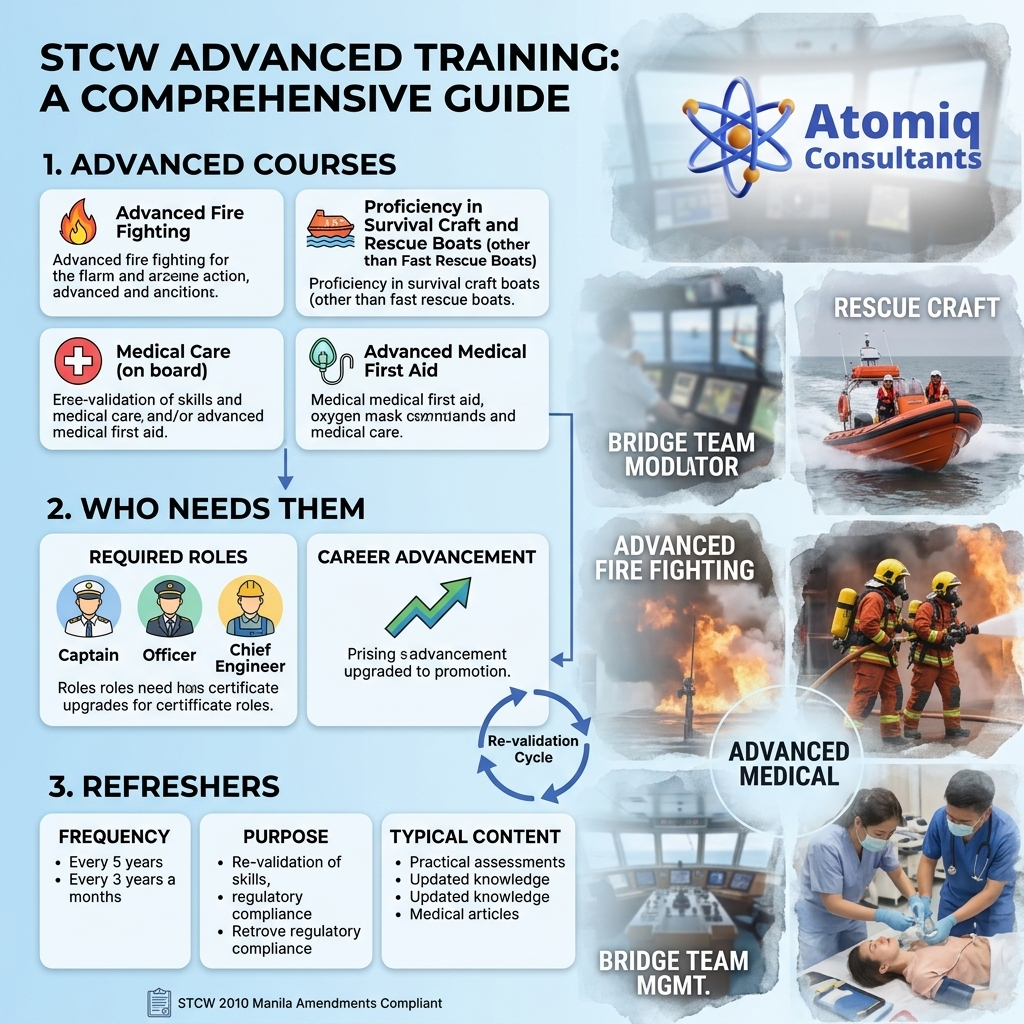
Revalidating STCW certificates as well? Refresher training (PST and FPFF) runs through Atomiq College, our Group’s training arm.
WhatsApp: +971 55 458 3416 · Free eligibility check Office: #903 Regal Tower, Business Bay, Dubai, UAE · 09:30–18:00 (UTC+4) Turnaround: the file check is with in One Day . Government processing times are set by each administration and quoted per application.