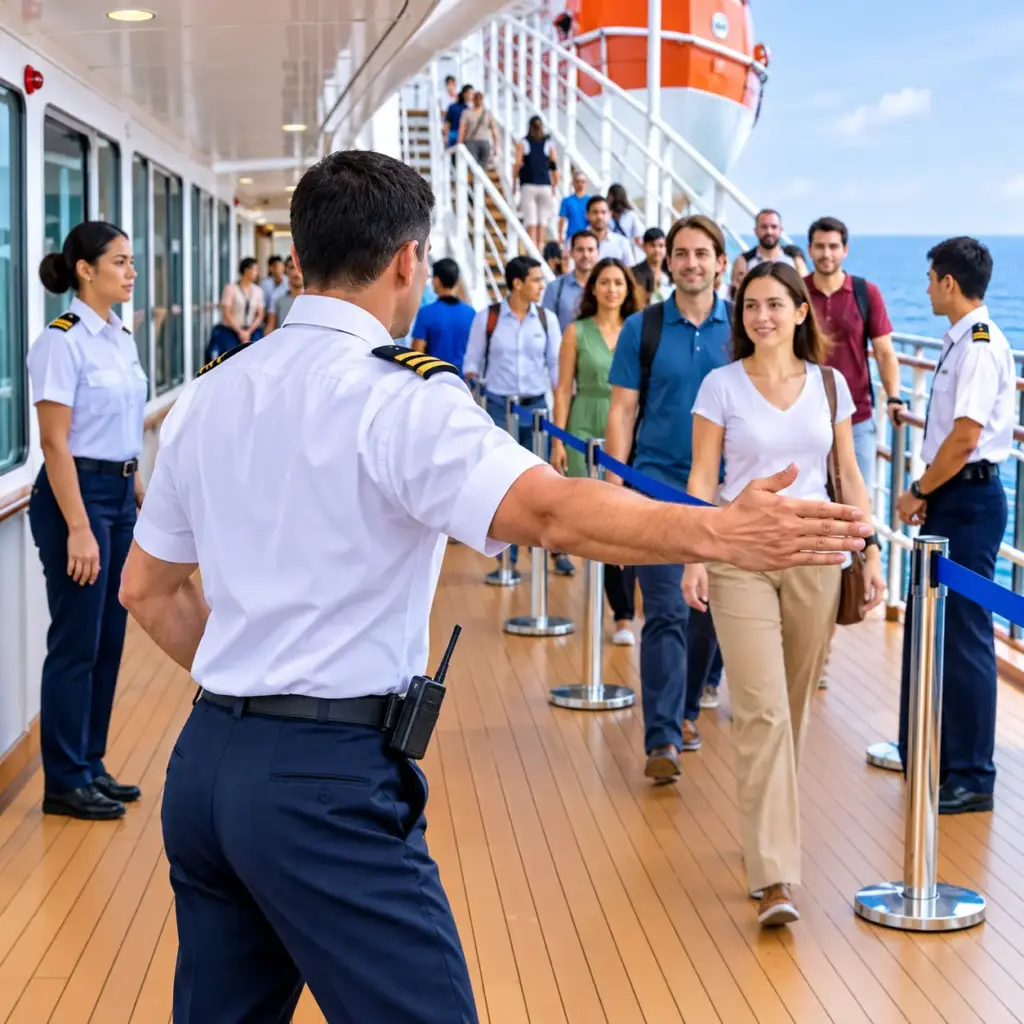
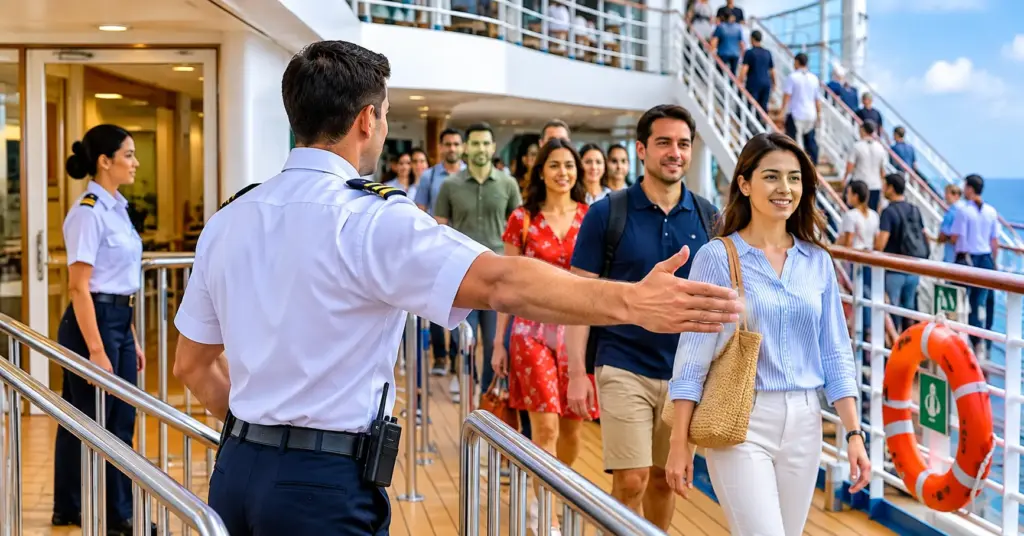
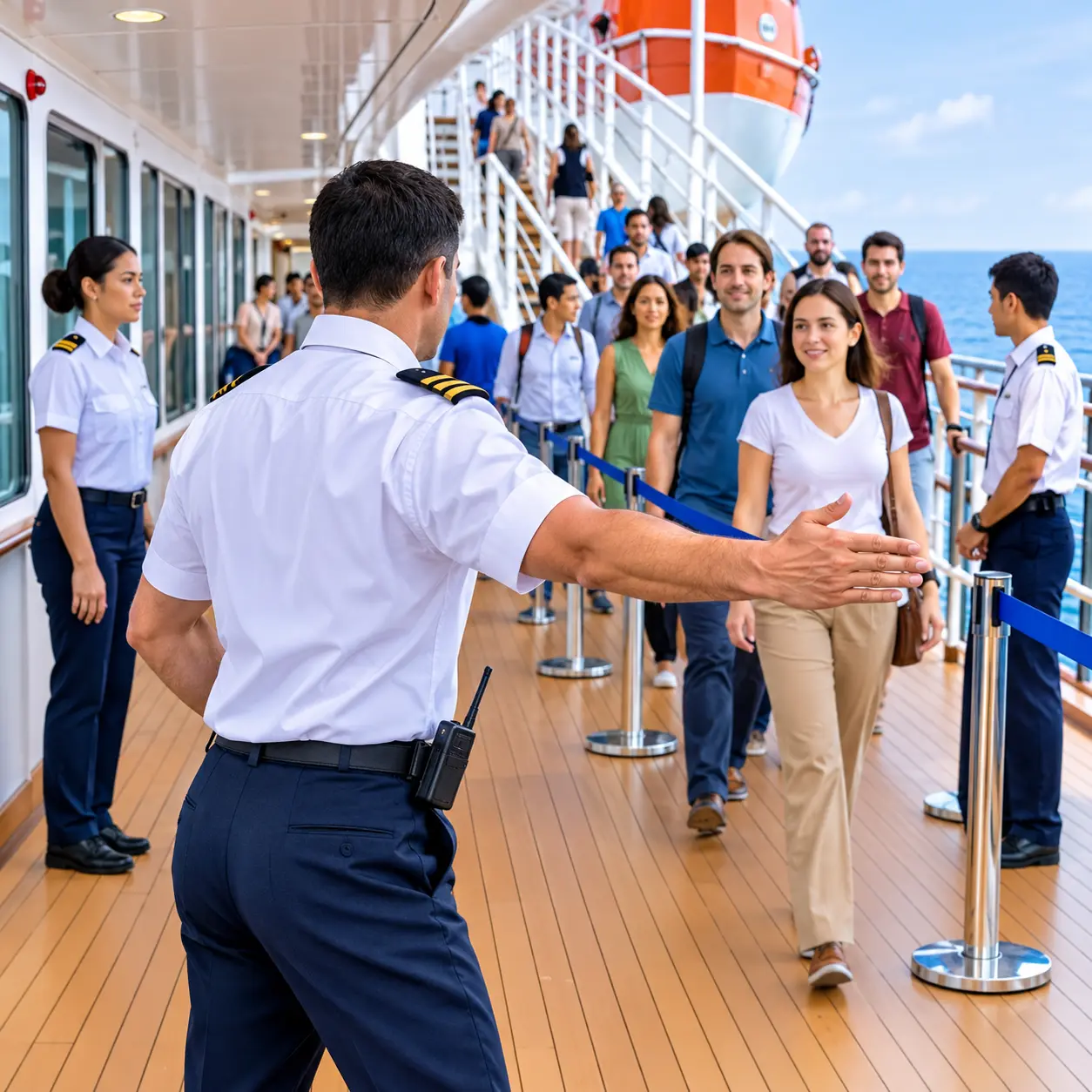
Crowd management training is the STCW Regulation V/2 qualification for crew on passenger ships who are named on the muster list to help passengers in an emergency. It covers guiding passengers to muster stations, keeping escape routes clear, preventing panic and counting people for evacuation. Holders must show refresher training or equivalent evidence at intervals of no more than five years.
By Dipak Paudel, Digital Content Creater. Last updated : 11/20/2026.
On a cargo ship, an emergency involves twenty or so trained crew. On a cruise ship or ro-ro ferry, it can involve thousands of passengers who have never seen the ship’s escape routes and don’t know what the alarm means. Crowd management training exists for that gap. This guide covers who needs it, what it teaches, how it differs from crisis management, and how it fits with your seaman book and other STCW certificates.
What STCW Regulation V/2 requires
Regulation V/2 of the STCW Convention sets extra training for everyone serving on passenger ships on international voyages. It sits on top of STCW Basic Safety Training. It does not replace it.
| Training | STCW reference | Who must complete it | Refresher |
|---|
| Passenger ship emergency familiarisation | Reg V/2; Section A-V/2 para 1 | Everyone serving on board | Not set as a 5-year refresher |
| Safety training for personnel providing direct service to passengers | Reg V/2; Section A-V/2 para 2 | Crew who serve passengers in passenger spaces (hotel, F&B, guest services) | Every 5 years |
| Crowd management | Reg V/2 para 7; Section A-V/2 para 3, Table A-V/2-1 | Masters, officers, ratings qualified under Chapters II, III and VII, and anyone on the muster list designated to assist passengers in an emergency | Every 5 years |
| Crisis management and human behaviour | Reg V/2 para 8; Section A-V/2 para 4, Table A-V/2-2 | Masters, chief engineers, chief mates, second engineers and anyone on the muster list responsible for passenger safety in an emergency | Every 5 years |
| Passenger safety, cargo safety and hull integrity | Reg V/2; Section A-V/2 para 5 | Masters, chief mates, chief and second engineers, and officers with loading or hull-door duties on ro-ro passenger ships | Every 5 years |
Source: IMO STCW Regulation V/2, paragraph 4, explicitly requires refresher training every five years for personnel covered by paragraphs 7–9.
The refresher rule. Under Reg V/2, crew required to hold crowd management, crisis management and the related passenger-ship training must, at intervals of no more than five years, either complete refresher training or provide evidence that they met the standard within the previous five years.
Who needs crowd management training
Your job title doesn’t decide it. The muster list does. If the ship’s muster list gives you a duty to assist passengers in an emergency, you need crowd management training, whether you are a deck officer, a bartender or a cabin steward.
| Role on a passenger ship | Crowd management | Crisis management |
|---|
| Master, chief mate, chief engineer, second engineer | Yes | Yes |
| Other deck and engine officers | Yes | If designated on the muster list |
| Deck and engine ratings | Yes | If designated |
| Hotel, F&B, housekeeping and guest-services staff with muster duties (stairway guide, assembly station team, cabin search) | Yes | If designated |
| Hotel and service staff with no passenger-assist muster duty | No. Familiarisation and passenger-service safety training apply | No |
| Security staff | Usually yes | Often designated |
The cruise line or ferry operator sets the muster list, so it decides which training you need. Ask for the requirement in writing before you book any course. Many cruise lines deliver V/2 training at their own academy or during onboarding, because it has to match that ship’s muster arrangements.
What the training covers
Table A-V/2-1 of the STCW Code sets one competence: contributing to the shipboard emergency plans and procedures to muster and evacuate passengers. In practice the course covers three areas.
Knowing the ship
- The ship’s emergency plans and life-saving appliance plans
- Assembly and embarkation stations, primary and secondary escape routes
- Where lifejackets, liferafts and evacuation equipment are stowed
Moving passengers to muster stations
- Giving short, clear and reassuring orders
- Controlling passenger movement in corridors, staircases and passageways
- Keeping escape routes clear of obstructions
- Helping passengers with reduced mobility and others who need special assistance
- Searching cabins and public spaces to make sure no one is left behind
Running the muster
- Keeping order at the assembly station
- Techniques to reduce and avoid panic
- Using passenger lists to count people for evacuation
- Checking that passengers are suitably dressed and have put on lifejackets correctly
Crowd management vs crisis management
The two are often taught together and sometimes sold as one course. They are separate STCW requirements with separate certificates.
| | Crowd management | Crisis management and human behaviour |
|---|
| STCW reference | Section A-V/2 para 3, Table A-V/2-1 | Section A-V/2 para 4, Table A-V/2-2 |
| Focus | Moving and controlling passengers on the ground | Leading the ship’s response to the emergency |
| Typical holder | Anyone designated to assist passengers | Senior officers and those responsible for passenger safety |
| Core skills | Directing people, keeping routes clear, counting, calming | Organising emergency procedures, using resources, controlling the response, communicating with passengers and crew, understanding how people behave under stress |
| Refresher | 5 years | 5 years |
If you hold a combined “crowd and crisis management” certificate, check that both elements are named on it. A certificate that names only one won’t satisfy a muster-list duty that needs both.
How crowd management fits with your other documents
Crowd management is one certificate in a set. A cruise or ferry operator will normally check all of these before you sign on:
| Document | Issued by | Notes |
|---|
| Seaman book (flag-state) | The flag administration | Seaman Books prepares and files the application. We don’t issue it |
| STCW Basic Safety Training (A-VI/1) | An approved training centre | Survival and fire-fighting modules need refresher evidence every 5 years. See STCW renewal |
| Security awareness or designated security duties (A-VI/6) | An approved training center | See PDSD explained |
| Passenger-ship training (V/2), including crowd management | The cruise line’s academy or an approved center | Set by the muster list |
| Seafarer medical certificate | A medical practitioner recognized by the flag | Valid for a maximum of 2 years |
For the full cruise document list by department, see seaman book and STCW for cruise ship staff. For the wider list of advanced and specialized courses, see STCW advanced training.
Common mistakes with crowd management certificates
- Letting the refresher lapse. The five-year clock runs from your last training or evidence date. Operators check it before every contract.
- Booking before asking the operator. Many cruise lines run V/2 training themselves. A certificate from elsewhere may not be accepted if it doesn’t reflect their ship.
- Holding crowd management when the muster list says crisis management. Moving into a senior role or a passenger-safety duty adds crisis management.
- Assuming an online certificate is enough. Crowd management includes practical elements. Check that the provider is approved by a flag administration before you pay. Note: Fully online crowd management training may be accepted by certain flag administrations. The Isle of Man Ship Registry explicitly lists online delivery as accepted for STCW Table A‑V/2‑1. Acceptance is flag-specific; confirm approval with the vessel’s flag administration and company before enrolling.
- Changing flag without checking acceptance. A certificate accepted by one flag isn’t automatically accepted by the next. See STCW recognition between countries.
Where Seaman Books fits
Seaman Books is a documentation agency. We don’t run crowd management courses and we don’t issue certificates or seaman books; flag administrations and approved training centers do. We help passenger-ship crew get the rest of the pack ready: the flag-state seaman book, STCW basic training through Atomiq College or an approved UAE partner center, and a check that every certificate is current and consistent before you apply.
Joining a cruise ship or ferry? Send your role, the operator and the documents you hold on WhatsApp +971 55 458 3416 or through the seafarer services form. We’ll tell you what’s missing and quote the full cost before you commit. Pricing is quoted individually after an eligibility check.

Frequently asked questions
What is crowd management training on ships?
Crowd management training is STCW Regulation V/2 training for passenger-ship crew designated on the muster list to assist passengers in an emergency. It teaches how to guide passengers to muster stations, keep escape routes clear, prevent panic, help people with reduced mobility and count passengers for evacuation, as set out in Table A-V/2-1.
How long is a crowd management certificate valid?
Crew required to hold crowd management training must complete refresher training, or show they met the standard, at intervals of no more than five years under STCW Regulation V/2. Some certificates carry an expiry date and some don’t, so track the date of your last training and check what your operator and flag require.
Who needs crowd management training?
Masters, officers and ratings on passenger ships, plus any crew member named on the muster list to help passengers in an emergency. That often includes hotel, housekeeping, food and beverage and guest-services staff with stairway, assembly station or cabin search duties. The ship’s muster list, set by the operator, decides who needs it.
What is the difference between crowd management and crisis management?
Crowd management covers moving and controlling passengers during an emergency and applies to anyone designated to assist them. Crisis management and human behavior covers leading the ship’s overall response and is required for the master, chief mate, chief and second engineers and anyone responsible for passenger safety. They are separate STCW certificates, each with a five-year refresher.
Do cargo ship seafarers need crowd management training?
No. Regulation V/2 applies to passenger ships, including cruise ships and ro-ro passenger ferries, on international voyages. Seafarers on tankers, bulk carriers and container ships don’t need it unless they move to a passenger ship, where the muster list will decide whether crowd management or crisis management applies to them.