 How to Get STCW Certification Online (And What Isn’t) 7 Steps Guide
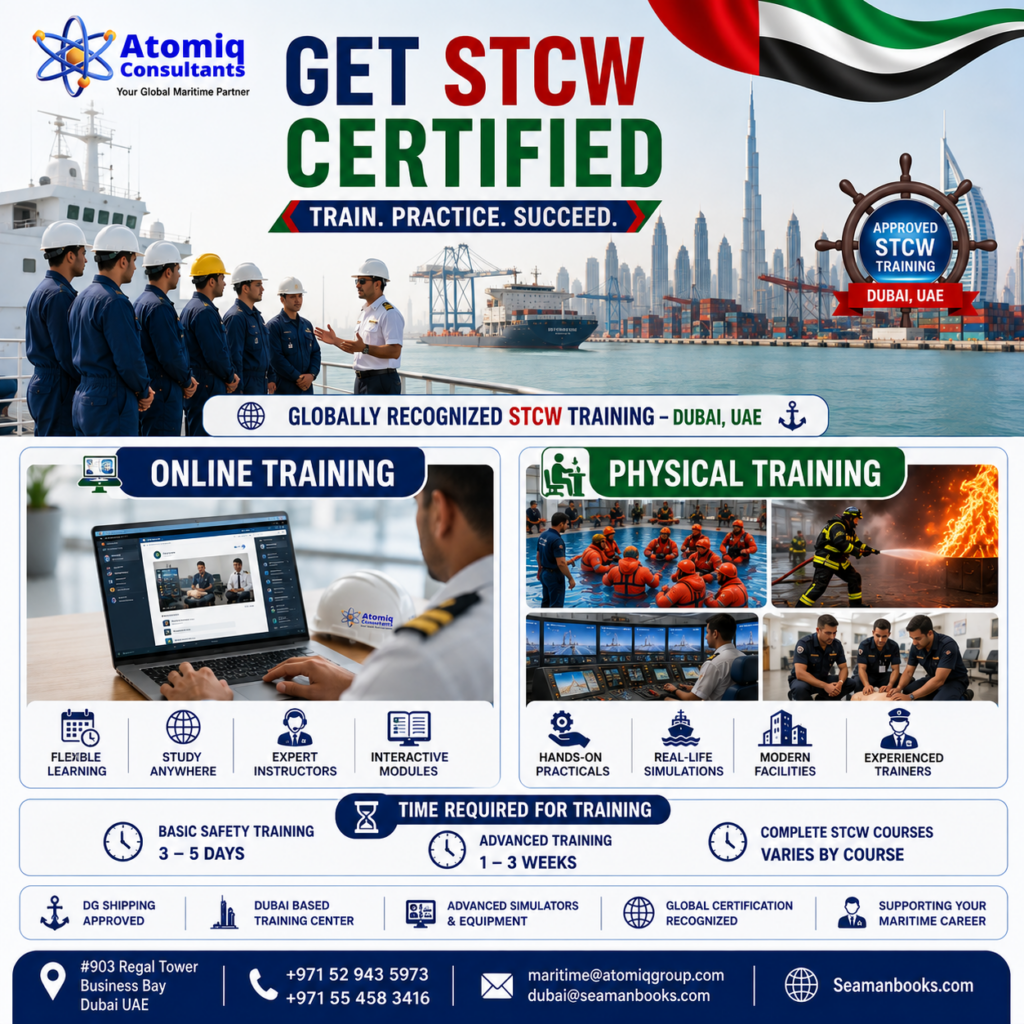
How to Get STCW Certification? If you’re planning a career at sea, this is probably the first question on your mind. The next question usually follows: Can I take STCW certification online, or do I need in-person practical training? The answer is both. While many STCW theory modules can be completed through flexible online learning, practical safety training must be completed at an approved training center to meet international maritime standards. At SeamanBooks.com by Atomiq Group, we make the entire process simple by offering both online and physical STCW training in Dubai. Whether you’re a new seafarer or an experienced maritime professional, our 7 easy-step STCW certification pathway covers all essential STCW modules, helping you earn a globally recognized certificate and start your maritime career with confidence.
To get STCW certification you complete an approved Basic Safety Training package, pass its practical assessments in person, and receive certificates issued or recognized by a maritime administration. Most seafarers start with the four Basic Safety Training modules plus security awareness training. Some of the theory can be studied online; the practical assessments cannot.
STCW is the qualification that lets you legally work at sea, and no shipping company, superyacht or cruise operator will sign you on without it. The confusing part is not whether you need it — it’s working out which certificates apply to your role, which training center is genuinely approved, and how much of the course you can actually do from home. This guide walks through the whole process in order.
What is STCW certification?
STCW certification is proof that a seafarer has met the minimum training standards set by the International Convention on Standards of Training, Certification and Watchkeeping for Seafarers. The convention was adopted on 7 July 1978 and entered into force on 28 April 1984, and it is administered by the International Maritime Organization (IMO). Its mandatory standards sit in Part A of the STCW Code, with recommended guidance in Part B.
Two later revisions shaped the certificates you’ll be booking today. The 1995 amendments moved certification from knowledge-testing to a competence-based model. The 2010 Manila amendments, in force from 1 January 2012, added modern-technology training, leadership and teamwork, security training for all seafarers, and — importantly for anyone renewing — mandatory refresher training every five years for survival and firefighting skills.
STCW is not a single certificate. It is a framework of separate certificates, each tied to a specific table in Part A of the STCW Code.
Who needs STCW certification?
You need STCW Basic Safety Training if you are employed or engaged in any capacity on board a seagoing ship with designated safety or pollution-prevention duties. In practice that covers almost everyone on a commercial vessel: deck and engine crew, but also stewards, chefs, deckhands, dive instructors, entertainment staff and hotel crew on cruise ships and superyachts.
It applies whether you are joining a 3,000-passenger cruise ship or a 24-metre charter yacht. If you are unsure whether your role is in scope, assume it is — operators almost universally require Basic Safety Training as a condition of employment even where an exemption might technically exist.
What’s included in STCW Basic Safety Training
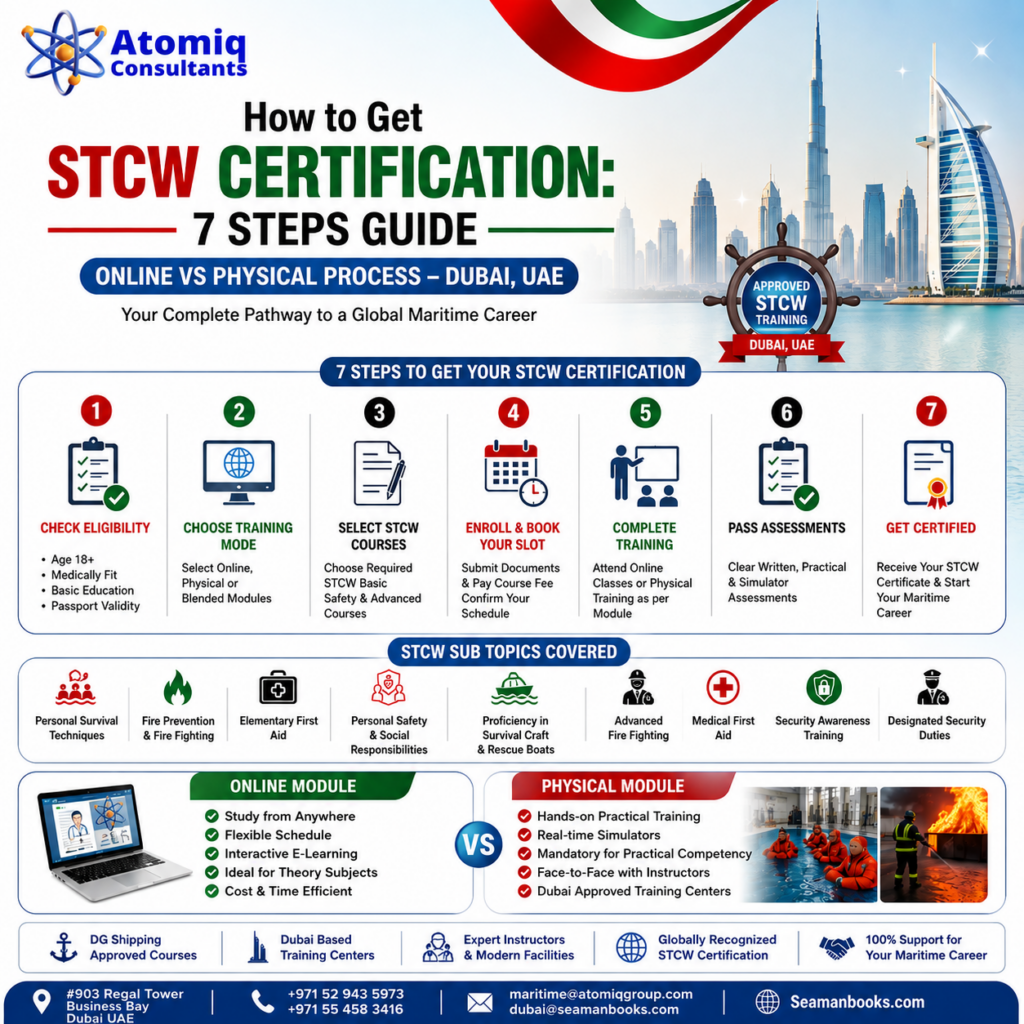
Basic Safety Training sits under STCW Regulation VI/1. It is made up of four modules, each mapped to its own table in the STCW Code. Security awareness training is a separate requirement under Regulation VI/6, but most training centres bundle it into the same block because every seafarer needs it.
|
Module |
STCW Code table |
What you actually do |
|
Personal Survival Techniques (PST) |
A-VI/1-1 |
Abandon-ship drills, lifejackets and immersion suits, boarding and righting a liferaft — in the water |
|
Fire Prevention and Fire Fighting (FPFF) |
A-VI/1-2 |
Fire theory, then live extinguisher, hose and breathing-apparatus work in a smoke-filled environment |
|
Elementary First Aid (EFA) |
A-VI/1-3 |
Immediate casualty care, CPR and AED use, assessed practically |
|
Personal Safety and Social Responsibilities (PSSR) |
A-VI/1-4 |
Shipboard safety culture, fatigue, environmental awareness, working relationships on board |
|
Proficiency in Security Awareness |
A-VI/6-1 |
Recognising security threats and understanding the ISPS Code |
One 2026 change worth knowing: the PSSR module now carries mandatory content on preventing and responding to bullying and harassment on board, reported to apply from 1 January 2026. [source — IMO resolution number and entry-into-force date against the current STCW Code ]
How to get STCW certification in 7 steps
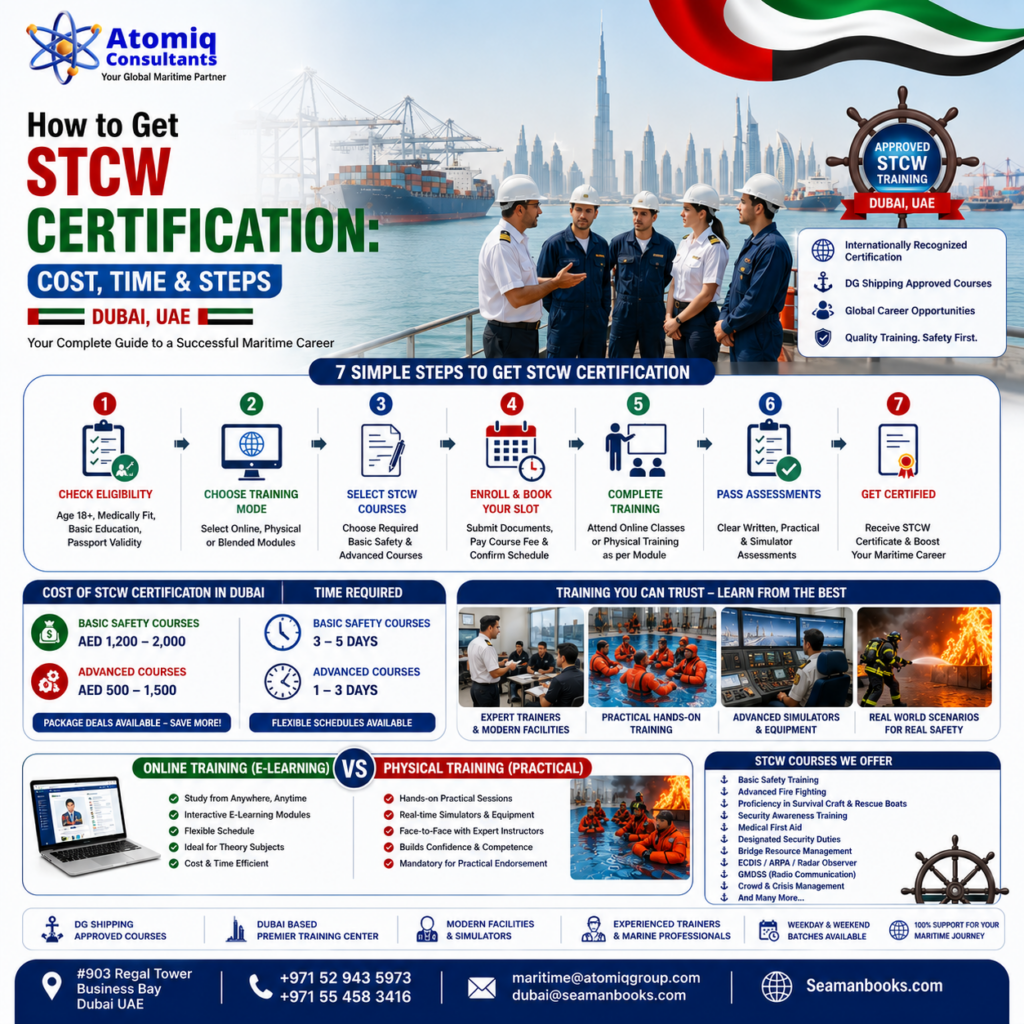
Step 1: Confirm which certificates your role requires
Start with the job, not the course. Basic Safety Training is the floor for nearly every seagoing role, but many positions need more on top of it: Proficiency in Survival Craft and Rescue Boats, Advanced Fire Fighting, Medical First Aid, or Designated Security Duties. Officers additionally hold a Certificate of Competency, which is a license to serve in a rank rather than a short-course certificate.
Ask the recruiter or operator for their exact certificate list in writing. Booking a package that’s missing one module is the most common and most expensive mistake in this process.
Step 2: Decide which administration will recognize your certificates
STCW is an international convention, but certificates are issued and approved nationally. A course approved by one maritime administration is not automatically accepted by another, and some flag states and employers are stricter than others about whose approval they’ll take.
Work backwards from where you intend to sail. If you’re aiming at the UK and European superyacht market, MCA-approved training is the usual expectation. If you’re targeting US-flag vessels, USCG-approved courses are the reference point. For Indian seafarers joining international fleets, DG Shipping approval and an INDoS number are the standard route.
Step 3: Verify the training center is genuinely approved
This is where people lose money. Maritime administrations publish lists of approved training providers, and the safest check is to find your chosen center on that list before paying anything. Be particularly careful with resellers: the UK’s Maritime and Coastguard Agency warns that “the company advertising MCA approved courses may not be the provider delivering the training but are instead acting as a commercial partner.”
Three checks before you book:
- Find the center by name on the relevant administration’s published approved-provider list.
- Confirm that the specific module you’re booking is covered by the approval, not just the center generally.
- Email the administration directly if the center isn’t listed — most publish a contact address for exactly this question.
Step 4: Get your seafarer medical certificate
Most approved centers will not let you into the water or the fire ground without evidence of medical fitness, and you’ll need one to be employed anyway. Under STCW you’ll hold a flag-state medical certificate — the UK ENG1 is the best-known example — confirming you’re fit for seagoing duties. Book it early; it’s frequently the thing that delays a course start.
Step 5: Book the course — online theory plus in-person practical
With the certificate list, administration and center settled, book the course itself. A blended booking means you complete the knowledge components online at your own pace, then attend the center for a shortened in-person block covering the practical assessments. It cuts the time you spend away from home and it’s the format most seafarers now choose.
Step 6: Complete the practical assessments in person
The practical block is the part that cannot be substituted. Expect to get into a pool in an immersion suit, board and right a liferaft, discharge extinguishers, wear breathing apparatus in a smoke-filled compartment, and demonstrate CPR to an assessor. Bring swimwear, a towel and closed footwear, and be prepared for a physically active few days.
Step 7: Collect, check and register your certificates
Before you leave, check each certificate for the correct spelling of your name, your date of birth, the issuing body, the STCW table reference and the issue date. Errors are much easier to fix on site than by email three weeks later. Then scan everything, store the scans somewhere you can reach from a ship, and add the expiry dates to a calendar — STCW refresher deadlines are easy to miss when you’re on rotation.
Can you get an STCW certificate online?
Partly — and this is the single most misunderstood point about STCW. You can complete a meaningful share of the theory online, but any element the STCW Code requires to be assessed practically must be done face to face. The MCA states the position plainly: “We do not accept any online courses where there is a requirement for face-to-face practical training in the STCW Code.”
So a website offering a complete STCW Basic Safety Training certificate with no attendance is selling something no serious operator will accept. What a legitimate online offer looks like is a blended course: theory online, practical in person.
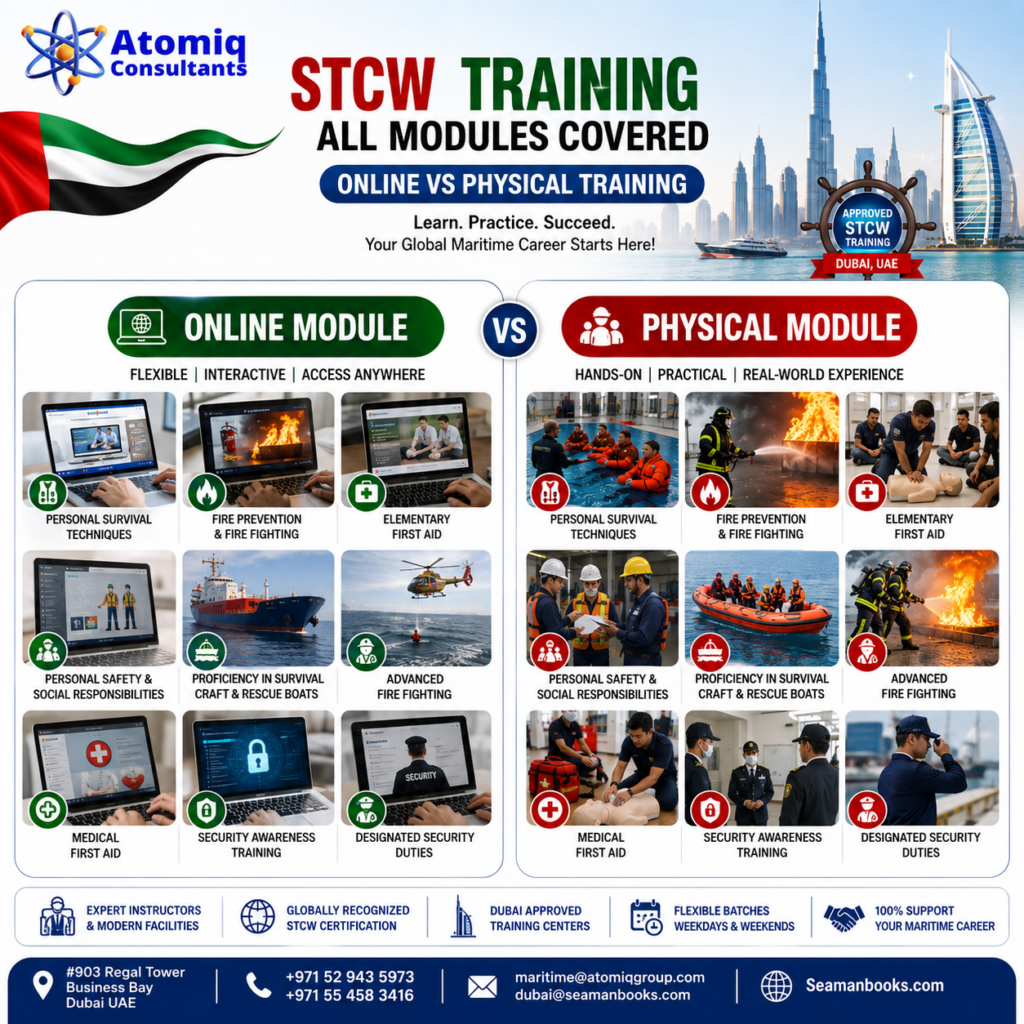
|
Element |
Theory online? |
In-person practical required? |
|
Personal Survival Techniques (A-VI/1-1) |
Partly |
Yes — in-water and liferaft work |
|
Fire Prevention and Fire Fighting (A-VI/1-2) |
Partly |
Yes — live fire and breathing apparatus |
|
Elementary First Aid (A-VI/1-3) |
Partly |
Yes — CPR and AED assessed practically |
|
Personal Safety and Social Responsibilities (A-VI/1-4) |
Mostly |
Varies by administration |
|
Proficiency in Security Awareness (A-VI/6-1) |
Often fully online where approved |
No practical element |
You can study STCW theory online, but you cannot be assessed online for anything the STCW Code requires you to do with your hands.
How long does STCW certification take?
Basic Safety Training is commonly delivered as a block of roughly five to six days when taken entirely in person, because the four modules have different lengths — firefighting is the longest, first aid and PSSR the shortest. A blended booking typically shortens the on-site block by moving the knowledge content online. [needs source — replace with the client’s own published course durations; these are typical market durations, not regulatory minimums]
Add lead time for the pieces you don’t control: a medical appointment, a passport or visa if you’re travelling to the centre, and course availability, which tightens sharply before the northern-hemisphere yachting season.
How much does STCW certification cost?
Cost varies too widely by country and centre to quote a single figure honestly, so budget by line item rather than looking for one number.
|
Cost line |
Notes |
|
Basic Safety Training course fee |
[insert client pricing] — the largest single item |
|
Proficiency in Security Awareness |
[insert client pricing] — sometimes bundled |
|
Seafarer medical certificate |
Paid separately to an approved doctor |
|
Travel and accommodation |
Only for the in-person block on a blended course |
|
Certificate issue or administration fee |
Charged by some administrations, not all |
|
Refresher training every five years |
Recurring cost to plan for, not a one-off |
How long is STCW certification valid?
The 2010 Manila amendments introduced a five-year cycle for the safety-critical skills that fade without practice. Seafarers must show evidence of maintained competence every five years for Personal Survival Techniques, Fire Prevention and Fire Fighting, Advanced Fire Fighting, and survival craft operations.
Two practical points follow from that. First, not every module carries the same refresher obligation — Elementary First Aid and PSSR are treated differently from the survival and firefighting modules, so check what your administration and employer require rather than assuming everything expires together. Second, if you’ve completed at least 12 months of sea service in the preceding five years, you may qualify for a shorter revalidation course instead of repeating the full module — which is a strong argument for keeping your discharge book and sea-service records tidy.
Five mistakes that cost seafarers their certificate
- Booking an unapproved centre. Check the administration’s published list first, every time, even for a well-known brand name.
- Buying a “fully online” Basic Safety Training certificate. If there is no practical attendance, it will not be accepted.
- Missing a module the employer required. Get the certificate list in writing before you pay.
- Leaving the medical to last. It’s the most common cause of a missed course start.
- Letting the five-year refresher lapse mid-contract. Diaries expiry dates the day you’re certificated.
FAQ
How do I get STCW certification for the first time?
Confirm which certificates your target role requires, choose an administration whose approval your employer accepts, verify the training center appears on that administration’s approved list, obtain a seafarer medical certificate, then book and complete Basic Safety Training including its in-person practical assessments.
Can I do an STCW course online?
You can complete much of the theory online through a blended course. You cannot complete the practical assessments online — the MCA explicitly does not accept online courses where the STCW Code requires face-to-face practical training.
How many STCW courses are there in Basic Safety Training?
Four: Personal Survival Techniques, Fire Prevention and Fire Fighting, Elementary First Aid, and Personal Safety and Social Responsibilities. Proficiency in Security Awareness is a fifth requirement under a separate regulation and is usually taught in the same block.
Do I need STCW to work on a superyacht?
Yes. Basic Safety Training is a baseline requirement for essentially all seagoing crew roles, including interior, galley and deckhand positions on privately owned and charter yachts.
How often do I need STCW refresher training?
Every five years for the survival and firefighting elements. With at least 12 months of sea service in the previous five years you may be eligible for a shorter revalidation course rather than the full module.
Is STCW certification valid in every country?
The standard is international, but recognition is national. Certificates issued under one administration’s approval are widely but not universally accepted — always confirm with the flag state and employer you’re targeting.
What’s the minimum age for STCW Basic Safety Training?
Most administrations set a minimum age for Basic Safety Training and additional restrictions apply to seafarers under 18.
Ready to book?
Once you know which certificates your role needs, the next step is booking an approved course. Our STCW certification courses combine online theory with the in-person practical block, so you spend less time away and still hold certificates an employer will accept. Check upcoming dates and reserve a place.