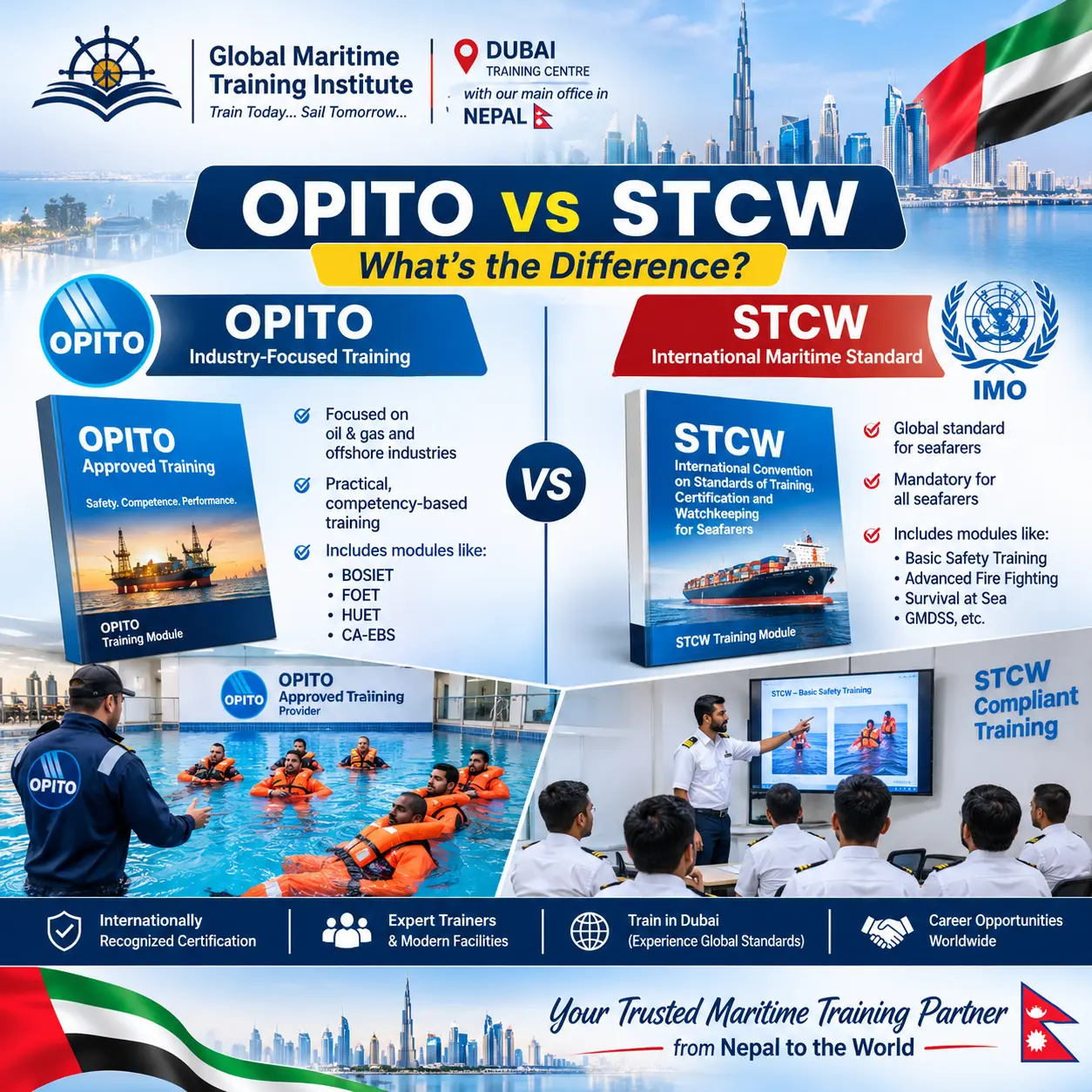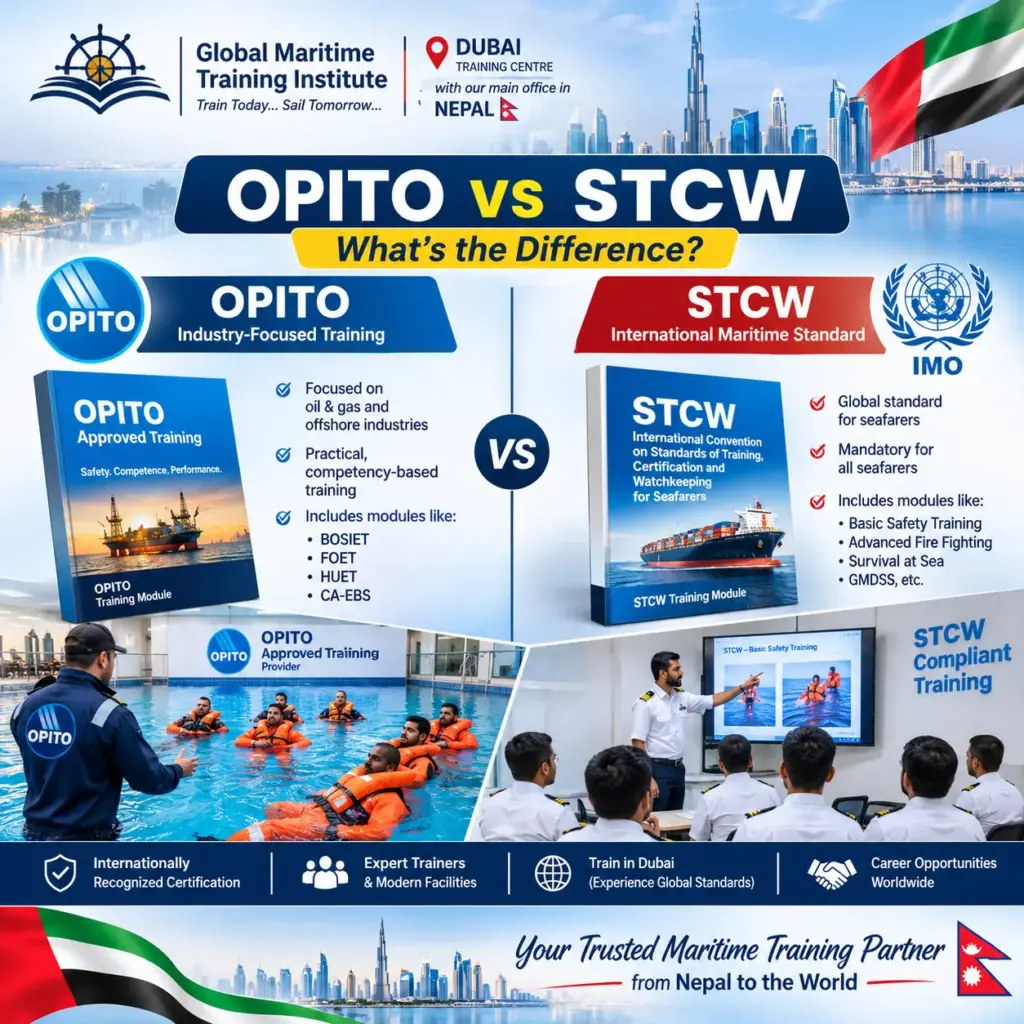
OPITO vs STCW at a glance
| STCW | OPITO (BOSIET) | |
|---|---|---|
| What it is | International convention adopted by the IMO in 1978, in force 28 April 1984 | Industry training standard set by OPITO, an industry-owned, not-for-profit skills body |
| Who sets the rule | Governments that are party to the convention, through their maritime administrations | Offshore oil and gas operators and duty holders, who require OPITO standards on their installations |
| Who it’s for | Seafarers serving on seagoing ships | “Personnel new (or returning) to the offshore oil and gas industry” (OPITO 5750) |
| Entry-level course | Basic Safety Training: PST, FPFF, EFA, PSSR | BOSIET with CA-EBS (standard 5750), which includes helicopter underwater escape |
| Training time | Typically five to six days for Basic Safety Training as one block | 20 hours 40 minutes guided learning, set by OPITO; the centre sets the schedule |
| Typical cost | AED 1,200–2,000 (about USD 325–545) for Basic Safety Training, varying by centre and country | Set by each approved center, not by OPITO. Quoted per center WhatsApp for Exact Price |
| Enquiry to certificate | Usually two to four weeks door to door (estimate, not a guarantee) | Depends on the centre’s next intake |
| Validity / renewal | PST and FPFF need refresher evidence every five years; EFA and PSSR do not | FOET must be completed within four years of BOSIET. A lapsed BOSIET means retaking BOSIET |
| Where it’s accepted | Every flag that is party to STCW, for shipboard service | Wherever the duty holder specifies OPITO; not a shipboard qualification |
| How to verify | With the issuing centre and the flag administration that approved it | OPITO’s public certificate validation page |
Sources: IMO, OPITO standards 5750 and 5850, BMA MN020, seamanbooks.com STCW enrolment page. Compiled 5 November 2026.
What is STCW?
STCW is the International Convention on Standards of Training, Certification and Watchkeeping for Seafarers. The IMO adopted it on 7 July 1978 and it entered into force on 28 April 1984. It sets the minimum training and certification every seafarer on a seagoing merchant ship must hold, from a deck cadet to a master.
STCW is law, not an industry preference. Each country that is party to the convention gives it effect through its maritime administration, and that administration approves the training centres and issues or endorses the certificates. When a Panama, Liberia or Palau inspector checks your documents, STCW is what they check against.
Every seafarer starts with Basic Safety Training, which is four separate elements under STCW Regulation VI/1:
- Personal Survival Techniques (PST)
- Fire Prevention and Fire Fighting (FPFF)
- Elementary First Aid (EFA)
- Personal Safety and Social Responsibilities (PSSR)
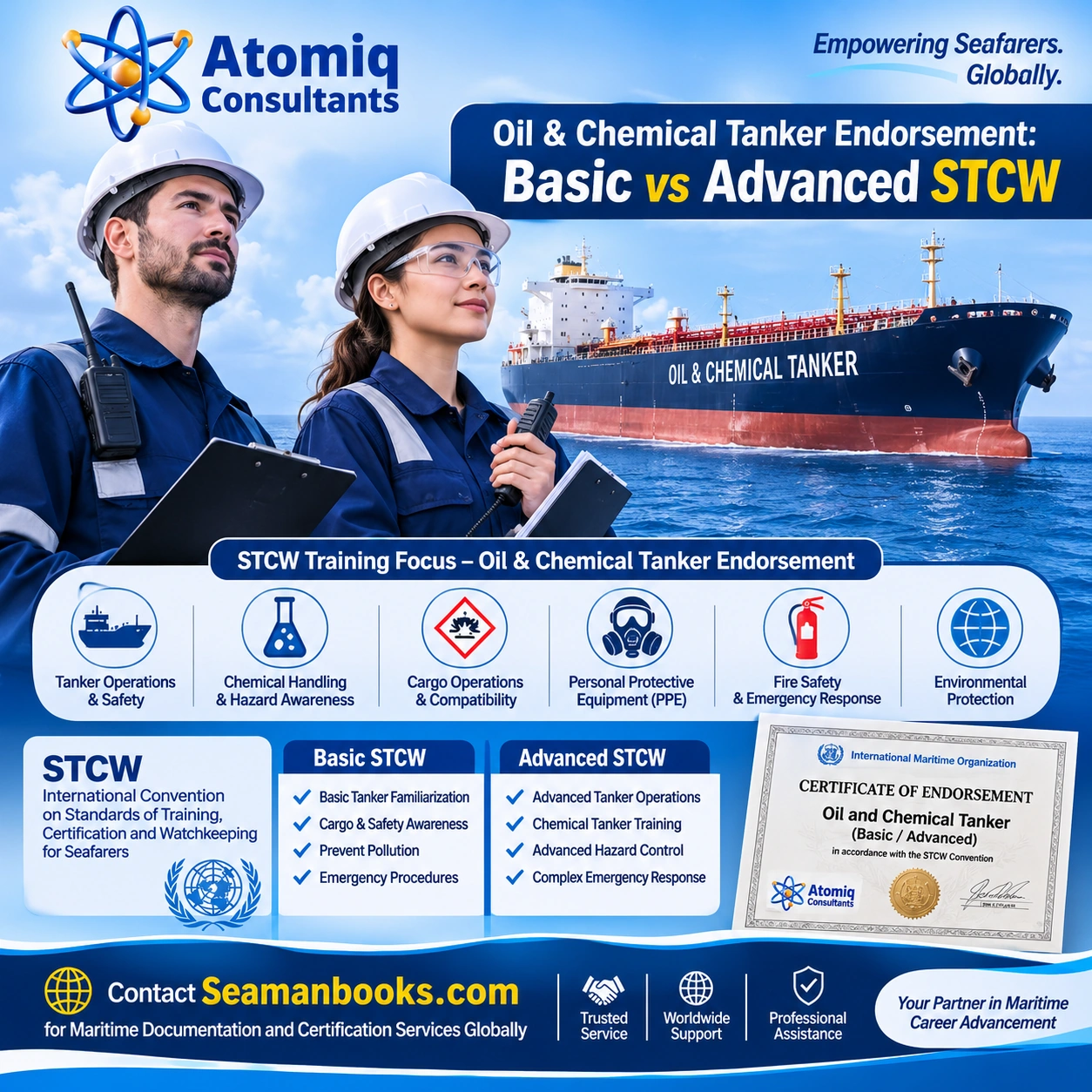
Ranks and ship types then add more: Proficiency in Survival Craft and Rescue Boats, Advanced Fire Fighting, tanker endorsements and others. See STCW basic vs advanced training.
What is OPITO?
OPITO describes itself as “the global, not-for-profit, safety and skills authority for safety-critical industries” and as an industry-owned organisation. It writes training standards for offshore oil and gas and approves the centres that deliver them. By its own figures it records over 500,000 registrations a year in more than 50 countries through 240 approved centres.
OPITO is not a government body and its standards are not a convention. They carry weight because operators and duty holders write them into the requirements for anyone flying to their installations. OPITO’s own standards defer to them in places: its renewal back-dating rule applies “unless stated otherwise by the Duty Holder or Asset Owner or Operator”.
The OPITO standards most offshore workers meet first:
| Standard | Code | Guided learning | Validity |
|---|---|---|---|
| BOSIET with CA-EBS | 5750 | 20 hrs 40 mins | Max. 4 years to FOET |
| FOET with CA-EBS (refresher) | 5850 | 8 hrs | 4 years |
| HUET with CA-EBS | 5295 | 7 hrs 10 mins | 4 years |
| Tropical BOSIET | 5501 | 19 hrs | Max. 4 years to T-FOET |
HUET is part of BOSIET, so most workers never book it separately. The details are in BOSIET vs HUET.
The four differences that matter
1. Legal force
STCW is a treaty obligation. Port state control can detain a ship whose crew lack valid STCW certificates, and a flag administration can refuse to endorse your CoC if your training is missing or out of date. OPITO is a contractual requirement: an operator can refuse to put you on a helicopter without a valid BOSIET, but no government enforces it as OPITO. In practice both can cost you a job. They do it through different routes.
2. Where you work
STCW covers your work on the ship. OPITO covers your work on, and getting to, the installation, including helicopter travel, safety induction and emergency response on a platform. OPITO’s BOSIET page does not mention STCW, ships or mariners at all, and the IMO’s STCW page does not mention OPITO. Neither is written to stand in for the other.
3. Renewal cycle
STCW’s five-year refresher rule came in with the 2010 Manila amendments. It applies to PST and FPFF in Basic Safety Training, and to survival craft, fast rescue boats and advanced fire fighting where you hold them. Elementary First Aid and PSSR do not need refreshing.
OPITO works on four years. You keep BOSIET current by completing FOET within four years. FOET only works while your BOSIET is still in date. Miss the window and you sit the full BOSIET again. If your previous certificate expires within three months of your new course, OPITO dates the new certificate from the old expiry date, so renewing early does not cost you time.
4. Who checks it
Your STCW certificates are checked by the flag administration, port state control and the ship’s manager. Your OPITO certificate is checked by the operator or its contractor, and anyone can check it against OPITO’s public online register. A certificate that does not appear there is a red flag to any operator, whatever the paper says.
Can BOSIET replace STCW Basic Safety Training?
No. The two standards overlap in subject matter, such as survival, fire and first aid, but no published rule from the IMO or OPITO makes one count for the other. BOSIET does not satisfy a flag administration checking your STCW Regulation VI/1 elements, and STCW Basic Safety Training does not satisfy an operator asking for BOSIET.
My recommendation: Use Bahamas as the named exception, citing Marine Notice 015 directly. Liberia can be included as corroborating evidence with a scope qualification.
Which should you choose?
Verdict: it is rarely a choice. Your workplace decides.
- You crew a ship, including supply vessels, anchor handlers and standby vessels: STCW Basic Safety Training is mandatory. Add BOSIET only if your contract involves helicopter transfer to an installation.
- You work on a fixed platform and fly out by helicopter: BOSIET with the operator’s required breathing system, plus an offshore medical. STCW is not normally asked for unless you also hold a marine role.
- You are marine crew on a mobile offshore unit such as a drilling rig or FPSO: expect both. The unit’s flag applies STCW to marine crew, and the operator applies OPITO to everyone on board. (Note: Bahamas: Bahamas Maritime Authority Marine Notice 015, §§6.5 and 7.1.3(v) (Version 4.1, 5 July 2024), expressly permits OPITO-approved basic training or equivalent industrial training towards offshore certification requirements, including STCW Code A-VI/1 basic training. This acceptance is limited to Bahamian-registered mobile offshore units (MOUs) and offshore certification; it does not constitute blanket equivalence for conventional merchant-vessel STCW certification. IMO Resolution A.1079(28) provides the complementary MOU training framework.)
- You are moving from shipping into offshore oil and gas: keep your STCW current and add BOSIET. Your STCW record does not replace BOSIET.
If you’re not sure which applies to you, send us the job offer or the operator’s requirement list. We will tell you which certificates it asks for before you book anything.
Getting both in Dubai and the GCC
Seaman Books is a Dubai-based documentation and enrolment consultancy. We do not deliver training ourselves and we do not issue certificates.
STCW. Atomiq Group’s training arm, Atomiq College, runs STCW Basic Safety Training as a five-day course covering all four elements, plus PST and FPFF refresher training. See STCW certifications and STCW enrolment and fees.
Note: Atomiq College intake is always open for online and physical training. Fees and details are available upon request via WhatsApp or direct contact with IMMARBE Belize. Approval reference to be confirmed.
OPITO. We find an OPITO-approved center with availability, confirm the center’s fee and our coordination charge in writing, and handle the enrolment. Course fees are set by the center, not by OPITO. See BOSIET and HUET enrolment.
What sits alongside both: an offshore medical for OPITO courses (OEUK offshore medical) and, for vessel crew, a valid seaman book. If your book is close to expiry, renew it on the same timeline, because a current STCW record will not get you aboard with an expired book.
Not sure which courses you need?
Send us your current certificates on WhatsApp. We’ll review your documents and tell you:
Which courses you need for your certification or renewal
Where the next available training seat is
Course fees and available training options
Common mistakes
- Booking BOSIET when the job needs STCW. Vessel crew who book BOSIET first still cannot sign on.
- Letting BOSIET lapse. FOET needs an in-date BOSIET, so one missed day turns an 8-hour refresher into the full 20-hour-40-minute course. Book about 90 days before expiry.
- Assuming all four STCW elements expire. Only PST and FPFF (plus advanced proficiencies you hold) need five-yearly refresher evidence.
- Ignoring the breathing-system variant. Operators specify CA-EBS or another EBS variant; tropical BOSIET suits some regions and not others. Check the operator’s list before you book.
- Trusting a certificate you can’t verify. If an OPITO certificate is not on OPITO’s register, or an STCW centre is not approved by a flag administration, the certificate will not get you on board.