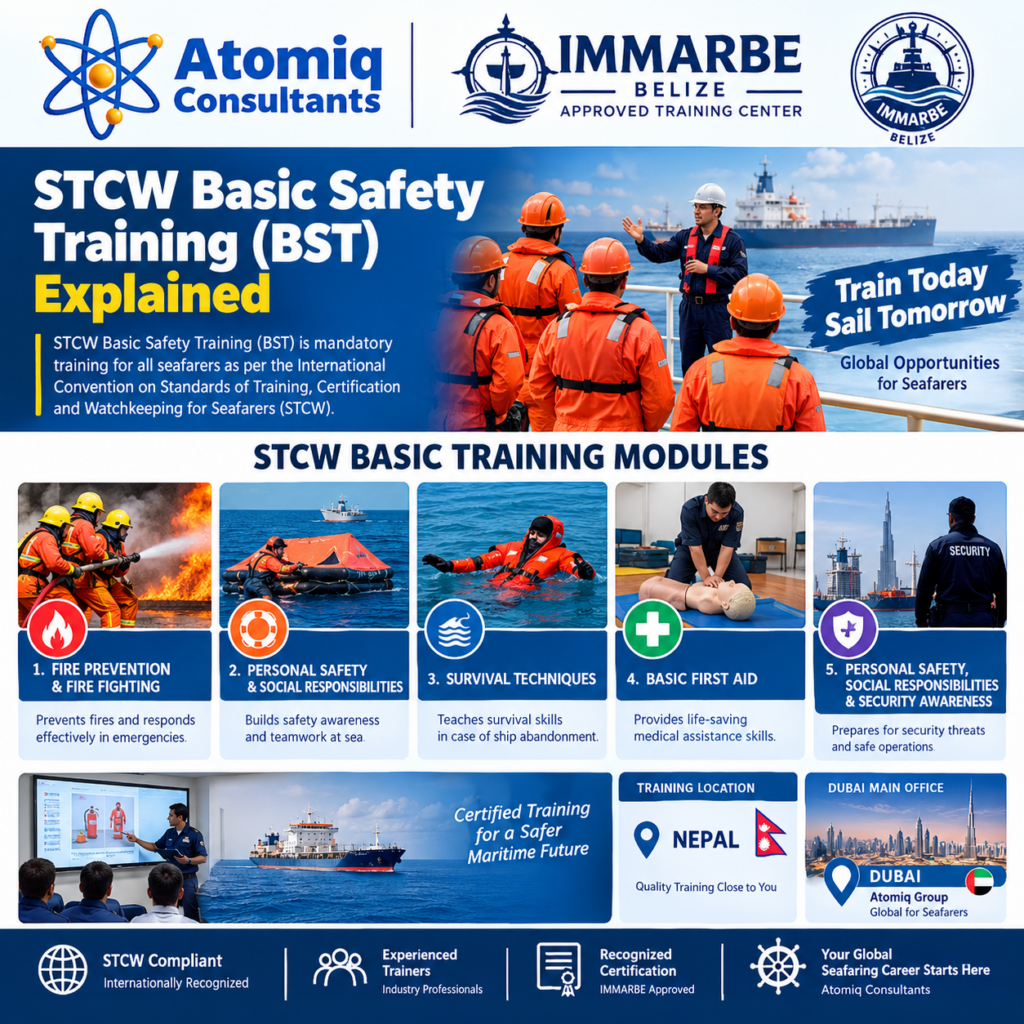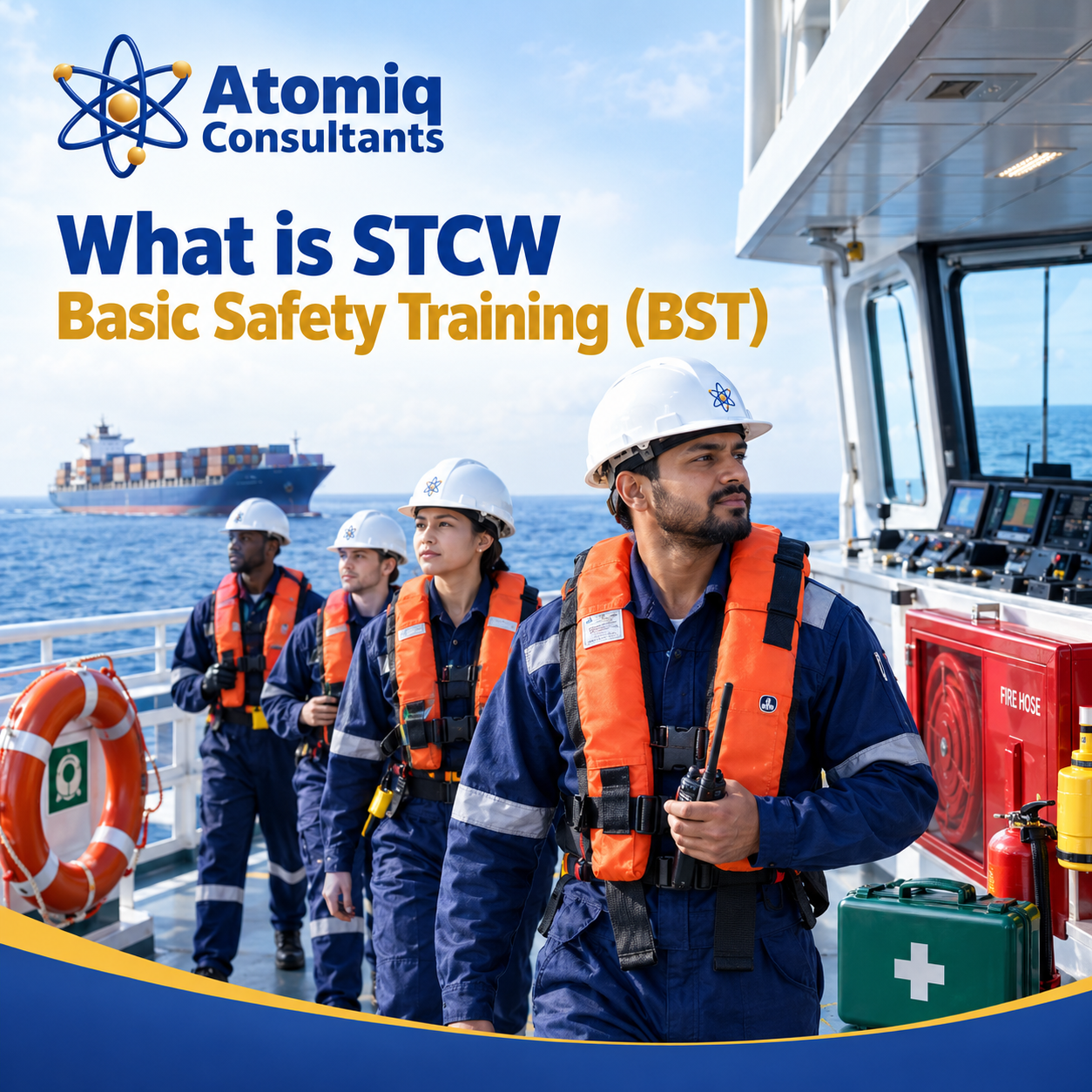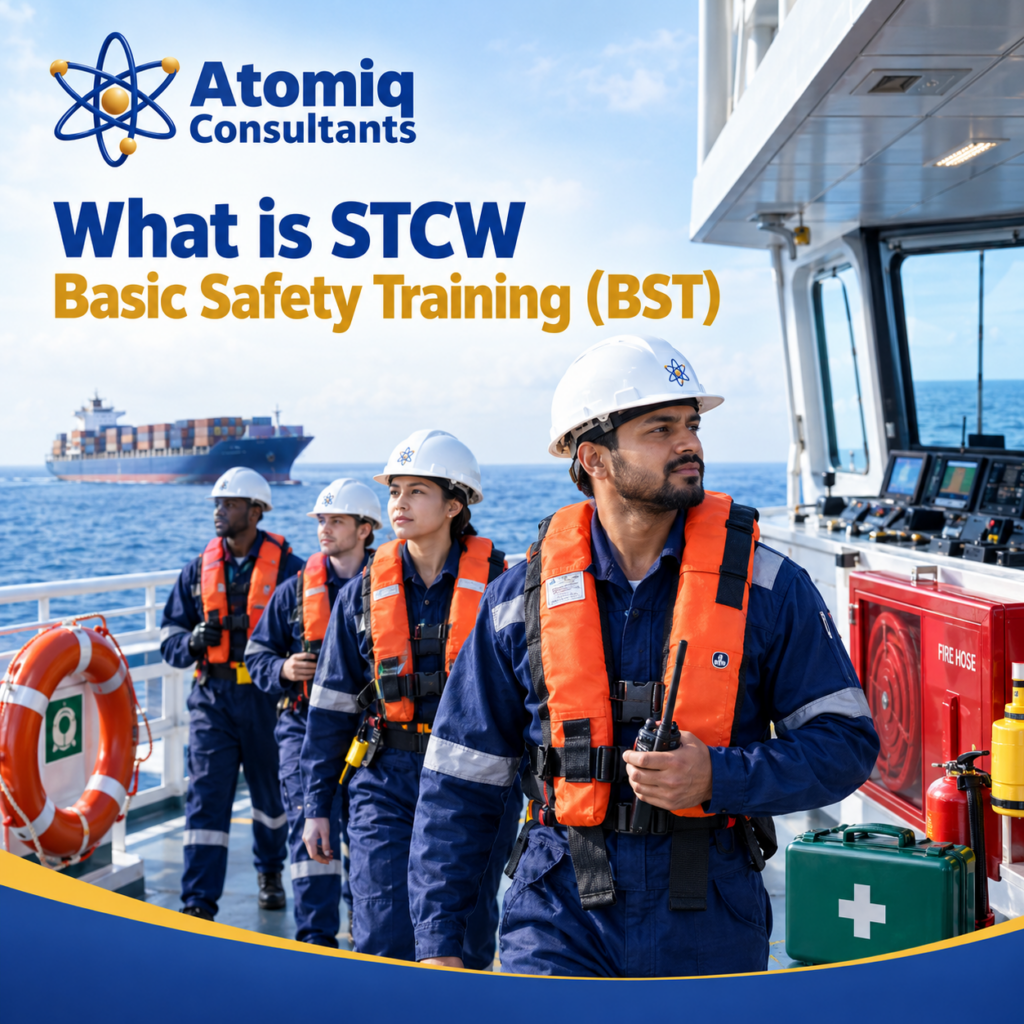
STCW Basic Safety Training (BST) is the mandatory entry-level safety training for seafarers under Regulation VI/1 of the STCW Convention. It is four courses: Personal Survival Techniques, Fire Prevention and Fire Fighting, Elementary First Aid, and Personal Safety and Social Responsibilities. It’s usually done in five to seven days at an approved training centre, before any shipboard duty.
Seaman Books is a maritime documentation consultancy in Business Bay, Dubai. We don’t deliver training and we don’t issue certificates. This page explains what BST is so you can tell whether the course you’re offered is the real one.
STCW BST at a glance
What it is The four basic proficiencies every seafarer with safety duties must hold before working on board Legal basis STCW Convention Regulation VI/1; competence standards in STCW Code Tables A-VI/1-1 to A-VI/1-4 What the Convention calls it “Basic training”. “Basic Safety Training” and “BST” are industry names for the same thing The four courses Personal Survival Techniques (PST) · Fire Prevention and Fire Fighting (FPFF) · Elementary First Aid (EFA) · Personal Safety and Social Responsibilities (PSSR) Typical duration 5–7 days when a centre runs all four as one block Minimum age 16 under UK MCA rules; other administrations set their own Delivery In person. The practical modules need a pool and a live-fire ground Assessment Written or oral exam plus observed practical demonstration Issued by The approved training centre, as one certificate per course Refresher PST and FPFF: every five years. EFA and PSSR: no Convention refresher Not the same as GWO Basic Safety Training (wind industry) or BOSIET (offshore oil and gas)
What STCW basic safety training is
The STCW Convention (the International Convention on Standards of Training, Certification and Watchkeeping for Seafarers) was adopted by the IMO on 7 July 1978 and came into force on 28 April 1984 (IMO). Chapter VI covers emergency, occupational safety, security, medical care and survival functions. Regulation VI/1 in that chapter sets the minimum safety training for all seafarers, whatever their rank or department.
That minimum is basic training. In practice, it lets you act on the day something goes wrong instead of waiting for help. You can abandon ship and survive in the water. You can fight a fire before it spreads. You can keep a casualty alive. You can work safely so you don’t become the next casualty.
When a crewing manager asks “Have you done your basic?”, this is what they mean. It’s the qualification everything else builds on. Advanced firefighting, survival craft and rescue boats, tanker endorsements and officer certificates of competency all assume you already hold it. For the difference between basic and advanced proficiencies, see STCW basic training vs advanced training.
BST is not a single certificate, and it’s not a seaman’s book. It’s four separate certificates of proficiency, each issued by the training centre that assessed you. More on that below.
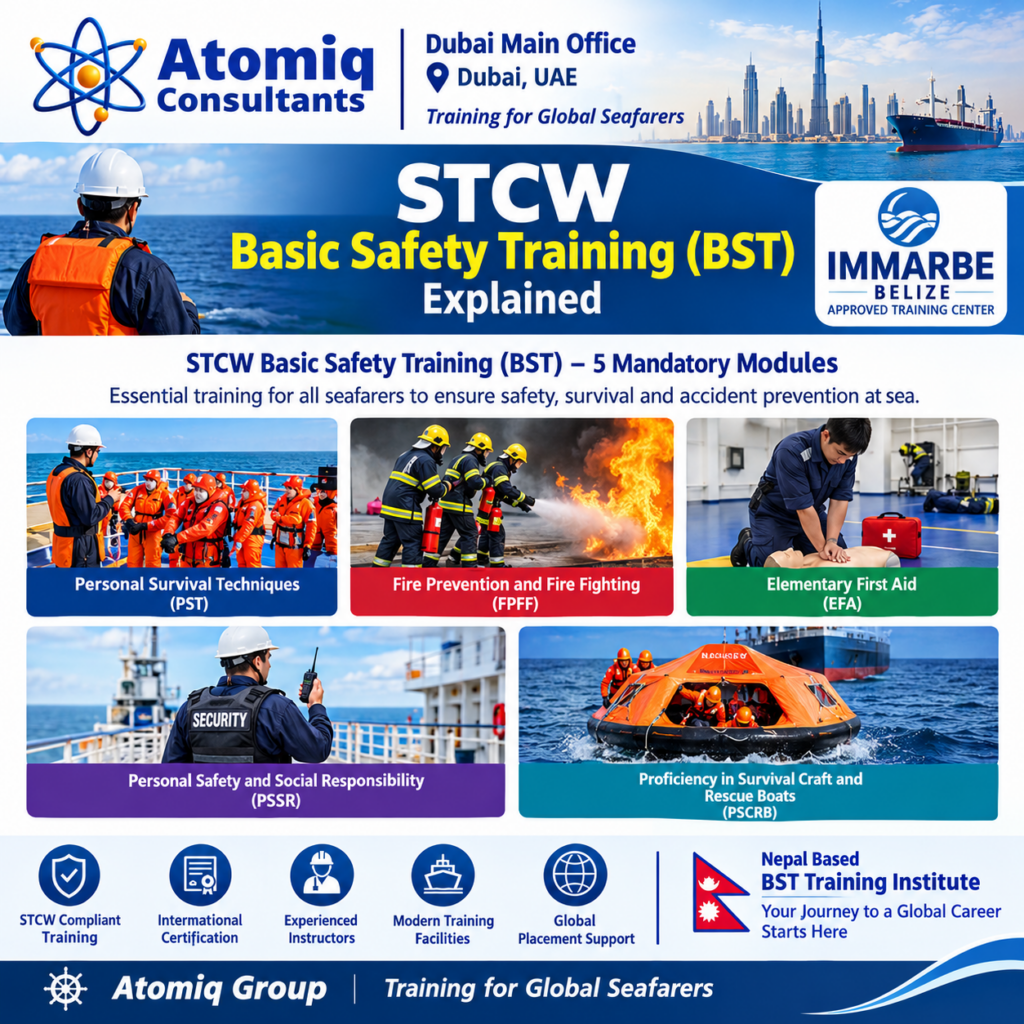
The four Basic Safety Training (BST) modules
Each module maps to one table in the STCW Code. The Code sets the competence you must show and how it’s evaluated. It doesn’t set a timetable. The four elements and their tables are listed in UK MCA guidance, MSN 1865 (M) Amendment 1, §3.1.
| Module | STCW Code table | What you learn | Where it happens |
|---|---|---|---|
| Personal Survival Techniques (PST) | A-VI/1-1 | Abandoning ship, lifejackets and immersion suits, entering the water, righting and boarding a liferaft, survival and rescue | Classroom, then a pool. You will be in the water |
| Fire Prevention and Fire Fighting (FPFF) | A-VI/1-2 | How shipboard fires start, extinguisher selection, hose handling, breathing apparatus, search in smoke | Classroom, then a live-fire ground with an enclosed space |
| Elementary First Aid (EFA) | A-VI/1-3 | Casualty assessment, CPR, bleeding, burns, fractures, moving a casualty safely | Classroom with manikins and dressings |
| Personal Safety and Social Responsibilities (PSSR) | A-VI/1-4 | Emergency procedures, safe working practice, pollution prevention, shipboard communication, fatigue and rest hours | Classroom only |
Personal Survival Techniques is where seafarers most often show up unprepared. It’s practical from the first hour after theory: you put on a lifejacket against the clock, enter the water, and board a liferaft unaided. Bring swimwear.
Fire Prevention and Fire Fighting uses real fire and real smoke. You’ll wear self-contained breathing apparatus and work in zero visibility. A centre that teaches this module from a classroom and a video isn’t delivering it.
Elementary First Aid is assessed on what you physically do, such as CPR on a manikin to the right depth and rate, not on what you can describe.
Personal Safety and Social Responsibilities is the only module with no practical element. In the first month on board it’s often the most useful one: who to report to, how a permit to work operates, and what your rest-hour entitlement is.
Why some centres list five courses, not four
Most centres sell basic training as a five-course package. They add Proficiency in Security Awareness (STCW Code Table A-VI/6-1), a short course on ship security levels and reporting threats. Most seafarers need it, and it makes sense to do it in the same week. But it sits under Regulation VI/6, not VI/1. Four is the regulation; five is the package. If an administration asks for your Regulation VI/1 certificates, it means the four.
Who needs STCW basic safety training
The rule is in the Code itself. As MSN 1865 §3.1 puts it, seafarers “employed or engaged in any capacity on board ship on the business of that ship as part of the ship’s complement with designated safety or pollution-prevention duties in the operation of the ship shall, before being assigned to any shipboard duties” complete basic training.
Three parts of that wording matter:
- “In any capacity”. Rank and department don’t matter. A deck cadet, a motorman, a cook and a cabin steward are all covered if they hold safety duties.
- “Designated safety or pollution-prevention duties”. On a commercial seagoing ship, nearly everyone on the muster list has an emergency role. That’s why employers treat BST as universal.
- “Before being assigned to any shipboard duties”. BST comes before your first joining, not during your first contract.
People on board with no designated safety duties get safety familiarization instead, a shorter briefing before taking up their role (MSN 1865 §2.1). In practice, manning agencies and operators rarely hire seagoing crew without full BST. Plan on needing it.
Who this usually means
| Your situation | Do you need BST? | What to check |
|---|---|---|
| First-time seafarer (cadet, rating, trainee) | Yes, all four courses | Do it before you apply for your seaman’s book. Most administrations ask to see it |
| Officer or engineer working towards a CoC | Yes, it’s a prerequisite | The CoC route assumes BST and adds advanced proficiencies |
| Cruise ship hotel, catering or entertainment crew | Yes, if you have muster or emergency duties (almost always) | Operators often add company-specific training on top. Get their list in writing |
| Offshore vessel crew (supply, standby, crew boats) | Yes, as merchant seafarers | Many offshore clients also want OPITO BOSIET. That’s a separate certificate (see below) |
| Seafarer returning after a break | You probably hold it already | Check whether your PST and FPFF are within five years. EFA and PSSR don’t need redoing under the Convention |
BST and your seaman’s book
BST and a seaman’s book (also called a CDC or SIRB) are two different documents from two different bodies:
- BST certificates are issued by an approved training centre. They prove you’ve completed and passed the training.
- A seaman’s book is issued by a flag-state administration. It’s your identity and sea-service record.
The order matters. Most administrations want evidence of basic training as part of a first seaman’s book application, so BST almost always comes first. For what a first application needs, see seaman book requirements for new applicants. For how flag-state seaman books work, see our seaman book and CDC guide.
Some administrations also require their own endorsement of training certificates before a ship accepts them. That’s a separate application, so a seafarer can hold valid BST certificates and still be held back at joining.
How long BST takes
Five to seven days for all four courses run as one continuous block. That’s the typical figure in the UAE and the one used across this site.
You’ll see other numbers, and the spread doesn’t mean anyone is cutting corners:
| Provider | Published duration | Regime |
|---|---|---|
| Seascope Maritime Training (Liverpool / Palma) | 5 days (five modules incl. Security Awareness) | UK MCA |
| BSM Maritime Training Centres | 8 days | Company standard |
| ODM Maritime Training Institute (Mumbai) | 12 days | India DG Shipping |
Durations as published by each provider, fetched 18 September 2026.
The reason is the one above: the STCW Code sets competence outcomes, not clock hours. Each administration sets its own minimum contact hours, and centres add time for class size and assessment. A 12-day course and a 5-day course can both be fully compliant.
Two practical tips. Do all four together, at one centre. If you split them across centres or months, your certificate dates won’t line up and every future refresher gets more complicated. And book your seafarer medical first. Centres won’t put you in the water or in breathing apparatus without one.
How BST is assessed
You pass BST on performance, not attendance. Theory is tested by written or oral exam. Practical parts are observed by an assessor against the criteria in each Code table. That typically means:
- putting on a lifejacket correctly and entering the water
- boarding a liferaft unaided
- choosing and using the right extinguisher for a given fire
- working in breathing apparatus and following the low-air drill
- performing CPR on a manikin to the required standard
If you can’t complete one element, you’re normally re-assessed on that element rather than failing the whole course. The certificate for that module isn’t issued until you pass it. If you’re not a confident swimmer, tell the centre when you book, not on the morning of the pool session. Centres can usually arrange the PST practical around it.
Does BST (Basic Safety Training) expire?
Not as a whole. This is the most common mistake on training pages, and it costs seafarers money when they re-sit courses they didn’t need to.
| BST certificate | Updating required every five years (STCW Convention) |
|---|---|
| Personal Survival Techniques (A-VI/1-1) | Yes |
| Fire Prevention and Fire Fighting (A-VI/1-2) | Yes |
| Elementary First Aid (A-VI/1-3) | No |
| Personal Safety and Social Responsibilities (A-VI/1-4) | No |
The five-year requirement came with the IMO’s 2010 Manila amendments, which introduced a “refresher training module every five years for basic training on personal survival techniques and fire prevention and firefighting; advanced firefighting; and proficiency in survival craft, rescue boats and fast rescue boats” (IMO). Elementary First Aid and PSSR aren’t on that list.
Your flag can require more. Administrations can go beyond the Convention minimum, so check your own flag’s rule. The UK’s requirements are in MSN 1865 §4.4. If your seaman’s book is under Panama, Palau, Liberia, Bahamas, Belize, Honduras or St. Kitts & Nevis, send us your certificate dates and we’ll check them against that administration. For lapsed certificates, see STCW renewal.
Can BST be done online?
Not the practical parts. Not anywhere, from anyone. PST needs you in the water, FPFF needs live fire, and EFA needs assessed hands-on demonstration. MCA guidance allows online delivery only for courses with no practical requirement, with completion checks and proper assessment (MSN 1865, Annex F §4.4).
The IMO’s 2010 amendments brought in “improved measures to prevent fraudulent practices” (IMO) because certificates without attendance are a real problem in this market. They fail at inspection, and the seafarer carries the consequence. More detail on online delivery is in our STCW certification guide.
STCW BST vs GWO BST vs BOSIET
“BST” means different things in different industries, and employers use it loosely. If you move between merchant shipping, offshore wind and offshore oil and gas, confirm which one is meant before you book.
| STCW Basic Safety Training | GWO Basic Safety Training | OPITO BOSIET | |
|---|---|---|---|
| Industry | Merchant shipping | Wind turbines (onshore and offshore) | Offshore oil and gas |
| Standard set by | IMO, STCW Convention | Global Wind Organisation | OPITO |
| Content | PST, FPFF, EFA, PSSR | First Aid, Manual Handling, Fire Awareness, Working at Height, Sea Survival | Offshore induction, helicopter underwater escape (HUET), sea survival, firefighting |
| Interchangeable? | No | No | No |
GWO module list per the Global Wind Organisation BST standard, fetched 18 September 2026.
For the offshore certificates, see our offshore training courses page and the offshore oil and gas certification guide.
How to check BST is genuine before you pay
Two questions and one link:
- “Which administration approved you, and what’s the approval reference?” A legitimate centre answers straight away, in writing.
- “Does that approval cover these four courses, delivered this way?” Approval is specific to each course and each delivery method.
- Check the register yourself. Flag administrations publish their lists of approved training providers. Belize’s registry, IMMARBE, publishes its approved maritime training institutes openly.
Walk away if you see any of these: a full BST certificate with no attendance, a price quoted before anyone asks which modules you already hold, or a provider that can’t name its approving administration.
Where Atomiq Group fits
Within Atomiq Group, training and documentation are separate. Atomiq College Private Limited, in Kathmandu, Nepal, is the Group’s maritime training institute. It’s listed on the IMMARBE Approved Entities register under Maritime Training Institutes.
Atomiq College runs STCW Basic Safety Training as a five-day course covering all four Regulation VI/1 modules, plus refresher training for PST and FPFF.
Seaman Books is the documentation side of the Group. We confirm which courses your rank and flag need, arrange enrolment, and prepare the seaman book and flag-state filings around the training. We don’t issue certificates and we’re not a flag state.
Where to go next
If you already know you need BST, the next step is the practical one: dates, fees and enrolment. Those are on STCW Basic Safety Training: courses and enrolment.
Not sure which certificates your rank needs, or whether your PST and FPFF are still in date? Send us your rank, your flag and your certificate dates and we’ll reply with the exact list for your situation.
- WhatsApp the Dubai desk: +971 55 458 3416
- Office: #903 Regal Tower, Business Bay, Dubai, UAE
For the full STCW picture, including advanced and specialised certificates, read STCW certification explained.