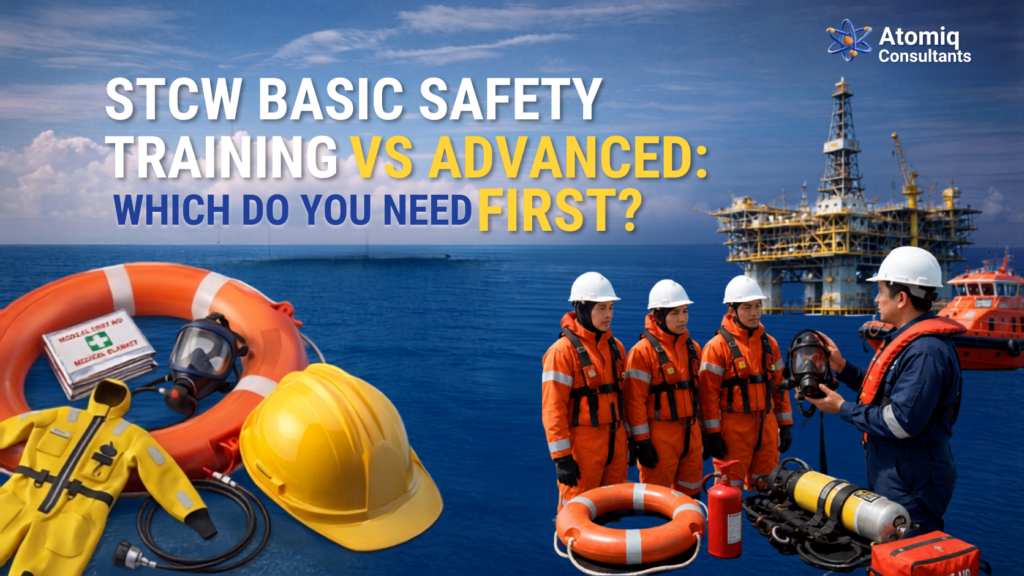
STCW basic training always comes first. It is the mandatory foundation every seafarer must hold before stepping aboard a commercial vessel, and it is the legal prerequisite for every STCW advanced course that follows. If you are choosing between the two, the order is decided for you: basic first, advanced second. The more useful question — and the one this guide answers — is what each level actually covers, when you are ready to move up, and which advanced course to book once your basic certificate is in hand.
The distinction matters because the two levels serve different points in a maritime career. Basic safety training gets you legally allowed to work at sea. Advanced courses qualify you for specific responsibilities, ranks, and vessel types. Understanding where the line sits saves you from booking a course you cannot yet enrol in, or from delaying a rank progression because a required certificate has lapsed.
What is STCW basic training?
STCW basic training — often called Basic Safety Training (BST) — is the entry-level safety qualification required under the International Convention on Standards of Training, Certification and Watchkeeping for Seafarers (STCW), adopted by the International Maritime Organization. Every person with designated safety or emergency duties on a seagoing commercial vessel must complete it before serving, regardless of rank or department.
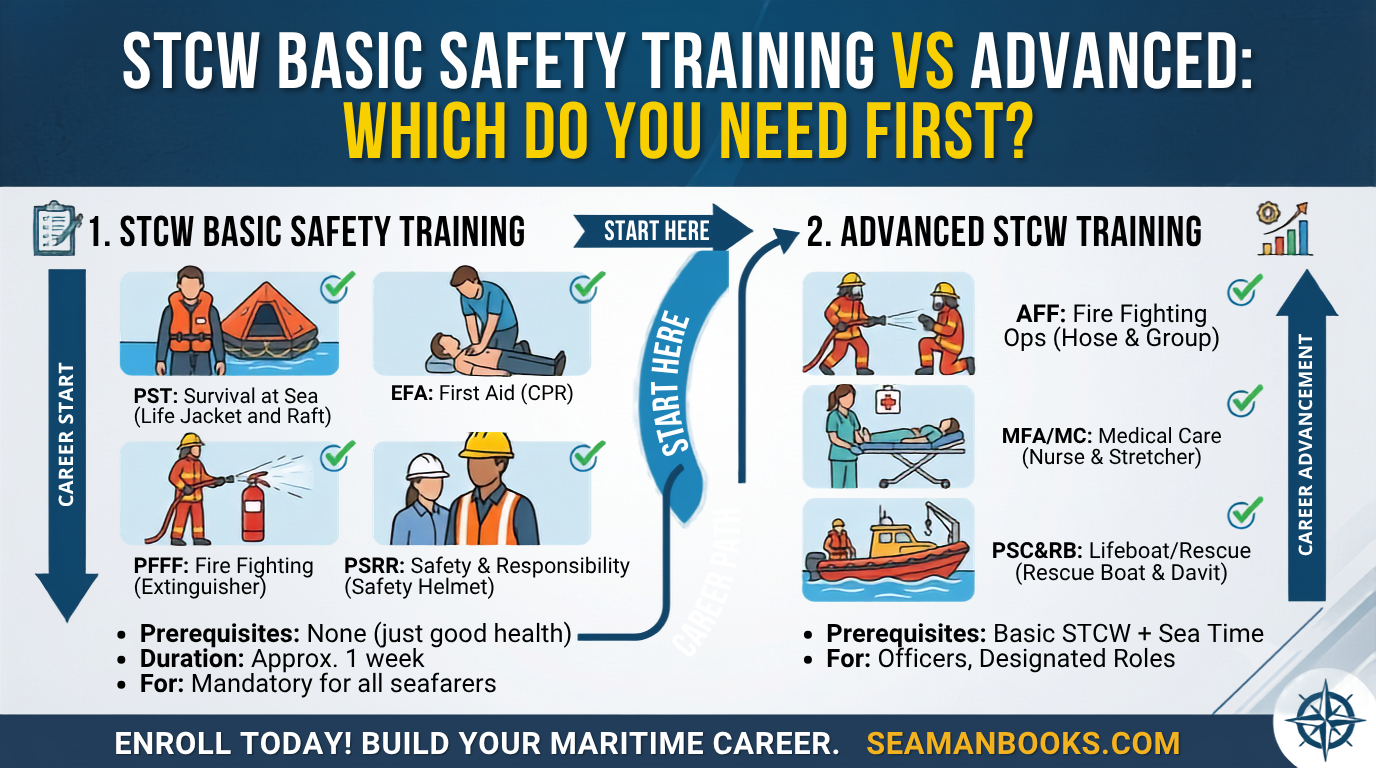
Under STCW Chapter VI, STCW basic training is built from four separate elements:
- Personal Survival Techniques (PST): how to survive if you have to abandon ship — life jackets, liferafts, cold-water survival, and sea survival principles.
- Fire Prevention and Fire Fighting (FPFF): recognising fire risks, using extinguishers and breathing apparatus, and acting as part of a firefighting team.
- Elementary First Aid (EFA): immediate casualty care, resuscitation basics, and managing an injured person until further help arrives.
- Personal Safety and Social Responsibilities (PSSR): shipboard safety culture, emergency procedures, pollution prevention, and working effectively as a crew.
Completed together, these four modules certify that you can keep yourself and others safe in the routine emergencies every seafarer may face. Basic training is the floor. It does not qualify you to lead a firefighting party, command a survival craft, or run a ship’s hospital — those are advanced responsibilities.
What are STCW advanced courses?
STCW advanced courses build directly on the basic modules, taking you from participant to team leader or specialist. They are required once your role carries greater responsibility — typically as you move into officer ranks, take charge of emergency parties, or join specialised vessels. The most common advanced and proficiency courses under STCW Chapter VI are:
- Advanced Fire Fighting (AFF): controlling and directing firefighting operations, organising the crew, and managing casualties and communications during a fire. It extends the basic FPFF module from “team member” to “team leader.”
- Proficiency in Survival Craft and Rescue Boats (PSCRB): taking charge of a lifeboat or rescue boat, launching and recovering it, and operating its equipment — the qualification behind a Lifeboatman certificate.
- Proficiency in Fast Rescue Boats (PFRB): a further specialisation for crews operating fast rescue craft, common on offshore and standby vessels.
- Medical First Aid and Medical Care: progressively advanced casualty care for officers who provide medical treatment on board where no doctor is present.
Each advanced course assumes you already hold the relevant basic competence. You cannot enrol in Advanced Fire Fighting without having completed basic Fire Prevention and Fire Fighting first — the advanced syllabus starts where the basic one ends.
STCW basic safety vs advanced training for seafarers: side by side
| Factor | STCW basic training (BST) | STCW advanced training courses |
| Purpose | Legal minimum to work at sea | Qualify for specific ranks, duties, and vessel types |
| Who needs it | Every seafarer with safety duties | Officers, emergency-party leaders, specialised crew |
| Core modules | PST, FPFF, EFA, PSSR | AFF, PSCRB, PFRB, Medical First Aid/Care |
| Role level | Team member / participant | Team leader / specialist |
| Prerequisite | None — the starting point | Relevant basic module must be held first |
| Typical duration | Around 5 days combined | 1–5 days per course, depending on the module |
| When you take it | Before your first sea service | As your rank or role advances |
| Refresher cycle | Every 5 years (PST, FPFF) | Every 5 years (AFF, PSCRB, PFRB) |
Which do you need first? A simple decision path
For anyone entering the industry, the sequence is fixed: complete STCW basic training before anything else, because no employer can legally sign you on without it and no advanced course will accept you without it. There is no scenario in which advanced comes first.
If you are already a working seafarer, the question shifts from “which first” to “what next.” Your next course depends on where you are heading:
- Progressing to an officer rank? Advanced Fire Fighting and Proficiency in Survival Craft and Rescue Boats are almost always required for certification. Book these ahead of your certificate of competency application, not after.
- Joining an offshore, tanker, or passenger vessel? Check the specific STCW proficiency courses your role and vessel type demand — fast rescue boats, medical care, or ship-type specific training may apply.
- Certificates approaching five years old? This is the most overlooked trigger. The survival and firefighting elements of both basic and advanced training must be refreshed every five years to stay valid. A lapsed refresher can ground you as surely as never having trained at all.
That last point is where most experienced seafarers actually need to act. Under the 2010 Manila Amendments to STCW, a refresher training module is required every five years for personal survival techniques, fire prevention and firefighting, advanced firefighting, and proficiency in survival craft and rescue boats. Holding the certificate once is not enough — revalidation keeps it live.
How the two levels work together
Think of STCW training as a ladder rather than a choice. Basic safety training is the first rung: it gets everyone onto the vessel safely and is deliberately broad. Advanced courses are the rungs above: narrower, deeper, and tied to specific responsibilities you take on as your career develops. You never replace basic training with advanced training — you add to it, and you keep both current through the five-year refresher cycle.
For working seafarers, the practical takeaway is that “which first” is rarely your real decision. You already have basic. What determines your next booking is your target rank, your vessel type, and your revalidation dates. Getting ahead of an expiring refresher or a rank requirement is the difference between a smooth crew change and a missed contract.
Frequently asked questions : STCW Basic vs Advanced
Do I need STCW basic training before an advanced course?
Yes. Basic Safety Training is a prerequisite for every STCW advanced course. Advanced Fire Fighting, for example, requires that you have already completed the basic Fire Prevention and Fire Fighting module. There is no route that skips the basic level.
How long is an STCW basic safety training certificate valid?
The survival and firefighting elements of basic training must be refreshed every five years under the STCW Manila Amendments. Elementary First Aid and PSSR do not carry the same mandatory refresher, but many employers and flag states expect your overall training to be current, so check your specific requirements.
Can I take basic and advanced STCW courses at the same time?
Generally no. Advanced courses assume you already hold the relevant basic competence, so most training centres require you to complete and hold your basic certificate before enrolling in the matching advanced module.
Which STCW advanced course should I take first?
For most seafarers progressing toward an officer rank, Advanced Fire Fighting and Proficiency in Survival Craft and Rescue Boats are the priority, as they are commonly required for certification. Your target rank and vessel type should guide the exact order.
How often do STCW advanced certificates need refreshing?
Advanced Fire Fighting and Proficiency in Survival Craft and Rescue Boats both require refresher training every five years to remain valid, in line with the same STCW rules that apply to the basic modules.
The bottom line
Basic before advanced — always. STCW basic training is the non-negotiable foundation, and STCW advanced courses are the qualifications you layer on top as your responsibilities grow. If you are already at sea and holding a valid basic certificate, your real decision is which advanced or refresher course keeps you eligible for your next role and contract.
If your Advanced Fire Fighting, survival craft, or firefighting refresher is due — or your next rank calls for an advanced qualification — browse our STCW courses and book the module that keeps your certification current and your career moving.