Offshore Oil & Gas Certifications: Everything You Need to Know
You can be the best welder on the Arabian Gulf coast and still not set foot on a rig. Offshore hiring doesn’t start with your skills — it starts with your file. Every offshore oil and gas certification in that file has an issuing body, an expiry date, and a regional catch, and one lapsed card is enough to lose a rotation you’ve already packed for.
This guide walks through every certification offshore oil and gas workers actually need in 2026: what each one covers, who issues it, how long it lasts, and how the requirements shift between the North Sea, the Gulf of Mexico, the GCC and Southeast Asia. It also covers the offshore worker documents that sit alongside your training certificates — the ones people forget until a crewing manager asks for them.
What Is an Offshore Oil & Gas Certification?
An offshore oil and gas certification is a formal credential proving a worker has completed the safety, survival, medical or competency training required to work on an offshore installation. Most are issued against internationally recognised standards — chiefly OPITO, STCW and GWO — carry a fixed validity period of two to five years, and must be verifiable by the operator before a worker is allowed offshore.
That last clause matters more than most people realise. Verifiable means the operator can look your certificate up in a central register. A paper certificate from an unapproved centre is not a certification — it’s a receipt.
The Four Layers of Offshore Certification
Here’s the frame that makes the whole acronym soup make sense. Offshore compliance is four stacked layers. Miss any single one and you don’t board, no matter how strong the other three are.
|
Layer |
What it proves |
Governing body |
Typical documents |
|
1. Safety & survival |
You can survive and escape an offshore emergency |
OPITO (oil & gas), GWO (offshore wind) |
BOSIET, FOET, HUET, H₂S, Sea Survival |
|
2. Marine competency |
You can perform your role safely at sea |
IMO, via your flag state |
STCW Basic Safety Training, Advanced Firefighting, PSCRB |
|
3. Medical fitness |
You’re physically fit for a remote, high-risk site |
OEUK, ENG1, or operator-specified scheme |
Offshore medical certificate, fitness-to-work |
|
4. Identity & right to work |
You are who you say you are and can legally travel |
Flag state, port state, immigration |
Seaman book (SID/CDC), passport, visa, TWIC (US) |
Most workers over-invest in Layer 1 and neglect Layer 4. Then the contract arrives with a three-week mobilisation window and their seaman book has four months left on it.
Layer 1: Offshore Safety Certifications Explained
BOSIET — Basic Offshore Safety Induction and Emergency Training
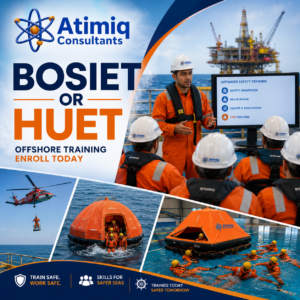
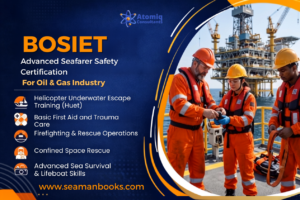
BOSIET is the foundation certificate for offshore oil and gas work. It’s a three-day course covering safety induction, helicopter travel and underwater escape, sea survival, firefighting and self-rescue. It’s delivered only by OPITO-approved centres, and it’s typically valid for four years.
If you hold one offshore certification, this is the one. North Sea operators, most GCC operators and a large share of West African and Asia-Pacific contractors treat it as non-negotiable for anyone travelling to an installation by helicopter.
Two variants matter:
- BOSIET with CA-EBS (Compressed Air Emergency Breathing System) — now the default in the North Sea and increasingly elsewhere. If you’re being hired into a UK or Norwegian scope, you need the CA-EBS version specifically.
- T-BOSIET (Tropical BOSIET) — the tropical-waters variant, standard for the Gulf of Mexico, West Africa, Southeast Asia and parts of the Middle East, where sea temperatures remove the need for full survival-suit training.
Booking the wrong variant is the single most common and most expensive certification mistake offshore workers make. Confirm the variant with your employer before you pay.
FOET — Further Offshore Emergency Training
FOET is the BOSIET refresher. It’s a one-day course that revalidates your BOSIET for another four years, and it exists in matching variants — FOET with CA-EBS (OPITO product code 5850) and FOET with EBS (code 5858).
The trap: FOET only works if your BOSIET is still in date. Let it expire and you’re back to the full three-day BOSIET at full price. Set a calendar reminder for 90 days before your expiry, not the week of.
HUET — Helicopter Underwater Escape Training
HUET teaches you to escape a submerged, inverted helicopter — the exact scenario that kills offshore workers in transit. It’s a one-day course covering brace positions, reference points, window jettison and controlled escape from a rotating simulator, usually with an emergency breathing system.
HUET is bundled inside BOSIET, so most workers never buy it separately. You’d take standalone HUET if you already hold current offshore safety training but need helicopter-specific certification added, or if your scope changes to include routine helicopter transfer.
H₂S Awareness
Hydrogen sulphide is colourless, heavier than air, and deadens your sense of smell before it kills you. H₂S training is a one-day course covering gas properties, detection, alarm response, escape breathing apparatus and rescue. OPITO runs it as separate theory and practical standards, codes 9014A and 9014B.
In the GCC, and on any sour-service field anywhere, this is effectively mandatory. Several Middle East operators will not process a gate pass without it.
Sea Survival and Advanced Firefighting
Sea survival covers abandonment, life raft entry, group survival techniques and helicopter rescue. It’s inside BOSIET but is also a standalone STCW element.
Advanced Firefighting goes beyond basic fire prevention into leading a firefighting team, breathing apparatus operations and command in a fire emergency. It’s required for senior deck and engine ranks and for designated emergency response roles offshore.
Rig Safety Training and MIST
Beyond the survival stack, most operators require an industry safety induction covering permit-to-work, hazard identification, manual handling and platform-specific risk. In the UK sector this is MIST (Minimum Industry Safety Training). Elsewhere it appears as operator-branded rig safety induction. Either way, budget for it — it’s usually a condition of the gate pass rather than of the contract, so it surfaces late.
HLO / HLA — Helicopter Landing Officer and Assistant
If you’ll work on the helideck, you need helideck-specific certification. HLA (Helicopter Landing Assistant) is a one-day course covering deck crew duties, refuelling support and emergency response. HLO (Helicopter Landing Officer) is the supervisory tier, responsible for the deck during helicopter movements. These are high-value add-ons — they widen your role eligibility considerably for one day of training.
GWO Basic Safety Training — the Offshore Wind Crossover
If your career is drifting toward offshore wind, and a lot of oil and gas careers are, GWO (Global Wind Organisation) Basic Safety Training is the equivalent entry credential. BST is modular — first aid, manual handling, fire awareness, working at heights and sea survival — and records are held centrally in the WINDA database so employers can verify them instantly.
GWO does not substitute for BOSIET, and BOSIET does not substitute for GWO. Workers moving between sectors generally need both. Confirm current module list and refresher intervals directly with GWO or your training centre before booking, as the standards are revised periodically.
Ready to book? Atomiq Group runs BOSIET, HUET, H₂S, Sea Survival, Advanced Firefighting, Rig Safety, GWO BST, HLA/HLO and Ship Cook courses for seafarers across India, Nepal and the GCC — and handles the documentation alongside the training.
Layer 2: STCW Certifications
STCW — the IMO’s International Convention on Standards of Training, Certification and Watchkeeping for Seafarers — is the marine layer. It applies to you if you’re crew on a vessel: offshore support vessels, anchor handlers, drillships, FPSOs, accommodation barges and most mobile offshore drilling units.
STCW Basic Safety Training is the four-element entry package:
- Personal Survival Techniques (PST)
- Fire Prevention and Fire Fighting (FPFF)
- Elementary First Aid (EFA)
- Personal Safety and Social Responsibilities (PSSR)
Under the 2010 Manila amendments, the IMO requires refresher training every five years for personal survival, fire prevention and firefighting, advanced firefighting, and proficiency in survival craft, rescue boats and fast rescue boats. Five years is the international floor — your flag state or employer may demand shorter.
The distinction that trips people up: BOSIET certifies you to be on an offshore installation. STCW certifies you to be crew on a vessel. On a drillship or an FPSO you may well need both. Our guides on how to get STCW certification step by step and STCW basic versus advanced training break down which tier your rank requires.
Layer 3: The Offshore Medical Certificate
No medical, no mobilization. An offshore medical is a physician assessment of your fitness to work in a remote environment where evacuation takes hours: cardiovascular screening, vision and hearing, BMI, blood pressure, and a review of any condition that could deteriorate without immediate care.
Which scheme applies depends on where you’re working:
- UK / North Sea — the OEUK offshore medical (formerly OGUK), issued by a doctor on the OEUK registered doctors list. Typically valid two years, and shorter for older workers or those with managed conditions.
- Seafarers on vessels — an ENG1 (UK) or the equivalent flag-state medical certificate under STCW.
- GCC operators — an operator-specified medical, frequently OEUK-equivalent, plus a country medical for the work visa. ADNOC, Saudi Aramco and QatarEnergy each publish their own contractor requirements — check the specific one for your contract.
- US Gulf of Mexico — operator and BSEE-driven, usually paired with fitness-for-duty and substance screening.
Practical note: book the medical first, not last. It’s the cheapest item on the list and the only one that can fail you outright, and discovering a problem before you’ve paid for BOSIET saves real money.
Layer 4: Offshore Worker Documents
Training certificates get you qualified. Documents get you aboard. The offshore worker documents most commonly missing when a contract lands:
|
Document |
Who needs it |
Why it stalls mobilization |
|
Seaman book (SID / CDC) |
Anyone signing on a vessel, including offshore support and drilling units |
Processing takes weeks; many flag states require it before signing articles |
|
Passport with sufficient validity |
Everyone |
Many jurisdictions require 6+ months’ remaining validity |
|
Work visa / gate pass |
Everyone working in-country |
GCC gate passes are operator-issued and need certificates already in hand |
|
TWIC card |
US Gulf of Mexico workers |
Background check adds weeks |
|
Yellow fever / vaccination records |
West Africa, parts of Asia-Pacific |
Refused entry without it |
|
Certificate verification records |
Everyone |
OPITO and WINDA registry entries; a paper copy alone is often rejected |
The seaman book is where most offshore careers stall. If you don’t hold one, our new-applicant requirements checklist walks through it, and if you’re based in the UAE, the Dubai and UAE process guide covers the local route.
Offshore Certification Requirements by Region
Certification is not portable in the way people assume. This is the table to screenshot.
|
Region |
Safety baseline |
Marine layer |
Medical |
Notable extras |
|
UK / Norway (North Sea) |
BOSIET with CA-EBS + MIST |
STCW for vessel crew |
OEUK medical |
Vantage POB registration; cold-water variant required |
|
UAE / GCC |
BOSIET or T-BOSIET + H₂S |
STCW for vessel crew |
Operator medical + visa medical |
Operator-specific gate pass; H₂S near-universal on sour fields |
|
US Gulf of Mexico |
T-BOSIET / HUET, SEMS induction |
USCG credentials for crew |
Operator fitness-for-duty |
TWIC card mandatory |
|
West Africa |
T-BOSIET + H₂S |
STCW for vessel crew |
Operator medical |
Yellow fever certificate; local content rules |
|
India / Southeast Asia |
BOSIET or T-BOSIET |
STCW (DG Shipping approved for Indian nationals) |
Flag-state medical |
Flag-state seaman book; regional variation is wide |
|
Offshore wind (global) |
GWO BST |
STCW for vessel crew |
Operator medical |
WINDA record required for verification |
Estimated — compiled from published operator and standards-body requirements as of August 2026. Contractor requirements change and are contract-specific; always confirm against your written scope before booking training.
Validity and Renewal at a Glance
|
Certification |
Typical validity |
Renewed by |
|
BOSIET |
4 years |
FOET (1 day) |
|
HUET |
4 years (with BOSIET) |
FOET or standalone refresher |
|
STCW Basic Safety Training |
5 years (IMO minimum) |
Refresher training |
|
Advanced Firefighting |
5 years (IMO minimum) |
Refresher training |
|
H₂S Awareness |
Commonly 2 years |
Full re-sit |
|
GWO BST |
Periodic refresher — confirm with GWO |
Refresher modules |
|
Offshore medical |
Typically 2 years, shorter with age or conditions |
Re-examination |
|
Seaman book |
Varies by flag state, commonly 5 years |
Renewal application |
The IMO five-year figure is Measured from the STCW Convention. The remainder are industry-typical values — your certificate’s printed expiry date and your operator’s policy override anything in this table.
The renewal rule that saves careers: stagger your certificates. If BOSIET, medical and seaman book all expire in the same quarter, one busy month can take you off the market entirely. Renew the cheapest item early to break up the cluster.
What Certifications Do Offshore Oil & Gas Workers Need, by Role?
|
Role |
Minimum stack |
|
Roustabout / roughneck |
BOSIET (or T-BOSIET), H₂S, rig safety induction, medical |
|
Rigger / scaffolder |
BOSIET, H₂S, medical, + trade competency (banksman/slinger, working at height) |
|
Welder / fabricator |
BOSIET, H₂S, medical, + coded welding qualification |
|
Deck crew on OSV / AHTS |
STCW BST, seaman book, medical, + BOSIET if visiting installations |
|
Offshore chef / steward |
BOSIET, medical, seaman book, Ship Cook Certificate (STCW-linked) |
|
Helideck crew |
BOSIET, HLA or HLO, H₂S, medical |
|
Offshore medic |
BOSIET, offshore medic qualification, medical, professional registration |
|
Offshore wind technician |
GWO BST (+ GWO BTT), medical, sea survival, WINDA record |
Two credentials in that table are quietly underrated. The Ship Cook Certificate is mandatory for catering crew under STCW and is chronically short in supply — it’s one of the fastest routes into offshore work for someone with a shore hospitality background. And HLA/HLO turns a general deck hand into a specialist for a single day of training.
How to Get Certified: A Practical Sequence
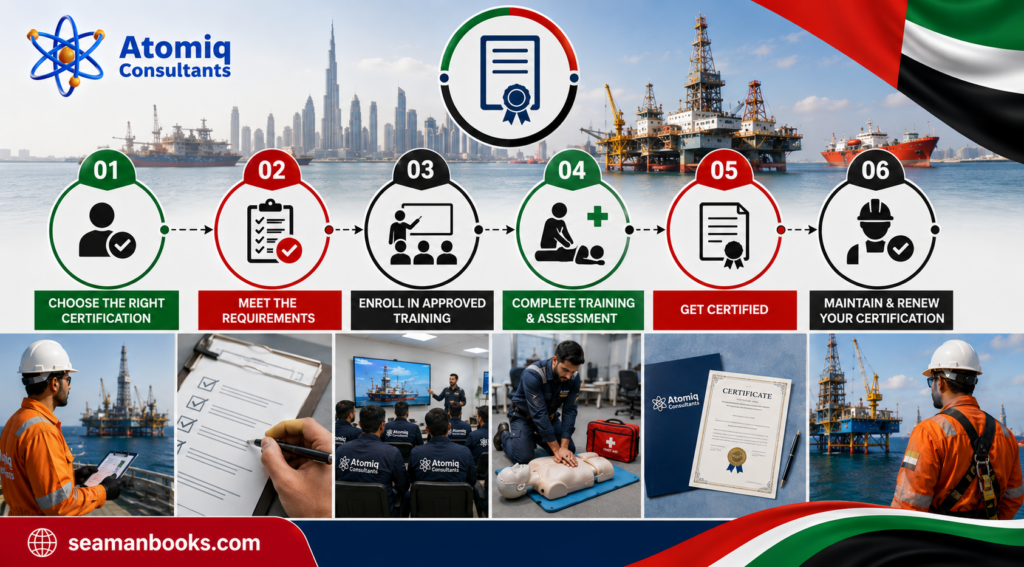
- Confirm the scope in writing. Get the exact certificate names and variants from the employer or crewing manager. “BOSIET” is not specific enough — ask CA-EBS or tropical.
- Do the medical first. Cheapest, fastest, and the only one that can disqualify you before you’ve spent anything else.
- Verify the training centre is approved. OPITO-approved for oil and gas, GWO-certified for wind. Check the body’s own register, not the centre’s website.
- Book the safety stack together. BOSIET, H₂S and rig safety in one block is cheaper and faster than three separate trips.
- Start documents in parallel. Seaman book and visa processing run on their own clock — begin them the same week you book training, not after.
- Register and verify. Make sure your record lands in the OPITO or WINDA registry. Then store scans in cloud storage with expiry dates in your calendar.
Five Mistakes That Cost Offshore Workers Contracts
- Booking the wrong BOSIET variant. Tropical instead of CA-EBS, or the reverse. Full re-sit, full price, contract gone.
- Letting BOSIET expire by a week. One day of FOET becomes three days of BOSIET.
- Training at an unapproved centre. The certificate looks identical and is worth nothing at the gate.
- Treating the seaman book as an afterthought. Certificates in hand, no document, no boarding.
- Clustered expiry dates. Everything renewing in the same month means one bad month costs a full rotation.
Frequently Asked Questions
What certifications do offshore oil and gas workers need?
Most offshore oil and gas workers need four things: an OPITO-approved safety certificate such as BOSIET, H₂S awareness training, a valid offshore medical, and identity documents including a seaman book where vessel work is involved. Vessel crew add STCW Basic Safety Training. Exact requirements vary by role, region and operator.
How long is BOSIET valid?
BOSIET is typically valid for four years. It’s renewed with FOET, a one-day refresher, provided your existing certificate hasn’t expired. If it has lapsed, you must retake the full three-day BOSIET course rather than the refresher.
Is BOSIET the same as HUET?
No. HUET is helicopter underwater escape training and forms one module inside the wider BOSIET course. BOSIET also covers safety induction, sea survival, firefighting and self-rescue. You can take HUET as a standalone course, but BOSIET cannot be replaced by HUET alone.
Do I need STCW if I already have BOSIET?
Often yes. BOSIET certifies you to be on an offshore installation; STCW certifies you as vessel crew. If you’ll be signed on the crew list of an offshore support vessel, drillship or FPSO, you’ll generally need both plus a seaman book.
Can I use my UK BOSIET in the UAE?
Usually yes, since OPITO standards are internationally recognised, but the variant matters. A cold-water BOSIET with CA-EBS is generally accepted in the GCC, while a tropical T-BOSIET may not satisfy a North Sea scope. Always confirm with the specific operator before travelling.
How much do offshore certifications cost?
Costs vary widely by country, center and course bundle, so any single figure is misleading. BOSIET is normally the largest single item, followed by advanced firefighting; H₂S, HUET and HLA are typically one-day and cheaper. Booking the safety stack as one block is usually cheaper than separate courses.
What is a seaman book and do offshore workers need one?
A seaman book, also called a Seafarer Identity Document or CDC, is a flag-state-issued record of identity and sea service. Anyone signing on a vessel’s crew list needs one, including crew on offshore support vessels and drilling units. Workers based permanently on fixed platforms may not.
Do offshore wind certifications transfer to oil and gas?
Not directly. GWO Basic Safety Training is the offshore wind standard; BOSIET is the oil and gas standard. There is real overlap in sea survival and first aid content, but operators in each sector generally require their own credential. Workers moving between sectors usually hold both.
How early should I renew my offshore certificates?
Start renewals 90 days before expiry. Training centres book out, medicals can require follow-up appointments, and document renewals such as seaman books can run for weeks. Renewing early also lets you stagger expiry dates so they don’t cluster in one month.
Which offshore certification should I get first?
Get your offshore medical first, since it’s the cheapest and can disqualify you. Then BOSIET, which unlocks the widest range of offshore roles. Add H₂S if you’re heading to the GCC or any sour-service field, and start your seaman book application in parallel.
The Short Version
Offshore oil and gas certification is four layers, not one list: safety training, marine competency, medical fitness and identity documents. BOSIET is the anchor credential, STCW covers you as vessel crew, the medical gates everything, and the seaman book is the one people forget until it’s too late. Get the variant right, verify the centre, and stagger your renewal dates.
Atomiq Group handles both halves of that job from Dubai — the training and the paperwork. Browse our offshore training courses, including BOSIET, HUET, H₂S, GWO BST and the Ship Cook Certificate, or book your BOSIET or HUET place directly. If your documents need attention first, we process seaman books and STCW certifications for seafarers across India, Nepal, the Philippines and the GCC.