Fishing vessels: a separate regime
MLC 2006 does not cover fishing vessels. Fishers’ rest is set by the ILO Work in Fishing Convention, 2007 (C188) where a State has ratified it, and by national law. For larger vessels at sea for more than three days, C188 sets minimum rest of 10 hours in any 24-hour period and 77 hours in any 7-day period.
Note: Make clear that C188 applies to commercial fishing operations, not automatically to all merchant ships, yachts or offshore vessels.
If you work in fishing, check which flag your vessel flies and whether that flag has ratified C188.
Country note: Indonesian seafarers
Indonesia’s maritime administration is the Directorate General of Sea Transportation (Direktorat Jenderal Perhubungan Laut) of the Ministry of Transportation, which issues Indonesian seafarers’ national documents, including the buku pelaut. Indonesia ratified MLC 2006 through Law No. 15 of 2016.
Indonesia ratified the Maritime Labour Convention (MLC), 2006, on 12 June 2017, and the Convention entered into force for Indonesia on 12 June 2018. Indonesia approved the Convention through Law No. 15 of 2016 (Undang-Undang Nomor 15 Tahun 2016), dated 6 October 2016.
On board, the rules come from the flag. An Indonesian AB on a Liberia-flag tanker works under Liberia’s implementation of MLC and STCW. Many Indonesian crew work in fishing, where the C188 section above applies instead. For flag-state seaman books, see our guide for Indonesian seafarers.
Recording your rest: don’t sign a false record
Your rest record does three jobs:
- It’s your evidence. In a complaint, the record is what an inspector reads first.
- It’s cross-checked. Inspectors compare it with logbooks and port times.
- It sits next to your service record. Your seaman book shows where and when you served. The rest record shows the conditions. Keep copies of both.
Adjusting rest hours “so the paperwork is clean” is a common pressure on board. Don’t sign a record you know is false. It deletes your own evidence and puts your signature on a document an inspector may treat as falsified.
If a schedule can’t be kept within the limits, raise it with your head of department, then the master. If it’s not resolved, MLC Regulation 5.1.5 gives you an on-board complaint procedure, and Regulation 5.2.2 lets you complain to a port State control officer ashore. Our MLC 2006 seafarer rights guide explains both routes.
Practical fatigue management for crew
Know your pattern
| Pattern | Rest available | The catch |
|---|---|---|
| 4-on/8-off (three watchkeepers) | Two 8-hour blocks a day | Usually compliant. Port work and drills eat into off-watch time |
| 6-on/6-off (two watchkeepers) | Two 6-hour blocks a day | No margin. Meals, handover and one call-out push it under |
| Day work plus on-call | One long night block | Repeated alarms break it into fragments |
| Offshore 12-hour shift | One 12-hour block | Compliant on paper. Travel days and night swings aren’t |
| Yacht guest service | Irregular | Rest follows the guests’ day, not a rota |
Write every interruption in your record when it happens, not at the end of the week.
Protect the core sleep
- Make one rest period at least 6 hours of actual sleep, not 6 hours off watch.
- Keep the cabin dark and cool. Eye masks and earplugs are cheap and they work.
- Stop caffeine several hours before your main sleep. Its effect lasts longer than most people expect.
- Avoid heavy meals right before sleeping.
Respect the low point
Alertness is lowest in the early hours of the morning, whatever your rank or experience. The 00–04 and 04–08 watches, and offshore night shifts, carry the most risk. Get up and move, use the bridge watch alarm as intended, and call for help early.
Time zones, fasting and joining
- Crossing time zones: each clock change takes an hour from someone. Rotate who loses it.
- Fasting months: crew who fast during Ramadan should plan sleep around the pre-dawn and sunset meals with their head of department before the month starts, and tell their watch partner.
- Joining day: after a long flight, tell the officer on watch how long you’ve been travelling. A first watch straight off a 30-hour journey is a known risk.
Speak up early
Reporting fatigue isn’t weakness. The IMO guidelines treat it as information a company needs to manage risk. A near-miss report that names fatigue is more useful than one that doesn’t.
For companies, masters, yacht managers and crewing managers
Module 2 of the IMO guidelines sets out the company’s part: realistic manning, workload planning around port calls, fatigue in the safety management system, and a culture where fatigue can be reported without penalty. Two practical steps protect crews and inspection records at the same time:

- Audit rest records against logbooks before a port State inspector does. Look for identical entries day after day, rest that never dips on port days, and records signed in bulk.
- Audit certificate expiries against contract end dates. A certificate that expires mid-contract means a crew change or a deficiency, often on short notice, and short-notice crew changes are themselves a fatigue driver.
Seaman Books does the second. We check crew certificates and seaman books against contract dates and flag requirements, and prepare renewals before they’re due. Our crew document audit explains what we check. We don’t audit rest records or run fatigue programmed. That stays with your DPA and the master.
Keep your certificates valid: the commercial part
Fatigue is managed on board. Expiring certificates are managed before you join, so you aren’t chasing paperwork during rest hours or field breaks.
| If you are… | Check this before your next contract | Next step |
|---|---|---|
| A seafarer joining a merchant ship | STCW Basic Safety Training; PST and FPFF refresher evidence every 5 years | STCW Basic Safety Training enrolment · STCW renewal |
| Offshore crew | BOSIET or FOET expiry against your rotation dates (renew inside the 3-month window) | BOSIET, HUET and FOET enrolment |
| Yacht crew | Seaman book and STCW basic training validity | Superyacht crew documents |
| Any seafarer needing a flag-state seaman book | Eligibility for Panama, Liberia, Belize, Palau, Bahamas, Honduras or St Kitts & Nevis | Free seaman book eligibility check |
| A crewing or yacht manager | Certificate expiries against contract end dates, across the crew list | Crew document audit |
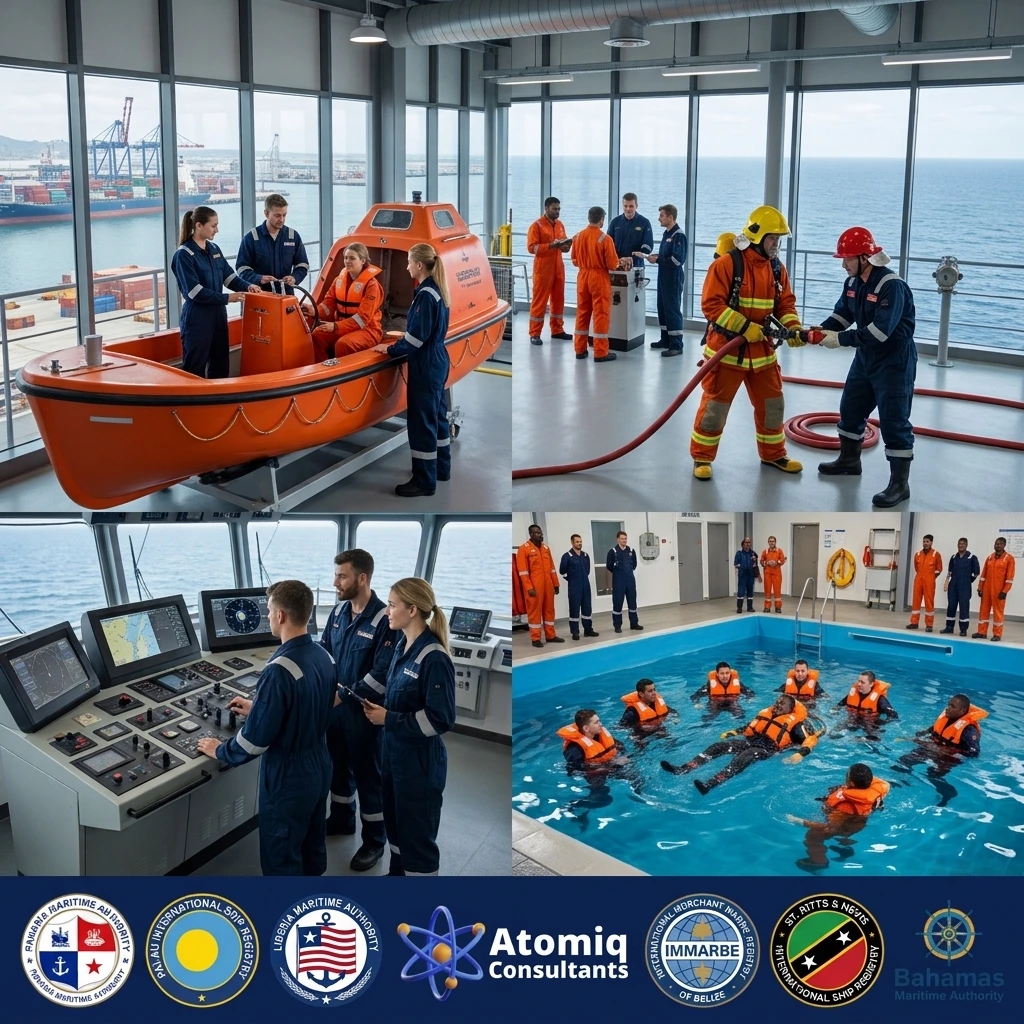
Who delivers the training. Training institutes deliver courses and issue certificates. For STCW, that’s Atomiq College Private Limited, our Group’s training institute in Kathmandu, listed on the IMMARBE Approved Entities register under Maritime Training Institutes.
Atomiq College runs STCW Basic Safety Training as a 5-day course covering all four A-VI/1 modules, plus PST and FPFF refresher training.
Offshore courses (BOSIET, HUET, FOET) are delivered by OPITO-approved centers, which we book for you. Fatigue management itself isn’t a mandatory standalone STCW certificate, and we don’t sell a “fatigue course”.
What it costs. Course fees are set by the training center; seaman book fees are set by the flag administration. Our coordination charge is quoted separately. You get all three in writing, itemized, before you pay anything.
How fast. We reply on WhatsApp during office hours, 09:30 to 18:00 Dubai time (UTC+4).
Send us three things
- Your rank and the type of vessel (ship, yacht, offshore)
- Your certificate list with expiry dates (a photo is fine)
- Your next joining date
We’ll tell you what expires before your contract ends and what to renew first.
WhatsApp +971 55 458 3416 · or use the form below.
Frequently asked questions: Seafarer Fatigue Management
How many hours of rest must a seafarer get?
At least 10 hours in any 24-hour period and 77 hours in any 7-day period, under MLC 2006 and STCW. Rest can be split into no more than two periods, one at least 6 hours long, with no more than 14 hours between them. A flag State can set stricter limits, never looser ones.
Do hours of rest rules apply to yacht crew?
On commercial yachts, generally yes: MLC and STCW apply through the flag, and large Red Ensign yachts are surveyed against the REG Yacht Code. Private yachts not engaged in trade usually fall outside both conventions, so the flag’s national law and your crew agreement decide your hours.
Do MLC rest hours apply offshore?
Crew on offshore support vessels are seafarers on ships, so MLC and STCW apply. Workers on fixed installations are usually covered by the coastal State’s offshore safety and working-time law instead. Mobile offshore units depend on the flag and the coastal State.
Can the master cancel my rest period?
Only for the immediate safety of the ship, the people on board or the cargo, or to help others in distress. Once normal operations resume, you must get adequate rest. A tight port schedule or a commercial deadline is not an emergency under the conventions.
What should I do if my rest hours record is wrong?
Don’t sign a record you know is inaccurate. Ask your head of department and the master to correct it. If they don’t, use the on-board complaint procedure under MLC Regulation 5.1.5, or complain to a port State control officer ashore. Keep your own notes and a copy.
Is there an STCW certificate for fatigue management?
No. Fatigue management isn’t a standalone mandatory STCW certificate. The hours-of-rest rules sit in STCW Section A-VIII/1, and the IMO Guidelines on Fatigue include a module on awareness and training for seafarers and companies. Your mandatory certificates are your basic training and your rank’s competency certificates.
Does a seaman book record hours of rest?
No. A seaman book (CDC, SIRB or discharge book) records sea service: ship, rank and dates. Hours of rest are recorded separately on board. Keep copies of both, because inspectors and future employers may look at them together.
How does fatigue relate to certificate renewal?
An expired certificate forces short-notice training or a crew change, often in your rest days or field break. Offshore, a lapsed BOSIET means retaking the full course instead of the one-day FOET. Checking expiries against contract dates before you join avoids both.
Written by Dipak Paudel, Seaman Books, Atomiq Management Consultancies L.L.C., #903 Regal Tower, Business Bay, Dubai. Seaman Books is a documentation support and processing partner. It is not a flag-state authority or a government body and does not issue documents.