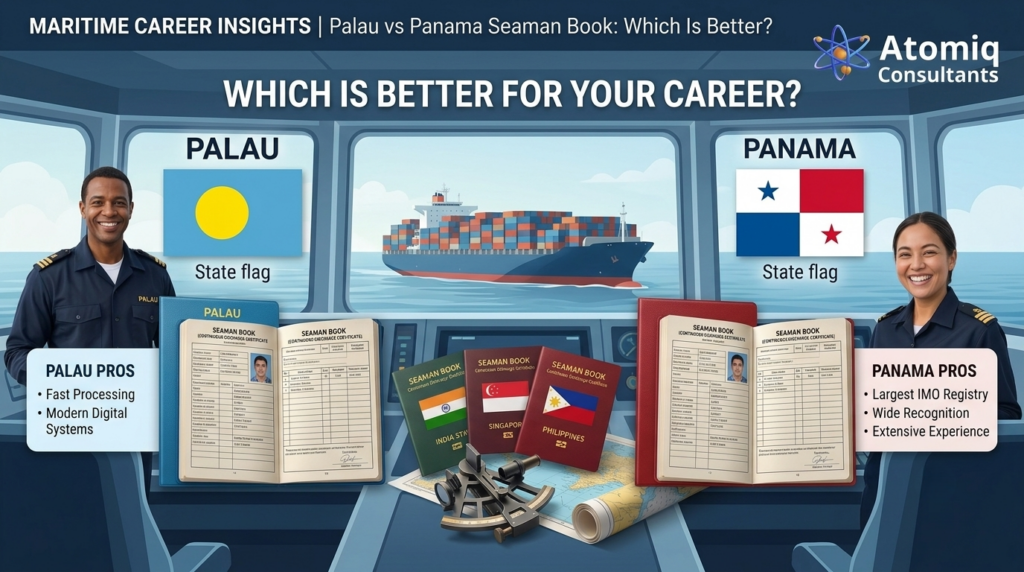
Palau vs Panama :- A practical, up-to-date comparison for seafarers choosing a flag-state seafarer document.
For most seafarers building a long-term career, a Panama seaman book is the stronger choice — it comes from the world’s largest ship registry and sits on the Paris MoU White List, so it opens more jobs and attracts fewer port inspections. A Palau seaman book still works as a valid, internationally recognized document and can be faster and more convenient to obtain, but Palau currently sits on the Paris MoU Black List, which is worth weighing before you decide.
If you’re a merchant seafarer, you already know the seaman book (also called a Seafarer’s Identity and Record Book, CDC, or discharge book) is one of the few documents you genuinely can’t sail without. What’s less obvious is that the flag that issues it matters — not just for paperwork, but for the kinds of vessels you can join, how often your ship gets stopped in port, and how a manning agent reads your CV. Palau and Panama are two of the most talked-about open registries for seafarers who want a quick, recognized document, so let’s put them side by side and cut through the noise.
First, what a seaman book actually does for you
A seaman book is your official seafaring ID and service record rolled into one. It confirms your identity at sea, records your sign-on and sign-off dates, and proves your sea time when you go for promotions or renew certificates. Under the STCW Convention and the Maritime Labour Convention (MLC, 2006), crew on internationally trading ships are expected to carry valid seafarer documentation, and flag states issue these books to seafarers regardless of nationality.
Both Palau and Panama run open registries (sometimes called flags of convenience). That means they’ll issue a seaman book to a qualified seafarer from almost any country, which is exactly why they’re popular with crew whose home authority is slow, expensive, or hard to reach. The document is recognized worldwide — the differences show up in reputation, reach, and the day-to-day realities of the flag.
The Palau seaman book at a glance
The Palau seaman book is issued through the Palau International Ship Registry, a modern open registry that markets itself as one of the world’s leading fully digital registries. It’s valid, STCW/MLC-aligned, and often praised for a fast, paperless application process.
Palau is a small Pacific island nation, and its registry is relatively young compared with the traditional giants. Its selling point is convenience: a digital-first workflow, quick turnaround, and straightforward requirements make it attractive to seafarers who need a recognized book without a long wait.
Where it stands today:
- Recognition: Accepted internationally as a valid seafarer document under STCW and MLC frameworks.
- Process: Known for speed and a fully online, paperless application — handy if you’re between contracts or ashore in a hurry.
- Fleet size: A smaller registry, so fewer Palau-flagged vessels are actively hiring compared with the largest flags.
- Flag reputation: Palau currently appears on the Paris MoU Black List (2025 performance list, valid July 2026–July 2027), rated “Medium Risk.” Ships on lower-performing flags tend to face more frequent, more detailed port state control inspections.
The Panama seaman book at a glance
The Panama seaman book is issued under the Panama Maritime Authority, which administers the largest ship registry in the world. It carries strong global recognition and, as of the 2025 Paris MoU performance list, Panama sits on the White List — the best-performing tier for port state control.
Panama has run an open registry for roughly a century and flags more vessels than any other country on earth. For a seafarer, scale translates directly into opportunity: a huge number of Panama-flagged ships are trading at any given moment, which means more berths, more manning agents, and more routes where a Panama book is exactly what’s expected.
Where it stands today:
- Recognition: Among the most widely recognized seafarer documents in the industry, backed by the world’s biggest fleet.
- Fleet size: The largest registry globally — the single biggest pool of vessels you could realistically join on this flag.
- Flag reputation: On the Paris MoU White List (2025 list, valid July 2026–July 2027), signalling a solid, low-risk port state control record.
- Process: Well-established but traditionally more document-heavy than Palau; timelines can vary depending on how you apply.
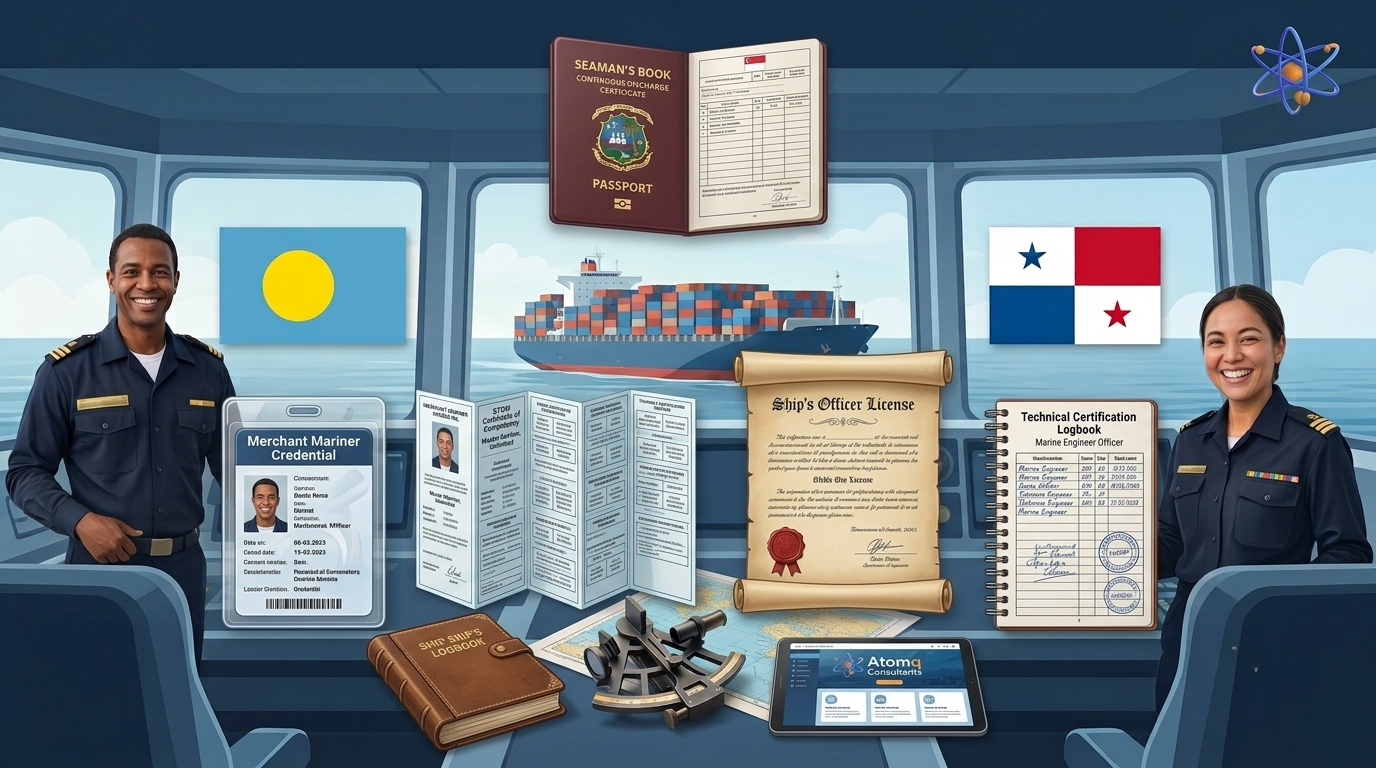
Palau vs Panama seaman book: head-to-head comparison
Here’s the quick-scan version. Use it to spot which factors matter most for your situation, then read the sections below for the “why.”
Factor | Palau Seaman Book | Panama Seaman Book |
Issuing authority | Palau International Ship Registry | Panama Maritime Authority |
Registry size | Small, growing open registry | Largest ship registry in the world |
Paris MoU status (2025 list) | Black List — “Medium Risk” | White List — low risk |
Global recognition | Recognized, but lower profile | Very high; industry-standard on many ships |
Job opportunities | Fewer Palau-flagged vessels hiring | Large pool of vessels and manning routes |
Application process | Fast, fully digital, paperless | Established; typically more documentation |
Best for | Speed, convenience, a quick recognized book | Long-term career reach and flag reputation |
Note: Paris MoU status reflects the flag’s port state control performance, not the validity of your personal document. A Palau seaman book is still a legitimate, usable book — the list simply tells you how the flag’s ships are performing under inspection.

Why flag reputation quietly shapes your career
A flag’s Paris MoU rating affects how often the ships you serve on are inspected and detained. White-listed flags like Panama enjoy lighter scrutiny; black-listed flags like Palau are targeted for more frequent, tougher port state control checks.
The Paris Memorandum of Understanding ranks flag states on a White, Grey and Black list using three years of inspection and detention data. It’s the closest thing the industry has to a report card for flags. On the 2025 performance list (valid 1 July 2026 to 6 July 2027), Panama ranks on the White List, while Palau appears on the Black List in the “Medium Risk” band.
Why should a seafarer care? Because port state control officers use these ratings to decide which ships to board. If you’re on a black-listed flag, expect more inspections, longer port calls, and more scrutiny of crew documents and drills. None of that makes your seaman book invalid — but it does shape your daily working life and, over time, the caliber of operator and vessel you tend to sail with. White-listed flags are generally chosen by higher-quality shipowners, and those are the contracts most seafarers want.
Job opportunities and how agents read your book
This is where Panama’s scale is hard to argue with. As the largest registry in the world, it puts an enormous number of vessels in play, and many manning agencies treat a Panama book as a familiar, no-questions-asked document. If your goal is maximum sea time and the widest choice of contracts, that reach counts.
Palau’s smaller fleet means fewer Palau-flagged ships are hiring at any moment. That’s not a dealbreaker — a seaman book is a personal document you can use across your career, and plenty of seafarers hold a flag book that differs from the flags they actually sail on. But if you’re choosing purely on “where will this open the most doors,” Panama has the edge on sheer volume.
Cost, speed, and the application experience
Palau’s reputation is built on speed and simplicity. Its digital-first process appeals to seafarers who need a recognized book quickly and don’t want to chase paperwork. If you’re joining a vessel soon and turnaround time is your priority, that convenience is a real, tangible benefit.
Panama’s process is long-established and dependable, though traditionally more document-intensive. Fees and processing times for both flags vary by how and where you apply, so treat current pricing as something to confirm before you commit rather than a fixed number. Working through an experienced processing service usually removes most of the friction on either flag.
So which seaman book is better for your career?
Choose Panama if you want maximum job reach and the reassurance of a top-tier flag reputation. Choose Palau if speed, convenience, and a quick, fully digital application matter more to you right now. Both give you a valid, internationally recognized seaman book.
It helps to match the flag to your situation:
- You’re building a long-term merchant career: The White List standing and the world’s largest fleet give you reach and reputation.
- You need a recognized book fast: The digital, paperless process is built for speed.
- You care most about lighter port inspections: Panama, thanks to its White List performance.
- You want a straightforward, low-hassle application: Palau tends to win on convenience.
Still on the fence? You don’t have to guess. Read our dedicated guides on the Palau seaman book and the Panama seaman book, or talk it through with someone who processes both every day.
Get Your Seaman Book — Palau or Panama Not sure which flag fits your plans? Our team processes both Palau and Panama seaman books and can match you to the right one based on where you’re headed. Fast, guided, and done properly. |
Frequently asked questions
Is a Palau seaman book valid worldwide?
Yes. A Palau seaman book is issued by the Palau International Ship Registry and is recognized internationally as a valid seafarer document under STCW and MLC frameworks. Its validity is separate from Palau’s Paris MoU flag rating, which measures the performance of Palau-flagged ships under inspection, not your personal document.
Is the Panama seaman book better than Palau’s?
For long-term career reach, most seafarers consider Panama the stronger option because it comes from the world’s largest registry and sits on the Paris MoU White List. Palau, however, is often faster and more convenient to obtain. “Better” depends on whether you prioritize reach and reputation (Panama) or speed and simplicity (Palau).
Do I need to be from Palau or Panama to get their seaman book?
No. Both are open registries and issue seaman books to qualified seafarers regardless of nationality. That’s one of the main reasons crew from around the world choose them.
Does the flag’s Black or White List status affect my job chances?
Indirectly, yes. A White-listed flag like Panama tends to be chosen by higher-quality operators and faces lighter port state control, while a Black-listed flag like Palau attracts more frequent inspections. Your seaman book stays valid either way, but the flag’s reputation can influence the vessels and operators you end up working with.
Can I hold a seaman book from a flag I don’t currently sail on?
Yes. A seaman book is a personal identity and service-record document. Many seafarers hold a book from one flag while serving on vessels flagged elsewhere. It remains usable across your career.
How long does it take to get a Palau or Panama seaman book?
Palau is generally known for a fast, fully digital process, while Panama’s established system can take longer and is more document-heavy. Exact timelines depend on how you apply and whether you use a processing service, so confirm current turnaround before you commit to a join date.
Which seaman book should a fresh cadet or junior seafarer choose?
If you’re early in your career and want the widest choice of vessels and a strong flag reputation, Panama is a safe long-term bet. If you simply need a recognized book quickly to get on board, Palau’s speed can be the deciding factor. Either can be a fine starting point.
The bottom line
Both flags give you a legitimate, internationally recognized seaman book — so you’re not choosing between “real” and “fake,” you’re choosing between reach and reputation (Panama) and speed and convenience (Palau). If your career is the priority, Panama’s White List standing and enormous fleet make it the safer long-term pick. If you need a recognized book in your hands quickly, Palau’s digital process is hard to beat.
Whichever way you lean, the smartest move is to process it correctly the first time. Contact our team and we’ll help you get the right seaman book sorted — Palau or Panama.
Source: Paris MoU 2025 Flag Performance List (White, Grey and Black List), valid 1 July 2026 – 6 July 2027. Registry details: Palau International Ship Registry; Panama Maritime Authority.