In This Article
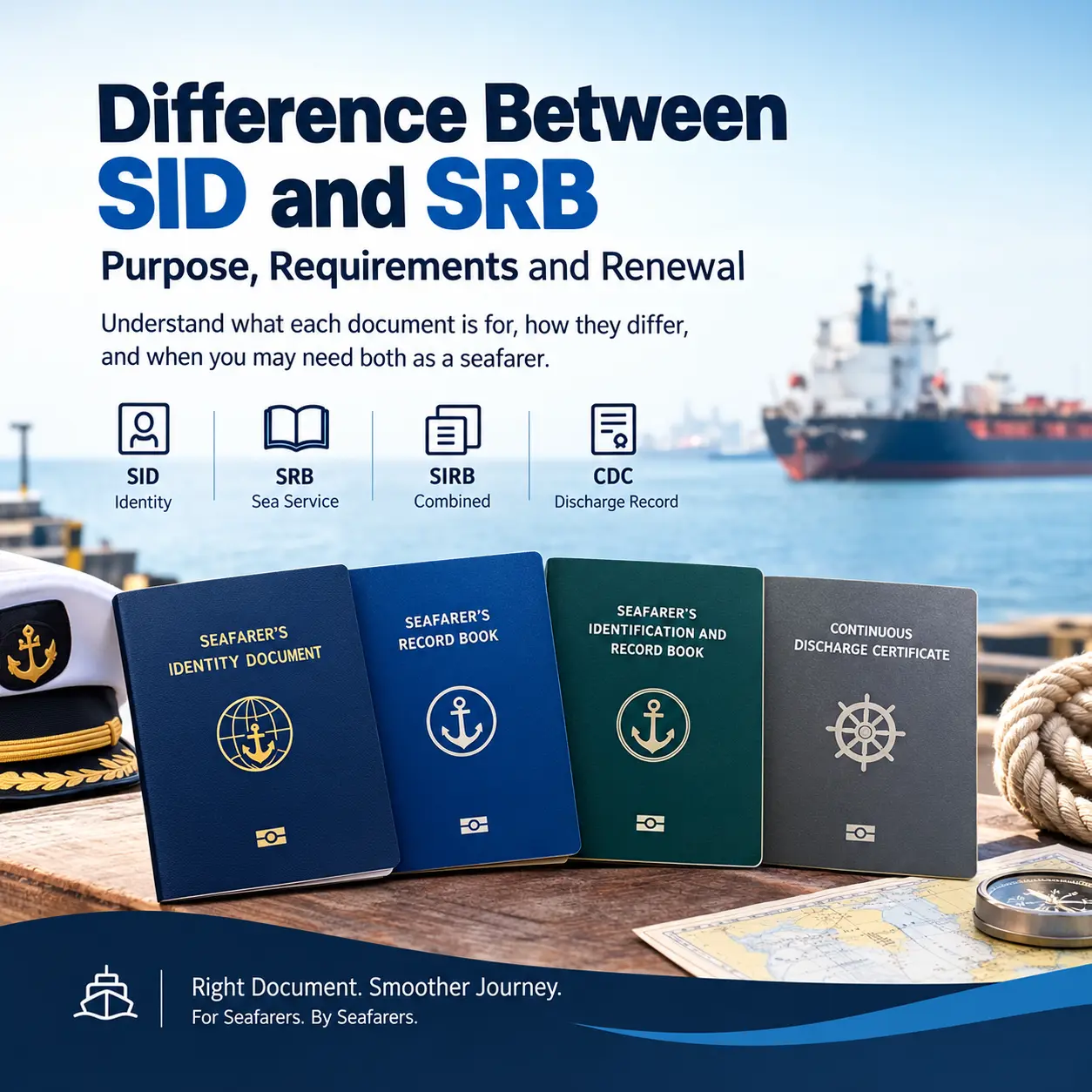
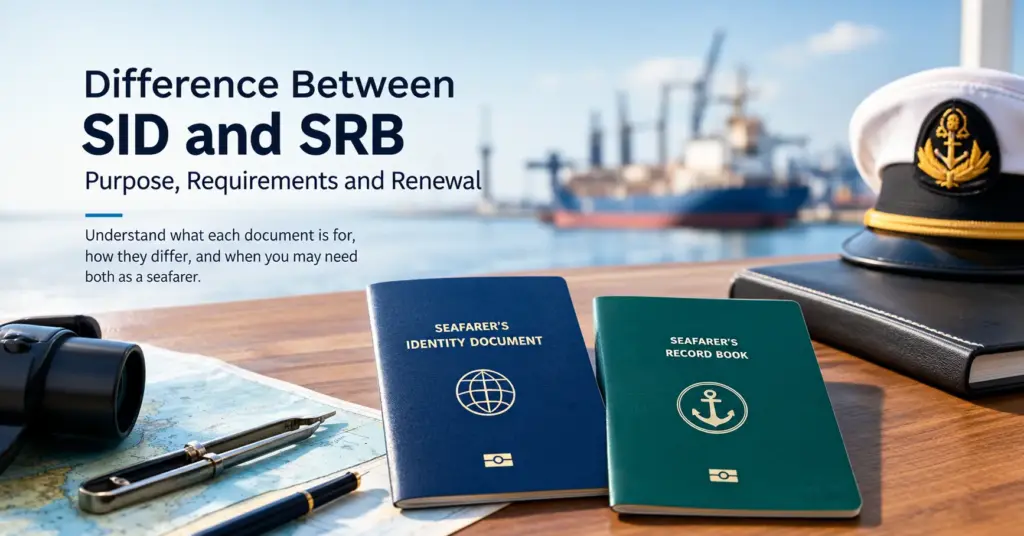
A Seafarer’s Identity Document (SID) and a Seafarer’s Record Book (SRB) serve different purposes. A SID is primarily used to establish a seafarer’s identity for specified maritime purposes, while an SRB records a seafarer’s service at sea. A seafarer may need one document or both.
The terms SID, SRB, SIRB, CDC and Seaman’s Book are not universally interchangeable. Some maritime administrations issue separate identity and service record documents, while others use a combined document or a different national naming system.
Quick answer: A SID primarily serves an identity document function, while an SRB records sea service. Whether both are required depends on the applicable national rules and the seafarer’s circumstances.
SID vs SRB vs SIRB vs CDC: Key Differences
Document | Full form | Primary purpose | Important consideration |
SID | Seafarer’s Identity Document | Establishes a seafarer’s identity for specified maritime purposes | Its use for travel or entry is subject to applicable rules and conditions |
SRB | Seafarer’s Record Book | Records sea service and related employment details | The issuing administration determines its format, entries and accepted uses |
SIRB | Seafarer’s Identification and Record Book | A combined identity and service record document in certain national systems | Its legal effect and replacement arrangements depend on the issuing country |
CDC | Continuous Discharge Certificate | Commonly records a seafarer’s identity and service or discharge history under a national system | The issuing administration determines its requirements and validity |
Seaman’s Book | General term used for various seafarer record or discharge books | Usually documents seafarer details and sea service | The name alone does not establish whether it meets a particular flag-state requirement |
These descriptions explain the general functions of the documents. They do not mean that every country uses the same document structure or terminology.
For example, India’s Continuous Discharge Certificate is governed by Indian rules, while the Philippines operates a system involving a Seafarer’s Record Book and Seafarer’s Identity Document. Other flag administrations issue their own forms of seafarer documentation.
What Is a Seafarer’s Identity Document (SID)?
A Seafarer’s Identity Document, or SID, is an identity credential intended specifically for seafarers. Its international framework includes the International Labour Organization’s Seafarers’ Identity Documents Convention (Revised), 2003, known as ILO Convention No. 185.
The Convention establishes requirements for the issuance, content and security of qualifying seafarer identity documents. It also addresses the facilitation of certain seafarer-related movements, including shore leave, transit and transfer, subject to the relevant provisions.
What Is the Purpose of an SID?
Depending on the applicable rules, SID may help to:
Establish the holder’s identity as a seafarer.
Support identity verification by competent authorities.
Facilitate qualifying shore leave when a vessel is in port.
Support specified transit or transfer arrangements connected with joining a vessel or repatriation.
Allow authorities to verify the identity document through the issuing administration.
The precise facilities available depend on the applicable international arrangements and national implementation.
Does a SID replace a passport?
No. ILO Convention No. 185 expressly identifies the SID as a stand-alone document, not a passport.
The Convention provides for a valid SID supplemented by a passport for certain transit and transfer purposes. The applicable conditions still matter, and other immigration requirements may apply.
What Is a Seafarer’s Record Book (SRB)?
A Seafarer’s Record Book, or SRB, is a document used to record a seafarer’s sea service under the relevant national system.
Depending on the issuing administration, it may include:
Personal and identifying details.
Vessel names and particulars.
Rank or capacity served.
Joining and discharge dates.
Entries relating to sea service.
Other information required by the issuing authority.
A record book can be important when documenting maritime employment history or supporting an application that requires verified sea service.
Does an SRB prove that a seafarer is qualified?
Not by itself. A record book documents service; it is not automatically a Certificate of Competency (CoC), Certificate of Proficiency (CoP), or other professional qualification.
An employer or maritime administration may require several documents for different purposes.
See our guide to know the difference.
Why Might a Seafarer Need Both an SRB and a SID?
Consider a seafarer preparing to join a vessel overseas. The employer may need documented evidence of previous sea service, while the itinerary and destination may require a qualifying identity document, passport and appropriate entry permission.
The SRB and SID can address different parts of that process.
Before applying, check:
Which documents the issuing administration requires.
Whether your current record book remains valid and accepted.
Whether a separate SID is required for your circumstances.
Whether your employer or vessel’s flag has additional documentation requirements.
Whether your travel itinerary requires a visa, passport or other entry authorization.
What Is the Difference Between SIRB and SRB?
SIRB commonly stands for Seafarer’s Identification and Record Book, while SRB stands for Seafarer’s Record Book.
In some national systems, the SIRB combines identity and service-record functions. A newer system may issue an SRB and SID separately. However, this is not a universal change that has occurred in every maritime jurisdiction.
When comparing the documents, check the following:
Issuing authority: Which maritime administration issued the document?
Document purpose: Does it establish identity, record service, or perform both functions under the applicable rules?
Validity: Is it still valid, and are there any official extension arrangements?
Replacement rules: Does the issuing authority require a new document, a separate document, or a renewal?
Acceptance: Will the document meet the requirements for the intended vessel and voyage?
Do not assume that an older SIRB must automatically be replaced simply because a separate SID and SRB system exists elsewhere.
Is a CDC the Same as a SID?
No. A Continuous Discharge Certificate commonly records a seafarer’s details and sea service or discharge history. A SID is primarily an identity credential under the relevant seafarer identity document framework.
Some national systems have historically combined identity and record-book functions in one document. That does not make every CDC equivalent to a SID issued under ILO Convention No. 185.
For example, India’s CDC system is governed by Indian legislation. The Philippines has its own arrangements for the SRB and SID. Other flag administrations establish their own requirements.
If you hold a CDC and are joining a vessel registered under a foreign flag, ask the employer or relevant administration whether your existing document is accepted and whether any additional document is needed.
For an India-specific comparison, read Indian CDC vs Foreign Seaman Book: Which Do You Need?
SID and SRB Requirements: Do the Rules Differ by Country?
Yes. A key point for international seafarers is that document names, eligibility rules, validity periods and replacement procedures vary by issuing administration.
The ILO Convention provides an international framework for qualifying seafarer identity documents. National maritime authorities determine their applicable issuance and administrative procedures, while flag-state rules and employer requirements may affect the documentation needed for a particular assignment.
A seafarer should therefore distinguish between three questions:
What does international law provide? The ILO framework addresses qualifying seafarer identity documents and specified movements.
What does my issuing country require? The relevant maritime administration sets its own procedures for issuance, renewal and replacement of national documents.
What does my next vessel or journey require? The vessel’s flag, employer, destination and transit route may create additional requirements.
Philippines-specific note: The Maritime Industry Authority (MARINA) administers the Philippine SID/SRB system. MARINA’s official online appointment information has distinguished holders of valid older SIRBs from applicants who need to apply for SRB and/or SID. The system has stated that holders of an SIRB valid for more than six months do not need to apply for the separate SRB and SID at that point.
However, transition arrangements, extensions and processing procedures can change. MARINA published further advisories on 13 October 2026 concerning the recognition of stamped extensions on expiring or expired SIRBs and delays affecting SRB/SID issuance or reissuance.
Filipino seafarers should therefore check the latest official MARINA instructions before renewing, replacing or travelling with an older SIRB. Do not rely solely on a general article, social media post or another seafarer’s experience.
Official Philippine resources:
MARINA official advisories
MARINA SID/SRB Online Appointment System
MARINA guidance on SID/SRB application through eGovPH
These should not be presented as a global rule for all seafarers.
Country Specific Examples: SID, SRB, CDC and Seaman’s Book Rules
The difference between a SID, SRB, SIRB and CDC becomes clearer when you compare national systems.
United Kingdom: SID vs Seaman’s Discharge Book
UK guidance distinguishes a seafarer’s discharge book from a qualifying Seafarer’s Identity Document. A discharge book records a seafarer’s service history, but it is not itself a travel document and is not automatically compliant with international SID requirements.
Seafarers travelling to the UK to join or change ships should check the applicable entry conditions and the identity documents accepted for their circumstances.
Official reference: UK Government — Issue of discharge books to seafarers.
India: CDC vs SID
India’s maritime documentation system has included a Continuous Discharge Certificate-cum-Seafarer’s Identity Document, while India also has provisions for biometric seafarer identity documents. The document held by an individual and the applicable current rules therefore matter.
Indian seafarers should consult the Directorate General of Shipping to confirm the requirements for their CDC, SID and any related application or renewal. Evaluate whether you need Indian CDC or Foreign Seaman Book
Official reference: Directorate General of Shipping — Seafarers Identity Document
Norway: Seafarer Identity Card vs Sea Service Book
Norway provides another example of a national system changing its seafarer documentation. The Norwegian Maritime Authority announced a Seafarer’s Identity Card intended to replace the Sea Service Book in 2026.
This is not a universal international replacement rule. Norwegian seafarers should consult the Maritime Authority for the current implementation status, eligibility and document requirements.
Official reference: Norwegian Maritime Authority — Seafarer’s Identity Card.
What should international seafarers take away?
Before joining a vessel, check the issuing country, the function of each document, whether it remains valid, and whether the relevant employer, flag administration and destination authority accept it. A document that records sea service is not automatically a qualifying SID or a substitute for a passport or visa.
SID and SIRB Renewal Requirements: What Documents Should You Check?
There is no single worldwide SID/SIRB renewal procedure. The correct process depends on the issuing authority and the type of document you hold.
Before applying for renewal or replacement, check:
Document validity: Confirm the printed expiry date and whether the issuing authority has published any applicable extension.
Renewal eligibility: Check when you may submit a renewal application and whether an appointment is required.
Required evidence: Review the official checklist for identity, existing documents, photographs, sea-service records or other supporting evidence.
Replacement circumstances: Lost, stolen, damaged or full record books may require a different procedure from an ordinary renewal.
Processing arrangements: Verify the current application channel, appointment system, fees and processing estimates.
Urgent deployment: If your joining date is close, check whether the issuing authority provides an official expedited process or temporary arrangement.
Common Mistakes to Avoid
Assuming SID and SRB are the same document:
They have different primary functions, even when a particular national system combines some of those functions in one document.
Assuming every seafarer must hold both:
The requirement depends on the applicable national rules and the circumstances of the voyage. Verify the requirement rather than applying a blanket rule.
Assuming a CDC automatically replaces a SID:
A CDC’s legal function depends on its issuing system. Do not assume that it is equivalent to a qualifying SID for every purpose.
Treating an older SIRB as automatically invalid:
A change in document structure does not by itself establish that every older document is invalid. Check the issuing authority’s transition, renewal and extension rules.
Assuming a SID guarantees visa-free entry everywhere:
The international framework covers specified purposes and conditions. It does not remove every passport, visa or immigration requirement.
Frequently Asked Questions – FAQs
What is the difference between SID and SRB?
A Seafarer’s Identity Document (SID) primarily establishes a seafarer’s identity for specified maritime purposes. A Seafarer’s Record Book (SRB) records sea service. Whether both are required depends on the applicable national rules and circumstances.
What is the main purpose of a Seafarer’s Identity Document (SID)?
The main purpose of a SID is to establish a seafarer’s identity under the relevant identity-document system. Under ILO Convention No. 185, qualifying SIDs can facilitate specified maritime movements, subject to the Convention’s conditions.
Why do I need both an SRB and an SID?
You may need both when a record book is required to document sea service and a separate identity document is required for applicable maritime or travel purposes. There is no universal rule.
What is the difference between SIRB, SRB and SID?
SIRB commonly refers to a Seafarer’s Identification and Record Book, SRB to a Seafarer’s Record Book, and SID to a Seafarer’s Identity Document. However, some national systems combine identity and service records, while others issue separate documents.
Is a CDC and SID the same?
No. A CDC commonly records a seafarer’s service or discharge history under a national system. A SID is primarily an identity document. Whether a particular CDC fulfils any additional identity-document function depends on the applicable national rules.
Can I travel internationally using only a Seaman’s Book?
No. You should not assume that a Seaman’s Book alone is sufficient. Check passport validity, visa and entry requirements, any applicable SID requirements, transit arrangements, and the documents needed to join the vessel.
For destination specific entry and visa questions, consult the relevant immigration authority and Atomiq Consulting
Do I need to renew my SID and SRB at the same time?
Not necessarily. Validity periods and renewal procedures depend on the issuing administration. If your country issues separate documents, check the expiry date and renewal rules for each one.
What are the SID and SIRB renewal requirements in the Philippines?
Philippine seafarers should consult MARINA’s current official guidance and application system. Requirements and transitional arrangements may depend on whether the seafarer holds an older SIRB, a separate SRB, a SID, or an expired document. Confirm the latest instructions before applying.
If I have a valid older Philippine SIRB, do I need a separate SID and SRB?
MARINA’s online appointment guidance has stated that a holder of an SIRB valid for more than six months does not need to apply for separate SRB and SID documents at that point. Because transition and extension arrangements can change, verify the latest MARINA advisories and your document’s status before relying on this rule.
Does an SRB alone meet the Philippine requirements for international service?
Do not assume so. MARINA has issued guidance distinguishing an SRB alone from a valid SIRB or a qualifying combination of SRB and SID. Filipino seafarers should check the latest official MARINA rules for the relevant voyage and document status.
Which authority issues SID and SRB documents?
The issuing authority depends on the country.Check the official issuing authority for your nationality and document type.
Where can I verify the international rules for SID?
Consult the International Labour Organization’s official text of Convention No. 185 on Seafarers’ Identity Documents. For national issuance, renewal and acceptance rules, consult the relevant maritime administration.
Official Resources for Further Reading
International Labour Organization: Seafarers’ Identity Documents Convention (Revised), 2003 (No. 185)
MARINA, Philippines: Official advisories and flag-state administration notices
MARINA SID/SRB application system: Official appointment portal
India, Directorate General of Shipping: Official website
Final Checklist:
Before applying for or renewing a SID, SRB, SIRB or CDC, confirm the following:
Which country issued your current document?
What function does that document serve?
Is it still valid, and does any official extension apply?
Does your issuing authority require a separate identity document and record book?
Does your employer or vessel’s flag require any additional documentation?
Have you checked the passport, visa and entry requirements for your route?