CoC vs CoP vs CDC vs Seaman Book: What’s the Difference?

Services

 
Posted on Google Google
Andy Fitriansyah profile picture
Andy Fitriansyah
Google star 1Google star 2Google star 3Google star 4Google star 5Trustindex verifies that the original source of the review is Google.
Trust agency and fast respon
Posted on Google Google
Zameel Kapat profile picture
Zameel Kapat
Google star 1Google star 2Google star 3Google star 4Google star 5Trustindex verifies that the original source of the review is Google.
Quality and Quick service
Posted on Google Google
Dody Pambudhi profile picture
Dody Pambudhi
Google star 1Google star 2Google star 3Google star 4Google star 5Trustindex verifies that the original source of the review is Google.
Fast and trusted. Very recommended 👍
Posted on Google Google
ahmed abouzid profile picture
ahmed abouzid
Google star 1Google star 2Google star 3Google star 4Google star 5Trustindex verifies that the original source of the review is Google.
Helpful and professionals Thanks Atomiq Consultant
Posted on Google Google
Leo Worrall profile picture
Leo Worrall
Google star 1Google star 2Google star 3Google star 4Google star 5Trustindex verifies that the original source of the review is Google.
Very fast application process and good service. Palau seaman’s book was dispatched to me by courier within 48 hours of payment. Would definitely recommend
Posted on Google Google
Olga Poltavtseva profile picture
Olga Poltavtseva
Google star 1Google star 2Google star 3Google star 4Google star 5Trustindex verifies that the original source of the review is Google.
Thanks Gyanvi, thanks Karunesh you made our day. We were very happy to receive such a quick response and excellent communication from the team. They work efficiently and fast, and the delivery service was also excellent! We received the seaman’s book for our sailor without any issues. Highly recommended! Thank you again, and have a great day!
Posted on Google Google
Wael Farouk profile picture
Wael Farouk
Google star 1Google star 2Google star 3Google star 4Google star 5Trustindex verifies that the original source of the review is Google.
It was a wonderful , fast and easy experience, thank you for your efforts and support
Verified by Trustindex
Trustindex verified badge is the Universal Symbol of Trust. Only the greatest companies can get the verified badge who has a review score above 4.5, based on customer reviews over the past 12 months. Read more
CoC vs CDC CoP vs vs Seaman Book What is the Difference

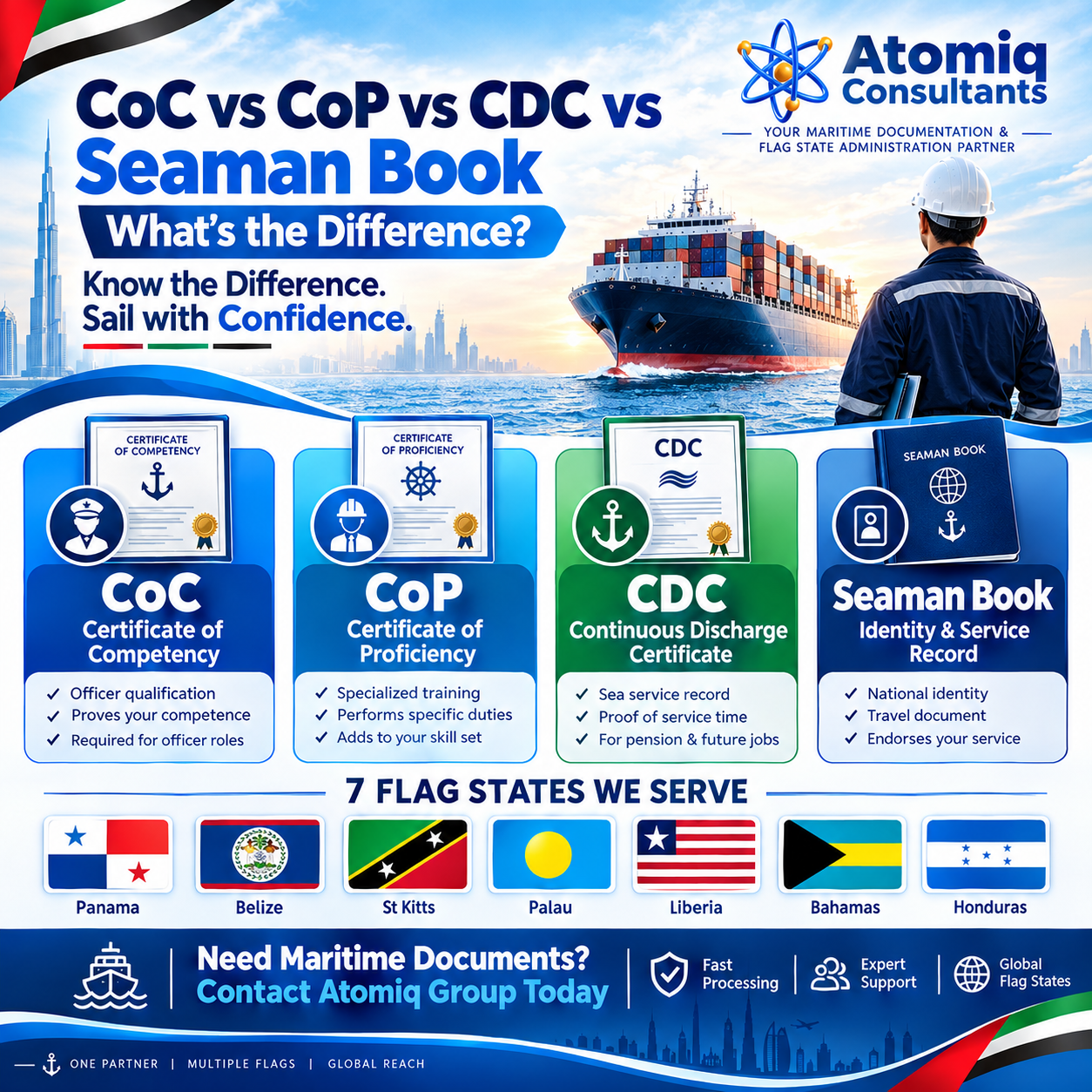
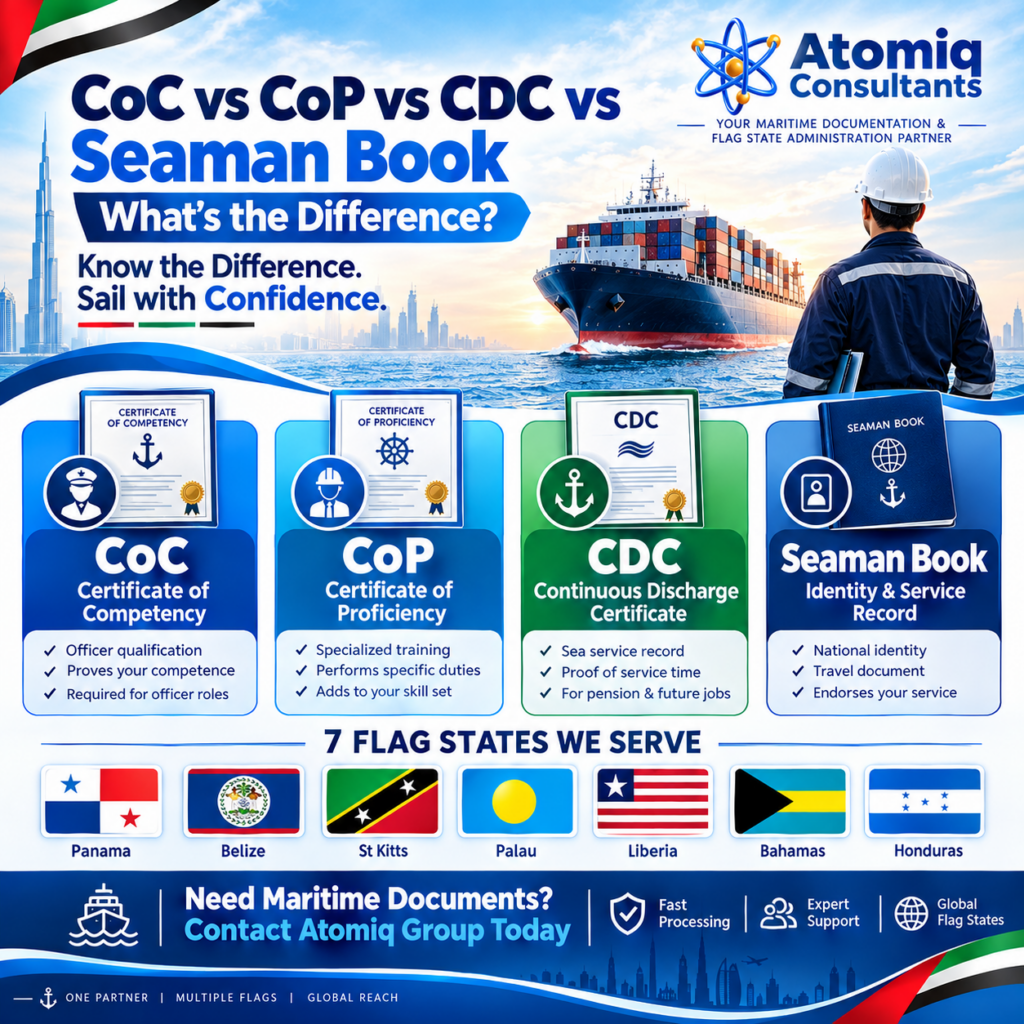
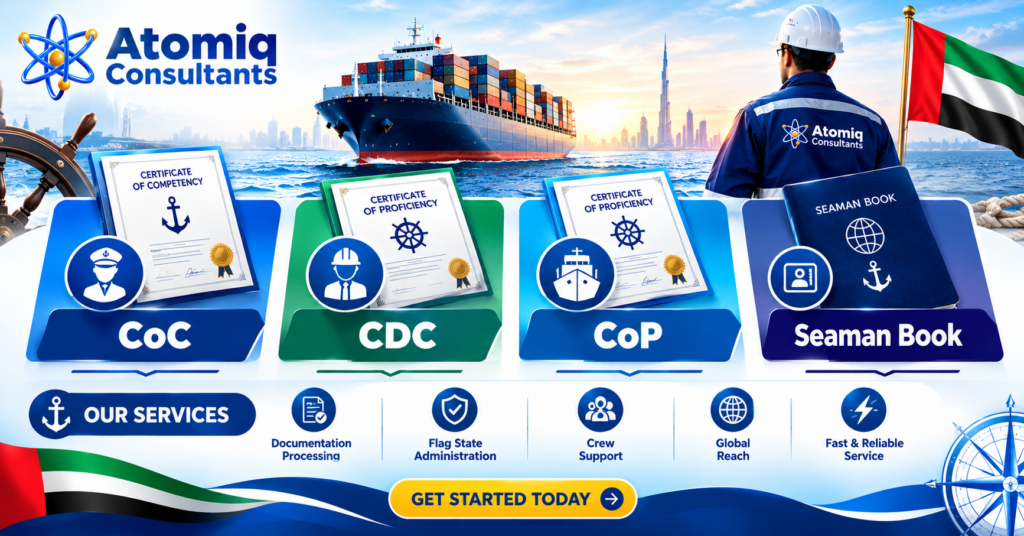
Five names, four documents. A seaman book, a CDC and an SIRB are one document under different administrations’ names: your identity and the continuous record of your sea service. A Certificate of Competency (CoC) is a rank licence — it says which capacity you may serve in. A Certificate of Proficiency (CoP) is defined by what it is not: any certificate other than a CoC, certifying one named competence rather than a rank. And a Certificate of Recognition, or endorsement, is a flag’s acceptance of a CoC that a different administration issued — the document most seafarers meet last. All four are issued by a maritime administration. None is issued by an agency, and none of them is a course.

That is the whole coc vs CDC answer. The rest of this page is the detail behind it, the part most seafarers get wrong, and what to do about the document people usually discover they are missing at the worst possible moment.

Seaman Books is a documentation partner in Business Bay, Dubai. We prepare and file seafarer documentation with flag-state administrations and arrange training with accredited centres. We are not a flag state, not a registry and not a training provider of record — and as this page explains, there is one document on it we cannot obtain for anybody.

The one table

 Seaman book / CDC / SIRBCertificate of Competency (CoC)Certificate of Proficiency (CoP)Certificate of Recognition (endorsement)
What it says about youWho you are, and every ship you served onWhat rank you are licensed to holdThat you meet the requirements for one named competenceThat this flag accepts a CoC another flag issued
CoversYour whole careerOne rank, one capacityOne competenceOne CoC, on one flag
Issued byA flag administrationAn administration, after examinationThe administration — on the evidence of training you completed at an approved centre. Some flags also let approved centres issue certain CoPs directly; see the flag table belowThe flag whose ship you are joining
Can an agency obtain it for you?No — an agency prepares and files; the administration issuesNo. It cannot be applied for on your behalf; it is earnedNo — you attend and pass, and the administration certifiesNo — but the application is filed on your behalf
Typical triggerFirst going to sea, or a foreign-flag contractPromotion to a certificated rankA vessel type, a role or a port state requirementJoining a ship flying a flag that did not issue your CoC
Also calledContinuous Discharge Certificate, Seafarer’s Record Book, SIRB, libreta de embarque, discharge bookLicence, ticket, “my CoC”; Panama: Título de Competencia“STCW certificate”, “my tickets”; Panama: Certificado de Suficiencia

Refrendo, COE, flag endorsement, CoR

Why four names exist for three things

Because each maritime administration names its own paperwork, and the industry then uses all the names interchangeably.

The three flags Seaman Books files with most publish the split clearly in their own words:

  • The Bahamas Maritime Authority states that its Seafarers and Manning Department “issues all seafarers documentation, including: Certificates of Competency; Certificates of proficiency; Certificates of Recognition (endorsements), Notices of Eligibility and Seafarers’ Record Books.” (BMA) — four separate document classes, named in one sentence, by the administration that issues them.
  • The Liberian Registry issues “Seafarer Identification and Record Books (SIRB)” and, separately, states that “All official Liberian Certificate of Competency (CoCs) and Certificate of Proficiency (CoPs) are issued by the Liberian Registry in Virginia or Manila office.” It also “offers examinations for officers to obtain Liberian original Certificate of Competency (CoC) and CoC Upgrades.” (LISCR)
  • The Panama Maritime Authority publishes the same document classes under Spanish names — Título de Competencia, Libreta de Embarque, Certificado de Suficiencia and Refrendo — and states its remit as evaluating and processing seafarer documentation “en estricto cumplimiento del STCW´78 en su versión enmendada”. (AMP)

The structure behind the names is set by the STCW Convention, whose chapters the IMO publishes: “Chapter II: Master and deck department”, “Chapter III: Engine department”, “Chapter V: Special training requirements for personnel on certain types of ships” and “Chapter VI: Emergency, occupational safety, security, medical care and survival functions” (IMO). Officer certification sits in Chapters II and III; the emergency, safety, security and survival training most seafarers hold sits in Chapter VI.

So when a crewing manager asks for “your CDC” and a training centre asks for “your CoP” and the agent asks for “your endorsement”, nobody is being imprecise. They are asking for three different documents.

The seaman book, CDC and SIRB: one document, three names

This is the document that records who you are and where you have served. Each engagement and discharge is entered in it, which is what makes it continuous — hence Continuous Discharge Certificate. Liberia calls its version a Seafarer Identification and Record Book; the Bahamas calls it a Seafarers’ Record Book; St Kitts & Nevis calls it a Continuous Discharge Certificate; Belize calls it a Seaman’s Book.

It says nothing about your competence. A master and a deck cadet hold the same kind of book. What differs is what is written inside it.

Whether it is the first step or an optional one depends entirely on the flag, and the spread is wider than most people expect. On Liberia it is the gate: “All seafarers must possess a Liberian seafarer book in order to be eligible to obtain Liberian documentation” (LISCR). On the Bahamas it is not required at all — “A Bahamas SRB is not mandatory to serve on board a Bahamian ship” (BMA Bulletin 107). The table further down this page gives the position flag by flag, because getting this wrong in either direction costs either money or a contract.

Holding your national one is usually not enough. If your own country issued your discharge book and you are joining a foreign-flag ship, that flag generally wants its own record book or its own recognition of your documents. Holding both is normal, not duplication. We cover the document itself in more depth in what a CDC certificate is and how to get one.

No, a CDC is not a course

This needs saying because a great many people search for one.

A CDC is a document, issued by a flag administration on an application. It is not a qualification you sit for. What people searching for a “CDC course” usually want is one of two other things: the STCW basic training that several flags require evidence of before processing a first book, or the enrolment and documentation package an agency assembles around both. If someone is selling you a “CDC course”, ask them precisely which certificate you will hold at the end of it, and who issues that certificate.

On the basic-training point the flags again differ, and this one is now checkable. Liberia requires it: applicants must “show evidence of having received approved ‘Basic Training'” in personal survival techniques, fire prevention and firefighting, elementary first aid, and personal safety and social responsibilities (RLM-118, §4.1.3.1). Panama requires the same A-VI/1 set for an entry-level rating document (AMP). The Bahamas does not: its first-application requirements are a passport copy, a medical certificate and a photograph, and the application comes from the company rather than the seafarer. Belize’s published list names security training under Regulation VI/6, which is a different requirement from basic safety training under VI/1 and is commonly confused with it.

Certificate of Competency: the rank licence

A CoC is the document that says you are licensed to serve in a particular capacity — Officer of the Watch, Chief Mate, Second Engineer, Master. It is the closest thing a seafarer has to a professional licence.

It is earned, not applied for. An administration issues a CoC after examination, on the basis of qualifying sea service: the Bahamas conducts “STCW Deck & Engineering Certificate of Competency (CoC) assessments and examinations, both written and oral, in The Bahamas” (BMA); Liberia states that “All seafarers must pass the Liberian CoC exam in order to be eligible to obtain a Liberian CoC” (LISCR).

The restriction is written into law where the law is published. Under the EU’s codified seafarer training directive, “Certificates of competency shall be issued only by the Member States, following verification of the authenticity and validity of any necessary documentary evidence” (Directive (EU) 2022/993, Article 4(4)). Endorsements carry the same restriction: they “shall only be issued by Member States” (Article 4(8)(b)).

So no agency can get you a CoC, including this one. There is no paperwork route to a CoC, no expedited channel and no agency that holds one for you. Anyone offering to supply a Certificate of Competency without examination and sea time is offering you a document that will fail at the first port state control inspection, with the consequence falling on you and not on them.

What an agency can legitimately do with a CoC you already hold is get it recognised by another flag — which is the next section but one, and is where most of the actual commercial need in this category sits.

Certificate of Proficiency: defined by what it is not

The cleanest definition available in published law is a negative one. A certificate of proficiency is “a certificate, other than a certificate of competency, issued to a seafarer stating that the relevant requirements regarding training, competencies or seagoing service … have been met” (Directive (EU) 2022/993, Article 2(36)). Liberia’s own regulation uses almost identical wording: “Certificate of Proficiency means a certificate, other than a Certificate of Competency issued to a seafarer, stating that the relevant requirements of training, competencies or seagoing service in the Convention have been met” (RLM-118, §2.1.31).

That is worth sitting with, because it corrects the usual mental model. A CoP is not a lesser version of a CoC. The CoC is the narrow category — the rank-bearing certificate for masters, officers and GMDSS radio operators. Everything else certified under the framework is a CoP: survival craft, advanced firefighting, tanker operations, security duties, ship’s cook, able seafarer.

Who issues it is the question people get wrong, and the answer is the administration, not the training centre. This is the single most common misconception in the category, and it matters commercially, because it determines who you chase when something is missing.

The training centre issues evidence that you completed approved training. The administration issues the certificate. Liberia states both halves: all official Liberian CoPs are issued by the Registry, while “Proof of training certificates issued by an approved training center will be recognized by the Liberian Registry for the purposes of seafarer certification”. Australia puts it in four words — “Only AMSA can issue a CoST” — while the training organisation issues “a single CoST course completion certificate” (AMSA). Canada codifies the same split: a “training certificate” is “a document issued by a recognized institution evidencing the holder’s successful completion of an approved training program or approved training course”, while competency certification runs through the Minister (Marine Personnel Regulations SOR/2007-115, s.1(1)).

The exception is real and you should know it. Some administrations also approve training institutions to issue certain CoPs directly. The Bahamas is explicit that both routes operate — the BMA issues CoPs, approved training institutions are also approved to issue certain Certificates of Proficiency, and separately the BMA “accepts STCW Regulation VI Certificates of Proficiency that are issued by a state that is on the IMO Whitelist” (BMA). Panama issues certain CoPs itself — tanker cargo operations under V/1, and ratings under II/4, II/5, III/4, III/5 and III/7 — and separately issues a refrendo de reconocimiento of foreign CoPs under Regulation I/10 (AMP).
coc vs cdc

Two things that do not vary:

  1. A CoP is not a rank. No combination of proficiency certificates substitutes for a CoC.
  2. An agency issues neither the training certificate nor the CoP. What we do is arrange the seat at an accredited centre and file the application with the administration.

Which certificates your role requires — and which carry a five-yearly updating requirement and which do not — is set out with its sources in STCW courses and certificates. This page deliberately states no validity period of its own.

The fourth document: endorsement, or Certificate of Recognition

This is the one most seafarers meet last, and it is the reason this page exists.

A Certificate of Recognition is a flag’s acceptance of a CoC that a different administration issued. You hold an Indian or Filipino or Ukrainian CoC; the ship flies Panama or Liberia or the Bahamas; that flag generally has to recognise your certificate before you can serve on its ship in that capacity. The Bahamas issues them under exactly that name — “Certificates of Recognition (endorsements)” (BMA); Panama calls it a Refrendo de Reconocimiento under Regulation I/10 (AMP); St Kitts & Nevis calls it a Certificate of Endorsement (SKANReg); Belize calls it an “Endorsement of Foreign Certificate of Competence” (IMMARBE).

Three things to know before you need one:

  • Your CoC does not travel by itself. It is valid, but validity and acceptance are different questions. The flag decides acceptance, and the port state inspects the result. The distinction is the same one set out in flag state vs port state.
  • Recognition runs at country level, not centre level. Belize states that “Belize is on the IMO Whitelist of the countries and as such we only accept Certificates of Competencies from persons certificated by countries from this list” (IMMARBE). St Kitts requires a certificate “issued by an administration whose certificates are recognised by St. Kitts and Nevis” (SKANReg), under bilateral Regulation I/10 agreements. Which administration issued your CoC therefore decides whether a given flag can recognise it at all.
  • This one an agency can legitimately file for you. Unlike the CoC itself, recognition is an application — documents, verification, filing, follow-up — and that is documentation work.

Does the flag need its own record book first?

This is the question that costs people the most time, because the answer is genuinely different per flag and almost nobody publishes the comparison. Here it is, from each administration’s own published requirements.

FlagIts own record book required before it will endorse your foreign CoC?What the administration publishes
LiberiaYes“All seafarers must possess a Liberian seafarer book in order to be eligible to obtain Liberian documentation”
St Kitts & NevisYes“Applicants for Endorsements, must be in possession of, or have applied for, a St. Kitts & Nevis CDC”
BahamasNoThe record book is not in the endorsement requirement list, and is expressly excluded as identification: “A Seaman’s Record Book is not an acceptable form of ID for application purposes”
BelizeNot required on the published listThe eleven documentary requirements for an Officer’s Endorsement do not include a Belize Seaman’s Book
PanamaNot required on the published listThe Regulation I/10 refrendo requirements are the F-76 form, a current passport, a photograph and an STCW A-I/9 medical certificate
PalauNot published in a form we can citeRequirements sit in MN-208; we have not been able to retrieve the text
HondurasNot published in a form we can cite

The administration’s site is not currently reachable

How to use this table: if you are joining a Liberian or St Kitts ship, budget for two applications, and start with the record book. If you are joining a Bahamas ship, do not let anyone sell you a record book as a precondition for your endorsement — the BMA says it is not one. For the flags in the bottom four rows, ask before you pay; we confirm with the administration rather than guessing, and so should anyone else quoting you.

Sources for every row are listed at the foot of this page. Requirements change; the dates we read them are stated.

Which one do you actually need?

Your situationWhat you needCan we file it?
Going to sea for the first timeSeaman book / CDC, plus, on several flags, STCW basic trainingYes — the book; and we arrange the training
Joining a foreign-flag ship, any rankThat flag’s record book, or its recognition of your documents — which one depends on the flagYes, for the flags we file with
You hold a national CoC and the ship flies another flagCertificate of Recognition / endorsement from that flagYes, for the flags we file with
Promotion to a certificated rankA CoC — examination with an administrationNo. Nobody can file this for you
A vessel type or role requires a named competenceThe relevant CoP — training at an approved centre, certificate from the administrationWe arrange the seat and file the application
Your book is full, expired, lost or damagedRenewal or replacement — see seaman book renewalYes

If you are not sure which row you are in, that is what the free eligibility check is for. Send the vessel or the flag and your rank, and we will tell you what that flag’s published requirements are for your case, and confirm anything unclear with the administration before you act on it — including when the answer is that you need nothing from us.

How to tell any of these is genuine

The category has a fraud problem, and the defence is verification you perform yourself rather than trust you extend to whoever sold you the document.

Verify at the administration, not at the agent. Every document above is issued by a flag administration. If it cannot be confirmed at that source, treat it as unconfirmed however convincing it looks.

What that actually means varies by flag, and it is worth knowing before you need it. Several administrations publish an online checker; several do not, and at least one publishes only an email address for verification enquiries. St Kitts & Nevis operates a public document validator that needs no login and checks a document control number (SKANReg). Panama directs verification enquiries to its certification department by email rather than to a public lookup. Where a flag has no public checker, an emailed confirmation from the administration is the real proof, and any agent should be willing to help you obtain one. Our walkthrough is at how to verify a seaman book online.

FlagVerification portalCurrent checkPublishing status
🇰🇳 St Kitts & NevisSKANReg ValidatorForm loads and requests a document control number.Accessible, but live query not independently confirmed (Skan Registry) 
🇧🇸 BahamasBMA Certificate VerificationSite returns a JavaScript requirement.Not confirmed functional (Bahamas Maritime Authority) 
🇱🇷 LiberiaLISCR Crew SearchApplication shell loads, but requires JavaScript.Not confirmed functional
🇧🇿 BelizeIMMARBE VerificationPage displays a server error alongside verification interface elements.Not confirmed functional (ImmArbe) 
🇵🇦 PanamaPanama Maritime Authority VerificationOfficial verification page is accessible and displays a document-number search field.Not confirmed through a live query (AMP Certificates) 

Three rules that do not depend on the flag:

  • Treat any offer of a CoC without examination as fraudulent. Every administration whose published process we have read requires examination. If someone claims a route that avoids it, ask them to name the administration and show its published procedure.
  • A price well below every other quote is a warning. Flag-state charges are set by the administration, not by the agent handling your file.
  • Nobody can guarantee a government outcome. An agent who guarantees approval is describing something they do not control.
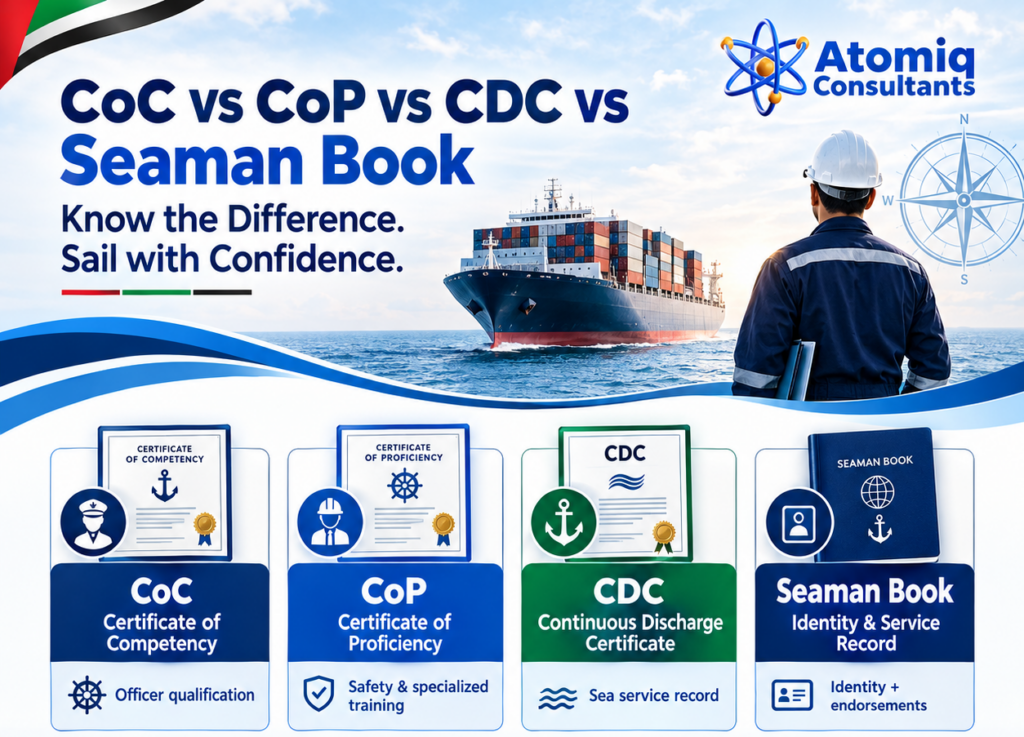
COC vs CDC vs Seaman Book: What's the Difference?

FAQ

Is a CDC the same as a seaman book?

Yes. “Continuous Discharge Certificate”, “seaman book”, “seafarer’s discharge book”, “Seafarers’ Record Book” and “SIRB” are different administrations’ names for the same document: your identity and the continuous record of your sea service.

What is the difference between a CoC and a CDC?

A CoC is a rank licence — it says what capacity you may serve in. A CDC is a record book — it says who you are and where you have served. A CoC is earned through examination; a CDC is applied for. Most seafarers hold a CDC; only certificated officers hold a CoC.

What is the difference between a CoC and a CoP?

A Certificate of Competency licenses you for a rank, and is the narrower category: it covers masters, officers and GMDSS radio operators. A Certificate of Proficiency is legally defined as any certificate other than a CoC, certifying one named competence such as survival craft or tanker operations. Holding every CoP in existence does not make you an officer, and you will need CoPs long before you need a CoC.

Who issues a Certificate of Proficiency — the training centre or the flag?

The administration issues the certificate; the approved training centre issues evidence that you completed the training. Liberia states that all official Liberian CoPs are issued by the Registry. Some flags, the Bahamas among them, also approve training institutions to issue certain CoPs directly, and accept CoPs issued by IMO whitelist states. If a certificate is missing, the administration is usually who you chase.

Can an agency get me a Certificate of Competency?

No — not this one, and not any other. A CoC is issued by an administration after examination, on the basis of qualifying sea service. Anyone offering one without those is offering a document that will fail inspection.

Do I need that flag’s seaman book before it will endorse my CoC?

It depends on the flag, and the answer genuinely differs. Liberia and St Kitts & Nevis both require their own record book first. The Bahamas does not, and expressly does not accept a record book as identification for the application. Belize and Panama do not list one among their published endorsement requirements. Check the flag before you pay for a document you may not need.

Is a CDC a course?

No. It is a document issued on an application. There is no CDC course and no CDC exam. What is usually meant is STCW basic training, which is a different thing and produces different certificates.

Do I need all four documents?

Most seafarers need two: a record book and the proficiency certificates their role requires. Officers add a CoC, and anyone joining a foreign-flag ship generally adds that flag’s endorsement or its own record book. Very few people need all four at once.

Not sure which of these you are missing?

Send your rank, the flag of the ship you are joining, and what you currently hold. We will tell you what that flag publishes as its requirements, which of those we can file for you, and which you have to earn yourself.

Written By

Picture of Dipak Paudel

Dipak Paudel

Dipak is an experienced maritime documentation and content professional with experience since 2021, specializing in seaman books, crew documentation, maritime compliance, and visa-related documentation solutions through SeamanBooks.com and Atomiq Consulting.

Contact Form

Recent Post