STCW Courses and Certificates: 25 Questions Seafarers Ask Most
STCW basic training is four courses, not five: Personal Survival Techniques, Fire Prevention and Fire Fighting, Elementary First Aid, and Personal Safety and Social Responsibilities — Tables A-VI/1-1 to A-VI/1-4 of the STCW Code. Five certificates must be updated every five years (PST, FPFF, Advanced Fire Fighting, Survival Craft and Rescue Boats, Fast Rescue Boats); Elementary First Aid, PSSR and the security proficiencies do not. Training must be delivered by a centre approved by a flag administration — a certificate bought online without attendance is not one.
The Complete STCW Training Course List for Seafarers (2026 Guide)
STCW courses are the mandatory safety and competence training every seafarer must complete before joining a commercial vessel. The confusing part is not the training itself — it’s working out which of the twenty-odd courses apply to your rank, your vessel type, and your flag state, and which ones quietly expire after five years while you’re at sea.
This guide maps every STCW course in one place: what each one covers, who legally needs it, and what has to be refreshed. Bookmark it — most seafarers get caught out by the refresher rules, not the entry requirements.
What are STCW courses?
STCW courses are training programmes set by the IMO’s International Convention on Standards of Training, Certification and Watchkeeping for Seafarers. They range from four basic safety modules that every crew member needs, through advanced firefighting and medical courses for senior ranks, to vessel-specific endorsements for tankers, passenger ships and polar waters. Each course must be delivered by a centre approved by a flag state administration.
The Convention entered into force on 28 April 1984. The 1995 amendments restructured it and created the STCW Code — the technical annex that actually specifies what each course must contain — and the 2010 Manila Amendments then introduced the five-year refresher cycles that trip up so many crew today. (IMO)
One thing to be clear on from the start: STCW sets the standard, but it does not issue your certificate. Your flag state — or a state whose certificates your flag recognises — does. A course completed at a centre your flag state doesn’t recognise is money spent for a certificate that won’t get you onboard. That distinction drives everything below.
The full STCW course list at a glance
|
Course |
STCW reference |
Who needs it |
Typical duration* |
5-year refresher? |
|
Personal Survival Techniques (PST) |
A-VI/1-1 |
All seafarers |
1–1.5 days |
Yes |
|
Fire Prevention & Fire Fighting (FPFF) |
A-VI/1-2 |
All seafarers |
1.5–2 days |
Yes |
|
Elementary First Aid (EFA) |
A-VI/1-3 |
All seafarers |
1 day |
No |
|
Personal Safety & Social Responsibilities (PSSR) |
A-VI/1-4 |
All seafarers |
1 day |
No |
|
Security Awareness |
A-VI/6-1 |
All seafarers |
0.5 day |
No |
|
Designated Security Duties (DSD) |
A-VI/6-2 |
Crew with assigned security duties |
1 day |
No |
|
Proficiency in Survival Craft & Rescue Boats (PSCRB) |
A-VI/2-1 |
Crew in charge of survival craft |
3–4 days |
Yes |
|
Proficiency in Fast Rescue Boats (FRB) |
A-VI/2-2 |
Crew operating fast rescue boats |
2 days |
Yes |
|
Advanced Fire Fighting (AFF) |
A-VI/3 |
Officers and crew controlling fire operations |
4 days |
Yes |
|
Medical First Aid |
A-VI/4-1 |
Nominated first-aid providers |
3–4 days |
Flag-dependent |
|
Medical Care |
A-VI/4-2 |
Crew in charge of medical care onboard |
4–5 days |
Flag-dependent |
|
Ship Security Officer (SSO) |
A-VI/5 |
Designated SSO |
2–3 days |
No |
|
Oil & Chemical Tanker Cargo Operations (Basic / Advanced) |
Reg. V/1-1 (Code A-V/1-1) |
Tanker crew and officers |
2–5 days |
No† |
|
Liquefied Gas Tanker Cargo Operations (Basic / Advanced) |
Reg. V/1-2 (Code A-V/1-2) |
Gas carrier crew and officers |
2–5 days |
No† |
|
Passenger Ship Training (crowd management, crisis management & human behaviour, ro-ro passenger safety) |
Reg. V/2 (Code A-V/2) |
Crew designated on the muster list to assist passengers |
1–3 days |
Yes‡ |
|
IGF Code Training (Basic / Advanced) |
Reg. V/3 (Code A-V/3) |
Crew on gas/low-flashpoint-fuelled ships |
2–5 days |
Yes |
|
Polar Waters Training (Basic / Advanced) |
Reg. V/4 (Code A-V/4) |
Officers on ships in polar waters |
3–5 days |
No† |
* Durations are indicative of common market practice and vary by flag state and training center.
† No five-yearly refresher is mandated by the Convention for tanker or polar waters training, but these endorsements are normally revalidated alongside your Certificate of Competency, and some flag states impose their own recency conditions. Confirm with your flag before assuming.
‡ The refresher requirement in regulation V/2 covers crowd management, crisis management and human behaviour, and ro-ro passenger safety. The lighter safety training for personnel providing direct service to passengers in passenger spaces is not caught by it.
Courses like GMDSS, Radar/ARPA, ECDIS and Bridge Resource Management sit under STCW Chapters II, III and IV rather than the safety chapters above. They form part of officer competence training rather than the universal safety set, so they’re covered separately in our STCW certifications service.
STCW Basic Safety Training: the four courses everyone starts with
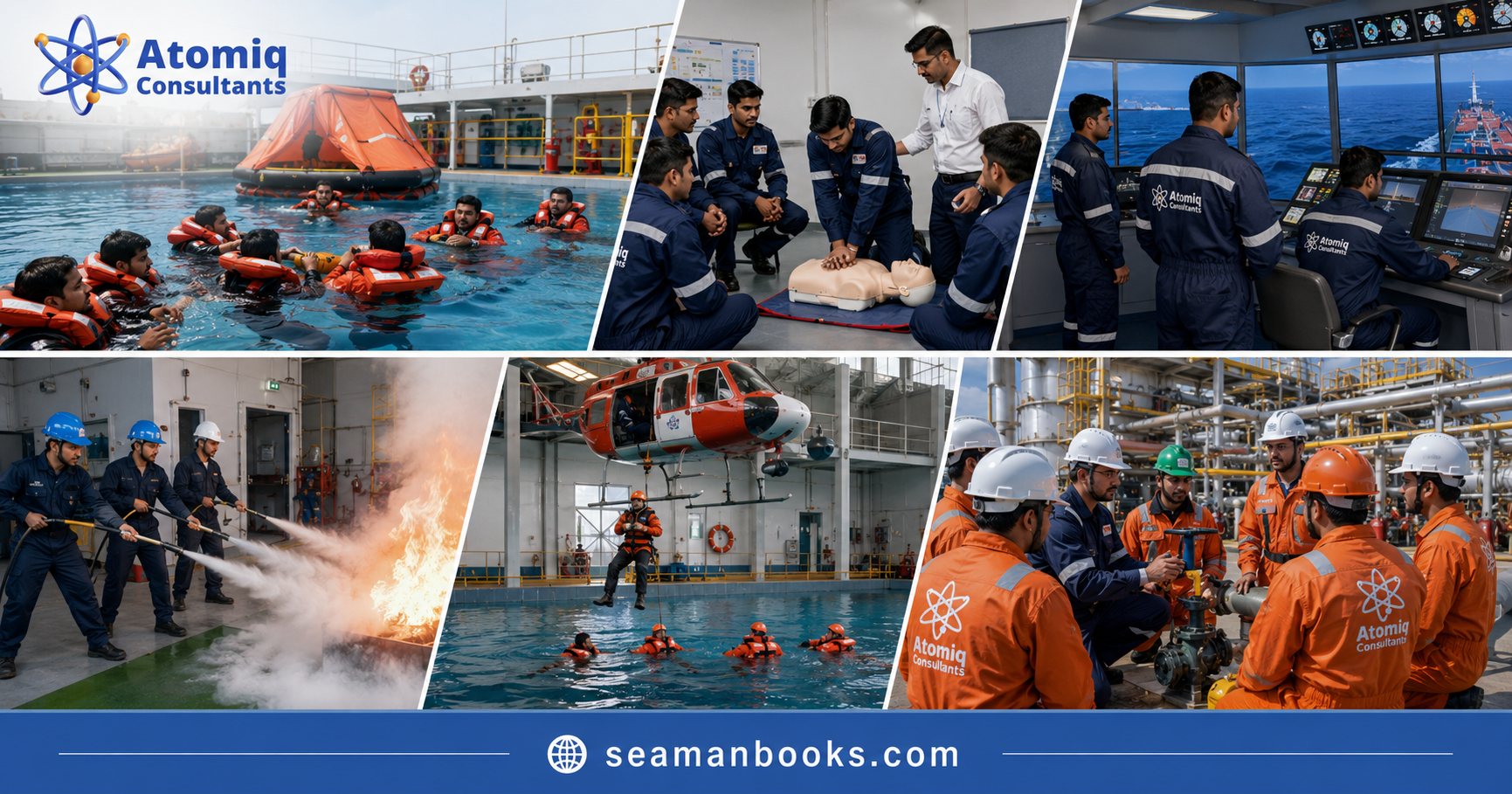
Basic Safety Training — often written as BST, or “STCW-95” and “STCW-10” out of habit — is the entry gate. Without it, no reputable operator will sign you on. The four modules sit under Convention regulation VI/1, with the detailed syllabus for each in Code sections A-VI/1-1 to A-VI/1-4.
- Personal Survival Techniques (A-VI/1-1). Abandoning ship, lifejacket and immersion suit drills, liferaft boarding, survival in water. Almost always includes a pool session.
- Fire Prevention and Fire Fighting (A-VI/1-2). Fire theory, extinguisher types, hose handling, and a live-fire exercise wearing breathing apparatus in a smoke-filled compartment.
- Elementary First Aid (A-VI/1-3). CPR, bleeding control, shock, casualty movement — enough to hold a situation until medical help arrives.
- Personal Safety and Social Responsibilities (A-VI/1-4). Shipboard hazards, safe working practice, pollution prevention, employment rights, fatigue, and living and working alongside a multinational crew.
Most centres sell all four as a single 5-day package, and many bundle Security Awareness (Code section A-VI/6-1) in as a fifth half-day — which is why you’ll see the basic set described as either four or five modules depending on who’s advertising it. Both descriptions are correct; check which regulations are actually printed on your certificates.
Advanced STCW courses
Once you hold Basic Safety Training, the next tier is driven by the duties written into your muster list and your rank.
Proficiency in Survival Craft and Rescue Boats (A-VI/2-1) qualifies you to take charge of a lifeboat or liferaft — required for anyone designated as a survival craft commander, which in practice means most ratings working toward promotion. Fast Rescue Boats (A-VI/2-2) is a separate, additional course, needed only where the vessel actually carries an FRB.
Advanced Fire Fighting (A-VI/3) moves you from fighting a fire to directing the response: tactics, ventilation control, team command and post-incident investigation. Effectively mandatory for deck and engineer officers.
Medical First Aid (A-VI/4-1) and Medical Care (A-VI/4-2) are a ladder, not alternatives. The first covers nominated first-aiders; the second qualifies the person who takes medical charge onboard and coordinates radio medical advice, and is a requirement for masters and chief mates on most vessels.
Ship Security Officer (A-VI/5) and Designated Security Duties (A-VI/6-2) cover the ISPS Code side — ship security plans, access control, threat assessment and drills.
Which STCW courses do you actually need?
The honest answer is that your rank sets the floor and your vessel type sets the rest. This is the pattern we see most often across the crew we process documentation for:
|
Your role |
Courses you’ll typically need |
|
Entry-level rating / trainee |
Basic Safety Training (4 modules) + Security Awareness |
|
Experienced rating / bosun |
The above + PSCRB, often Advanced Fire Fighting |
|
Deck or engineer officer |
The above + Advanced Fire Fighting, Medical First Aid, plus Chapter II/III competence courses |
|
Master / Chief Mate / Chief Engineer |
The above + Medical Care, often SSO |
|
Cruise and ferry crew |
Basic Safety Training + passenger ship training under Reg. V/2. Which part depends on your muster-list role: all personnel need emergency familiarisation; staff serving passengers in passenger spaces need the A-V/2 safety training; anyone designated to assist passengers in an emergency needs crowd management |
|
Tanker crew |
Basic Safety Training + Basic, then Advanced, tanker cargo operations for the cargo carried |
|
Offshore and rig personnel |
Basic Safety Training + offshore-specific training: BOSIET initially, FOET as its refresher, or standalone HUET where helicopter transfer is the only exposure — see BOSIET vs HUET |
|
Superyacht crew |
Basic Safety Training + PSCRB; larger yachts add Advanced Fire Fighting and security training |
Two caveats worth more than they look. First, offshore courses like BOSIET and HUET are not STCW courses — they’re OPITO-accredited industry standards that sit alongside STCW, and operators in the Gulf and North Sea usually want both sets. Note also that FOET is the periodic refresher for BOSIET rather than an alternative to it, which is a common and expensive mix-up. Our offshore courses page sets out how the two sets stack. Second, some flag states and some employers require more than the Convention minimum. The Convention is a floor, not a ceiling.
STCW refresher courses: what expires and what doesn’t
This is where most certificate problems actually originate, so it’s worth being precise.
Under Chapter VI, five certificates carry a five-year refresher requirement: Personal Survival Techniques, Fire Prevention and Fire Fighting, Advanced Fire Fighting, Proficiency in Survival Craft and Rescue Boats, and Proficiency in Fast Rescue Boats. Elementary First Aid and Personal Safety and Social Responsibilities are not caught by the Convention’s five-yearly requirement.
Two more sit under Chapter V and are widely missed: passenger ship training (crowd management, crisis management and human behaviour, ro-ro passenger safety) and IGF Code training for gas and low-flashpoint-fuelled ships. Both carry an explicit five-year cycle in the Convention text. If you work cruise, ferry or LNG-fuelled tonnage, these expire on you just as surely as your firefighting certificate does.
One nuance on Elementary First Aid and PSSR: the Convention’s five-yearly requirement covers only Personal Survival Techniques and Fire Prevention and Fire Fighting, so strictly those two are what needs re-evidencing. In practice, though, several administrations revalidate the whole Basic Training endorsement as a single unit, and most centres issue and renew all four modules as one certificate. Check what your flag actually renews rather than what the Code lists.
Flag-States STCW Courses
There’s also a second route out of a refresher that many seafarers don’t realise is in the Convention itself, not a flag-state favour. The standard wording requires you to either undertake appropriate refresher training or provide evidence of having achieved the required standard of competence within the previous five years. In practice that means documented seagoing service plus participation in the relevant onboard drills can satisfy the requirement — but the burden of proof sits with you, and it depends entirely on the quality of your discharge records and how your administration chooses to accept that evidence.
Practical advice: diary your PST and FPFF expiry dates the day you receive the certificates, and renew three months early. A lapsed refresher discovered during pre-joining checks costs you the contract, not just the course fee. If yours have already expired, we cover the recovery route in fixing expired CDC and STCW certificates.
What’s changing for STCW courses in 2026
Two developments are worth tracking.
Prevention of bullying and harassment is now part of PSSR. Amendments to the STCW Code added bullying and harassment prevention to the Personal Safety and Social Responsibilities syllabus, applying from 1 January 2026. If you completed PSSR before that date your certificate remains valid, but new courses and updated training material now include it.
A full revision of the Convention is underway. The IMO is running a comprehensive review of STCW — the first since the process that produced the Manila Amendments — covering digitalisation, decarbonised fuels, and automation, with a revised Convention anticipated later this decade. Nothing changes for course requirements yet.
Where to take STCW courses — and why approval matters more than price
Any centre can print a certificate. Far fewer hold live approval from a flag state administration that your employer’s vessel actually flies. The rejections we see most often are not failed courses — they’re valid courses taken at centres the flag state doesn’t recognise, or certificates that can’t be verified when a crewing manager checks them.
Before you pay for any STCW course, confirm three things: which flag state approval the centre holds, whether that approval covers the specific regulation you need (A-VI/2-1 approval doesn’t imply A-VI/3), and how the certificate can be verified online by an employer. Then check it lines up with the flag state of your seaman’s book — a mismatch between your documentation and your training is one of the more expensive mistakes in this industry to unwind.
Atomiq Group has processed STCW certification and renewals alongside seaman’s books for crew across the GCC, India, Singapore, Turkey, the UK and the USA. We’ll tell you which courses your target rank and vessel type actually require, arrange them through recognized centers, and make sure the paperwork matches the flag state on your book.
👉 Tell us your rank and target vessel — we’ll map your STCW course list
That block answers the four questions asked most often. The other 21 are below, grouped, each answered in the first two sentences. Every regulatory statement links to the authority that published it.
Seaman Books is a documentation and enrolment partner based in Business Bay, Dubai.
We also provide STCW training courses and certificates through Atomiq Group, managed by Atomiq College Pvt. Ltd., Nepal, an authorized seafarers and maritime training institute and a wing of Atomiq Management Consultancies. Our training portfolio includes Basic Safety Training (BST), Security Awareness Training (SAT), STSDSD, Passenger Ship Training, and Tanker Training, supporting aspiring and professional seafarers in developing essential maritime skills and obtaining relevant training certificates in accordance with applicable regulatory requirements.
25 Frequently Asked Questions About STCW
What STCW is
1. What does STCW stand for?
STCW stands for the International Convention on Standards of Training, Certification and Watchkeeping for Seafarers. The IMO adopted it on 7 July 1978 and it entered into force on 28 April 1984. The convention sets the minimum training every seafarer must hold; the STCW Code Part A contains the mandatory standards behind it. (IMO)
2. What is an STCW certificate?
An STCW certificate is documentary proof that you met a specific standard of competence in the STCW Code, issued by a training centre under the approval of a flag administration. It is not a job licence and it is not issued by the IMO. Each certificate covers one named competence — there is no single document called “the STCW certificate”.
3. Is STCW the same as basic training?
No, though the words are used as if they were. Basic training is one part of STCW: the four courses under Regulation VI/1 that nearly every seafarer needs before joining a ship. STCW as a whole also covers advanced firefighting, survival craft, security duties, tanker and passenger-ship training, and officer competence. Basic training is the entry point, not the whole convention.
4. Is an STCW certificate the same as a Certificate of Competency?
No. A Certificate of Competency (CoC) is a rank licence — it says you may serve as, for example, Officer of the Watch. STCW certificates of proficiency say you completed a named safety or security course. You need proficiency certificates long before you need a CoC, and holding all the basic modules does not make you an officer.
Which courses, and how many
5. How many STCW courses are there?
There is no fixed total — STCW covers dozens of proficiencies across Chapters II to VI, and which ones you need depends on your rank, vessel type and trade. What is fixed is the basic training set: four courses under Regulation VI/1. Most seafarers then add Security Awareness, and deck and engine ratings add survival craft and advanced firefighting.
6. Which four courses make up STCW basic training?
| Course | STCW Code table | Typical duration |
|---|---|---|
| Personal Survival Techniques (PST) | A-VI/1-1 | 1–1.5 days |
| Fire Prevention and Fire Fighting (FPFF) | A-VI/1-2 | 1.5–2 days |
| Elementary First Aid (EFA) | A-VI/1-3 | 1 day |
| Personal Safety and Social Responsibilities (PSSR) | A-VI/1-4 | 1 day |
| Security Awareness (added by most centres) | A-VI/6-1 | 0.5 day |
Course-to-table mapping per MCA MSN 1865 (M) Amendment 1 §3.1. Durations are the figures published on our own STCW enrolment page; actual hours are set by the centre.
7. Is Security Awareness one of the basic courses?
It is mandatory for most seafarers, but it is not part of Regulation VI/1. Security Awareness sits under Regulation VI/6 (Table A-VI/6-1), and Designated Security Duties under A-VI/6-2. Centres bundle it with the four basic courses and sell the result as a five-module package, which is why you will see the basic set described as both four and five.
8. What is the difference between basic and advanced STCW training?
Basic training is the Regulation VI/1 set everyone needs. Advanced training — Advanced Fire Fighting, Proficiency in Survival Craft and Rescue Boats, Medical First Aid, Ship Security Officer — is role-specific and usually required for a particular rank or certificate. We cover the split in detail in STCW basic training vs advanced training.
9. Which STCW course should I do first?
Do the four Regulation VI/1 courses together, in one block, at one centre. They are normally timetabled as a single five-to-seven-day intake, the certificates are issued together, and splitting them across centres or months creates mismatched dates that complicate every later renewal. Add Security Awareness in the same block.
Getting certified
10. How do I get an STCW certificate?
Four steps: obtain a seafarer medical certificate, enrol at a training centre approved by a flag administration, attend and pass the practical assessments in person, then collect the certificate the centre issues. The centre certifies you — no agency, including this one, can issue an STCW certificate on your behalf. Our full walkthrough is in how to get STCW certification.
11. Who is allowed to issue an STCW certificate?
Only a training centre holding approval from a flag administration for that specific course. The UK’s MCA, for example, requires that training be “given by an MCA approved training provider” (MSN 1865 §3.1), and every other flag publishes an equivalent list. If a provider cannot name the administration that approved it and show its approval reference, treat the certificate as worthless.
12. What documents do I need to enrol, and how old do I have to be?
You will normally be asked for a passport with at least six months’ validity, a seafarer medical certificate, passport photographs, your seaman book or proof of application, and proof of age — 16 or over. Requirements vary by centre and by flag; we confirm the exact list with the centre before you pay. (Document list per our enrolment page.)
13. Where can I do STCW training in Dubai or the UAE?
At an approved centre in the UAE — we arrange the seat rather than deliver the course, confirming availability and the centre’s fee before you commit. Dubai intakes, what the fee covers and what is charged separately are set out on STCW courses in Dubai. Our office is in Regal Tower, Business Bay.
14. How long does STCW basic training take?
Five to seven days of training for the full basic set, plus roughly one to two weeks for the certificates to be issued after completion. Door to door — enquiry to certificate in hand — expect two to four weeks in a normal case, longer if the medical or an intake date slips. (Figures as published on our enrolment and certification pages.)
15. How much do STCW courses cost?
Course fees are set by each approved centre, not by the IMO, the flag or by us, and they vary by country, by module and by intake — so there is no single figure. What changes the total is how many modules you need, whether you are doing the full basic set or one refresher, the country you train in, and whether your medical and seaman book are already in hand.
Send us your rank and target join date on WhatsApp and we will come back with the centre’s own fee for your module list before you commit to anything.
Online training, CBT and fraud
16. Can I do STCW courses online?
Only the theory parts, and only where your flag permits it. The MCA allows online delivery for “theory-based courses that have no practical requirements” with additional verification safeguards (MSN 1865 §4.4). Personal Survival Techniques, Fire Prevention and Fire Fighting, survival craft and advanced firefighting all require physical assessment — water entry, live fire — and cannot be completed remotely by anyone, anywhere.
17. Is computer-based STCW training accepted?
For theory modules such as Security Awareness or PSSR, computer-based delivery may be accepted where the flag has approved that centre to deliver it that way. It does not replace the practical courses. Check the approval before you pay: a centre approved for classroom delivery is not automatically approved for the same course online.
18. How do I check an STCW certificate is genuine?
Verify it with the issuing centre and with the flag administration that approved that centre — not with the seller. Certificate fraud is a recognised problem the IMO’s 2010 Manila amendments addressed directly through “improved measures to prevent fraudulent practices associated with certificates of competency” (IMO). A certificate that arrives without attendance will fail at the first port state control inspection, and the seafarer carries the consequence.
Validity and renewal
These three answers are deliberately short. /stcw-renewal/ holds positions 1–9 for the validity queries and is the page that should rank for them.
19. Do STCW certificates expire?
Not as a class. Five certificates require documented updating every five years — Personal Survival Techniques, Fire Prevention and Fire Fighting, Advanced Fire Fighting, Proficiency in Survival Craft and Rescue Boats, and Fast Rescue Boats. Elementary First Aid, PSSR and the security proficiencies carry no such requirement. Full detail, including what to do at expiry, is in STCW renewal.
20. Where does the five-year rule come from?
From STCW itself. The 2010 Manila amendments introduced a “refresher training module every five years for basic training on personal survival techniques and fire prevention and firefighting” (IMO). Flags implement it individually: the UK requires that “from the 1st January 2017 you must have documentary evidence of either having completed the training course or updated your training within the last 5 years” (MCA).
21. What if my STCW lapsed years ago?
You update rather than start over: the refresher is short — the MCA sets it at 4 or 7 hours depending on the course — and a new five-year cycle runs from the completion date. There is no grace period; on the day it lapses, it has lapsed. If a crew change is close, see fixing an expired CDC and STCW certificate.
Where it applies
22. Is my STCW certificate valid worldwide?
STCW is an international convention, so a certificate issued by an approved centre is recognised in principle everywhere — but acceptance is decided by the flag of the ship you are joining and by the port state that inspects it, and some flags require their own endorsement or recognition of a certificate issued under another administration. Confirm with the flag before you accept a contract, not after.
23. Do I need STCW as well as a seaman book?
Yes — they answer different questions. The seaman book (CDC / SIRB) is your identity and service record, issued by a flag administration. STCW certificates prove you are trained. Most employers require both, and most flags will not process a seaman book without evidence of basic training. We handle both sides together; see services for seafarers.
24. Are BOSIET and HUET STCW courses?
No. BOSIET, HUET and FOET are OPITO offshore standards for the oil and gas industry, not STCW proficiencies. Offshore workers joining a vessel often need both: STCW for the maritime side, OPITO for the installation. See offshore training enrolment: BOSIET and HUET.
25. Do I need STCW for a cruise ship or a yacht?
For a cruise ship, yes — including hotel, retail and entertainment staff, who are crew under the convention regardless of their department. See seaman book and STCW for cruise ship staff. For yachts it depends on tonnage, trade and flag; commercially registered yachts generally require the basic set, and private yachts vary.
Still not sure which courses you actually need?
Send your rank, your flag and your target join date. We come back with the module list for your case, the approved centre with the nearest intake, and the centre’s own fee — before you commit to anything.
- WhatsApp: +971 55 458 3416
- Free eligibility check: services for seafarers
- Office: #903 Regal Tower, Business Bay, Dubai, UAE
The short version
STCW courses stack in three layers: the four basic safety modules everyone needs, an advanced tier driven by your rank and duties, and vessel-specific endorsements for tankers, passenger ships, gas-fueled vessels and polar waters. The two things worth getting right are the refresher cycle — survival techniques, firefighting, advanced firefighting, survival craft and fast rescue boats under Chapter VI, plus passenger ship and IGF training under Chapter V, all on five years — and the approval status of the center you train at, which matters more than what the course costs.
If you’re not sure which list applies to you, that’s a five-minute conversation rather than a research project. Send us your rank, target vessel type and current certificates and we’ll come back with the exact courses you need and the flag-state route to get them recognised.
Related reading: STCW Certification Explained: A Complete Guide for Seafarers 2026 · Offshore Courses · What is a CDC Certificate? · Managing Multiple Crew Certifications