2. Maritime Career Departments: Deck, Engine, or Catering?
Before enrolling in any training, the most important decision is choosing your department. There are three core departments aboard any commercial vessel.
The Deck Department (Navigation)
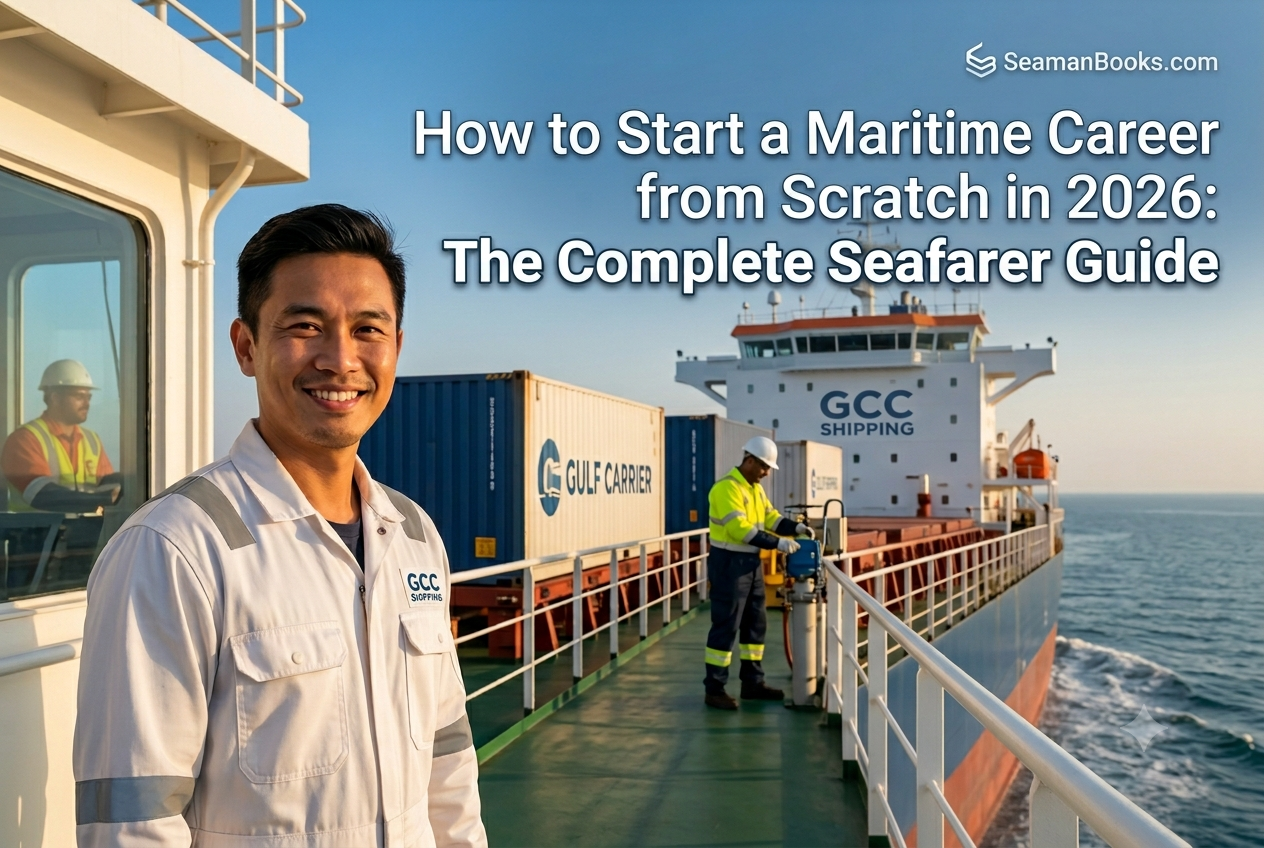
The Deck department handles vessel navigation, cargo operations, safety management, and watchkeeping. If you love the sea, want to eventually become a Master (Captain), and enjoy leadership and responsibility — this is your path.
Entry-level ranks: Ordinary Seaman (OS) → Able-Bodied Seaman (AB) → Officer of the Watch (OOW) → Chief Mate → Master
Typical qualifications needed:
- BSc Nautical Science or Marine Transportation degree
- STCW Basic Safety Training (BST)
- Officer of the Watch (OOW) Certificate of Competency
The Engine Department
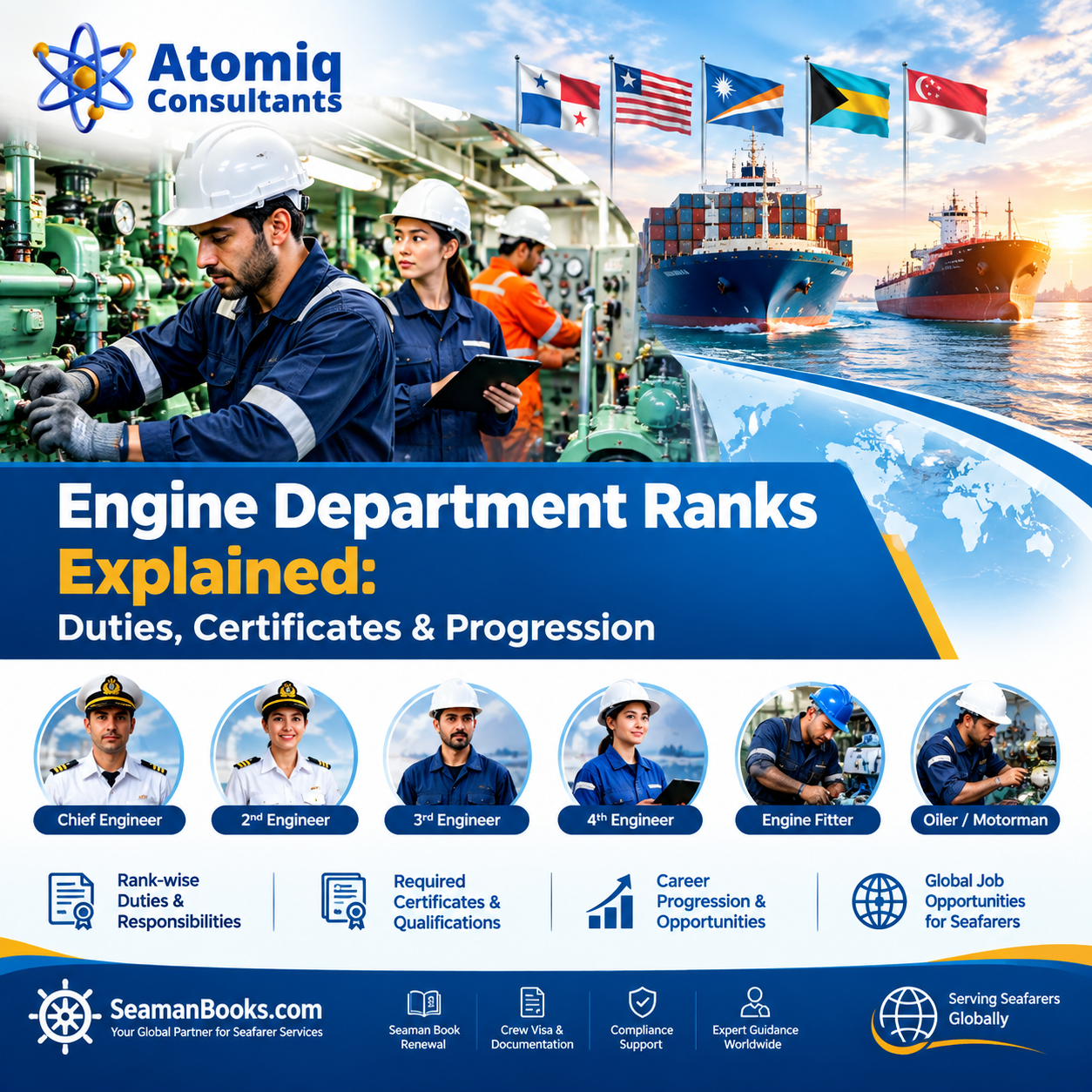
The Engine department manages the propulsion systems, electrical systems, pumps, and all machinery aboard. If you are technically inclined and enjoy engineering, mechanical systems, and problem-solving — the engine room is your world.
Entry-level ranks: Wiper/Motorman → Oiler → Junior Engineer → 4th Engineer → Chief Engineer
Typical qualifications needed:
- BSc Marine Engineering or equivalent
- STCW Basic Safety Training
- Officer in Charge of Engineering Watch (OICEW) Certificate of Competency
The Catering/Hospitality Department
Often overlooked but critically important, the catering department manages food preparation, crew welfare, and housekeeping. On cruise ships, this department is enormous. Entry is faster and requires less academic investment.
Entry-level ranks: Messman → Cook → Chief Cook → Chief Steward
Typical qualifications needed:
- Basic food hygiene/safety certification
- STCW Basic Safety Training
- Relevant culinary or hospitality diploma (preferred)
Pro Tip from SeamanBooks.com: Not sure which department suits you? Ask yourself — do you enjoy being on the bridge watching the horizon, working with engines in the machinery space, or feeding and managing crew welfare? Your honest answer narrows it down instantly.
3. Step-by-Step: How to Start a Maritime Career With No Experience
This is the exact pathway followed by thousands of successful seafarers globally. Follow each step carefully.
Step 1: Meet the Basic Eligibility Requirements
Before applying to any maritime institute, you must confirm you meet these baseline requirements:
Requirement | Details |
Age | Minimum 16–18 years (varies by country and rank) |
Education | High school diploma / 10+2 (Science preferred for officer track) |
Medical Fitness | ENG1 / ML-5 or equivalent seafarer medical certificate |
Vision | Correctable vision meeting maritime standards |
Hearing | Must pass audiometric test |
Language | English proficiency (STCW working language at sea) |
Step 2: Choose an Approved Maritime Training Institute
This is non-negotiable. Your institute must be approved by your flag state authority and compliant with the STCW Convention (Standards of Training, Certification and Watchkeeping for Seafarers).
Graduating from an unrecognized institute means your certificates will not be accepted by shipping companies or foreign flag states. Always verify approval status before enrolling.
How to verify:
- Check your country’s maritime authority website (e.g., MARINA in the Philippines, DG Shipping in India, MCA in the UK)
- Look for the institute on the White List of STCW-compliant countries maintained by IMO
Step 3: Complete STCW Basic Safety Training (BST)
STCW Basic Safety Training is the single most important certification for any new seafarer. It is mandatory for everyone who works aboard a seagoing vessel — regardless of department or rank.
BST consists of four core modules:
- Personal Survival Techniques (PST) — Abandoning ship, life rafts, survival at sea
- Fire Prevention and Firefighting (FPFF) — Fire behavior, extinguishers, breathing apparatus
- Elementary First Aid (EFA) — Basic life support, CPR, wound treatment
- Personal Safety and Social Responsibilities (PSSR) — Ship safety culture, crew communication
This typically takes 5–10 days and is delivered at approved maritime training centers. Without BST completion, you cannot board any commercial vessel.
Step 4: Complete Pre-Sea Training or Cadetship
Depending on your country and career path:
- Officer track: Complete a 2–4 year BSc degree in Nautical Science (Deck) or Marine Engineering (Engine) with integrated sea training/cadetship
- Rating track: Complete a 3–6 month pre-sea rating course followed by direct ship joining
Cadetships are often sponsored by shipping companies — meaning the company pays for your training in exchange for a work commitment after graduation. Apply to these programs aggressively.
Step 5: Obtain Your Seafarer Documents
Once you’ve completed basic training, you’ll need:
- Seafarer’s Identification and Record Book (SIRB) — Your sea service record
- STCW Certificates — Issued after completing each approved course
- Passport — Valid, with at least 18 months validity
- Flag State Certificate (for officers) — Issued by your maritime authority after examination
- Yellow Fever Vaccination Card — Required for many international ports
- GMDSS Certificate (for Deck officers) — Radio communications at sea
Step 6: Apply for Your First Ship Position
With your documents ready, apply through:
- Manning agencies (crewing agents) — Most seafarers find first jobs through these
- Direct company applications — Major shipping companies like Maersk, MSC, and Maran Tankers recruit directly
- Your training institute’s placement cell
- Online maritime job portals — Dockstaff, SeafarerJobs, Martide
Important: For your first ship, prioritize gaining sea time and experience over salary. The sea time you log now determines when you can sit for your next Certificate of Competency.
4. STCW Certifications Explained: The Passport of Every Seafarer
The Standards of Training, Certification and Watchkeeping (STCW) Convention — adopted by IMO in 1978 and significantly amended in 2010 (Manila Amendments) — sets the global minimum standards for seafarer training and certification.
Think of STCW certifications as your professional passport at sea. Without them, no reputable company will employ you.
Core STCW Certifications by Level
For All Seafarers (Mandatory)
Certificate | Who Needs It | Validity |
STCW Basic Safety Training (BST) | Every seafarer | 5 years (refresher required) |
Proficiency in Security Awareness | Every seafarer | No expiry |
Medical First Aid | Rating/Officer | 5 years |
For Deck Officers
Certificate | Rank | Notes |
Officer in Charge of Navigational Watch (OICEW/OOW) | 3rd Officer / Junior Watch Officer | STCW Reg. II/1 |
Chief Mate (500 GT or more) | Chief Officer | STCW Reg. II/2 |
Master (500 GT or more) | Captain/Master | STCW Reg. II/2 |
GMDSS General Operator’s Certificate (GOC) | All Deck Officers | Mandatory for Watchkeepers |
Advanced Fire Fighting (AFF) | OOW and above | 5 years |
Medical Care Onboard Ship | OOW and above | 5 years |
For Engine Officers
Certificate | Rank | Notes |
Officer in Charge of Engineering Watch (OICEW) | 4th/Junior Engineer | STCW Reg. III/1 |
Chief Engineer Officer (3,000 kW+) | Chief Engineer | STCW Reg. III/2 |
High-Voltage Endorsement | Senior Engineers | Vessel-specific |
Specialized / Endorsement Certificates
Certificate | Vessel Type |
Basic Tanker Training (Oil, Chemical, Gas) | Tanker vessels |
Passenger Ship Familiarization | Passenger/Cruise ships |
Crowd Management | Cruise/Passenger vessels |
Security Officer (PFSO/SSO) | Security-focused roles |
Dynamic Positioning (DP) — Basic & Advanced | Offshore vessels |
STCW 2010 Manila Amendments — What Changed?
The 2010 Manila Amendments introduced stricter requirements including:
- Mandatory rest hours (minimum 10 hours rest per 24-hour period)
- New training requirements for able seamen
- Enhanced security training requirements
- Refresher and revalidation requirements every 5 years for key certificates