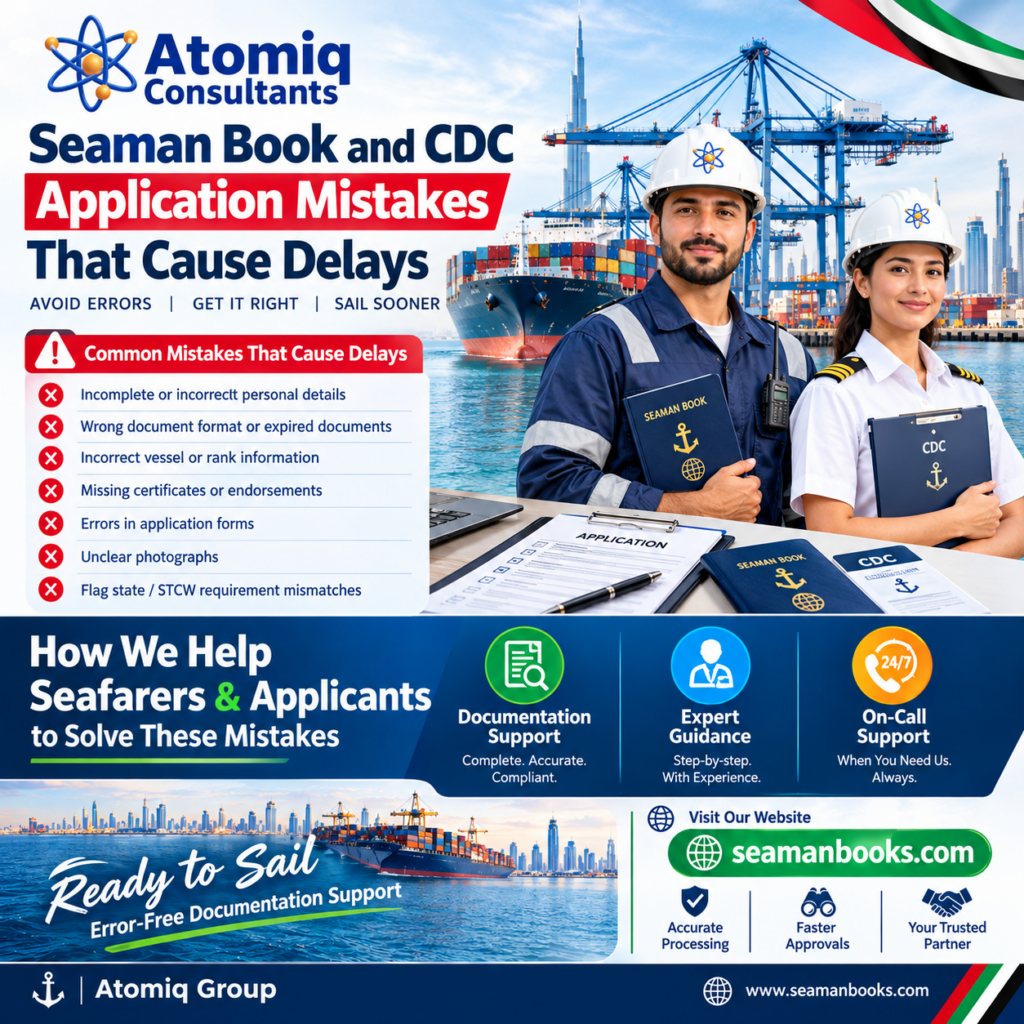
Most seaman book and CDC applications are not rejection or refused on eligibility — they stall on the paperwork. Nine document-level errors account for the delays we see most often: a passport that does not match the application, a passport too close to expiry, missing or expired STCW certificates, a photograph that misses the administration’s specification, scans that cannot be read, sea service that carries no signature or stamp, the wrong document type for the country you are dealing with, an unanswered query from the administration, and a fee paid without a traceable reference. Every one of them is checkable before you submit. None of them is quick to fix afterwards.
In short — A delayed application is almost always a file problem, not an eligibility problem. — The decision belongs to the flag administration. Seaman Books prepares and verifies the file; we do not issue documents and no consultancy can compel an outcome. — Requirements differ between flags by design — MLC, 2006 leaves the form of the sea-service record to national law. — The cheapest fix is the pre-submission check on this page. It costs nothing to run.
Not sure whether your file is clean? Send us your passport details page and your certificate list on WhatsApp and we will tell you what an administration will query. The eligibility check is free and the service fee is quoted upfront afterwards, with no hidden charges.
WhatsApp: +971 55 458 3416 · Office: #903 Regal Tower, Business Bay, Dubai
Why applications stall instead of failing outright
A flag administration reviewing a seafarer’s file is doing one thing: deciding whether the identity, the qualifications and the sea service in front of it hold together and can be verified. When one element does not match another, the reviewer does not usually refuse the application. They raise a query, and the file stops moving until it is answered.
That is why “my application is delayed” and “my application was rejected” usually have the same underlying cause, and why the fix is the same: make the documents agree with each other before anyone else has to ask.
The nine mistakes that cause delays CDC or Seaman Book Application
| # | The mistake | What the reviewer sees | Check before you submit |
|---|---|---|---|
| 1 | Name or date of birth does not match the passport | A single-character difference — the exact pattern a forged document produces | Read your application against your passport character by character, including name order and transliteration from a non-Latin script |
| 2 | Passport too close to expiry | A document that will outlive its own identity basis | 6 months may technically qualify for an eTA but recommends 8 months. |
| 3 | Missing or expired STCW certificate | An applicant claiming a role the training record does not support | List every certificate with its expiry date. Anything expiring during the intended contract is treated as expired |
| 4 | Photograph does not meet specification | A photo that cannot be used on the document | Get the specification for your flag in writing before the photo is taken. Size, background, headwear and glasses rules are not interchangeable between administrations |
| 5 | Scans that cannot be read | Glare, a cropped edge, a missing reverse side, a stamp that will not resolve | Open every file at 100% on a large screen. If you cannot read a stamp, neither can the reviewer |
| 6 | Sea service that cannot be evidenced | Entries with no signature, no stamp, or no matching employment agreement | Match each entry to a signed record. Unsupported sea service is the slowest of all queries to resolve |
| 7 | The wrong document, or the wrong flag’s rules | An application built on requirements that belong to another administration | Confirm which administration you are applying to and use only that administration’s requirement list |
| 8 | An unanswered query | A file sitting in a queue awaiting a reply that went to a spam folder or an agent who did not forward it | Use an address you check daily. If an intermediary filed for you, ask in writing who receives the administration’s correspondence |
| 9 | A fee paid without a traceable reference | A payment that cannot be matched to an application | Keep the reference number and the receipt. An unmatched payment stops a file as effectively as a missing certificate |
“Approved but not dispatched” — what that usually means
Approval and physical issue are separate steps. An application marked approved means the administration has accepted the file; the booklet still has to be produced and sent. A file sitting between those two points is normally waiting on production, on courier or collection arrangements, or on a delivery address that does not match the one on the application.
What it does not usually mean is that the approval has been withdrawn. Before chasing it, check the delivery address you gave and confirm who is authorised to collect.
| Flag state | Verified post-approval route | What the source establishes |
|---|---|---|
| Panama | Electronic delivery for CoE/CoC; courier/EMS arrangements exist for physical “value documents” | Panama changed CoCs and CoE endorsements to electronic form from 1 April 2026. For physical value documents sent to consulates, Panama’s circular provides for private courier or government postal service (EMS). (panamamaritimegroup.com) |
| Palau | Not verified | I found Palau’s official seafarer-document pages, but they do not establish a post-approval courier, agent-collection, or registered-office pickup route. (plauaer.org) |
| Belize | Designated office / agent route; physical delivery may be courier | IMMARBE says Deputy Registrars through designated offices are the recommended medium for seafarer services. A designated Belize Deputy Registrar also states that, after issuance, physical documents can be delivered or collected, with courier used for delivery. (immarbe.com) |
| St Kitts & Nevis | Courier/mail through applicant/registrar route; not verified as mandatory collection method | SKANReg says originals can be forwarded by mail/courier, and applications can be submitted through regional Maritime Registrars or directly to SKANReg. Its published material also describes seaman’s books being sent by courier. (skanregistry.com) |
| Bahamas | Electronic delivery; hard copy available on request | BMA states that its certification is available electronically, with certificates accessible through BORIS. It specifically says courier systems are no longer needed, although a hard copy can be supplied on request. (Bahamas Maritime Authority) |
| Liberia | Electronic delivery | The Liberian Registry’s current Seafarer Portal says SEA360 provides secure electronic delivery and mobile access to official seafarer documents. (LISCR | LIBERIAN REGISTRY) |
| Honduras | Delivery route not sufficiently specified publicly | The Honduran administration confirms document processing and has a collection fee, but its published terms do not clearly establish whether approved seafarer documents are dispatched by courier, collected by an agent, or picked up at a registered office. (merchantmarine.gob.hn) |
How to track an application
Tracking depends entirely on who filed. If you applied directly to an administration, the reference number issued at submission is the tracking key and the administration’s own channel is the only authoritative status. If a consultancy or manning agent filed on your behalf, they hold that reference — and you are entitled to ask for it.
A provider who will not tell you which administration your application went to, or will not give you the reference, is the single clearest warning sign in this category. Our guides to verifying a seaman’s book online and to applying through a manning agent versus directly cover what a legitimate route looks like.
How long it should take
We are not publishing a turnaround figure on this page, and you should be careful with any that you find. Processing time depends on the administration, on your rank and on whether your file is complete — and a site-wide average tells you nothing about your own application.
Ask for a figure against your specific flag, rank and document type. If you would like ours, send us the file and we will quote the realistic window alongside the fee.
| Flag state | Standard turnaround | Expedited turnaround (if applicable) | Basis/source | Reconciled status |
|---|---|---|---|---|
| Panama | Up to 25–30 days (printed book) | Within 10 days (urgent); Processing Certificate 3–5 business days | SeamanBooks 2026 service comparison (Seaman Books) | Reconciled |
| Palau | 1–2 working days | Often same-day | SeamanBooks 2026 service comparison (Seaman Books) | Reconciled |
| Belize | 1 working day | Provisional in a few days | SeamanBooks 2026 service comparison (Seaman Books) | Reconciled |
| St Kitts & Nevis | 1 working day | 24 hrs | SeamanBooks 2026 service data (Seaman Books) | Reconciled |
| Bahamas | 1–2 working days | 24 hrs | SeamanBooks 2026 service comparison (Seaman Books) | Reconciled |
| Liberia | 2 working days | 24 hrs | SeamanBooks 2026 service comparison (Seaman Books) | Reconciled |
| Honduras | 2 working days | 24 hrs | SeamanBooks 2026 service comparison (Seaman Books) | Reconciled |
Why the requirements differ between flags
This is the source of more wasted applications than anything else on the list, and it is not an accident of administration. The sea-service record that seafarers call a seaman’s book or a CDC exists because the Maritime Labour Convention, 2006, as amended requires it: under Standard A2.1, paragraph 1(e), seafarers “shall be given a document containing a record of their employment on board the ship”.
Paragraph 3 of the same Standard then says that the document must not record anything about the quality of a seafarer’s work or their wages, and that “the form of the document, the particulars to be recorded and the manner in which such particulars are to be entered, shall be determined by national law.”
That last clause is the whole answer. The obligation is international; the format is national. A checklist written for one flag is not a checklist for another, and using one for the other is mistake 7.
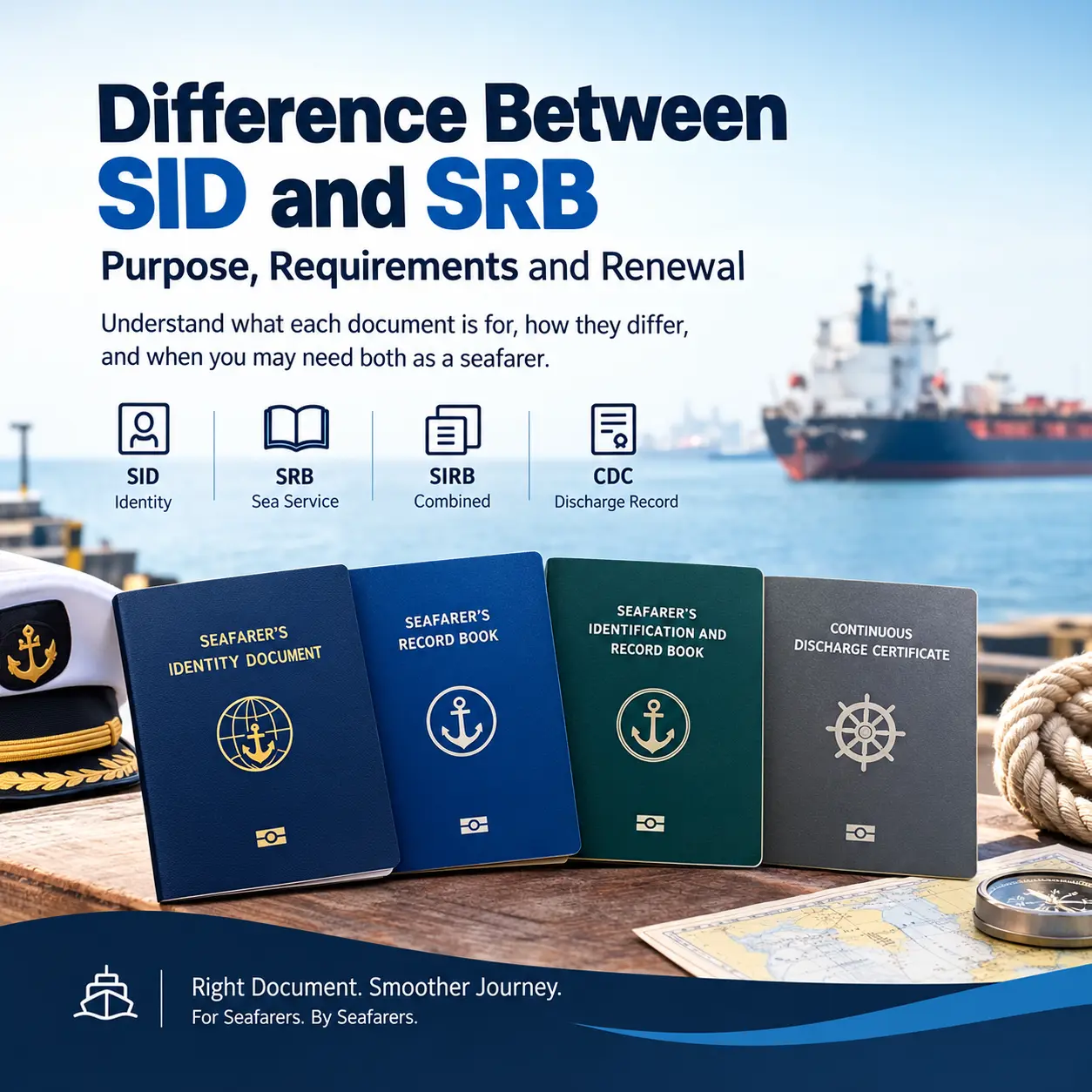
The seaman’s book is not a seafarers’ identity document
A separate and costly confusion. Under the Seafarers’ Identity Documents Convention (Revised), 2003 (No. 185), a seafarers’ identity document is issued by a ratifying state to its own nationals who are seafarers, under conditions comparable to those for travel documents.
A flag-state seaman’s book is a different instrument, obtained from the administration whose flag you sail under. One does not substitute for the other, and applying for the wrong one — or assuming that holding one satisfies a request for the other — stops files regularly. If you are unsure which you need, CoC vs CoP vs CDC vs seaman book sets out the four documents side by side.
The pre-submission check
Run this before you submit anything, to any administration.
- Application details read character by character against the passport, including name order.
- Passport validity confirmed against your flag’s requirement.
- Every certificate listed with its expiry date, and none expiring inside the intended contract.
- STCW certificates current and matching the rank applied for.
- Photograph taken to the administration’s written specification.
- Every scan opened at full size and confirmed legible, both sides, all four corners.
- Every sea-service entry matched to a signed and stamped record.
- Correct administration confirmed, and its own requirement list used.
- A contact address you check daily, and written confirmation of who receives correspondence.
- Payment reference and receipt saved.
If an item fails, fix it now. Every one of these costs minutes before submission and weeks afterwards.
Applying for a Continuous Discharge Certificate (CDC) is one of the most important steps in a seafarer’s career. A CDC serves as an official maritime identity and sea service record required for working onboard international vessels. However, many seafarers face delays or rejection because of incomplete applications, incorrect details, or missing documents.
Understanding how to avoid CDC rejection can save time, reduce stress, and improve approval chances. Before submitting your application, it is important to follow a proper documentation checklist and verification process. At Atomiq Group, seafarers receive professional assistance for CDC processing, maritime documentation verification, and international compliance support.
What is a CDC?
A Continuous Discharge Certificate (CDC), also known as a Seaman Book, is an official document that records a seafarer’s onboard employment history and sailing experience.
A CDC is commonly required for the following:
- Joining merchant navy vessels
- International shipping jobs
- Offshore maritime operations
- Immigration and port verification
- Sea service documentation
Without a valid CDC, seafarers may not be eligible to work onboard international ships.
Why CDC Applications Get Rejected
Many CDC applications are rejected due to preventable mistakes. Even minor errors can lead to delays or disqualification during verification.
Some common reasons include:
Incorrect Personal Information
A mismatch in name, passport number, or date of birth across documents can create verification issues.
Incomplete Documentation
Missing certificates, photographs, or application forms may result in rejection.
Expired Certificates
Expired STCW certifications, passports, or medical fitness certificates can affect approval.
Low-Quality Scanned Documents
Blurred or unclear copies may not meet maritime authority standards.
Invalid Sea Service Records
Incorrect or incomplete sea service details can lead to document verification problems.
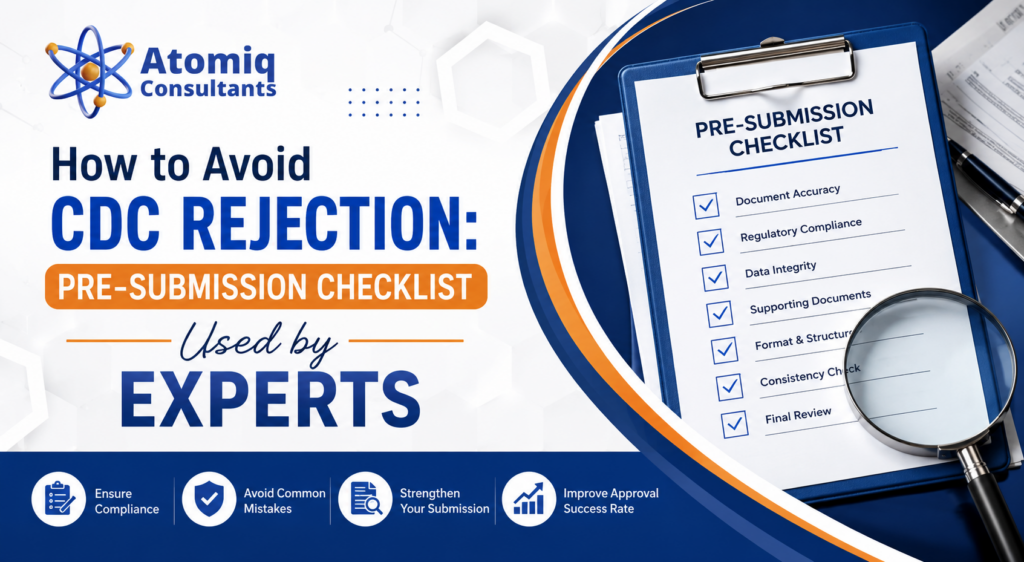
Expert Pre-Submission Checklist to Avoid CDC Rejection
Following a professional checklist before submission can significantly improve approval chances.
1. Verify Passport Details
Ensure your passport is valid and all details match your maritime documents exactly.
2. Check STCW Certifications
Make sure all mandatory STCW certificates are updated and valid.
3. Review Personal Information Carefully
Verify:
- Full name spelling
- Date of birth
- Nationality
- Signature consistency
- Contact details
Consistency across all documents is essential.
4. Submit Clear Scanned Copies
Use high-quality scanned copies of:
- Passport
- STCW certificates
- Medical certificate
- Educational documents
- Existing CDC (if applicable)
Avoid blurry or cropped images.
5. Confirm Sea Service Documentation
Ensure sailing records and sea service certificates contain:
- Vessel name
- Rank
- Joining and sign-off dates
- Authorized signatures
6. Follow Correct Photo Specifications
Many CDC applications require specific passport-size photo dimensions and background colors.
7. Double-Check Application Forms
Carefully review every section before final submission to avoid typing mistakes.
Importance of Proper CDC Documentation
Proper documentation helps seafarers:
- Avoid processing delays
- Improve approval chances
- Meet international maritime standards
- Join vessels faster
- Maintain professional credibility
A well-prepared application reduces complications during maritime authority verification.
How Atomiq Group Helps Seafarers
Atomiq Group provides expert support for CDC processing and maritime documentation verification. Services include:
- CDC application assistance
- Seaman Book processing
- Maritime document verification
- STCW documentation support
- Offshore certification guidance
- International compliance assistance
Atomiq Group helps seafarers minimize documentation errors and improve processing efficiency.
Why Professional Verification Matters
Many seafarers submit applications without proper review, leading to rejection and unnecessary delays. Professional assistance helps:
- Identify missing documents
- Verify information accuracy
- Ensure compliance with maritime standards
- Reduce rejection risk
- Improve processing success rates
Expert guidance can save both time and money during CDC application procedures.
Tips for Faster CDC Approval
- Keep digital backups of all certificates
- Renew documents before expiry
- Use accurate and updated contact information
- Submit applications early
- Seek professional guidance when unsure
Being proactive with documentation management improves overall approval efficiency.
Conclusion
Understanding how to avoid CDC rejection is essential for every seafarer planning an international maritime career. Most CDC rejections occur because of simple documentation mistakes that can be prevented through careful verification and professional guidance.
With support from Atomiq Group, seafarers can confidently complete CDC applications, improve approval chances, and ensure smoother maritime documentation processing.
FAQ
What is the most common reason a CDC or seaman book application is delayed?
A mismatch between the application and the passport — name order, spelling, transliteration or date of birth. A single character is enough, because that difference is exactly what a fraudulent document produces, and a careful reviewer has to query it.
What does “application approved but not dispatched” mean?
The administration has accepted the file but the document has not yet been produced or sent. It is usually a production, courier or collection issue rather than a change to the decision. Check the delivery address on the application and confirm who is authorized to collect.
How do I track my CDC application status?
Through the administration you applied to, using the reference number issued at submission. If an agent or consultancy filed for you, they hold that reference and should give it to you on request.
Do CDC requirements differ between Panama, Liberia and the Bahamas?
Yes, and by design. MLC, 2006 Standard A2.1(3) leaves the form of the record and the particulars to be entered to national law, so each administration sets its own document list, photo specification and evidence rules. Use only the requirement list of the administration you are applying to.
Is a seaman’s book the same as a seafarers’ identity document?
No. Under ILO Convention No. 185, a seafarers’ identity document is issued by a state to its own nationals. A flag-state seaman’s book is a record of sea service obtained from the administration whose flag you sail under. Neither replaces the other, and neither replaces a passport.
Can Seaman Books guarantee my application will be approved?
No, and no one can. The decision belongs to the flag administration. What a documentation consultancy does is prepare and verify the file so the administration can act on it without a second round of queries.
What happens if my STCW certificate expires during my contract?
Treat it as already expired. Employers and administrations commonly assess certificates against the end of the intended voyage, not the date of application, so a certificate lapsing mid-contract is generally queried at submission.
Next step
Send us your passport details page, your certificate list and the flag you are applying under. We will tell you which of the nine items above your file would be queried on, before it reaches an administration. The eligibility check is free and the service fee is quoted upfront afterwards, with no hidden charges.
WhatsApp: +971 55 458 3416 · Office: #903 Regal Tower, Business Bay, Dubai
If your document has already expired rather than stalled, start here instead: How to Renew Your Seaman Book. If you are applying for the first time, seaman book requirements for new applicants is the document list to work from.