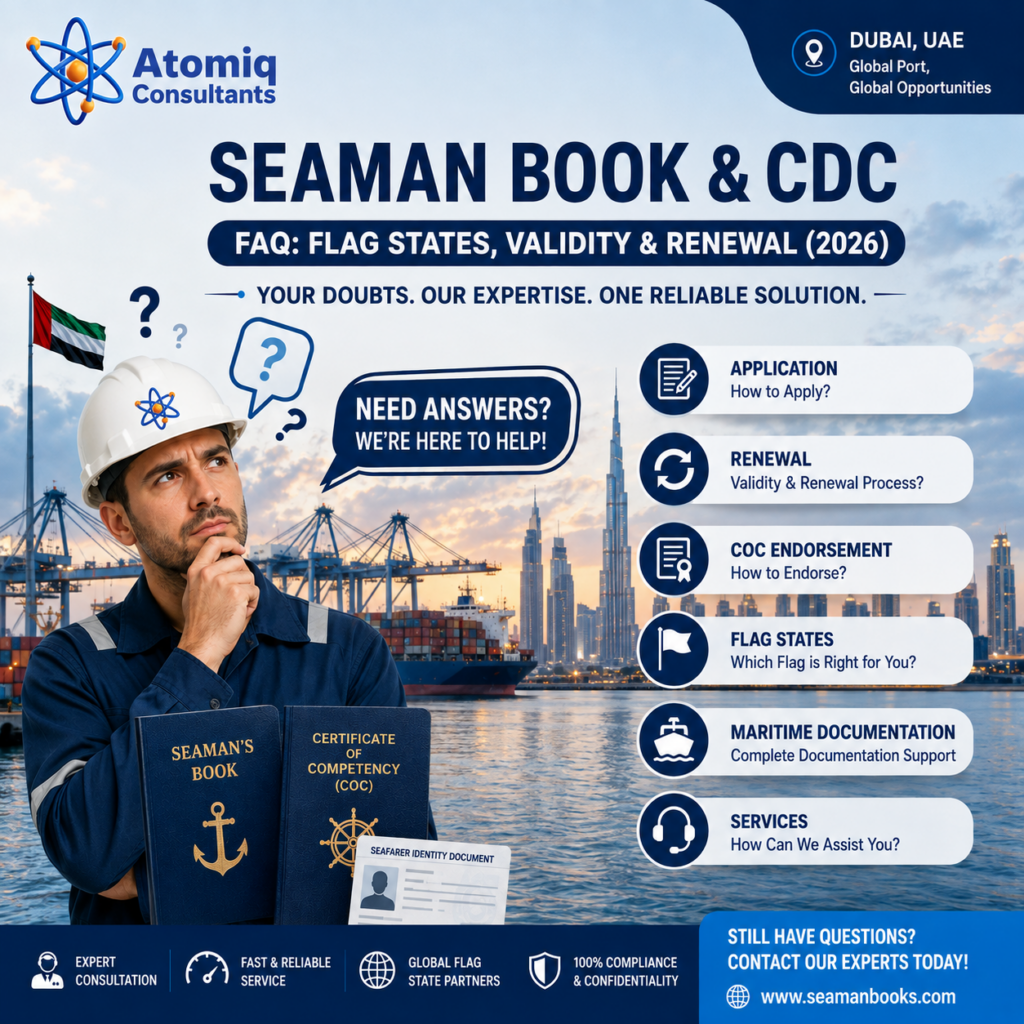
Seaman Book & CDC FAQ: Flag States, Validity & Renewal (2026)
Every week, seafarers ask us the same questions — and most of them start the same way: “Which seaman book should I get, and will it actually be accepted?” This seaman book FAQ collects the 30 questions we answer most often at Seaman Books, an ISO-certified maritime consultancy operating from Dubai since 2011, and answers each one in plain language.
Use it as a reference hub. Every answer is short enough to read in ten seconds, and where a topic deserves more depth we link straight to the full guide — Panama, Palau, Liberia, Bahamas, Belize, St. Kitts & Nevis, Honduras, STCW and offshore training.
What is a seaman book? A seaman book — also called a Continuous Discharge Certificate (CDC), seafarer’s record book or discharge book — is an official document issued by a flag state administration that records a seafarer’s identity, rank and complete sea service history. It is the primary proof of sea time used for employment, promotion and STCW certification.
Seaman book basics
Most confusion in this seaman book FAQ comes from one thing: three separate documents get called “the seaman book” in conversation. It helps to keep them apart from the start.
- Seaman book / CDC — records your sea service. Issued by a flag state.
- Seafarers’ Identity Document (SID) — proves who you are for shore leave and transit.
- STCW certificates — prove what you are trained and competent to do.
You will usually need all three, plus a valid passport and a current medical certificate. The answers below start with the first of them.
1. What is a seaman book?
A seaman book is an official identity and service-record document issued by a flag state maritime administration to a seafarer. It records your full name, date of birth, nationality, rank or capacity, and every period of sea service — ship name, position held, sign-on date and sign-off date. Employers, port authorities and training bodies treat it as the primary evidence of your sea time.
2. What does CDC stand for?
CDC stands for Continuous Discharge Certificate. The name reflects its purpose: it records each discharge from a vessel continuously, in sequence, so your sea service reads as one unbroken career history. “CDC”, “seaman book”, “seafarer’s record book”, “discharge book” and “seaman’s service book” all describe the same category of document.
3. Is a seaman book the same as a seafarer’s identity document (SID)?
No. A seaman book records sea service; a Seafarers’ Identity Document records identity for shore leave and transit, under ILO Convention No. 185 (2003), which revised Convention No. 108 (1958). Some flag states issue both in one booklet, others issue them separately. Neither replaces your national passport.
4. Do I legally need a seaman book to work at sea?
In practice, yes. The Maritime Labour Convention, 2006 requires that seafarers be given a document containing a record of their employment on board, and flag states implement this through the seaman book or discharge book. Beyond the legal basis, no reputable crewing manager will sign you on without one.
5. Can my seaman book show comments about my performance?
No. Under MLC 2006, the record of employment on board must not contain any statement as to the quality of your work or your wages. It is a factual service record: vessel, rank, dates, voyage type. Character or performance assessments belong in a separate reference, not in your CDC.
6. Does a seaman book replace my passport?
No. A seaman book is not a substitute for a passport. You still need a valid national passport to travel to and from the vessel, and many countries additionally require a crew or transit visa. Your seaman book supports those applications by proving you are a working seafarer.
Eligibility and required documents
7. Who is eligible for a seaman book?
Anyone joining or already working in a seagoing capacity: cadets and first-time ratings, experienced officers and engineers, offshore oil and gas crew, catering and hotel staff on cruise ships, and superyacht crew. Most flag states require a valid passport, medical fitness and basic safety training. There is no requirement to hold prior sea time.
8. Can a first-time seafarer with no sea experience apply?
Yes. A seaman book is issued before your first contract — it is the document your sea service gets recorded into. First-time applicants typically need a passport, a seafarer medical certificate and STCW Basic Safety Training. See our STCW certification guide for the four mandatory modules.
9. What documents do I need to apply for a seaman book?
Requirements vary by flag, but the standard set is: a completed application form, a clear copy of your valid national passport, six recent passport-size colour photographs, a valid seafarer medical fitness certificate, and STCW Basic Safety Training certificates (Personal Survival Techniques, Fire Prevention & Fire Fighting, Elementary First Aid, and Personal Safety & Social Responsibility).
10. What is the minimum age to hold a seaman book?
Under MLC 2006 the minimum age for work on board a ship is 16, with additional restrictions on night work and hazardous duties for seafarers under 18. Individual flag states may set a higher threshold, and some employers will not hire under-18 crew at all. Confirm the age rule for your chosen flag before applying.
11. How long is a seafarer medical certificate valid?
A seafarer medical fitness certificate is normally valid for a maximum of two years, reduced to one year for seafarers under 18, while a colour-vision certificate can run up to six years. Your medical must be current on the date you apply — an expired certificate is the most common cause of rejected applications.
Choosing a flag state
This is the decision that costs seafarers the most time when it goes wrong. There is no global seaman book — each document is issued by a national administration, and the practical question is never “which flag is best in the abstract” but “which flag will the operator I want to work for accept, and how fast can I hold it”. Work backwards from the fleet you are targeting.
12. What is a flag state, and why does it decide my seaman book?
A flag state is the country a ship is registered in, and it holds legal authority over that ship and the documents its crew carry. Because seaman books are issued by flag administrations rather than by an international body, the flag you choose determines your document’s format, cost, processing time and acceptance profile.
13. Which flag state seaman book is best?
There is no single best flag — the right choice depends on the vessels you want to join, your employer’s requirements and how fast you need the document. Panama and Liberia dominate merchant shipping by tonnage; Palau, Belize, St. Kitts & Nevis and Honduras are popular for speed and accessibility; Bahamas is favoured on cruise and superyacht routes.
14. Is a Panama seaman book widely accepted?
Panama operates the world’s largest ship registry by registered tonnage, so a Panama seafarer document is recognised across virtually every major trading route and crewing agency. It is the default choice for merchant navy crew on bulk carriers, tankers and container ships. Read the full Panama seaman book guide.
15. Why do seafarers choose a Palau seaman book?
Palau International Ship Registry has become popular with first-time seafarers and offshore crew because its documentation process is among the fastest available — we process Palau flag state documentation the same day in eligible cases. It covers deck, engine, technician and catering categories. See the Palau seaman book page.
16. What is a Liberia seaman book used for?
Liberia runs one of the two largest open registries in the world and is heavily represented in tanker, LNG and container fleets. A Liberian seafarer identification document suits officers and ratings targeting large commercial tonnage and long-term contracts with major operators. Details on the Liberia seaman book page.
17. Are Belize, St. Kitts & Nevis and Honduras seaman books legitimate?
Yes — all three are documents issued by sovereign flag administrations and are widely used on coastal, offshore, tug, barge and small-tonnage vessels. Acceptance depends on the operator and trading area rather than legitimacy. Compare the Belize, St. Kitts & Nevis and Honduras options.
18. Who should get a Bahamas seaman book?
The Bahamas registry has a long-standing reputation on passenger and cruise tonnage and is strongly represented in the superyacht sector. If you are targeting cruise lines, large yachts or Caribbean and Mediterranean trading patterns, a Bahamas seafarer document is a strong fit. Start with the Bahamas seaman book page.
Flag state comparison at a glance
Flag state | Typically chosen by | Common vessel types | Guide |
Panama | Merchant navy officers & ratings | Bulkers, tankers, container ships | |
Palau | First-time seafarers, offshore crew | Offshore support, coastal, general cargo | |
Liberia | Officers on large commercial tonnage | Tankers, LNG, container ships | |
Bahamas | Cruise and superyacht crew | Passenger ships, large yachts | |
Belize | Coastal and short-sea crew | Tugs, barges, small cargo | |
St. Kitts & Nevis | Crew needing fast issuance | Coastal, offshore, yachts | |
Honduras | Offshore and regional crew | Offshore support, fishing, coastal |
Validity periods and fees differ by administration and change without notice. Ask us for the current figure for your flag before you pay anything.
Not sure which flag your employer will accept? Send us your passport and certificate details and we will run a free document check — we tell you which flags you qualify for today and what is missing. Apply now →
Applying, timelines and cost
Almost every delayed application we see fails on the same three things: a medical certificate that expires inside the processing window, a passport scan too dark to read the machine-readable zone, and photographs that do not meet the registry’s background or size rules. Fix those before you submit and the rest is administration.
19. How do I apply for a seaman book?
Four steps: choose your flag state, assemble your documents (passport, photographs, medical certificate, STCW certificates), submit the application through the flag administration or an authorised agent, then receive the issued book. Working through an authorised consultancy matters because most flag administrations do not accept walk-in applications from individual seafarers.
20. How long does it take to get a seaman book?
Turnaround depends entirely on the flag and on whether your file is complete. Some flags — Palau among them — can be processed the same day when every document is in order. Others take several working days to a few weeks. Incomplete medicals and unclear passport scans are what cause almost all delays.
21. Can I get a seaman book without visiting the issuing country?
Yes. Open registries are designed to issue documents remotely through authorised agents, so you do not need to travel to Panama, Palau, Liberia or the Bahamas. You submit scanned documents, and the issued book is delivered to you or held for collection. We handle the registry-side process from Dubai.
22. How much does a seaman book cost?
Cost is made up of the flag administration’s fee plus any agent or courier charges, and it varies by flag, category and processing speed. Because registry fees are revised periodically, we quote per application rather than publish a fixed price. Contact us with your flag and rank for a current all-in figure.

23. Can a crewing company apply for several seafarers at once?
Yes. Bulk and corporate processing is standard for manning agents, maritime academies and offshore contractors — a single submission covering an entire crew list, with one point of contact and consolidated invoicing. We also support fleet-level compliance through our offshore vessel documentation service.
Renewal, loss and endorsements {#renewal}
24. How do I renew an expiring seaman book?
Start 60 to 90 days before expiry. You resubmit an application to the same flag administration with your existing book, a current passport, a valid medical certificate and in-date STCW certificates. Renewing early matters because you cannot legally sign on with an expired document, and a gap between contracts costs you sea time.
25. What happens if my seaman book is full, lost or damaged?
You apply for a replacement or continuation book from the issuing flag administration. For a lost book, most flags require a police report or sworn declaration plus evidence of your previous sea service. Keep scanned copies and photographs of every page — reconstructing undocumented sea time is slow and sometimes impossible.
26. Can I hold seaman books from two different flag states?
Yes, holding documents from more than one flag is permitted and is common among crew who move between fleets or trading areas. Each book records only the service performed on that flag’s vessels, so you must keep both current. Employers will normally ask to see whichever document matches the ship’s flag.
STCW and offshore training
A seaman book proves where you have been. STCW certificates prove what you can do. Crewing managers check both, and an expired training certificate will keep you ashore just as effectively as an expired book — so treat the two as one folder with one review date.
27. What is STCW, and how does it relate to my seaman book?
STCW is the International Convention on Standards of Training, Certification and Watchkeeping for Seafarers, adopted by the IMO in 1978 and substantially revised by the 2010 Manila amendments, which entered into force on 1 January 2012. Your seaman book records sea service; STCW certificates prove competence. Most flag states require both.
28. Which STCW courses do I need before my first ship?
STCW Basic Safety Training, which is four modules: Personal Survival Techniques, Fire Prevention and Fire Fighting, Elementary First Aid, and Personal Safety and Social Responsibility. Tanker, passenger-ship and security duties carry additional requirements. Our STCW certifications page sets out the full course map by rank.
29. How often must STCW certificates be revalidated?
Certificates of competency are revalidated at intervals not exceeding five years, and since the Manila amendments the survival-craft and fire-fighting elements of basic training also require five-yearly refresher training. Practically, that means auditing your certificate folder once a year so nothing lapses mid-contract.
30. Do offshore workers need different training from merchant crew?
Often, yes. Offshore oil, gas and wind roles typically add sector-specific safety training on top of STCW basics — helicopter escape, sea survival and offshore induction depending on the region and the operator. Our offshore training courses cover the combinations most offshore contractors ask for.