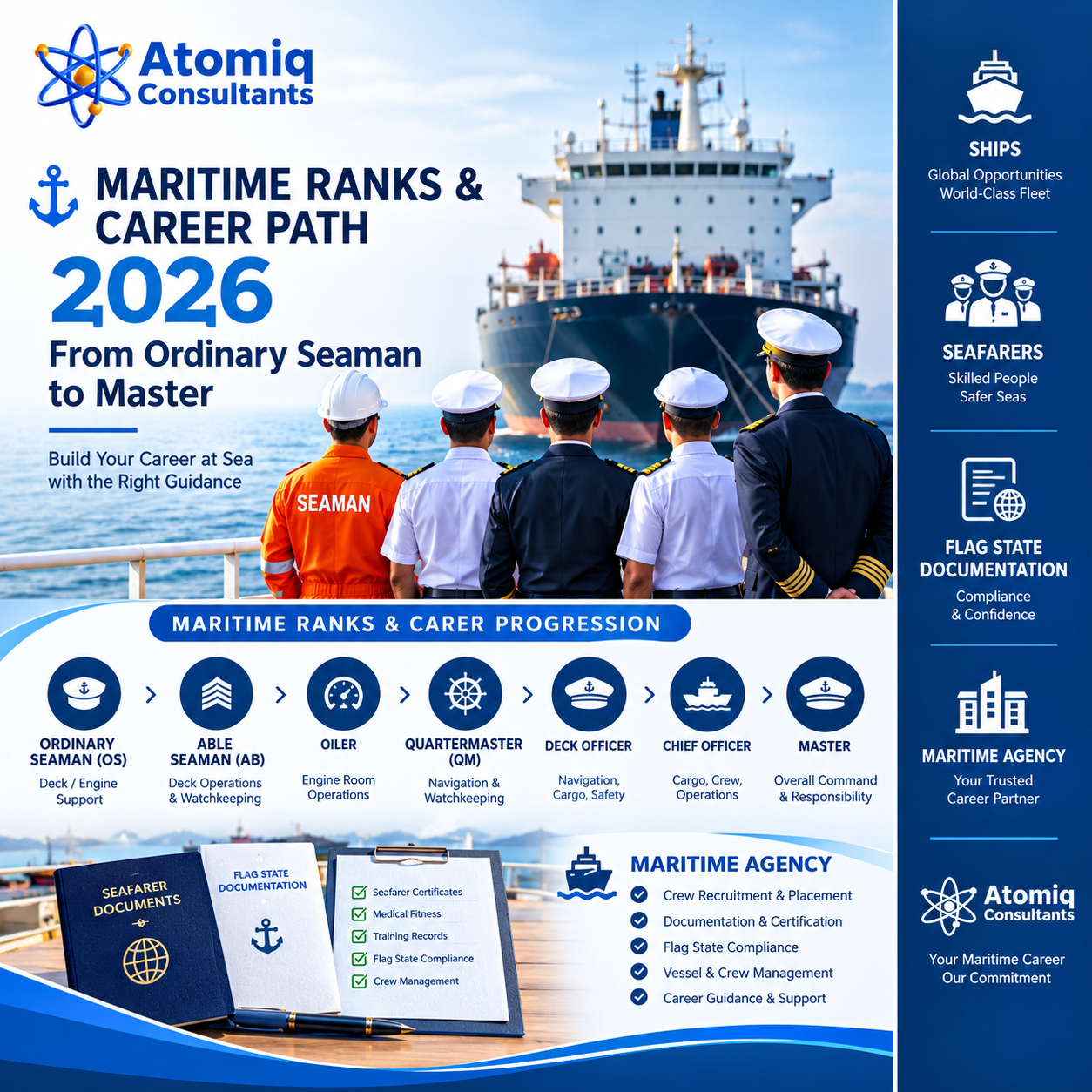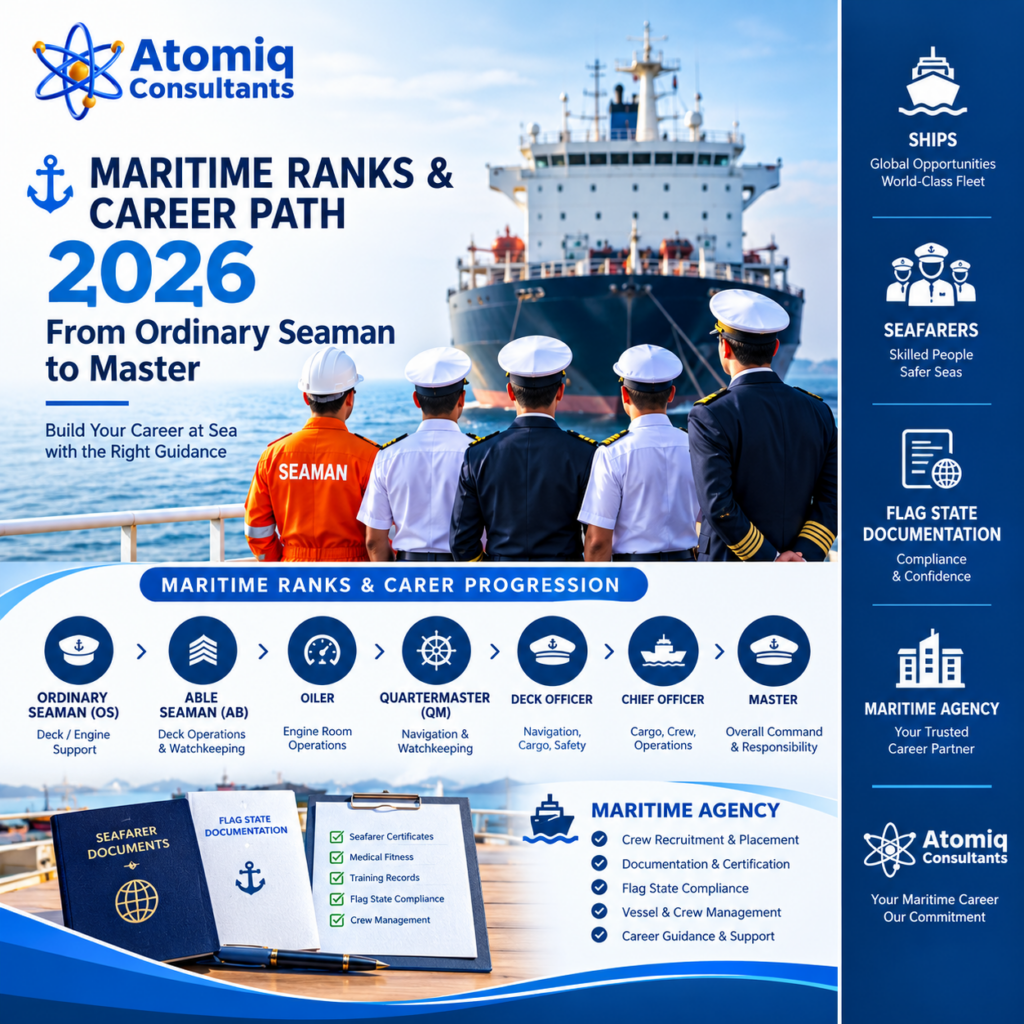
A maritime ranks or merchant ship’s crew is organized into three main departments — deck, engine and catering — with the Master (captain) in overall command and the Chief Engineer heading the engine room. Under the STCW Convention, every officer rank sits at one of two certificate levels, operational or management, and every step up is gated by a certificate and a minimum period of sea service, not by years in the job. Through an approved cadetship, the minimum qualifying sea service from first berth to Master is about 36 months; starting as an Ordinary Seaman, about 60.
This page covers ranks on merchant ships. Naval and marine corps ranks are a different system and are not covered here.
Maritime ranks in order
Maritime ranks from highest to lowest, the ranks on a typical merchant ship:
| Level | Deck department | Engine department | STCW level |
|---|---|---|---|
| Command | Master (Captain) | Chief Engineer | Management |
| Second in command | Chief Officer (Chief Mate) | Second Engineer | Management |
| Watchkeeping officer | Second Officer | Third Engineer | Operational |
| Watchkeeping officer | Third Officer | Fourth Engineer | Operational |
| Specialist officer | — | Electro-Technical Officer (ETO) | Operational |
| Trainee officer | Deck Cadet | Engine Cadet | No certificate of competency |
| Senior rating | Bosun (Boatswain) | Fitter | Appointment, not a separate certificate |
| Certificated rating | Able Seafarer Deck (AB) | Able Seafarer Engine / Motorman | Certificate of proficiency |
| Watch rating | Ordinary Seaman (OS) | Oiler | Certificate of proficiency |
| Entry | Deck Boy / trainee rating | Wiper | STCW basic training only |
Catering department. Chief Cook, Cook, and Steward or Messman, who feed the crew and keep accommodation. On passenger and cruise ships this becomes a large hotel department with its own hierarchy. Catering ranks are not certificated under STCW’s deck and engine chapters; ship’s cooks must be trained and qualified under the Maritime Labour Convention, 2006.
The Master outranks everyone on board, including the Chief Engineer. Read across the table and the deck and engine ladders line up rank for rank — the Panama Maritime Authority’s seafarer certification list uses this same two-department, regulation-by-regulation structure.
Officers and ratings: the two tiers
Every rank on the table falls into one of two tiers, and the difference is the document you hold.
- Officers hold a Certificate of Competency (CoC) — a licence to serve in a given capacity, on ships up to a given size or power. Deck officers are certificated under STCW Chapter II, engineers under Chapter III.
- Ratings hold Certificates of Proficiency (CoP) for the watch or skill they perform, such as Rating Forming Part of a Navigational Watch (Regulation II/4) or Able Seafarer Engine (Regulation III/5).
Cadets sit between the two: officers under training who sail against an approved training record book and hold no CoC yet. If the acronyms are unfamiliar, CoC vs CoP vs CDC explained sets out what each document is and who issues it.
Five things rank lists usually get wrong
1. There are fewer officer certificates than officer ranks. Third Officer and Second Officer hold the same certificate — Officer in Charge of a Navigational Watch (OICNW, Regulation II/1). Third Engineer and Fourth Engineer likewise share one — Officer in Charge of an Engineering Watch (OICEW, Regulation III/1). Promotion between them is a company decision, not a new certificate.
2. The Second Engineer is not level with the Second Officer. On ships of 3,000 kW or more, the Second Engineer holds a management-level certificate (Regulation III/2) and ranks alongside the Chief Officer.
3. Deck certificates scale with tonnage; engine certificates scale with power. Deck officer certificates are issued by gross tonnage band, engine certificates by main propulsion power — 750 kW and 3,000 kW are the thresholds.
4. Bosun and Fitter are appointments, not certificates. Both are senior ratings, normally held by an experienced able seafarer. Neither is an officer.
5. The ETO has no management-level step. The Electro-Technical Officer certificate (Regulation III/6), introduced by the 2010 Manila amendments, is an operational-level certificate. An ETO does not progress to Second or Chief Engineer without qualifying separately on the engineering ladder.
Career path: from Ordinary Seaman to Master
There are two ways onto the officer ladder, and the choice between them is the biggest single decision in a deck or engine career.
| Step | Deck | Minimum sea service (46 CFR) | Engine | Minimum sea service (46 CFR) |
|---|---|---|---|---|
| Entry → watch rating | Ordinary Seaman (RFPNW, II/4) | 6 months, or approved training plus 2 months. Age 16 | Oiler (RFPEW, III/4) | 6 months, or approved training plus 2 months. Age 16 |
| Watch rating → able seafarer | AB Deck (II/5) | 18 months deck service, or 12 plus approved training. Age 18 | AB Engine (III/5) | 12 months engine service, or 6 plus approved training. Age 18 |
| Rating or cadet → first officer certificate | OICNW (II/1) | 36 months deck service — or 12 months in an approved cadetship | OICEW (III/1) | 36 months engine service — or an approved programme with 12 months at sea, plus 6 months supervised watchkeeping |
| → Second in command | Chief Mate (II/2) | 12 months as OICNW | Second Engineer (III/2, ≥3,000 kW) | 12 months as OICEW |
| → Command | Master (II/2) | 36 months as OICNW, or 24 including 12 as Chief Mate | Chief Engineer (III/2, ≥3,000 kW) | 36 months as OICEW, or 24 including 12 as Second Engineer |
Service figures as codified by the US Coast Guard at 46 CFR Part 11 and Part 12, which mirror STCW Chapters II and III. Your certifying administration may add examinations, approved courses or ship-type service.
How long does it take to become a Master?
Adding up the minimums above:
| Route | Minimum qualifying sea service to Master or Chief Engineer |
|---|---|
| Approved cadetship | About 36 months — 12 as cadet, 12 as watchkeeping officer, 12 as Chief Mate or Second Engineer |
| Starting as Ordinary Seaman or Wiper | About 60 months — 36 to reach the first officer certificate, then the same 24 |
Derived from the 46 CFR figures in the table above; they are minimums, not typical timelines. In calendar terms it takes longer. Sea service counts time on board, not leave between contracts, each certificate needs an examination, and a berth has to be available at the next rank. The cadetship’s advantage is fixed in regulation: it compresses 36 months of qualifying service for the first officer certificate into 12.
Can an Ordinary Seaman become a captain?
Yes. Rating service counts toward the 36 months needed for the first deck officer certificate, and from there the path to Master is the same as for a cadet. It is the longer route, and in practice the examinations for OICNW require the same knowledge a cadetship teaches, so most ratings who make the move complete approved training along the way.
Switching departments
The deck and engine ladders are separate. Sea service in one does not count toward a certificate in the other, so a move across is close to a fresh start.
Department guides
Each department has its own page with every rank’s duties, certificates and progression:
- Deck department ranks — Master to Deck Boy, the three deck certificate levels, and the watch each officer stands.
- Engine department ranks — Chief Engineer to Wiper, the kW thresholds, and how engine ranks line up with deck ranks.
- Seafarer salary by rank — what each rank is paid and where the figures come from. The biggest increases sit at the same certificate steps shown on this page.
Getting your first berth
Ranks are only half of it; someone has to hire you into the first one. Two pages cover that step:
- How to start a maritime career — officer and rating entry routes, training and first documents.
- Manning agents vs direct application — how seafarers are actually hired, and the fees an agency is never allowed to charge you under MLC 2006.